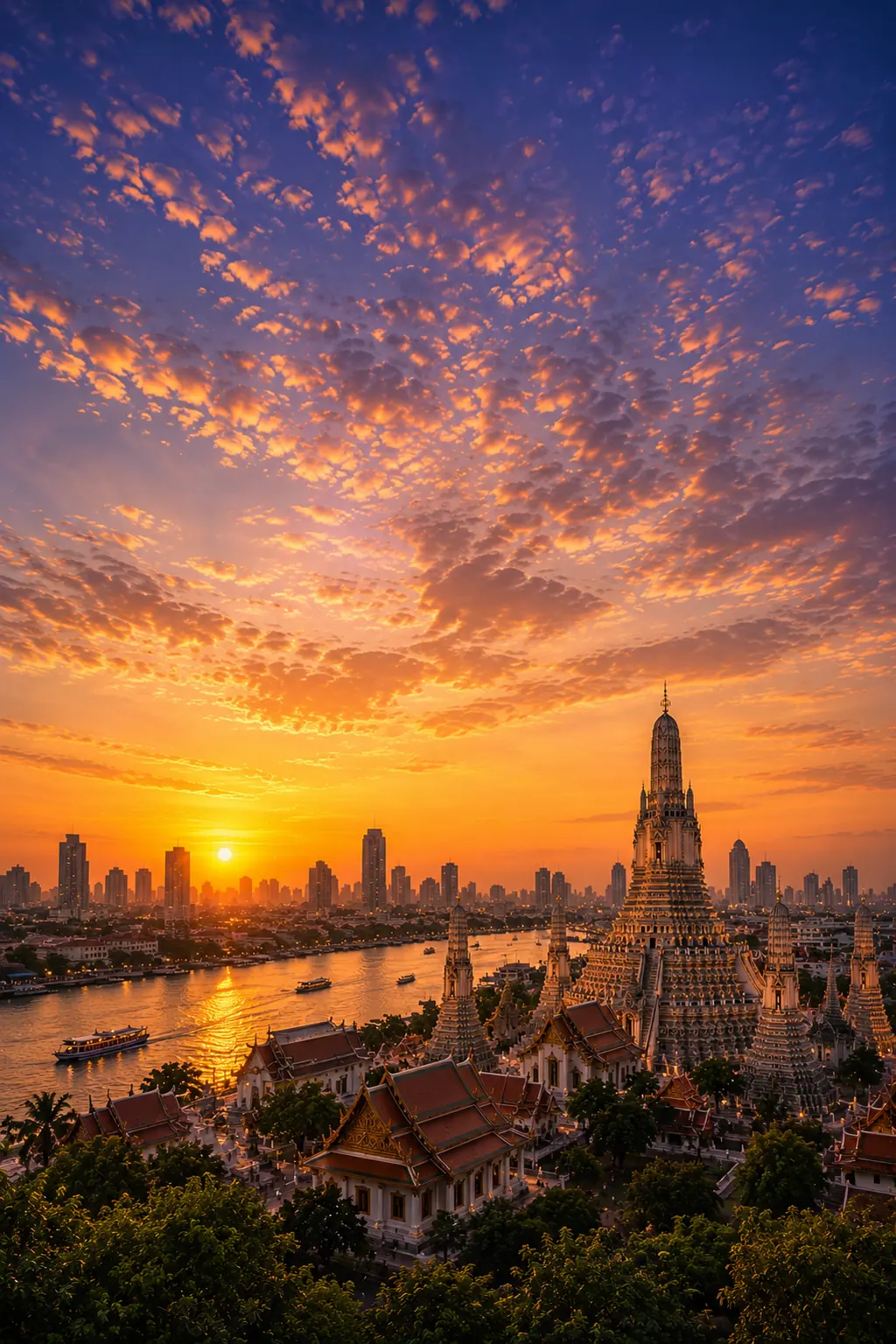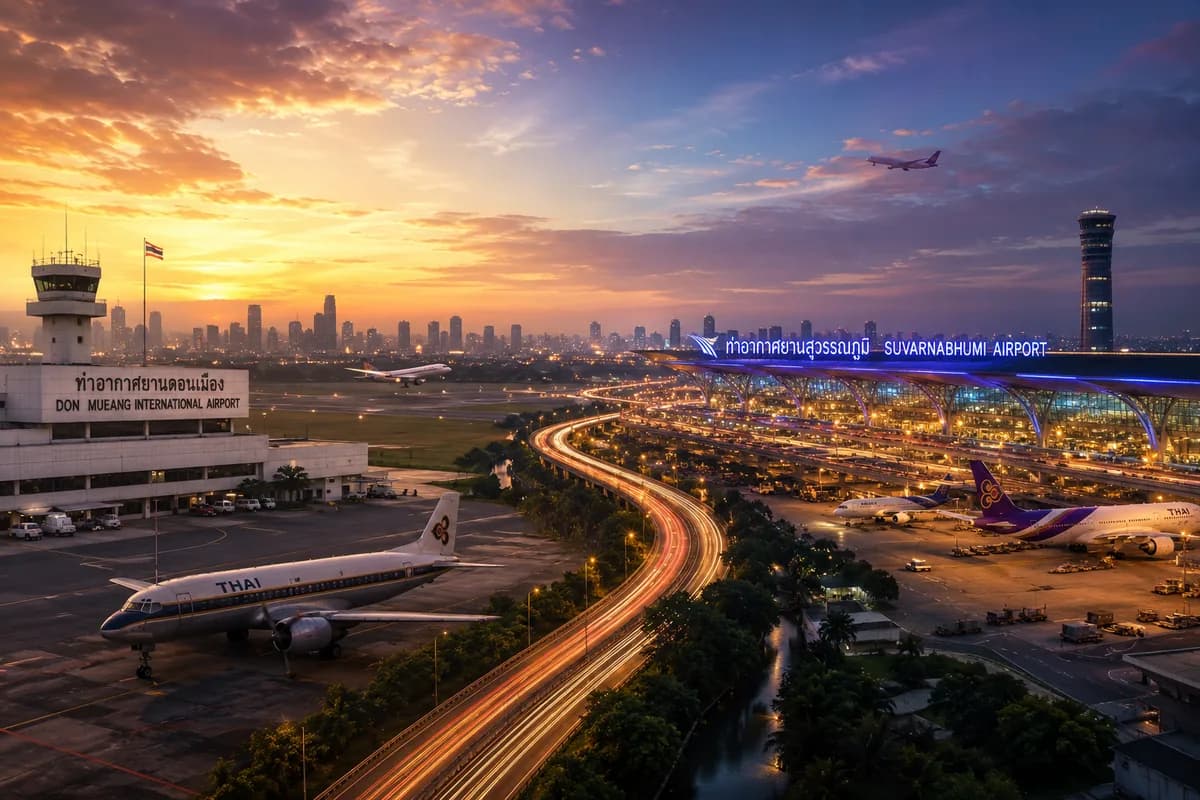
For millions of travellers, Bangkok begins at an airport.
Sometimes it begins beneath the sweeping steel-and-glass roof of Suvarnabhumi, where aircraft from around the world feed into one of Southeast Asia's great international gateways. Sometimes it begins at Don Mueang, a very different airport with more than a century of aviation history behind it and an extraordinary second life as one of Asia's great low-cost hubs.
Both are big. Both are busy. And both are unmistakably part of modern Bangkok.
Yet the story of Bangkok's airports stretches much further back than the age of package holidays, low-cost airlines and long-haul jets. It begins when powered flight itself was still new, continues through Thailand's transformation into one of the world's major tourism destinations, and now points toward an aviation network built to serve hundreds of millions of journeys in the decades ahead.
This is the story of how Bangkok ended up with not one major airport, but two — and why the future may effectively give the city a third.
Before Don Mueang, Bangkok Had an Airfield at a Racecourse
Thailand's aviation story began surprisingly close to the centre of Bangkok.
In 1911, the ground now occupied by the Royal Bangkok Sports Club at Sra Pathum became the country's first airfield, drawing crowds to watch some of the earliest flying machines in Asia. It was a workable beginning, but aviation was developing quickly and Thailand needed somewhere better suited to permanent flying operations.
The answer lay to the north of the city, at a site called Don Mueang.
On 8 March 1914, aircraft of Thailand's fledgling air arm made the transfer from the old Sra Pathum field to their new home. It placed Don Mueang at the very beginning of the country's military and civil aviation history, and it means that a traveller boarding a flight there today is using an airport whose story stretches back well over a century.
From Hawks to Aeroplanes
Even Don Mueang's name carries a piece of local history.
Before aircraft arrived, the area was a stretch of relatively high, flood-resistant land on Bangkok's northern edge, known for the birds of prey that once circled over its fields and woodland, and connected to the city mainly by rail.
There is something rather fitting about it: a place once associated with hawks overhead became one of Asia's longest-running homes of powered flight.
Don Mueang Becomes Bangkok's Gateway to the World
As aviation grew, so did Don Mueang.
Commercial services began there in 1924, and over the following decades the airfield evolved into the civilian gateway known as Bangkok International Airport. For generations of travellers, this was simply Bangkok's airport — the place where journeys to Thailand began and ended.
Long before anyone had heard the airport code BKK associated with Suvarnabhumi, BKK belonged to Don Mueang.
That small piece of aviation trivia illustrates just how complete Don Mueang's role once was. International travellers, domestic passengers, flag carriers and regional flights all passed through the same airport north of the city, and by the early 2000s it was handling well over 30 million passengers a year — among the busiest airports in Asia.
As Thailand's economy and international tourism grew dramatically in the second half of the twentieth century, Bangkok became one of Asia's great destination cities and a major aviation crossroads between Europe, East Asia, South Asia and Australia.
Eventually, another enormous airport would be required.
The Search for Bangkok's Next Airport
The location chosen for Bangkok's future gateway could hardly have sounded more colourful.
East of the city, in what is now Samut Prakan province, lay an extensive low-lying area known as Nong Ngu Hao — commonly translated into English as Cobra Swamp.
Land for a future airport there was acquired as early as the 1970s, but the project developed across decades as Bangkok and international aviation kept changing around it. By the 1990s the concept had taken clearer shape, and construction of the airport travellers recognise today began in the early 2000s.
Few major international airports can claim an origin story involving a place called Cobra Swamp.
Even better, the name that eventually replaced it could hardly be more different.
From Cobra Swamp to the Golden Land
The new airport was given the name Suvarnabhumi, generally translated as "Golden Land" — a name with deep resonance in Southeast Asia, long used in ancient traditions and texts in connection with a prosperous land somewhere in the region.
For Thailand's new international gateway, it was an appropriately ambitious choice.
Suvarnabhumi was never conceived simply as a bigger replacement terminal. It was designed as a statement: a modern airport capable of establishing Bangkok even more firmly as one of Asia's principal aviation hubs.
Its scale still communicates that ambition today. The airport spreads across a vast site roughly 30 kilometres east of central Bangkok, its original terminal built around long concourses whose curved roof structures have become instantly recognisable from the air.
On 28 September 2006, Suvarnabhumi opened for commercial service. Bangkok had entered a new aviation era.
The Day BKK Moved Across Bangkok
Opening Suvarnabhumi produced one of those unusual moments when something travellers normally regard as permanent suddenly moved.
The familiar airport code BKK transferred to Suvarnabhumi. Don Mueang became DMK.
For decades, BKK had meant Don Mueang. From 2006 onward, those same three letters would mean an entirely different airport on the opposite side of Bangkok. Even the English spelling of the older airport settled into the modern "Don Mueang," rather than the "Don Muang" familiar to generations of earlier travellers.
It was meant to mark the beginning of a new chapter for Bangkok aviation. What happened next gave the story an unexpected twist.
Don Mueang Gets a Second Life
Suvarnabhumi became Thailand's principal global gateway, but Don Mueang proved far too useful — and far too well positioned — to disappear from Bangkok's aviation map.
At the same time, low-cost aviation was transforming the way Southeast Asia travelled. Airlines such as Thai AirAsia, Nok Air and Thai Lion Air made flights between Bangkok, Thai provincial cities and neighbouring countries accessible to far larger numbers of passengers, and Don Mueang turned out to be almost perfectly suited to this new era.
Instead of becoming merely a monument to Bangkok aviation history, the old airport reinvented itself as a major hub for low-cost carriers, serving both domestic and international routes. Today its two passenger terminals divide international and domestic traffic, and the airport still operates on the same two runways it has used for decades.
In 2024, Don Mueang handled around 30.5 million passengers. Suvarnabhumi handled around 62.2 million.
Together, Bangkok's two airports moved close to 93 million passengers in a single year.
The airport that welcomed its first aircraft in 1914 was still very much alive more than a century later.
Two Airports, Two Personalities
The interesting thing about flying through both is how different they feel.
Don Mueang carries its history more visibly. It is an airport that has been extended, adapted and reinvented over generations, with a real sense of continuity: the same patch of Bangkok that welcomed pioneering aircraft before the First World War now sends jets across Thailand and Asia every few minutes.
Suvarnabhumi feels like something built at an entirely different scale. Its huge departure hall, soaring structural forms and long concourses make the airport's size immediately obvious — the difference between knowing an airport is big and having the building repeatedly remind you.
And Then Suvarnabhumi Became Bigger Again
The original airport was only the beginning.
In September 2023, Suvarnabhumi opened SAT-1, its first Midfield Satellite terminal — a four-storey building of around 251,400 square metres with 28 additional aircraft gates, connected to the main terminal by an underground Automated People Mover. The new terminal lifted the airport's passenger capacity from roughly 45 million to around 60 million a year.
Passengers can therefore check in at the familiar main building and later find themselves riding a train underneath the airfield to a completely separate satellite complex.
Then came another major addition. Suvarnabhumi's third runway entered full operation on 1 November 2024, increasing the airport's potential flight movements from 68 to 94 per hour.
The airport that opened in 2006 is already significantly larger and more capable than the original version. And Thailand is nowhere near finished with it.
Don Mueang Is Growing Too
Bangkok's older airport is entering another chapter of its own.
AOT's long-running Phase III development for Don Mueang centres on a new international passenger terminal, renovation of the existing buildings, and improved road and rail connections. The project has been redesigned more than once as costs and forecasts have shifted, but the direction is consistent: lifting Don Mueang's capacity from around 30 million passengers a year toward approximately 40 million.
For an airport that welcomed its first aircraft in 1914, the idea of constructing an entirely new passenger terminal more than a century later is remarkable.
Don Mueang is not simply being preserved. It is still evolving.
Suvarnabhumi's Next Transformation
Suvarnabhumi's future plans are larger again.
AOT's next major phase centres on a new South Terminal, built in stages so investment can track actual passenger growth rather than arriving all at once. The first stage focuses on ground stabilisation — a reminder that Suvarnabhumi was built on the old Nong Ngu Hao swamp and still needs ongoing soil work — before construction of the terminal itself, alongside a fourth runway that would eventually lift flight-handling capacity from 94 to 120 movements an hour.
Taken together, AOT's long-term master plan envisions Suvarnabhumi eventually serving around 120 million passengers a year, with the fullest stages of the South Terminal project targeted for completion in the early 2030s.
That would put a future Suvarnabhumi into an entirely different scale from the airport that opened with an initial design capacity of around 45 million passengers.
Could Bangkok Eventually Have Three Major Airports?
In practical terms, yes — although the third is not actually in Bangkok.
Around 140 kilometres southeast of the capital lies U-Tapao International Airport, on the edge of the Pattaya–Rayong region and at the heart of Thailand's Eastern Economic Corridor.
Thailand has much larger ambitions for it. The U-Tapao Airport and Eastern Aviation City project, developed under a long-term public-private partnership and concession model, is intended to turn the site into the country's third major commercial international airport, complementing Suvarnabhumi and Don Mueang rather than serving as a small regional alternative. Its opening phase is modest by Bangkok standards, but the long-term masterplan — built out in stages as demand grows — envisions U-Tapao eventually handling tens of millions of passengers a year.
What makes the plan particularly interesting is the railway.
Thailand's long-planned three-airport high-speed rail line is designed to connect Don Mueang, Suvarnabhumi and U-Tapao on one 220-kilometre corridor, running through Bangkok and onward toward Pattaya and the Eastern Economic Corridor, with trains capable of up to 250 km/h.
The project is still working its way through contracting and planning, with current official timelines pointing toward the early 2030s for full service, though the exact date has moved as planning has progressed and may well move again before construction is complete.
If eventually realised, the idea of a "Bangkok airport" becomes much broader. Rather than two isolated airports competing for traffic, the region would effectively have a three-airport aviation system connected by rail.
From a Racecourse to Three Airports
That may be the most remarkable part of the whole story.
Bangkok's aviation age began with aircraft using the grass inside a racecourse. Then came Don Mueang: an airfield on quiet ground north of the city that grew into Thailand's international gateway. Almost a century later came Suvarnabhumi: the Golden Land rising from the area once nicknamed Cobra Swamp, built on a scale suitable for a Thailand receiving tens of millions of international visitors every year.
And Don Mueang did not disappear when its successor arrived. Instead, it found a new role and became an essential part of the low-cost aviation revolution that transformed travel across Thailand and Southeast Asia.
Now both are expanding again, while U-Tapao is slowly being developed to join them in a much larger regional system.
Few pieces of infrastructure tell Bangkok's story quite so neatly. One airport carries more than a century of history. The other embodies the scale and confidence of modern Bangkok. Both continue growing.
And somewhere between Don Mueang's first aircraft in 1914 and a future high-speed train that may one day connect three international airports lies the story of how Bangkok became one of the great aviation cities of Asia.