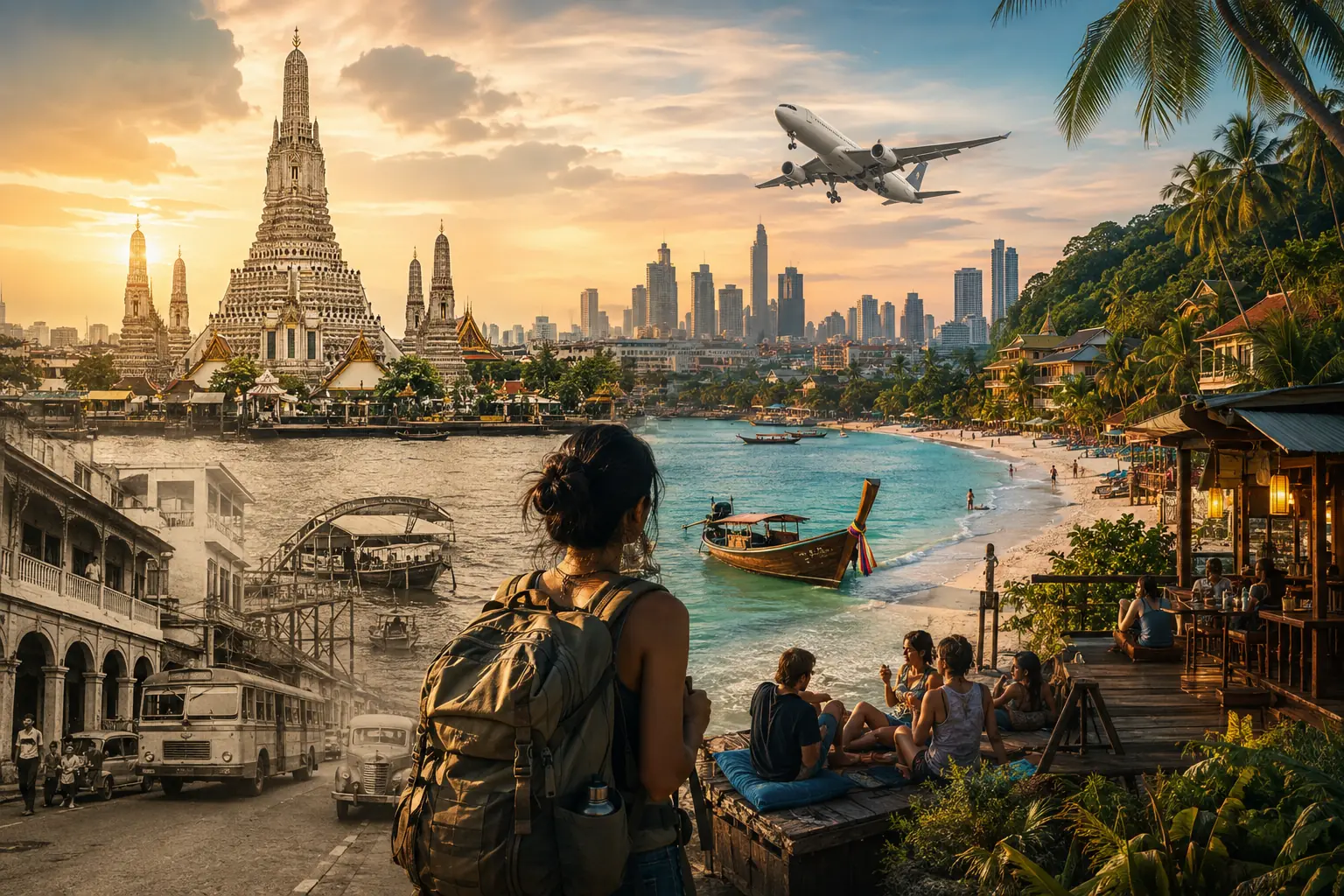
Thailand did not become a tourism giant because travellers simply discovered it. The Thailand that millions of visitors know today was built over decades — through airports and roads, hotels and government promotion, wars and package holidays, backpackers and beach resorts, low-cost airlines and the rise of Asia’s travelling middle class.
No single moment created modern Thai tourism. It accumulated. One generation made Bangkok easier to reach; the next built hotels and beach resorts; another turned islands into names known across Europe; another arrived with a backpack and a guidebook; later generations came on budget airlines from Kuala Lumpur, Seoul, Shanghai, Mumbai and dozens of other cities. Each layer made the next one easier to add.
That matters because Thailand’s tourism story is often reduced to one convenient explanation. The Vietnam War is sometimes treated as the beginning. Cheap prices are offered as the secret. Beaches, nightlife, hospitality or marketing are each presented as if one of them alone explains the country’s success. All were important. None was enough on its own.
The more interesting story is how Thailand built a tourism system broad enough to serve very different travellers at the same time — and flexible enough to keep changing as those travellers changed.
1. Before Mass Tourism
Long before package holidays and beach resorts, Siam was already receiving foreign visitors. Diplomats, merchants, missionaries, scholars and wealthy travellers moved through Bangkok and other parts of the kingdom during the nineteenth and early twentieth centuries. Their journeys were not tourism in the modern mass-market sense, but they helped establish an international image of the country, along with the first services built to receive outsiders.
Bangkok’s position mattered from the start. It was a royal capital, a trading city and an increasingly important point on regional transport routes. River traffic, railways and steamship connections made movement more predictable, and hotels serving foreign guests appeared long before the jet age. The state, too, began thinking about travel promotion surprisingly early: Thailand’s tourism authority traces organised promotional work back to railway publicity in the 1920s and to government tourism-development proposals in the 1930s.
What Thailand did not yet have was scale. International travel was expensive, slow and limited to a small minority, and the country still lacked the hotel capacity, air links, road access and organised promotion needed to turn individual visitors into an industry. The ingredients existed. They simply were not yet connected into a machine.
2. Building the Gateway — the 1950s and 1960s
The post-war decades changed the equation. Civil aviation expanded rapidly, long-distance travel became faster, and Bangkok’s role as a regional gateway grew with it. Don Mueang developed into an increasingly important international airport, while Thai Airways and foreign carriers connected the capital more closely with Asia, Europe and beyond. For travellers moving through Southeast Asia, Thailand was becoming easier to include in an itinerary rather than a difficult journey in its own right.
Hotels followed the traffic. A World Bank tourism review from the early 1970s recorded fewer than 1,000 hotel rooms considered suitable for foreign visitors in 1960; by 1970, it estimated around 10,000 such rooms nationwide, with most of the expansion coming in the second half of the 1960s. Government incentives encouraged private hotel investment, while international hotel brands and experienced operators moved into Bangkok.
Visitor numbers rose alongside them. Thailand recorded only 81,340 international visitors in 1960, according to later Tourism Authority of Thailand summaries. By 1965 the figure was around 225,000; by 1970 it was close to 630,000. That was still tiny beside the tens of millions who would come later, but the direction had changed. Thailand was no longer simply receiving travellers — it was building the capacity to host them.
3. Vietnam, R&R and the Acceleration of Tourism
The Vietnam War became one of the most powerful accelerators of this early phase, especially for Bangkok and Pattaya. From 1966, substantial numbers of American servicemen came to Thailand on rest-and-recreation leave. Tourist Organisation of Thailand figures reproduced by the World Bank show around 33,000 R&R arrivals in 1966, rising to about 71,000 in 1969 before falling as the American withdrawal progressed.
Their spending supported hotels, restaurants, bars, transport businesses and entertainment districts, while the wider American military presence in Thailand strengthened roads, airfields and commercial networks. Pattaya, within reach of both Bangkok and the military facilities on the eastern seaboard, changed particularly quickly — from a small coastal settlement into an internationally known resort.
But the war should not be allowed to swallow the whole story. Tourism promotion had already begun. Air links were already improving. Hotels were already being built. Visitors were arriving from Malaysia, Japan, Britain, Australia, Germany and elsewhere, and a 1970 breakdown showed the United States as the largest single source market — but not the majority of all visitors. R&R was significant. It was not the entire industry.
The best way to understand the Vietnam period, then, is as an accelerator. It increased demand, concentrated investment and helped create service economies in particular places. When the war wound down, the tourism infrastructure did not disappear — it was repurposed for the civilian travel boom that followed.
4. Thailand Starts Selling Thailand
Infrastructure makes tourism possible; promotion turns possibility into demand. Thailand began building a dedicated national tourism organisation at the end of the 1950s: the Tourist Organisation of Thailand was established by royal decree in 1959 and formally opened in March 1960. In 1979 it was upgraded into the Tourism Authority of Thailand, or TAT, with a broader mandate covering promotion, development, facilities and tourist support.
That institutional continuity became one of Thailand’s real advantages. Rather than relying only on individual airlines, hotels or tour operators to sell the country, Thailand developed a national marketing voice. Overseas offices promoted destinations, worked with travel companies and helped package the country into an image that could be sold abroad.
The campaigns grew more sophisticated as the market grew. TAT’s own history identifies Visit Thailand Year in 1980, followed by another major Visit Thailand Year in 1987. The long-running Amazing Thailand brand was launched internationally in 1998 and became one of the most recognisable tourism slogans in Asia.
Promotion did more than raise awareness, though — it repeatedly widened the idea of what a Thailand holiday could be. Temples and beaches could sit beside shopping, food, festivals, spas, golf, nightlife, nature and, later, luxury travel. Thailand was learning not just to advertise destinations, but to sell several different versions of itself to different markets at once.
5. Bangkok, Pattaya and the First Tourism Corridors
Early tourism was highly concentrated. In the early 1970s, Bangkok dominated foreign-visitor accommodation, while Pattaya had already become the country’s best-known seaside resort for international travellers. Chiang Mai, Hat Yai and Songkhla were important regional destinations, but the national map of tourism was still narrow — Phuket, despite its enormous potential, remained difficult to reach and had very little foreign-oriented accommodation.
This concentration mattered because tourism grows through corridors. A traveller needs more than an attraction; they need an airport, a road, a room, food, local transport, booking channels and confidence that the journey will work. Once those elements exist in one place, businesses cluster around them — and more visitors then justify more flights and hotels, which in turn lower the barriers for still more visitors.
Bangkok became the great gateway because it combined air access with culture, commerce and accommodation, while Pattaya benefited from proximity to the capital and from the service economy built up during the 1960s. Together they set a pattern Thailand would repeat elsewhere: improve access, create beds, market the destination, then let private businesses multiply around the resulting flow of people.
The tourism map would later spread dramatically, but Bangkok’s role never faded. Even travellers heading straight for an island often entered the country through the capital, which made Bangkok not merely a destination but part of the machinery feeding the rest of Thailand.
6. The Package-Holiday Revolution
As long-haul flying became more affordable, Thailand entered the European package-holiday system. Tour operators could now combine flights, airport transfers and hotel rooms into a single product that removed much of the uncertainty from travelling to Southeast Asia. The change was fundamental: Thailand no longer had to appeal only to adventurous independent travellers or wealthy long-distance tourists. It could be sold as a normal holiday. For European travellers, especially those escaping winter, the appeal was obvious. Warm weather, beaches, relatively low local costs and a growing stock of resort hotels made long stays attractive, and tour operators, charter programmes and later scheduled-air packages created predictable seasonal demand. Hotels could plan around blocks of arriving guests, destinations could expand around known markets, and local excursion, restaurant and transport businesses gained a reliable customer base.
This era also turned place names into brands. Pattaya, Phuket and later other beach destinations were no longer simply locations on a map — they became products printed in brochures, compared by price, hotel class and transfer time. A family in Scandinavia, Germany or Britain could choose Thailand in much the same commercial way they might choose Spain, Greece or the Canary Islands, only with the added promise of Southeast Asia.
Package tourism also reshaped the business behind the holiday. Overseas operators could negotiate room allocations, airlines could plan seasonal capacity, and Thai hotels could reach customers who might otherwise never have booked an unfamiliar property directly. That distribution network reduced the perceived risk of a long-haul trip: a traveller could buy the whole journey from a company at home, while the Thai tourism economy received a steadier, more predictable stream of guests. It also encouraged resort areas to standardise services around international expectations — without making every hotel identical.
Package tourism is sometimes treated as the opposite of independent travel, but both systems strengthened Thailand at once. Packages delivered volume and predictable investment. Independent travellers would soon create demand in places the large tour operators had not yet reached.
7. Backpackers Built Another Thailand
The second tourism network grew from the bottom up. Backpackers did not need large resorts, formal tours or polished infrastructure — they needed cheap rooms, transport information, simple food and a way to reach the next place. Thailand proved unusually good at supplying all four.
Khao San Road became the symbolic centre of this world. Once associated with Bangkok’s rice trade, it began changing into a budget-travel district in the late 1970s and early 1980s. Lonely Planet’s early Thailand guidebooks helped connect small guesthouses and local businesses with a growing stream of independent travellers, and by the 1990s Khao San had become a legendary staging post for journeys across Thailand and the wider Southeast Asian “banana pancake trail.”
The importance of backpackers goes far beyond one Bangkok street, though. They created early demand for islands, beaches, mountain towns and small communities where there was not yet enough volume to justify major hotel investment. A bungalow, a family guesthouse, a minibus service, a dive shop or a ferry connection required far less capital than an international resort, and small Thai businesses could respond to that demand quickly.
In that sense, backpackers helped map a second Thailand. Package tourists proved where large-scale resort demand existed; independent travellers tested new routes. Some of those routes later became mainstream — what began as a cheap guesthouse cluster or a difficult boat journey could, over time, acquire paved roads, an airport, boutique hotels and five-star resorts.
8. Phuket, Samui and the Beach Boom
Few examples show the transformation more clearly than Phuket. A World Bank review in the mid-1970s described the island as having some of southern Thailand’s greatest tourism potential, while also noting its poor accessibility and minimal facilities for foreign visitors — a description almost impossible to reconcile with the Phuket of today. That gap is precisely the point.
Roads improved. The airport expanded. Hotels multiplied. Tour operators added capacity. Beaches such as Patong, Kata and Karon developed distinct tourism economies of their own, while Phuket became a gateway to Phang Nga Bay, the Phi Phi islands and the wider Andaman coast. The destination moved from possibility to product to international brand.
Koh Samui followed a different but related path. Its early appeal was closely tied to independent travellers and simple beach accommodation, and it was better ferry links, electricity, roads and, eventually, a commercial airport that changed the scale of its tourism. Resorts moved upmarket, air access cut travel time, and Samui became capable of serving backpackers, honeymooners and luxury travellers all at once.
Across southern Thailand, the same process repeated with local variations. Krabi, Khao Lak, Koh Lanta, Koh Tao and other destinations entered the tourism network at different times and at different levels of intensity. The result was not one beach resort but an entire coastal system with its own range of price points, atmospheres and target markets.
9. The Asian Travel Revolution
For much of the twentieth century, Thailand’s international tourism image was closely tied to long-haul visitors from Europe, North America, Australia and Japan. The twenty-first century changed that balance. Rising incomes across Asia created vast new populations able and willing to travel internationally, while low-cost airlines made short regional trips dramatically easier. This shift changed both geography and frequency. A traveller from Kuala Lumpur, Singapore, Ho Chi Minh City or another regional hub no longer had to treat Thailand as a once-in-a-lifetime long-haul holiday. Bangkok, Phuket, Chiang Mai and other destinations could become weekend trips, shopping trips, concert trips, medical trips or simply repeat leisure visits, as AirAsia and other low-cost carriers expanded route networks across Southeast and East Asia and established airlines increased their own capacity.
Airport infrastructure grew with the market. Suvarnabhumi opened for commercial services in September 2006, giving Bangkok a major new international gateway, while Don Mueang later found a powerful second life as a low-cost hub. Phuket and Chiang Mai grew into international gateways in their own right, and direct flights increasingly let travellers bypass Bangkok altogether.
The effect went well beyond cheaper seats. Low-cost flying made Thailand more modular: visitors could combine Bangkok with Chiang Mai, or Phuket with another Asian city, or simply take several trips a year instead of one. Tourism became less dependent on a single long annual holiday, and more woven into the everyday mobility of Asia’s growing middle classes.
10. From Western Holiday Destination to Global Tourism Giant
By the 2010s, Thailand was no longer best understood as a Western holiday destination that happened to sit in Asia. It had become a global tourism platform with a strongly Asian customer base. China grew into a giant source market. Malaysia remained crucial because of proximity and land connections. South Korea, India, Russia and the wider ASEAN region became major contributors alongside the long-established visitors from Europe, Australia, Japan and North America.
The numbers show the scale of that transformation. Thailand passed one million international visitors for the first time in 1973. It was receiving around 1.9 million by 1980, more than five million by 1990 and around ten million by the beginning of the 2000s. In 2019, immediately before the pandemic, the country approached 40 million international arrivals.
Growth on that scale could not have happened if Thailand had offered only one type of holiday. Different markets wanted different things: Chinese group tourism, Russian winter stays, Malaysian cross-border travel, Indian weddings and family trips, European package holidays, Gulf medical and luxury travel, Korean leisure trips and long-haul independent travel all placed different demands on the same national system.
Thailand’s advantage was that it rarely had to choose just one. Bangkok could serve business travellers, shoppers, backpackers and luxury guests within the same city. Phuket could offer mass-market resorts, private villas and nightlife side by side. Chiang Mai could combine culture, cafés, nature, long stays and domestic tourism. The country grew large not because every visitor wanted the same Thailand, but because so many different Thailands could coexist.
11. Covid: The Machine Stops
Then, almost overnight, the machinery stopped. International aviation collapsed during the Covid-19 pandemic, borders tightened, and a tourism system built for constant movement suddenly had very few foreign customers. The shock was especially visible in places built around international visitors: hotel occupancy collapsed, tour companies went quiet, entertainment districts emptied, and workers left tourist centres in search of other income.
The contrast with 2019 could hardly have been greater. Thailand had expected almost 40 million foreign visitors that year; in 2021, after prolonged entry restrictions, the total was only 427,869. For an industry built over six decades, the disappearance of the international market exposed just how deeply tourism had become woven into local economies far beyond airlines and hotels.
Covid also showed that tourism infrastructure is not the same thing as tourism demand. Thailand still had beaches, airports, resorts, restaurants and trained staff. What it lost, temporarily, was the flow connecting them. Reopening therefore became a logistical and political project as much as a tourism one: restoring confidence, testing entry systems and gradually reconnecting Thailand with the global aviation network.
The Phuket Sandbox in 2021 became one of the early experiments in reopening, followed by broader easing and, finally, the removal of remaining Covid entry requirements in 2022. The machine did not switch back on at full speed. It restarted route by route and market by market.
12. Why Thailand Came Back So Quickly
Thailand’s rebound was strong because most of the underlying system had survived. Airports did not need to be invented again. Hotels were already built. Travel agents knew how to sell the country, and airlines knew the routes. Millions of previous visitors already knew what Thailand offered, and many wanted to return.
International arrivals rose to about 11.15 million in 2022 and more than 28 million in 2023; in 2024, Thailand welcomed more than 35 million foreign visitors. Recovery was not perfectly linear, and different markets returned at different speeds, but the pace at which large-scale demand reappeared showed the value of decades of accumulated tourism capital.
Repeat visitors matter enormously here. A destination with a huge base of people who have already visited does not have to sell itself from zero after every crisis — travellers already know the airports, the neighbourhoods, the islands, the food and the service culture. Some return to the same hotel or province; others use their familiarity with Thailand as a base for exploring somewhere new.
The breadth of the country also spreads the risk. If one source market weakens, another may grow. If one type of travel slows, another can stay strong. That diversification does not make Thailand crisis-proof, but it does make the tourism system more resilient than a destination dependent on one beach, one nationality or one travel product.
13. Thailand No Longer Sells One Thailand
Modern Thailand is not marketed as a single holiday. It is a portfolio. A traveller can come for street food, Michelin-starred dining, island beaches, Muay Thai, temples, festivals, cosmetic procedures, medical treatment, golf, diving, nightlife, shopping, meditation, luxury villas, national parks, remote work or a family resort — and often combine several of them in one trip.
This is now visible in official strategy as well as in the private market. TAT has increasingly emphasised value, sustainability, wellness, culture, sport, gastronomy, events and “soft power” alongside the traditional sun-and-sea appeal, with marketing aimed more precisely at different source markets and traveller types rather than assuming one universal foreign tourist.
The shift matters economically. Competing only on cheap rooms and cheap food is dangerous, because another destination can always undercut you. Competing on variety is harder to copy. Thailand can offer a first-time backpacker a low-budget route, then sell that same person a boutique hotel ten years later, a family holiday later still, and perhaps a golf, wellness or long-stay trip after that.
That capacity for reinvention may be one of Thailand’s least appreciated tourism assets. The country has repeatedly absorbed new traveller cultures without abandoning the old ones — package tourism did not eliminate backpacking, luxury did not eliminate budget travel, and wellness did not replace nightlife. New layers were simply added to the existing system.
14. The Real Reason Thailand Became Thailand
There is no satisfying single-cause answer to why Thailand became one of the world’s great tourist destinations. The Vietnam War mattered, but tourism existed before it and expanded long after it. Low prices mattered, but cheap destinations are common. Beaches mattered, but plenty of countries have tropical coastlines. Marketing mattered, but advertising cannot compensate for poor access or a weak tourism economy.
Thailand’s success came from combination and timing. It sat in a favourable geographic position as international aviation expanded, and Bangkok became a regional gateway. The state created a tourism-promotion organisation early and kept marketing the country for decades. Private investors built hotels and resorts, while small entrepreneurs built guesthouses, restaurants, transport services, dive shops and travel agencies. Package holidays delivered volume while backpackers opened new routes. Airports and low-cost airlines connected more destinations to more markets, and a large service economy learned to serve visitors at almost every price level.
Just as important, Thailand kept changing the product. The country that sold Bangkok and Pattaya in the early era was not the same Thailand that later sold Phuket package holidays, Khao San backpacking, Samui bungalows, Chinese group travel, medical tourism, luxury pool villas or digital-nomad stays. Yet each new version inherited the infrastructure, knowledge and international recognition of the one before it.
That is why this is a bigger story than the rise of any single destination. Thailand became a tourism giant by building a system in which discovery could be repeated — where new travellers could keep finding a version of the country that felt made for them, while businesses and destinations kept finding ways to turn that interest into a journey that was relatively easy to buy, reach and repeat.
Thailand was discovered many times. The achievement was building a tourism machine capable of welcoming each new wave.