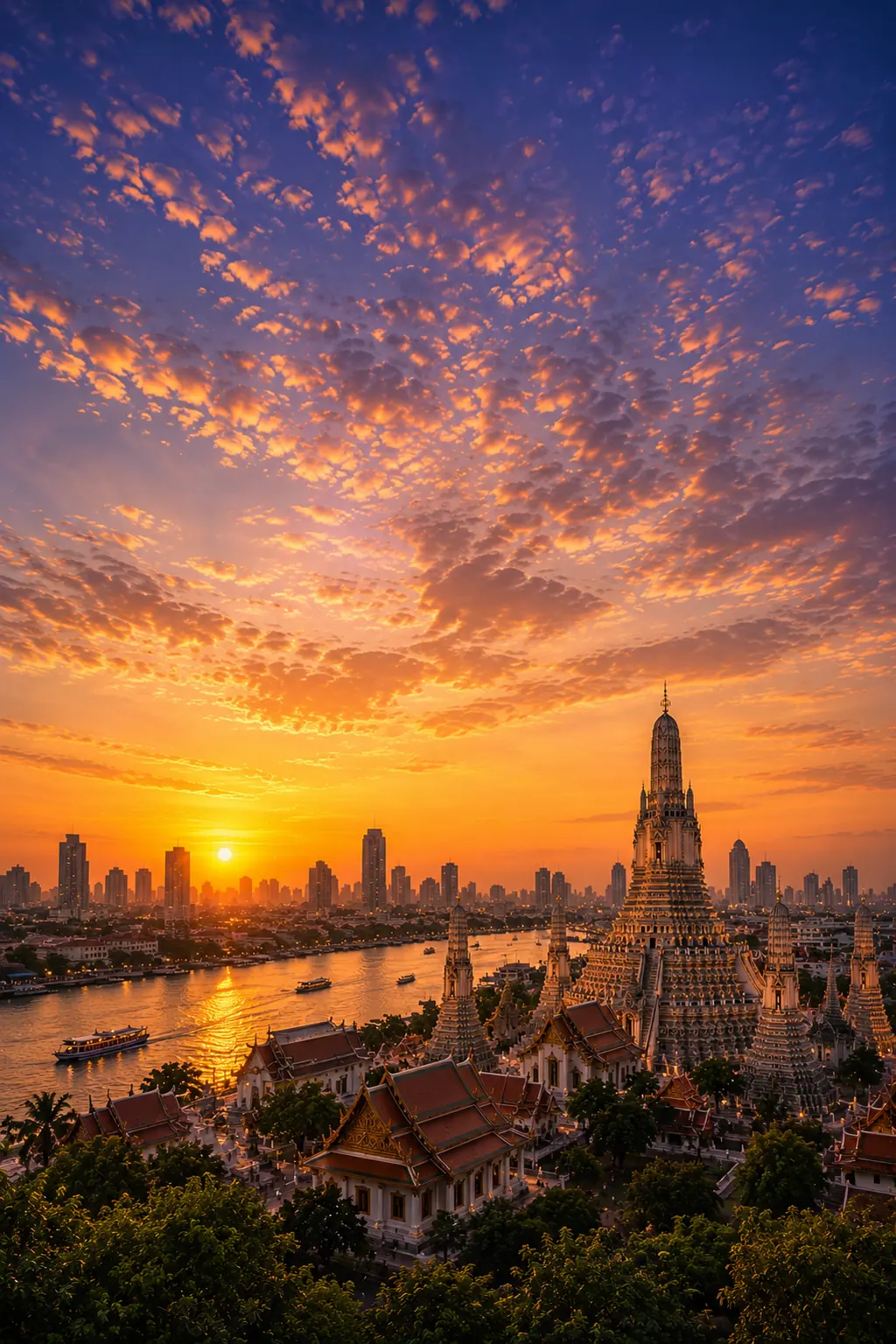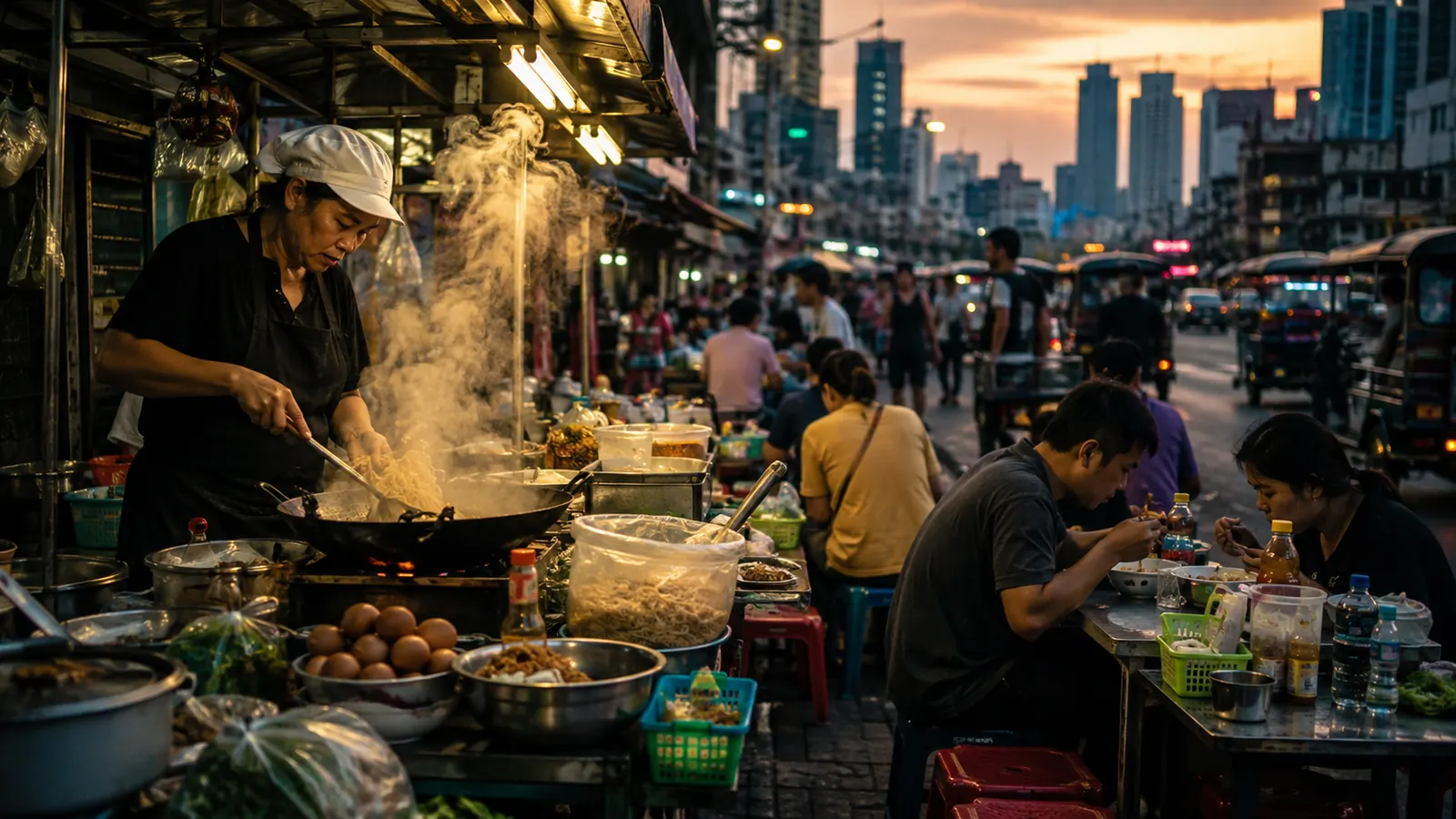
Bangkok street food is often photographed as if it were a single thing: a wok flaring beside a pavement, a noodle cart under fluorescent light, plastic stools crowded around a stall at midnight. Yet the history behind that scene is much larger than the modern pavement.
Bangkok did not wake up one morning and invent "street food". Long before the capital became a road-based metropolis, food moved through the city by water. Vendors sold ingredients and prepared dishes from boats, markets gathered beside canals, and households bought from people who came directly to the waterfront. When roads replaced waterways as the main arteries of urban life, the food trade moved with them. Pushcarts, shophouses, market stalls and pavement kitchens became new versions of an older idea: food brought close to where people lived, worked and travelled.
Over the next century, Bangkok changed enormously. Chinese migration reshaped the commercial city. New roads created new neighbourhoods. Rural migrants arrived in search of work. Office districts, buses, factories, shopping centres and mass transit changed the rhythms of the day. Women built businesses around prepared food. Noodles, rice dishes, curries, sweets, grilled foods and regional specialities moved between communities and became part of the everyday urban repertoire.
The result was not simply a tourist attraction. It was a food system built around a city in motion.
1. Before the Street Came the Canal
To understand Bangkok street food, it helps to begin with a problem in the name itself. For much of Bangkok's early history, the most important "streets" were not streets at all.
The capital established in 1782 developed around the Chao Phraya River and a dense network of khlongs. Houses faced the water. People travelled by boat. Produce arrived from surrounding provinces through waterways that connected Bangkok with agricultural districts and regional markets. An 1865 issue of the Bangkok Recorder described the canals as the great avenues through which produce reached the capital.
Food vending naturally fitted this landscape. Research reconstructing Bangkok's early vending economy describes floating markets, delivery boats and sellers bringing both ingredients and prepared foods directly to waterside homes. Thai women were prominent among sellers, while Chinese men were also active in food trading. Some boats carried meat, bean sprouts, tofu, coffee or snacks. Noodles could arrive around lunchtime; other prepared foods circulated later in the day.
That does not mean every modern Bangkok street-food dish can be traced unchanged to an eighteenth-century boat. It cannot. Nor does 1782 provide a clean "birth date" for Bangkok street food. The important point is structural: selling food outside the home, close to transport routes and daily traffic, was already part of the city's life before the pavement became its defining stage.
This older water economy also explains why the distinction between market, delivery service, mobile vendor and street stall has never been perfectly neat in Bangkok. The forms changed. The principle remained familiar: take food to the people rather than requiring the people to build every meal from scratch at home.
2. When Bangkok Turned Towards the Road
The nineteenth century changed the physical logic of Bangkok.
During the reign of King Mongkut, Rama IV, major new roads were constructed as the capital expanded and adapted to growing international trade and diplomacy. Charoen Krung - widely known at the time as New Road - was built between 1861 and 1864. Thailand's Fine Arts Department identifies it as Bangkok's first major road constructed for movement through the city centre, and contemporary reporting from the Bangkok Recorder in 1866 already treated it as a striking symbol of an urban landscape becoming more road-oriented.
The change was gradual, not a sudden abandonment of water. Bangkok remained an amphibious city for decades. But as roads such as Charoen Krung, Bamrung Mueang and Fueang Nakhon became more important, commerce began to reorganise around land transport.
Food vending moved with that transition. Historical research describes mobile sellers shifting from boats towards pushcarts and land-based stalls. Shophouses created another hybrid form: home, kitchen, shop and dining room could coexist within one narrow commercial building. Streets became places not merely to pass through but to sell, cook and eat.
Markets also reflected the change. Nang Loeng Market, officially opened around the turn of the twentieth century, is often described in heritage research as one of Bangkok's earliest purpose-built land markets. Its significance is not that it replaced every floating market overnight. It shows a city developing new food infrastructure for an increasingly land-based way of life.
Bangkok's famous pavement food therefore did not erase the canal economy. It inherited its mobility.
3. Chinese Bangkok and the Everyday Noodle Bowl
No history of Bangkok's public food culture can be written without the city's Chinese communities.
Chinese migrants had been central to Bangkok's trade, labour and commercial development since the early Rattanakosin period, and their role expanded during the nineteenth and early twentieth centuries. Areas such as Sampheng, Yaowarat and Talat Noi became major centres of business and community life, and research on Bangkok's food economy repeatedly finds Chinese vendors especially visible in the emerging land-based trade.
Noodles are an obvious part of this story, but the influence goes well beyond one dish. Congee, tofu, soy-based seasonings and a range of stir-fried and braised dishes became part of Bangkok's wider food world through long processes of migration, adaptation and everyday exchange.
The most useful way to understand that history is not to divide every bowl into "Thai" and "foreign" halves. Bangkok's food culture was being made in the interaction itself. A 2025 study of Chinese restaurants in modern Thai history notes that much Chinese food was integrated into everyday street food, often adapting to Thai-language names, local ingredients and local tastes. That integration is one reason so many dishes can now feel simultaneously connected to Chinese migrant history and completely at home in Bangkok.
Street vending also offered an economic ladder. Historical studies describe Chinese labourers moving into petty trade and food vending, sometimes using the earnings and commercial networks built there to establish larger businesses later.
Yaowarat would eventually become internationally famous for eating after dark, but its deeper importance is that it preserves one of the clearest examples of how migration became urban tradition. Bangkok did not passively receive a Chinese food culture. Generations of cooks, families and customers remade it inside the Thai capital.
4. Markets, Shophouses and the Space Between Home and Restaurant
The phrase "street food" can make Bangkok's food world look simpler than it really is.
A vendor may cook on a pavement but store ingredients in a nearby shophouse. A family business may have tables under an awning yet function more like a tiny restaurant. A stall may sit at the edge of a fresh market, drawing on suppliers only a few metres away. A cart may move between a transport stop and a neighbourhood at different times of day.
This flexible geography became one of Bangkok's strengths.
Old commercial districts show how different forms overlapped. Bang Rak grew along Charoen Krung into a multicultural business area of shophouses, foreign firms, Chinese communities and local commerce. Nang Loeng combined market trade, prepared food, sweets and residential life. Yaowarat linked wholesale and retail commerce with family kitchens, roadside sellers and restaurants.
These were not separate food systems. They fed one another.
A street vendor needed markets for fresh ingredients. Markets benefited from workers and residents buying prepared meals. Shophouses provided storage, cooking space and family labour. Mobile carts followed customers. Small stalls could become permanent shops, while restaurants could retain the speed, specialisation and open-kitchen character of street vending.
That is why Bangkok's street-food history is better understood as a history of public eating than as a history of objects called "stalls". The city developed a spectrum of places between the private kitchen and the formal restaurant. What mattered was convenience, proximity and the ability to fit food into urban life.
5. The 1960s: A Bigger City, a Bigger Appetite
If early Bangkok established the foundations of food vending, the decades after 1960 transformed its scale.
Thailand's first National Economic and Social Development Plan began in 1961, during a period of rapid economic change and urban growth. Bangkok drew workers from across the country into construction, factories, transport, services and the informal economy, and academic research on street vending describes the city's population rising sharply during the 1960s and the resulting demand for inexpensive, ready-to-eat food growing with it.
This is the period that is sometimes simplified online into "the birth of Thai street food". That goes too far. Vendors, markets and public eating were already well established. What changed was the density of demand and the number of people whose working lives made prepared food outside the home especially practical.
Migration also widened Bangkok's menu.
Research from the period and later studies found many female vendors originating from the Northeast. As Isan migrants became part of the capital's workforce and neighbourhoods, foods associated with the Northeast became increasingly visible in the city. Som tam is one of the clearest examples: its rise in Bangkok was tied not to a single promotional campaign but to cooks and customers carrying regional tastes into a rapidly expanding metropolis.
The same process happened in many directions. Bangkok was absorbing people from Thailand's regions while continuing to integrate Thai-Chinese foodways and international influences. Street food became one of the places where those movements were made edible.
The city was not learning to eat "instead of Thai food". It was learning how many different Thai lives could fit around the same pavement.
6. Public Eating Becomes an Urban Habit
The deeper transformation was not simply that Bangkok had more vendors. It was that buying prepared food became a normal way to organise daily life.
Geographer Gisèle Yasmeen used the idea of Bangkok's "foodscape" to study what she called public eating: purchasing and consuming food prepared outside the home. Her research connected the practice to urbanisation, gender, work, household change and the use of public space.
That framework helps avoid another easy myth - the claim that Bangkok street food simply "replaced home cooking". The reality is more flexible. A household might cook rice but buy curry. Someone could eat breakfast near a bus stop, lunch beside an office and dinner at home. Prepared food could be carried away in bags, eaten at a stall or combined with food from the household kitchen.
Women were central to this system, both historically and in modern Bangkok. Studies of the city's food trade have repeatedly found women making up a large share - in some periods the overwhelming majority - of prepared-food sellers. Street vending could turn culinary knowledge, family labour and relatively modest capital into income.
At the same time, the city itself made public eating practical. Long commutes, irregular working hours, small businesses, schools, hospitals, markets and transport interchanges created waves of demand throughout the day. Vendors responded with extraordinary precision. Breakfast appeared where commuters passed. Lunch stalls clustered around offices. Evening sellers served people returning home. Night vendors fed workers whose schedules continued after most kitchens had closed.
By the early 1990s, an FAO-linked study found around 20,000 street-food vendors in Bangkok offering more than 200 kinds of meals, snacks and drinks. The same research found street food making a substantial contribution to the diets of urban residents.
By then, eating outside was not marginal to Bangkok. It was infrastructure.
7. The City Tries to Organise the Pavement
Popularity did not remove the practical tensions created by street vending.
Food stalls use space that is also needed by pedestrians, traffic, drainage, waste collection and neighbouring businesses. Cooking requires water, fuel, storage and waste disposal, and food safety becomes more difficult when kitchens operate in exposed public environments. Bangkok's authorities therefore spent decades moving between accommodation, regulation, sanitation programmes and removal.
Temporary permitted vending areas existed by the early 1980s. The Public Health Act and the 1992 law on cleanliness and public order strengthened the legal framework affecting sellers in public space. Yet regulation was never simply a story of government versus vendors. Public demand for inexpensive food remained powerful, while authorities also recognised the economic importance of the trade.
Sanitation programmes show the other side of the relationship. Thailand's Department of Health and Bangkok authorities worked with the FAO during the 1990s on street-food safety, developing codes for stall design, clean water, ice handling, utensils, food storage and waste. Thailand's later Clean Food Good Taste programme brought food sanitation into a national framework for restaurants and street vendors.
These efforts matter historically because they challenge the romantic picture of street food as something valuable only when it is completely informal. Bangkok's food culture has survived partly through negotiation: between access and order, low costs and hygiene, livelihood and pedestrian space.
That negotiation continues today.
8. 1997 and a New Generation of Vendors
The Asian financial crisis of 1997 created another turning point.
Companies closed, jobs disappeared and many workers who might once have expected stable formal employment had to find new ways to earn an income. Studies of Bangkok after the crisis found that some laid-off white-collar workers stayed in the city and entered street vending rather than returning to provincial homes.
Researchers called them a "new generation" of vendors. They often brought different educational backgrounds, business skills and marketing ideas into the informal economy. Some targeted office workers and middle-income customers. Some chose private commercial spaces or transport-linked locations. Product ranges widened, presentation changed and the distinction between a street stall, pop-up business and small restaurant became even less clear.
The crisis did not create street vending. It demonstrated why the sector endured.
When formal employment contracted, Bangkok's food economy could absorb people quickly because the barriers to entry were lower than in many other businesses. A cart, a specialised dish, family labour and a good location could become a livelihood. For customers, the same system provided meals at prices suited to a difficult economy.
Street food was therefore both cultural and economic. Its resilience came from being able to respond quickly when the city changed.
9. From Daily Convenience to Global Symbol
By the twenty-first century, something curious had happened. A food system built primarily to serve everyday urban life had become one of Bangkok's strongest international images.
Travel writing, television and social media turned open-air kitchens into symbols of the city. Yaowarat at night became globally recognisable, and visitors sought out stalls that generations of Bangkok residents had treated simply as places to eat.
The arrival of the MICHELIN Guide made the shift especially visible. Michelin and the Tourism Authority of Thailand announced the first Bangkok edition in 2017, explicitly recognising a dining landscape that ranged from fine restaurants to street-food hawkers. The inaugural 2018 guide included 28 Thai street-food stalls, and Jay Fai received one Michelin star.
That moment was important, but it did not make street food valuable. It changed who was looking at it.
At almost exactly the same time, Bangkok was tightening control over pavement vending. The post-2014 "Return Walkways to the Public" policy sharply reduced permitted vending areas and triggered public debate over livelihoods, pedestrian access and the character of the city.
The apparent contradiction - global celebration alongside local restriction - is actually part of the same history. Street food has always depended on scarce urban space. As Bangkok becomes denser, richer, more mobile and more heavily regulated, the question of who may use the pavement becomes harder, not easier.
Bangkok's street food fame therefore should not freeze the city into a postcard. The culture survives because it changes.
10. The City That Keeps Eating Outside
Bangkok street food has no single inventor, no single neighbourhood and no honest one-line origin story.
Its history begins before the modern street, in a capital where boats delivered ingredients and prepared dishes through canals. It moves onto roads as Bangkok modernises. It grows through Thai women's commerce and Chinese migrant enterprise. It expands through markets and shophouses. It absorbs regional migration and changes again when millions of workers need fast, affordable meals. It becomes part of a culture of public eating, then adapts to sanitation programmes, economic crisis, mass transit, tourism and new rules for public space.
That long history explains why the food can look so different from one corner to another while still feeling unmistakably Bangkok.
A noodle cart beside an old shophouse carries one strand of the story. An Isan grill near a construction site carries another. Curry ladled into takeaway bags for office workers belongs to the same history as bowls served from a market counter. A Michelin-recognised stall may be internationally famous, but it still belongs to an urban system built around cooks meeting customers where the city moves.
Bangkok continues to regulate that system. Rules issued by the Bangkok Metropolitan Administration in 2024 set conditions for designated trading areas, and enforcement in 2025 and 2026 shows that the balance between vending and public-space management remains active rather than settled.
Yet the deeper continuity is remarkable. For more than two centuries, Bangkok has repeatedly changed the physical form of food selling without abandoning the underlying idea.
First the vendor came by boat. Then came the pushcart. Then the pavement stall, the market counter, the shophouse kitchen and the food cluster beside the bus stop or train station.
The city changed the route.
The food kept following the people.