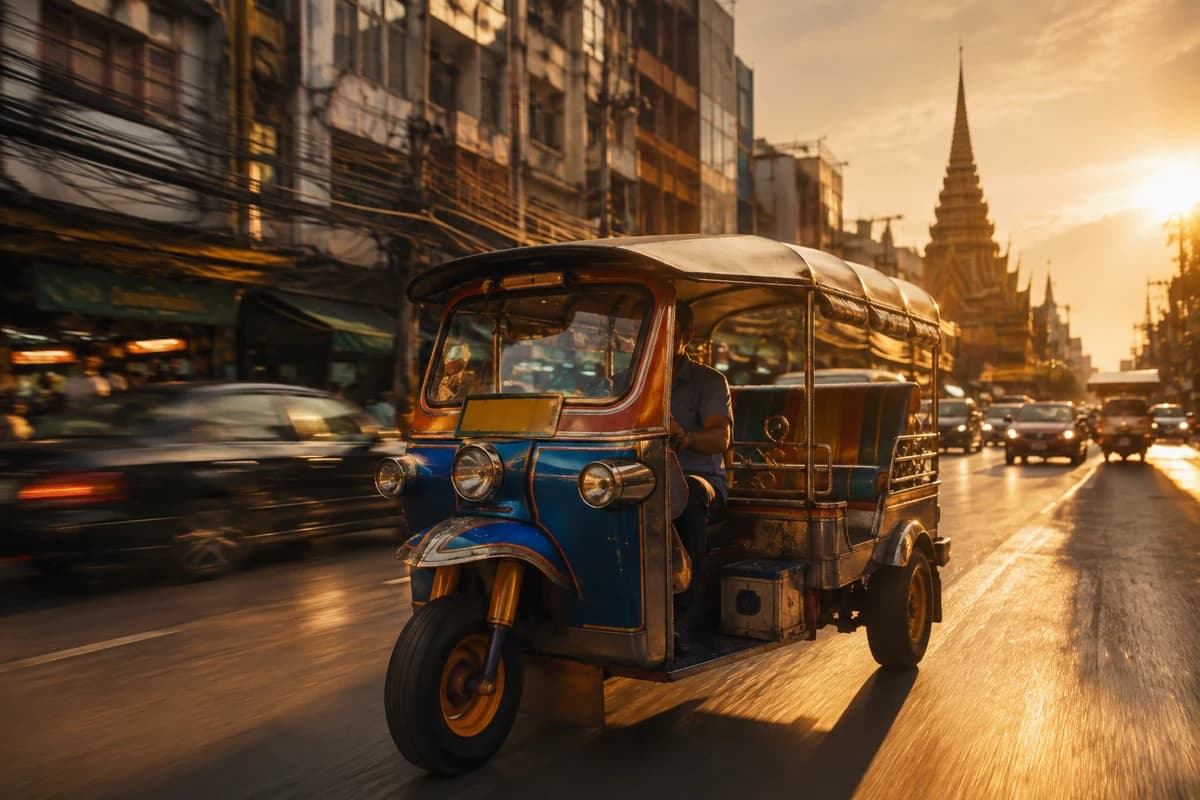
1. The Vehicle That Became a Country
Some national symbols are designed.
Others simply refuse to disappear.
Thailand’s tuk-tuk belongs to the second category.
It is noisy, exposed to the weather, not especially spacious and less essential than it once was in a city that now has air-conditioned taxis, ride-hailing apps, BTS trains, MRT lines and motorbike taxis. Yet show somebody a brightly coloured three-wheeler squeezing between Bangkok traffic, and they rarely need the country named.
That recognition is extraordinary.
A tuk-tuk can appear in a tourism campaign, a film, a fashion show, a souvenir shop or a cartoon and carry the same message: Thailand. The Tourism Authority of Thailand has repeatedly used it as a national travel icon. A tuk-tuk-inspired costume even won Best National Costume at Miss Universe in 2015. In 2024, when Bangkok received its own Monopoly edition, the tuk-tuk was one of the city-themed playing pieces, described by TAT as perhaps Bangkok’s most iconic symbol.
But the tuk-tuk was not born as an ancient Thai vehicle.
It is not a motorised descendant that can be traced unchanged through centuries of Siamese transport. Its recognisable modern form appeared in Thailand only in the middle of the twentieth century, as Bangkok was modernising rapidly and older forms of street transport were being pushed out.
The first motorised three-wheelers came from Japan.
Thailand did what Thailand often does remarkably well.
It took something imported, adapted it to local needs, gave it a new social life and eventually made the world associate it more strongly with Thailand than with the place it came from.
The machine arrived as transport.
It stayed as identity.
2. Before the Tuk-Tuk: Thailand Already Had Three Wheels
The tuk-tuk did not enter a country unfamiliar with three-wheeled passenger transport.
Decades earlier, pedal-powered samlor — literally “three wheels” — had become a common sight in Thai cities. Academic research from Chulalongkorn University describes the Thai cycle rickshaw as a locally developed vehicle that spread widely from the 1930s onward.
The appeal was obvious.
A bicycle could move one person. A modified three-wheeler could carry passengers or goods, create paid work and move through streets that did not require the size or expense of a motorcar.
For many drivers, the samlor became an occupation. For many passengers, it became a practical part of short-distance urban travel.
But Bangkok was changing around it.
By the late 1950s and early 1960s, the capital was becoming increasingly motorised. Cars, buses and taxis occupied more road space, while the government pursued a vision of a faster, more modern city. Slow pedal tricycles came to be treated as a traffic problem and, just as importantly, as something that did not fit comfortably inside that modern image.
Restrictions eventually pushed pedal samlor out of central Bangkok, although they survived elsewhere in Thailand.
That created a transport gap.
People still needed something small, cheap and manoeuvrable for short trips. Drivers still needed work. Bangkok’s streets had not suddenly become so efficient that every journey required a full-sized car.
What disappeared was human-powered three-wheel transport.
What arrived almost immediately was the engine.
The continuity matters.
The social continuity matters too. Pedal-samlor driving had become work for people with limited capital, including migrants from the provinces trying to earn money in the capital. When Bangkok restricted the vehicles, the decision was therefore not merely a transport-planning adjustment. It affected livelihoods and helped push an older form of informal mobility away from the city centre. Motorised three-wheelers inherited part of that economic niche: low-entry-cost passenger transport built around individual drivers, queues, street knowledge and short journeys that larger transport systems did not always serve well.
The tuk-tuk did not replace an empty space. It entered an existing Thai culture of small-scale, flexible three-wheel transport and changed the amount of horsepower involved.
3. The Japanese Little Trucks Arrive
The direct mechanical ancestor of the Bangkok tuk-tuk came from Japan.
Academic work on Bangkok transport records that Daihatsu began exporting motorised three-wheel vehicles to Thailand in 1959. Thai accounts commonly place the first well-known batch of Daihatsu Midget DK vehicles around 1960, when roughly thirty small three-wheeled utility vehicles were imported.
They were not originally glamorous passenger taxis.
The Daihatsu Midget was a compact commercial machine: narrow, cheap and designed to move goods through streets where a conventional truck would be excessive. It had motorcycle-like steering and a small engine — exactly the sort of vehicle that could make sense in a crowded Asian city.
Other Japanese three-wheelers also appeared in Thailand, including vehicles associated with makers such as Mazda, Hino and Mitsubishi.
A popular modern retelling sometimes begins with Italy’s Piaggio Ape and then draws a straight arrow from Italy to Japan to Thailand. Three-wheeled commercial vehicles certainly developed in several countries after the Second World War, and the Ape is an important part of that wider history. But the evidence for Thailand’s familiar tuk-tuk points much more directly to Japanese light three-wheelers, especially Daihatsu imports, rather than to a single documented Ape-to-Midget design chain. The wider technology was international. Thailand’s particular machine emerged through the vehicles it actually imported and modified.
The useful part of the story is not deciding which Japanese badge deserves the title of “first tuk-tuk.”
It is what Thai users did next.
Cargo bodies were adapted. Roofs and passenger seating were added. Workshops repaired and modified the machines. Drivers used them in ways suited to Thai streets and Thai passenger demand. Imported hardware gradually became a local transport form.
The name changed too.
The formal Thai description is rot sam lo khrueang — a motorised three-wheeler. “Tuk-tuk” is commonly explained as an onomatopoeic nickname imitating the repetitive sound of the early small engines. The exact moment when everybody agreed to call them that is harder to document than the explanation makes it sound, but the nickname stuck spectacularly well.
A Japanese model name could disappear.
An engine noise could become international vocabulary.
That is branding no advertising agency could have planned.
4. Thailand Did Not Invent the Three-Wheeler — It Invented the Thai Tuk-Tuk
Three-wheeled motor vehicles were not unique to Thailand.
Italy had the Piaggio Ape. Japan had a major light three-wheel commercial-vehicle industry. India developed auto-rickshaws on a huge scale. Similar machines spread through countries across Asia and beyond.
This is where origin stories can become unnecessarily competitive.
Thailand does not need to claim the invention of the motorised three-wheeler in order to claim the tuk-tuk as part of Thai culture.
The important transformation happened after the imported machines arrived.
Thai workshops began producing parts and eventually whole vehicles. The passenger body evolved around local practice. The Bangkok tuk-tuk developed an open-sided cabin, compact proportions, bright paint and a visual personality quite different from many enclosed auto-rickshaws elsewhere in Asia.
Academic work on Thai transport notes that local manufacturers continued building tuk-tuks after the Japanese source vehicles disappeared from production. By the late twentieth century, Bangkok’s machines were no longer simply old Japanese imports circulating beyond their intended lifespan. They were being assembled and produced in Thailand, even where engines or other components came from abroad.
That distinction matters.
Local production also changed the economics of survival. Imported machines eventually became old machines; parts wore out, model lines changed and Japanese manufacturers moved toward four-wheel vehicles. Thai workshops could not preserve a working transport fleet by waiting indefinitely for identical replacement vehicles from abroad. Fabricating bodywork, substituting parts and building complete three-wheelers turned repair culture into manufacturing culture. In that sense, the tuk-tuk became Thai not only because passengers used it, but because Thai mechanics learned how to keep the form alive after its original industrial context had moved on.
A technology can have a foreign mechanical ancestor and still become a locally developed object.
Thailand also never produced only one universal three-wheeler. Different provinces evolved different forms. Northeastern “Skylab” vehicles look like extended motorcycle-based tricycles. Ayutthaya and Trang became associated with distinctive rounded “frog-head” tuk-tuks. Other towns use local combinations of three-wheelers, songthaews and adapted motorcycles.
The Bangkok tuk-tuk is therefore not “the Thai three-wheeler” so much as the version that became internationally famous.
Tourism would make sure of that.
5. Bangkok Needed It Before Tourists Loved It
It is easy now to imagine the tuk-tuk as something that exists mainly to give visitors a photograph.
That reverses the story.
The tuk-tuk became useful before it became picturesque.
Mid-century Bangkok needed short-distance transport that could fit between buses and taxis in both price and physical size. A small three-wheeler required less road space than a car and could carry more than a motorcycle. For drivers transitioning from pedal samlor, motorisation also meant a different working day: more speed, more range and less dependence on human muscle.
The vehicles were not universally welcomed.
A 2002 Time report on the history of Bangkok tuk-tuks recounts that Prime Minister Sarit Thanarat attempted to phase them out in the early 1960s, seeing them as noisy, slow and dangerous obstacles to traffic. The plan did not ultimately remove them. Driver and owner resistance mattered, and the tuk-tuk survived the modernisation campaign that had already hurt its pedal-powered predecessor.
That survival is almost ironic.
Bangkok kept trying to modernise.
The tuk-tuk kept becoming more Bangkok.
By the 1990s, academic research recorded thousands operating in the metropolitan area. Yet their role was already changing. Metered taxis, private cars and expanding public transport offered alternatives. The tuk-tuk was no longer the obvious technological future of urban mobility.
Instead, it found another job.
It became the vehicle you remembered.
The same lack of enclosure that made it less comfortable than an air-conditioned taxi made it more dramatic. You heard the engine, smelled the street, felt the heat and watched Bangkok move past without glass between you and the city.
As transport became more efficient, the least efficient part of the experience became the selling point.
That shift also explains why the tuk-tuk can be simultaneously ordinary and exotic. For a local passenger, a three-wheeler may simply solve the last kilometre between a market, station, home or workplace. For a visitor, the same movement can feel cinematic. Tourism adds meaning to the machine without completely replacing its transport function. The two economies overlap: a driver may carry local passengers at one time of day and visitors at another, while different districts develop very different dependence on tourist demand.
6. From Working Vehicle to Tourist Ritual
Somewhere along the way, riding a tuk-tuk stopped being merely a way to arrive somewhere.
It became something visitors felt they were supposed to do.
Bangkok tourism gave the tuk-tuk a new economic role. Hotels recommended rides. Guidebooks photographed them. Travel programmes used them as moving scenery. Drivers concentrated around temples, markets, railway stations and visitor districts, where passengers were more likely to value novelty as much as transport.
The Tourism Authority of Thailand eventually promoted tuk-tuk routes deliberately as a way to experience “Thainess.” In 2016, its A Touch of Thai Vehicles project highlighted Bangkok tuk-tuks alongside long-tail boats in Krabi, horse-drawn carriages in Lampang and local motor-tricycles in Loei.
That is a revealing comparison.
By then the tuk-tuk was being marketed less like a taxi and more like a cultural experience.
This is also where the vehicle acquired some of its less charming international reputation. No meter means the fare is usually negotiated. In tourist areas, that can produce inflated prices, unwanted shopping stops or the familiar “very cheap city tour” that somehow develops a sudden interest in tailors and gem shops.
Those stories are real enough to become part of traveller folklore.
But they should not erase the drivers.
A tuk-tuk is also somebody’s workplace. Drivers buy, rent, maintain and fuel vehicles; queue for passengers; compete with taxis, motorcycles and apps; and operate inside an increasingly difficult urban transport market. The tourist sees ten minutes of excitement. The driver sees an income model.
That difference is useful to remember.
A national icon still has to pay for petrol.
7. There Is No Single Thai Tuk-Tuk
The international image is Bangkok: narrow front wheel, open passenger bench, chrome, bright paint, city lights.
Travel around Thailand and the category becomes messier.
In the Northeast, motorcycle-derived three-wheelers often called Skylabs have long served as local passenger vehicles. A modern transport review describes them as operating mainly in provincial and rural settings, commonly on flexible short-distance trips rather than fixed bus routes.
Ayutthaya has its famous rounded-front tuk-tuks, sometimes nicknamed hua kob — “frog head” — whose body shape is immediately different from the Bangkok model.
Trang has preserved a related distinctive style.
Chiang Mai has tuk-tuks too, but they share the transport landscape with red songthaews that play a much larger everyday role for many local trips.
These differences matter because tourism has flattened the word.
Visitors may call almost any small Thai three-wheeler a tuk-tuk, while local names, vehicle designs and operating patterns can be much more specific.
Even Bangkok vehicles are not frozen in one form. Engines, fuel systems, bodywork, lights and decorations have changed over time. Older two-stroke machines helped create the sound associated with the name, but later vehicles increasingly used different engines and fuels.
The tuk-tuk survives partly because it has never been one exact engineering specification.
It is better understood as a Thai transport family with a famous Bangkok branch.
That flexibility is one reason the symbol works so well.
A tuk-tuk can change its engine, colour, chassis and business model and still somehow look like a tuk-tuk.
Try doing that with a London black cab.
8. How Three Wheels Became Soft Power
Tourism turned the tuk-tuk into a souvenir.
Thai institutions turned it into a symbol.
TAT has used tuk-tuks repeatedly in international promotion. A 34-year-old Thai tuk-tuk driven from Bangkok toward Europe became a promotional attraction at the Hungarian Formula 1 in 2017. TAT reported that people along the route recognised the machine as Thai even far from Southeast Asia.
That is soft power in unusually literal form.
The vehicle moves, and the national association moves with it.
In 2015, designer Hirankrit Pattaraboriboonkul transformed the tuk-tuk into a national costume for Miss Universe Thailand contestant Aniporn Chalermburanawong. The spectacular mechanical outfit won Best National Costume. TAT, which had supported the project, described the tuk-tuk as one of Thailand’s most iconic symbols.
It has appeared in official tourism graphics, international exhibitions, advertising and film-location promotion. In 2024, Thai government communications pointed to tuk-tuks alongside Thai food, massage and clothing as recognisable elements of Thai soft power in an Apple advertisement filmed in Thailand.
This is a remarkable promotion for a vehicle that governments once considered a traffic nuisance.
The reason is visual efficiency.
A temple might need context. A beach could be almost anywhere tropical. A plate of food may require somebody to identify it.
The tuk-tuk needs roughly half a second.
Bright body. Three wheels. Open cabin. Bangkok street.
Thailand.
Few transport machines have become such effective national logos without actually being logos.
Its success also says something about how tourism imagery works. The tuk-tuk is recognisably modern but visually unlike the global car fleet. It suggests density, improvisation and street-level movement without requiring an explanation of Thai history. That makes it unusually useful for marketing a city that sells both modernity and sensory intensity. The irony is that an object once criticised for being incompatible with a modern capital eventually became one of the images through which modern Bangkok sells itself.
9. The Electric Tuk-Tuk Problem: What Happens When the Sound Disappears?
The tuk-tuk has always contained a contradiction.
People love the character.
Cities do not necessarily love the emissions, noise or old engines that helped create it.
That has pushed the vehicle into another round of reinvention.
Thailand’s EV policy has explicitly included tuk-tuks in zero-emission vehicle targets. Electric three-wheel development is also happening through Thai research institutions and private companies, while app-based electric services have introduced a completely different version of the experience in Bangkok.
An electric tuk-tuk can be quiet, cleaner at the point of use and easier to integrate with modern ride-hailing and payment systems.
It can also create a tiny identity crisis.
If “tuk-tuk” is partly the sound of an engine, what do you call one that hums?
Apparently, still a tuk-tuk.
That tells us the symbol has become stronger than its original machinery.
TAT has already used electric tuk-tuks in visitor campaigns. Thai researchers are developing modern electric three-wheelers for passenger and cargo use. The practical future of the vehicle may therefore look very different from the smoky machines remembered from older Bangkok streets, alongside the conventional tuk-tuks still working the same streets today.
That does not necessarily weaken the tradition.
The original tuk-tuk was itself an adaptation to technological change. It replaced human power with engines. Thai builders changed imported designs. Drivers shifted fuels. Tourism changed the business model. Apps are changing it again.
Electrification is not the first reinvention.
It is simply the one happening now.
10. Not Ancient. Still Thai.
There is a slightly uncomfortable instinct behind many national-origin stories.
We want famous cultural objects to be ancient, unique and invented entirely at home.
The tuk-tuk fails almost all of those tests.
It is modern.
Its direct mechanical ancestors were imported.
Other countries have three-wheeled motor taxis.
The name may simply imitate an engine.
And none of that makes it less Thai.
Thailand’s contribution was the transformation.
A Japanese utility vehicle entered a country that already understood the usefulness of three-wheel passenger transport. Thai drivers and workshops converted it. Local manufacturers reproduced and changed it. Bangkok gave it a working environment. Tourism gave it an audience. Thai marketing turned it into a national image. Other provinces created their own three-wheel forms. Electric technology is now rewriting it again.
The result is something more interesting than an invention claim.
It is cultural ownership through use.
The tuk-tuk became Thai because Thailand kept doing things with it.
People drove it. Fixed it. Painted it. Argued over fares in it. Decorated it. Exported it. Put it on postcards. Dressed a Miss Universe contestant as one. Drove one across continents. And eventually began replacing the engine whose sound may have given the vehicle its name.
That is how everyday objects become symbols.
Not because they remain unchanged.
Because people keep recognising them after every change.
Thailand did not invent the three-wheeler.
It made the tuk-tuk impossible to imagine anywhere else.