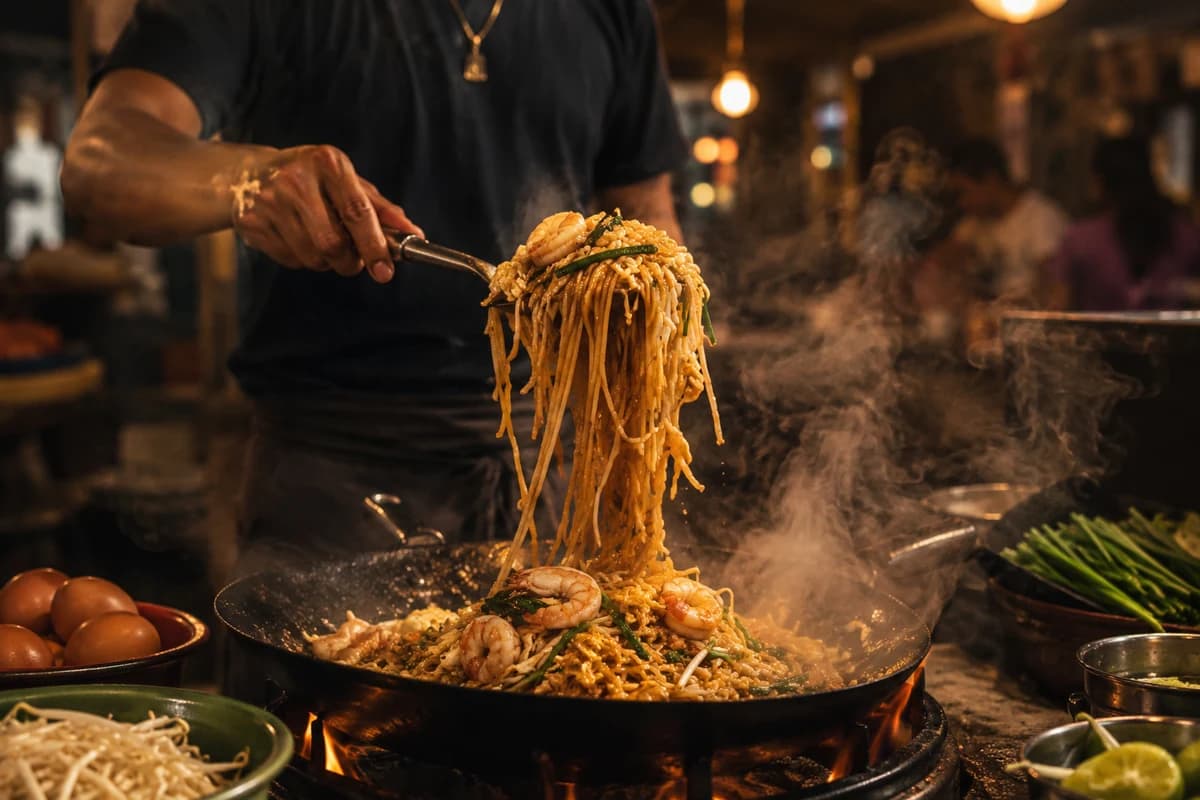
1. The Dish Everyone Thinks Is Ancient
There are Thai dishes that look old because they are old.
Pad Thai has achieved something slightly different. It looks old because it became famous enough that people stopped asking when it appeared.
For many visitors, it is practically the opening sentence of Thai food. The name is familiar before the first trip. The ingredients are recognisable. The level of chilli can usually be negotiated without a diplomatic incident. And somewhere between the lime wedge, crushed peanuts and bean sprouts, a diner gets the reassuring feeling that they have ordered something unmistakably Thai.
That part is true.
What is misleading is the idea that Pad Thai has sat unchanged at the centre of Thai cuisine for centuries.
The dish grew out of a much more recent world. Chinese migration had already made rice noodles and wok cooking part of everyday urban food in Siam. Then, during the government of Field Marshal Plaek Phibunsongkhram from 1938 to 1944, noodles became entangled with a much larger project to modernise the country, shape national identity and encourage new forms of everyday behaviour.
Recent academic work describes Pad Thai as an innovation created through the “Thai-isation” of Chinese kway teow and promoted from above within Phibun-era nationalist policy. Other Thai historians are more cautious about the exact recipe and timing, arguing that the dish we now recognise as Pad Thai was not clearly documented under that name until later.
That disagreement is not a problem to hide.
It is the interesting part.
Pad Thai is a national icon whose history shows how national food actually gets made: not by remaining pure, but by borrowing, adapting, naming, promoting and repeating something until millions of people begin to recognise it as their own.
2. Before Pad Thai: Chinese Noodles in Siam
Before there was Pad Thai, there were noodles.
More specifically, there were Chinese noodles and Chinese communities whose influence on Thai food runs so deep that modern diners can easily forget where one tradition ends and another begins.
Large-scale Chinese migration into Siam accelerated during the nineteenth and early twentieth centuries. Teochew speakers became especially prominent in Bangkok and the central region, working in trade, transport, markets, mills, workshops and food businesses, and their culinary influence travelled with them.
The Thai word kuai tiao — commonly used for rice noodles and noodle dishes — is itself derived from a southern Chinese term. Soup noodles, dry noodles and stir-fried noodles became familiar parts of the urban food landscape, and cooking quickly in a wok was also strongly associated with Chinese culinary practice.
That does not mean Thai people simply copied Chinese food.
Food rarely travels that neatly.
Ingredients change. Customers change. Vendors discover what sells. Local seasonings enter the pan. A dish that begins inside one migrant community can become ordinary city food within another generation.
Historian Chatichai Muksong has pointed to kuai tiao pad — fried noodles — as an important predecessor to Pad Thai. These dishes existed before the famous national name did, showing that the key technique was already present: rice noodles meeting high heat, oil and the wok.
This matters because one of the simplest Pad Thai myths is that a government suddenly invented a noodle dish from nothing.
It did not.
The raw material for Pad Thai was already there in Thai-Chinese food culture.
That background also complicates the idea that Chinese and Thai food occupied separate worlds. Chinese migrants and their descendants were becoming part of Thai society at the same time that the state was trying to define what counted as Thai, and cuisine moved across that boundary more easily than official categories did. A noodle technique could arrive through migration, become familiar in Bangkok, pick up local flavours, and eventually be re-labelled as a national dish without anyone needing to erase the earlier stages completely.
What changed was the meaning attached to it.
3. A Government Trying to Build “Thai-ness”
To understand why a plate of noodles became politically interesting, it helps to remember what Thailand was doing at the end of the 1930s.
Plaek Phibunsongkhram became prime minister in December 1938. His government pursued an assertive nation-building programme designed to create a more unified, modern and visibly “civilised” national culture.
In 1939, Siam was officially renamed Thailand for the first time. Between 1939 and 1942, the government issued a series of cultural mandates covering subjects that reached surprisingly far into daily life: national terminology, language, dress, routines, public behaviour, consumption and duties to the nation.
The point was not merely symbolism.
The state was trying to make national identity something people performed every day.
This was the same political environment in which citizens were encouraged to use the national language, salute national symbols, consume domestic products and adopt modern standards of dress and conduct. Food was therefore not an isolated curiosity inside the programme — it sat beside a wider attempt to make a modern Thai nation visible in habits that could be repeated by ordinary people. A noodle dish could do political work precisely because it did not look political once it reached the table.
Food fitted naturally into that project.
Phibun-era economic nationalism encouraged the use of Thai products and sought to strengthen Thai participation in commerce at a time when Chinese businesses played a major role in the economy. Noodle production and vending could serve several goals at once: create small businesses, provide inexpensive food, encourage a shared national habit, and transform something strongly associated with Chinese food culture into something labelled Thai.
A 2024 study in National Identities argues that this process was central to the development of Pad Thai. Drawing on policy and recipe evidence, the authors describe the dish as an innovation of Chinese kway teow through Thai-isation, and link its promotion to the Phibunsongkhram government’s nationalist programme and National Nutrition Project.
That does not mean every person eating noodles was participating in politics consciously.
Most people probably wanted lunch.
But states do not need citizens to recite policy documents for policy to become culture. If a government promotes a food, teaches people to make it, encourages vendors to sell it and wraps it in the language of national identity, the political project can eventually disappear behind the taste.
That is more or less what happened.
4. Did Phibun Invent Pad Thai?
This is where the story gets messy.
The version repeated most often online says that Prime Minister Phibun personally created Pad Thai — or ordered it created — during the late 1930s or Second World War, then distributed a standard recipe across the country and turned it into Thailand’s national dish.
Parts of that story fit the historical context very well.
His government unquestionably promoted noodles. Nation-building policy unquestionably tried to shape everyday culture. Recent academic research supports a top-down role in turning a localised Chinese noodle form into a specifically Thai national food.
But the exact invention story is less secure.
Chatichai Muksong, a Thai historian interviewed by Smithsonian in 2024, has argued that although fried noodles were promoted during Phibun’s first premiership, the recipe documented at that time was not necessarily the same dish later recognised as Pad Thai. He points to a 1962 household manual in which “Pad Thai noodles” and ordinary “stir-fried noodles” appeared as separate items, and considers that an important early written use of the distinct name.
That leaves two useful levels of certainty.
First: the Phibun era clearly matters. Noodle promotion, nationalism, food policy and the localisation of Chinese food all belong to the history of Pad Thai.
Second: saying that one man sat down, invented the exact modern recipe and launched it fully formed is much harder to prove.
There are also popular accounts claiming that a housekeeper in Phibun’s household devised the dish. That story circulates widely, including in Thai cultural writing, but it is better treated as part of the Pad Thai origin tradition than as a securely documented invention certificate.
The safest conclusion is also the most interesting one.
Pad Thai emerged through a process.
Government policy accelerated it. Chinese noodle culture supplied the foundation. Thai cooks and vendors localised it. Later recipes stabilised what people came to expect. Tourists then helped turn one version into the international standard.
One wok. Many authors.
5. How a Chinese Noodle Became Thai
The name itself tells the story.
Pad means stir-fried. Thai announces the identity being claimed.
Earlier forms were often described through kuai tiao, a word with Chinese linguistic roots. The longer expression kuai tiao pad Thai therefore contained the transformation in miniature: Chinese-origin noodles, stir-fried in a style strongly associated with Chinese cooking, deliberately marked as Thai.
The Thai part was not just the label.
The flavour structure mattered.
What most people now recognise as classic Pad Thai brings together sourness from tamarind, saltiness from fish sauce, and sweetness traditionally supplied by palm or coconut sugar. Chilli is usually adjustable rather than buried invisibly in the sauce. Dried shrimp, firm tofu, preserved radish, egg, peanuts, bean sprouts and Chinese chives create a dish that is neither simply Chinese nor easily reduced to one older Thai recipe.
It is Thai-Chinese food that became national food.
That may sound contradictory only if national cuisines are imagined as sealed boxes.
Thai cuisine is full of histories of exchange. Chinese migration shaped noodle culture and stir-frying. Indian, Persian, Malay, Portuguese and other influences entered different parts of the culinary landscape. Ingredients now treated as obvious parts of Southeast Asian food once travelled from much farther away.
Pad Thai is unusually transparent about this process, because the political naming happened recently enough to see.
It also shows why “authenticity” can be a slippery word.
A dish can have foreign roots and still become genuinely Thai. It can be promoted by a government and still become ordinary street food. It can change over decades and still carry cultural continuity.
National identity is sometimes less like a family heirloom and more like a very successful recipe: ingredients arrive from different places, but eventually everybody knows what the finished dish is supposed to taste like.
6. Noodles, Wartime and the Street Cart
The Second World War strengthened the noodle story.
Thailand entered a period of shortage, inflation and disruption. A severe flood in 1942 damaged rice-growing areas in the Chao Phraya basin and added to food pressure. Government promotion encouraged people to eat and sell noodles, which could be presented as practical, economical and suitable for small-scale commerce.
This is often explained with a simple calculation: noodles used less rice than eating rice directly, so switching meals would stretch the national rice supply.
The exact arithmetic, and the role of shortage in the creation of Pad Thai, are harder to pin down than popular retellings suggest. The more defensible point is that wartime conditions made noodle promotion useful and gave the government another reason to expand an already existing campaign.
Street vending was important because it turned policy into repetition.
A national dish does not become national because somebody announces it once. It becomes national because people can buy it cheaply, vendors can reproduce it quickly, and the ingredients fit the economics of everyday life.
Pad Thai was well suited to the street.
Most preparation could happen before the order arrived. The actual cooking was fast. A hot wok, soaked noodles, sauce and prepared ingredients could become a complete meal in minutes, and customers could adjust the balance afterward with chilli, lime, peanuts or sugar according to local habit.
The stall also solved another problem for a government interested in economic participation: a noodle cart required far less capital than opening a restaurant.
The result was a food that could spread through kitchens and commerce at the same time.
Noodles also fitted the tempo of a changing city. Bangkok was becoming more mobile, wage work was expanding, and prepared food sold by vendors mattered increasingly to people who could not or did not cook every meal at home. Stir-fried noodles were portable urban technology: inexpensive equipment, fast service and a product that could be adjusted to whatever ingredients were affordable that day. Long before “street food” became a tourism category, vendors were solving an everyday problem of feeding cities.
That combination helped Pad Thai escape its political origin story.
Eventually, nobody needed a government campaign to explain why a plate of noodles was a good idea.
7. One Dish, More Than One Pad Thai
International restaurant menus can make Pad Thai look standardised: noodles, egg, tofu, bean sprouts, peanuts, lime, choose chicken or prawns.
Thailand is less obedient.
Even within the broad family of Pad Thai, noodles, moisture, sweetness, sourness, protein and garnish can shift considerably.
Sen Chan — rice noodles associated with Chanthaburi — became especially closely linked to Pad Thai. Their texture works well in stir-frying, and the name appears in versions such as Pad Thai Sen Chan. Eastern coastal recipes have also used crab and richer gravies in ways that look quite different from the dry, carefully balanced plate many foreign diners expect.
Korat adds another complication.
Pad mee Korat is a famous stir-fried noodle tradition from Nakhon Ratchasima with its own local identity, and some cultural accounts identify it as an influence on Pad Thai’s development. It is not simply “Pad Thai from Korat.” The relationship is better understood as evidence that dry stir-fried rice noodles already existed in regional Thai foodways, and that national dishes rarely begin from one isolated kitchen.
The garnish can tell its own story too.
A traditional plate may arrive with Chinese chives, bean sprouts, banana blossom, chilli flakes, lime and crushed peanuts arranged so the diner finishes the seasoning. Prawns now look almost compulsory in tourist photography, but older versions did not always centre large fresh prawns, and eggs could once be treated as an optional addition rather than an automatic part of every plate.
This is what happens when a dish becomes successful.
First people argue about where it came from.
Then they argue about how it should be made.
The existence of variation does not weaken Pad Thai’s identity. It proves that people actually cook it.
8. The Restaurant Dish Foreigners Could Understand
Pad Thai had another advantage that would matter enormously once Thai food began travelling abroad: it was easy to explain.
A diner unfamiliar with nam prik, fermented fish, regional curry pastes or the logic of a shared Thai meal could understand stir-fried noodles immediately.
That accessibility did not make the dish culturally simple. It made it commercially portable.
Menus abroad reinforced the effect. Restaurants trying to introduce an unfamiliar cuisine need dishes customers can pronounce, picture and order without assistance, and Pad Thai offered all three. It also worked as a bridge dish: someone who came in for noodles might return for som tam, tom kha, larb, boat noodles or a regional curry later. In that sense, Pad Thai’s international importance is larger than the number of plates sold. For many diners it became the doorway through which the rest of Thai cuisine entered.
Thai restaurants began developing in the United States from the 1960s, with much faster growth in cities such as Los Angeles during the 1970s and 1980s as Thai immigration increased. Historian Mark Padoongpatt has shown that Thai food in America was not merely transplanted intact — Thai restaurateurs adapted presentation, menus and flavours while also using food to define a distinctive Thai identity for American customers.
Pad Thai was almost designed for that environment.
It was recognisably Asian without requiring chopstick expertise. It could be made vegetarian. It accepted different proteins. Chilli could be softened without dismantling the dish. Sweet, sour and salty flavours created an immediate sense of complexity without demanding that a first-time customer understand an entire regional cuisine.
The reversal is difficult to miss.
A dish partly shaped through a twentieth-century attempt to define Thai national identity became one of the easiest tools for explaining Thailand to foreigners.
Then the foreigners began explaining Thai food back through Pad Thai.
That is where success creates distortion.
Thailand contains far more food traditions than one wok-fried noodle dish. Many Thais do not eat Pad Thai constantly, and regional cuisines from Isaan, the North, the South and the central plains have their own structures, ingredients and histories.
But international icons are rarely democratic.
One dish gets the passport photo.
9. From Global Thai to Global Icon
By the beginning of the twenty-first century, Thailand stopped relying on restaurants to spread by accident.
The government made international Thai cuisine an explicit economic and cultural strategy.
The Global Thai initiative, launched in the early 2000s, became one of the best-known examples of what scholars now call gastrodiplomacy: using national cuisine to shape a country’s image, support exports, encourage tourism and build relationships with foreign publics.
Thailand’s wider “Kitchen to the World” policy supported Thai restaurants abroad, food businesses, chefs and the export of ingredients. Thai SELECT certification was developed to identify restaurants meeting government-backed standards for Thai cuisine. The policy did not revolve around Pad Thai alone, but Pad Thai benefited enormously because it was already the dish many foreign customers knew by name.
The scale of Thai food abroad grew dramatically. Thai government figures in 2024 reported more than 17,000 Thai restaurants globally, compared with roughly 5,500 when the early-2000s promotion effort began. The exact totals vary by year and counting method, but the direction is unmistakable.
Thai food became international infrastructure.
A traveller in Europe, North America or Australia no longer needed to visit Thailand to encounter green curry, tom yum or Pad Thai. A local Thai restaurant could become the first cultural contact point years before the person booked a flight.
Pad Thai was ideal soft power because it rarely felt like soft power.
This later campaign should not be confused with the Phibun-era nation-building project. They belonged to different political moments and had different immediate goals. Yet there is a striking continuity in the mechanism. In both cases, food was used to make “Thailand” tangible through everyday consumption. The first project worked mainly inward, helping define national culture at home. The twenty-first-century project worked outward, using restaurants and cuisine to make Thailand familiar overseas. Pad Thai happened to fit both worlds unusually well.
Nobody sat down thinking, “I am now participating in Thai public diplomacy.”
They ordered noodles.
That is precisely why food works.
10. A National Dish Built From Movement
Pad Thai is sometimes treated as proof of timeless Thai culinary tradition.
It may be better understood as proof of Thailand’s ability to absorb change.
The noodles carry Chinese migration. The wok carries Chinese technique. The flavour balance became distinctly Thai. The name belongs to twentieth-century nationalism. Wartime policy helped make noodles economically useful. Street vendors made them ordinary. Later cooks stabilised and diversified the dish. Thai migration and restaurants carried it abroad. Government gastrodiplomacy then helped build an international environment in which Thai food could become familiar almost anywhere.
None of that makes Pad Thai less authentic.
It makes “authentic” more interesting.
The dish did not have to exist for five hundred years to become culturally important. It did not need one inventor. It did not need an untouched original recipe waiting in an archive.
What mattered was adoption.
Thai cooks made it. Thai vendors sold it. Thai diners recognised it. The state promoted it. Restaurants abroad translated it. Foreign customers remembered the name.
Eventually, Pad Thai became something that national symbols often become: so familiar that its constructed history disappeared from view.
And that may explain why its origin story matters.
Pad Thai did not simply travel from Thailand to the world.
Before it could do that, a travelling noodle had to become Thai.