1. The Fabric the World Thinks It Knows
Thai silk has one of those reputations that arrives before the fabric does.
Mention it to somebody who has never visited Thailand, and they may already picture luminous colour, a slightly irregular surface, elegant scarves, formal dresses, or the kind of interior fabric that looks expensive before anyone has checked the price tag.
In Thailand, the picture is much wider.
Silk can be courtly or rural, ceremonial or commercial, subtle or almost aggressively colourful. It can be woven as matmee ikat in the Northeast, as intricate brocade, as plain cloth, as regional dress, or as fabric destined for fashion houses and hotels. The thread may have travelled only a few kilometres from mulberry field to loom, or through an industrial supply chain before becoming a finished textile.
That diversity is easy to lose, because the modern international story of Thai silk has such a famous central character: Jim Thompson.
The American who settled in Bangkok after the Second World War became so closely associated with Thai silk that he is still routinely described as the man who “revived” or even “saved” the industry. There is truth in that, stated carefully. Thompson helped reorganise production, develop products for international buyers and connect Thai weaving to fashion, design and show business abroad.
But he did not invent Thai silk.
He did not teach Thailand how to weave it.
And he was never the only force carrying the craft forward.
The more interesting story is what happened when a very old body of textile knowledge met modern marketing, tourism, state policy, royal patronage, international fashion and a rapidly changing Thai economy.
Thai silk became global because many different people made it global.
2. Long Before Jim Thompson
Silk production in the lands that became Thailand has a history far older than the modern nation-state.
Archaeological and historical evidence points to very long traditions of sericulture and textile production in the region. By the early twentieth century, Siamese officials regarded silk as an established rural craft worth modernising, particularly in the Northeast. Government programmes between 1901 and 1913 brought Japanese sericulture specialists to Siam in an attempt to improve mulberry cultivation, silkworm breeding, reeling and production methods.
The results were mixed.
The programme invested heavily in schools, experimental stations and new techniques, but academic work on the project concludes that its long-term effect on rural silk output was limited. The gap between official plans and household practice was simply too large to close by instruction alone.
That failure tells us something useful about Thai silk.
Silk was not merely an industry waiting for a better factory system. Much of it was produced inside household economies, where families raised silkworms, reeled thread and wove cloth according to local needs, skills and traditions. Production could supplement agricultural life rather than replace it.
Regional identity mattered as much as national branding.
In Surin, for example, silk weaving developed distinctive matmee — ikat — traditions among Khmer, Kui and Thai-Lao communities. Patterns, colours, natural dyes and the uses of particular textiles could carry social, ceremonial and community meaning. Elsewhere in Thailand, different weaving structures, motifs and forms of dress developed their own separate histories.
This is why “Thai silk” should never be imagined as one ancient national fabric with one pattern and one origin.
The national label came later. The weaving came first.
Silk also moved through different social worlds long before anyone tried to package it as a national luxury brand. Court demand, regional exchange and imported textiles existed alongside village production, and Siam was never culturally sealed off from the textile traditions of China, India, Laos, Cambodia or the wider region. That makes any claim to a perfectly isolated, purely national silk tradition difficult to defend. What became recognisable as Thai silk was shaped inside Southeast Asian networks while still developing highly distinctive local practices. The useful question, then, is not whether every thread can be labelled uniquely Thai — it is how Thailand turned diverse local textile traditions into something the modern world learned to recognise under one national name.
3. Silk Was Local Before It Was National
Before Thai silk became a symbol sold to visitors, it was often a practical expression of place.
A household that raised silkworms did not begin with a finished bolt of luxury fabric. It began with mulberry leaves.
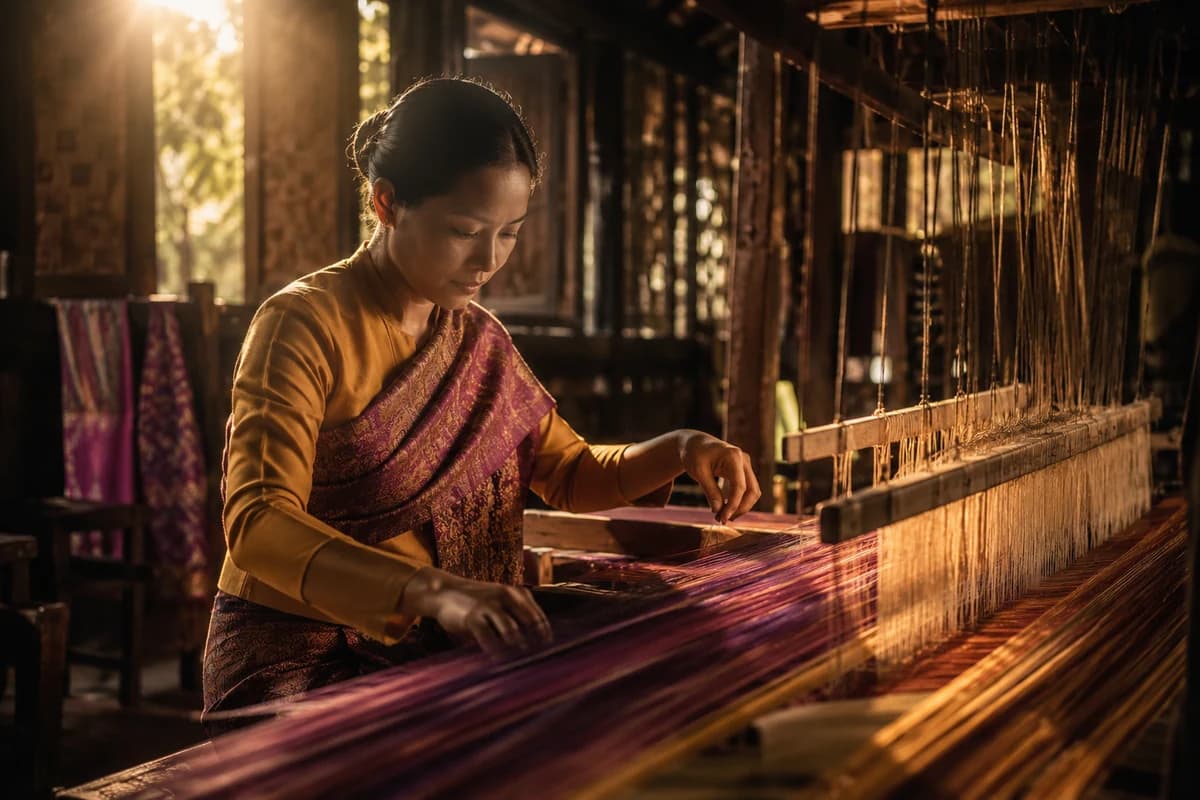
Silkworms feed on mulberry. Cocoons are produced. Filaments are reeled into thread, which is prepared, sometimes twisted or combined, then dyed and finally woven. Patterned textiles add another layer of labour before the loom even starts moving: in matmee, sections of yarn are resist-tied and dyed before weaving, so that the pattern gradually appears as the threads cross on the loom.
The process is slow enough to make the phrase “handmade” feel inadequate.
A finished textile contains agricultural knowledge, insect care, fibre preparation, colour work and weaving skill. Different people may handle different stages, or one household may do several of them.
That production system also explains why silk could survive without becoming a large export industry. A craft can remain culturally important even when it is economically small.
For many rural producers, weaving was compatible with agricultural life and domestic responsibilities. It could be carried out in the home, fitted around other work and passed down through families. Knowledge was often strongly associated with women, although silk production as a whole involved wider household and community labour.
What modern commerce would eventually ask from this system was difficult: more consistent quantities, colours, quality and delivery schedules, without destroying the qualities that made handwoven silk attractive in the first place.
That problem did not begin with Jim Thompson.
He was simply unusually good at seeing a market in it.
There was another tension hidden inside that market problem. Foreign buyers often wanted consistency, but part of the appeal of handwoven silk was precisely that it did not look industrially perfect — slight changes in thread thickness, colour and surface gave the cloth its character. Commercial revival therefore required producers to improve reliability without sanding away every trace of the loom and the hand behind it. That balance between standardisation and individuality would follow Thai silk for decades, from Thompson’s early orders to today’s certification schemes.
4. A Craft Under Pressure
By the middle of the twentieth century, handwoven silk faced a very different economy from the one in which many regional traditions had developed.
Machine-made textiles were faster and cheaper. Synthetic fibres were expanding. Urban consumers had more options. A material that required silkworms, reeling, dyeing and handloom work had to compete with cloth produced at industrial speed.
The pressure was not uniquely Thai — handcraft industries across the world were being squeezed by mechanised manufacturing.
In Thailand, the problem was particularly visible because silk production remained dispersed. Weavers could possess extraordinary skill while having little access to international buyers, fashion networks or the kind of design feedback required by foreign markets.
This is where modern revival stories often become too dramatic.
It is easy to write: “Thai silk was dying, then Jim Thompson appeared.”
Reality was more complicated. Silk weaving had not vanished. Regional production survived, and different communities continued to maintain their skills. The Thai state had already tried to improve sericulture decades earlier. Court and elite use of silk had not disappeared. What was weak was the commercial bridge between scattered production and the new international luxury market.
The craft existed. The global brand did not.
That difference created an opening for somebody who understood both aesthetics and connections.
5. Jim Thompson, Ban Krua and the Market Problem
James H. W. Thompson was born in the United States in 1906, trained in architecture and served with the Office of Strategic Services during the Second World War. After the war, he settled in Bangkok.
His most consequential discovery there was not silk itself, but the possibility of building a business around it.
Thompson developed a close relationship with the Ban Krua weaving community in Bangkok, a Cham Muslim community across the canal from the house he would later build. Ban Krua had experienced silk weavers and a tradition that could support production, while Thompson brought something very different: access to foreign tastes and foreign buyers.
That partnership matters, because it corrects the hero version of the story.
The weavers were not anonymous labour waiting for a foreigner to provide culture. They were the people who knew how to make the fabric. Thompson’s contribution was to organise, commission, experiment, specify colours and designs, improve consistency and market the results to people who had never heard of Ban Krua.
He also resisted one obvious industrial solution: simply turning the work into a centralised, mechanised factory. The home-based model let many weavers continue working within their communities while supplying a commercial company.
By the early 1950s, the Thai Silk Company had taken shape around that ambition. The company’s own official histories differ slightly on whether its founding should be dated to 1950 or 1951, but the important point is the same: Thompson turned his experiments into a formal business at the moment post-war international fashion was looking for new materials and visual languages.
He understood something that sounds obvious only after somebody has succeeded at it.
Traditional craft does not become a global luxury product merely because it is beautiful. Someone has to make the rest of the world notice.
Thompson also altered what was being noticed. He encouraged stronger colour combinations, worked on production quality and responded to the tastes of decorators and fashion buyers abroad. So the fabrics that became internationally famous should not be imagined as untouched museum specimens suddenly lifted from a village loom. They were products of collaboration and adaptation. The craftsmanship was Thai; the commercial styling increasingly answered to an international market. Preservation and invention were happening at the same time.
6. When Thai Silk Entered Fashion and Show Business
Thompson’s real advantage was not that he knew more about weaving than the weavers.
It was that he knew people who knew fashion.
His American connections gave him routes into design, publishing, theatre and interiors. Thai silk reached editors and designers in New York at a time when the texture and colour of handwoven fabric could look dramatically different from industrial cloth.
Vogue became part of the legend. So did The King and I.
The Rodgers and Hammerstein musical, set in nineteenth-century Siam, became one of the most visible cultural productions associated with Thailand in mid-century America. Thai Silk Company fabrics were connected with its famous costumes, helping put the material in front of audiences who might never have encountered Thailand beyond a theatre programme.
The irony is difficult to miss.
A Western musical presenting its own highly stylised vision of Siam helped create demand for a genuine Thai craft.
Fashion and interiors did the rest. Thompson’s fabrics were not marketed as rough ethnographic curiosities. They were presented as sophisticated design material: rich colour, unusual texture, luxury, modernity.
That repositioning mattered enormously.
A handloom textile from Thailand could now sit in the same conversation as couture, theatre costumes, high-end interiors and international design.
By the 1960s, Thai silk was no longer simply something produced in Thailand.
It was something foreigners travelled to Thailand expecting to find.
That is the moment a craft starts becoming part of a country’s tourism identity.
The process also changed how outsiders imagined Thailand. Silk fitted beautifully into the mid-century visual language of the country: saturated colour, tropical luxury, courtly references and skilled handcraft. That image could be romanticised, and often was, but it proved extraordinarily effective. By linking a physical product to an idea of Thailand, silk became more than fabric. It became a souvenir that could keep performing “Thailand” long after the traveller had gone home — as a dress, a cushion, a wall covering, or a length of cloth waiting for somebody to decide what to do with it.
7. Queen Sirikit and the Second Global Silk Story
Jim Thompson is the best-known foreign name in the story, but the international rise of Thai silk cannot be explained by his company alone.
Queen Sirikit played a separate and highly visible role in turning Thai textiles into symbols of national culture and modern elegance.
During the late 1950s and 1960s, a series of Thai national dress styles was developed under her initiative. On international state visits, including the major Western tour of 1960, Thai silk could appear not as village handicraft but as part of sophisticated royal dress and modern couture. Pierre Balmain was among the designers who worked on her wardrobes, including garments that combined Thai silk with contemporary Western tailoring.
The message was powerful: Thai textiles could be traditional without looking old-fashioned.
The economic side became even more important later.
The SUPPORT Foundation, established in 1976 under Queen Sirikit’s patronage, promoted traditional handicrafts as a way for rural families — particularly women — to supplement household income. Handwoven silk and cotton became central to the programme, and weaving centres and projects supported skills that in some places were under pressure or had already declined.
The foundation did more than preserve cloth behind glass.
It created reasons to keep weaving.
In the late 1970s and beyond, Queen Sirikit also wore village-woven SUPPORT textiles in settings seen by Thai and international audiences alike, deliberately bringing high fashion and rural weaving into the same frame.
This is one reason the story should never be reduced to “Jim Thompson saved Thai silk.”
Thompson helped build an international commercial market.
Royal patronage, public institutions and rural producers helped make Thai textiles part of national identity.
Those stories overlap, but they are not the same story.
The distinction also matters geographically. Thompson’s famous early partnership was rooted in Bangkok’s Ban Krua community, while much of the later royal and government effort focused on rural weaving traditions across the country, particularly communities where handcraft could provide supplementary income. The global Thai silk story therefore connects a Bangkok commercial network with village economies far beyond the capital. One helped create international demand; the other helped broaden the base of traditions, livelihoods and regional textiles that could answer it.
8. What Makes Thai Silk Look Like Thai Silk?
There is no single visual test that can identify every authentic Thai silk textile from across a room.
That is worth saying, because tourist marketing often suggests otherwise.
Handwoven silk can show slight variations in the yarn and surface that give the cloth a lively texture. Colours can shift with light, because silk fibres reflect it differently depending on angle and weave. Traditional Thai silk threads, regional dye practices and handloom methods can produce characteristics that experienced buyers recognise.
But Thai silk is not one weave.
Matmee uses resist-dyed yarn to build patterns into the cloth. Brocades introduce supplementary threads and can become extraordinarily elaborate. Plain-weave silk may depend more on colour and texture. Regional textiles can carry motifs associated with local communities and ceremonial use.
Modern production complicates the picture further. Thailand now produces silk across a spectrum ranging from highly traditional hand processes to commercially adapted methods.
That is why official certification exists.
The Queen Sirikit Department of Sericulture administers the Royal Peacock certification system, which distinguishes four categories: Gold for the most strictly traditional Royal Thai Silk standards, Silver for Classic Thai Silk, Blue for Thai Silk produced with more adaptable methods, and Green for Thai Silk Blend products, in which silk remains the principal fibre but other fibres are also used.
The point is not that one label is morally superior to the others.
It is that the phrase “Thai silk” covers more than a tourist shop can communicate on a sign.
Origin, fibre, reeling, loom type and production method all matter. A fabric can be genuinely Thai while belonging to a different part of that spectrum.
For a visitor, the practical lesson is simple: price, shine and the word “silk” on a shop sign are not enough to tell the whole story. Handwoven silk, machine-woven pure silk and silk blends are different products. So are a new scarf made for the tourist market and a regional textile whose pattern carries community meaning. None of this makes shopping for silk impossible. It simply makes Thai silk more interesting than the old trick of holding a fabric up to the light and pretending authenticity can always be settled in ten seconds.
9. The Mystery Did Not End the Story
Jim Thompson disappeared in Malaysia’s Cameron Highlands in March 1967.
He was never found.
The mystery became so famous that it sometimes threatens to swallow the work that made his name famous in the first place. Books, theories and documentaries have spent decades asking what happened during a walk in the hills.
For Thai silk, the more important fact is what happened afterward.
The company continued. The industry continued. Weavers continued.
Thompson’s house in Bangkok became a museum and one of the city’s best-known cultural attractions. The company that carries his name expanded far beyond the small post-war network into an international textile and lifestyle business.
Meanwhile, Thai silk also developed through channels that had nothing to do with the Jim Thompson brand: village cooperatives, private producers, royal projects, government sericulture programmes, regional craft centres, fashion designers and tourism.
The Ban Krua relationship itself changed as production shifted and Bangkok transformed around the community. The old image of Thompson crossing the canal to inspect weaving belongs to a specific period, not an unbroken present.
That is another reason not to confuse a company history with the history of Thai silk.
One man can become the face of a revival. He cannot own the tradition that made the revival possible.
Even his disappearance illustrates the imbalance in public memory. The mystery is instantly marketable: an American “Silk King” walks into the Cameron Highlands and vanishes. The slower story — generations of Thai and Cham weavers, silkworm farmers, dyers, designers and institutions building an industry before and after him — is less cinematic. Yet that is the story that explains why Thai silk survived the disappearance of its most famous salesman.
10. How Thailand’s Silk Became Known Around the World
Thai silk went global because several different transformations happened at once.
A regional and household craft already existed. The Thai state had tried to modernise sericulture before the Second World War. Jim Thompson and Thai weaving communities found ways to reshape handwoven silk for foreign design markets. Fashion editors, stage productions and interior designers gave the material visibility abroad.
Queen Sirikit used Thai textiles in public and international settings, linking them to modern national identity, while SUPPORT created economic reasons for rural weaving traditions to continue.
Tourism then carried the reputation further. Visitors did not need to understand matmee, sericulture or weaving history before deciding that Thai silk was something worth bringing home.
Government certification and specialist institutions later tried to protect what the label meant, as the market grew larger and more complicated.
None of these forces worked alone.
That is what makes the story so revealing.
Thai silk did not conquer the world simply because foreigners discovered a beautiful old fabric. The fabric had to be made, adapted, promoted, worn, protected and repeatedly reintroduced to new audiences.
And through all of that change, the most important part remained the least glamorous part of the story: somebody still had to raise the silkworms, prepare the thread and sit at the loom.
Jim Thompson helped the world look at Thai silk.
Thailand’s weavers gave it something worth looking at.