1. A Soup Everyone Recognises — and a History That Is Harder to Pin Down
Few Thai dishes announce themselves as quickly as tom yum.
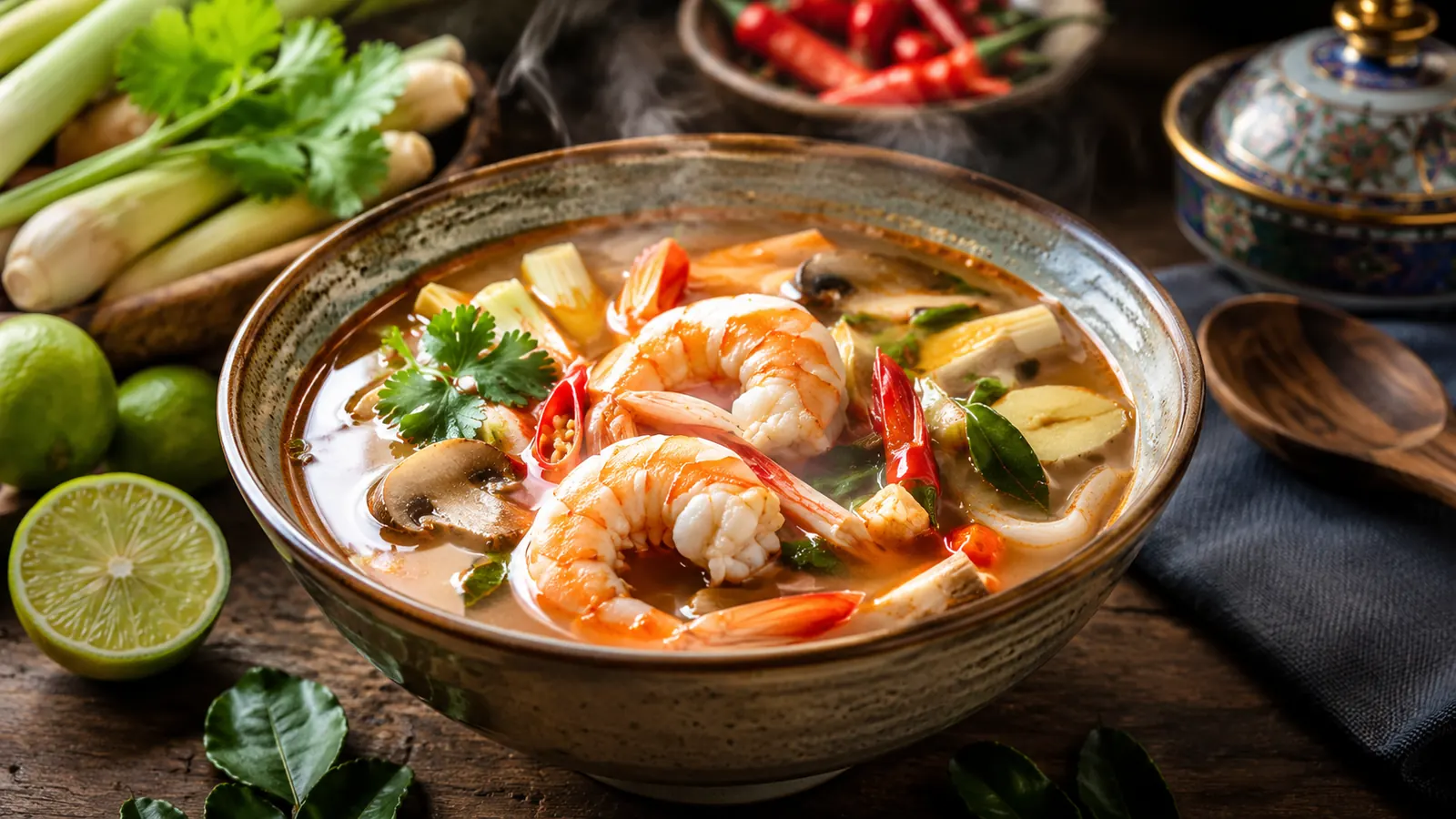
Before the bowl reaches the table, the aroma often arrives first: lemongrass, galangal and makrut lime leaf rising through steam, followed by chilli, lime and the savoury depth of fish sauce. Add prawns and the dish becomes tom yum kung, one of the most internationally recognised expressions of Thai cooking.
Its familiarity can make the history seem obvious. Surely a dish this famous must have a neat origin story — a first cook, a first recipe and a date when the modern version appeared.
The evidence is more interesting than that.
The words and cooking style associated with tom yum appear in Thai sources well before the modern bowl became standard. Nineteenth-century cookery records contain several tom yum preparations. An 1898 cookbook records dishes named tom yum kung song khrueng and tom kung kap het khon. Yet those recipes do not look exactly like the tom yum kung most diners would recognise today.
A much more familiar clear prawn version appears in a published royal-food account from 1964, describing a dish prepared two years earlier.
That does not mean tom yum kung was suddenly invented in 1962. Food rarely works like that.
Many Thai culinary skills were transmitted orally in families and communities long before they were written down. A cookbook records a moment when somebody chose to document a recipe; it does not necessarily record the moment the food first existed.
Tom yum is therefore best understood as a family of Thai soups that developed over time. Fish, prawns and other ingredients changed. The balance of sourness and heat changed. Ingredients that were available in one household could differ from another. Later, clear and creamy styles became familiar side by side.
The history is not one straight line. It is a living Thai cooking tradition gradually becoming visible in the written record.
2. What Does Tom Yum Actually Mean?
The name itself gives a clue to the cooking method.
Tom refers to boiling or cooking in liquid. Yum — also written yam in some romanisation systems — refers to mixing or combining ingredients in the strongly seasoned style associated with Thai yum preparations. Kung means prawn or shrimp.
Put together, tom yum kung is less like a poetic title and more like a practical description: prawns cooked in a broth and seasoned in the tom yum manner.
That matters because tom yum is bigger than one prawn soup. Thai cooks make tom yum with fish, chicken, seafood and other proteins. Earlier written evidence often points to fish. Even today, a Thai menu may specify tom yum pla, tom yum gai or another variation rather than treating prawns as mandatory.
The shared identity lies in the broth and seasoning logic. Fresh aromatic herbs perfume the liquid. Sourness is added, often with lime. Fish sauce contributes salt and savoury depth. Chilli gives heat. The main ingredient contributes its own sweetness and character. The result can be piercingly bright or gentler and richer depending on the style.
There is no need to force every bowl into one exact formula. That flexibility is part of the tradition.
The important distinction is between recognising a culinary family and declaring one modern restaurant recipe to be the only authentic version. Thai households, cooks and regions have always had room for variation. The dish can change while remaining recognisably tom yum.
That ability to hold a clear identity without requiring perfect uniformity is one reason the soup has proved so durable.
3. Before the Famous Prawn Soup: Tom Yum in Early Thai Sources
The written trail begins before the famous modern version.
Thai government cultural material notes references to the words tom yum and kaeng tom yum in literature associated with the early Rattanakosin period. These references tell us that the term and the broader idea of tom yum cooking were already familiar well before the twentieth century.
By the late nineteenth century, the documentary evidence becomes more specific. A periodical from the reign of King Chulalongkorn recorded tom yum preparations including fish. This fits a wider historical pattern: fish was abundant and central to everyday food in the riverine landscapes of central Thailand.
Then, in 1898, a cookbook compiled by students at the Wang Lang girls’ school in Bangkok recorded dishes named tom yum kung song khrueng and tom kung kap het khon.
The first of those is especially revealing because the name sounds familiar while the recipe does not. It included prawns but also other ingredients such as cooked pork, dried or grilled fish, pickled garlic, cucumber and madan, a sour tropical fruit. The broth was seasoned with fish sauce, pickled-garlic liquid, sugar and lime, with chilli and coriander added at the end.
A closely related preparation appears in an earlier printed source under the name tom yum khamen, and later in Lady Plian Phasakorawong’s Mae Khrua Hua Pa as a preparation also described as kaeng nok mo — literally suggesting a curry or soup seasoned outside the pot.
That technique is worth noticing. The hot liquid could be poured into a serving bowl and then adjusted with sour, salty and spicy seasonings rather than having every flavour cooked for a long time in the pot.
Anyone who has watched lime juice added at the end of a modern tom yum will recognise the logic. The ingredients have changed considerably. The principle of protecting fresh, sharp flavours has not.
4. Why the Rivers of Central Thailand Matter
The modern cultural story of tom yum kung is strongly connected with the Central Plains.
In Thailand’s UNESCO nomination, the dish is described as part of the culinary knowledge of riverside communities in central Thailand, a region shaped for centuries by agriculture, waterways and an abundance of freshwater food.
This landscape matters. The Chao Phraya basin and its connected rivers, canals, ponds and flooded fields supported rice cultivation while also providing fish, prawns and aquatic plants. Families could combine what came from the water with herbs and aromatics grown around homes and gardens.
Tom yum kung makes sense in that environment. Freshwater prawns contribute sweetness and richness to the broth. Lemongrass, galangal, makrut lime leaves and shallots bring fragrance. Chilli adds heat. Lime and fish sauce sharpen the final seasoning.
The dish therefore does not need an elaborate origin legend to explain why it emerged. Its ingredients already belonged to the landscape and to everyday Thai cooking knowledge.
UNESCO’s inscription also places unusual emphasis on something a recipe alone cannot capture: environmental knowledge. Knowing how to make the dish includes choosing ingredients, understanding herbs, recognising good prawns and maintaining the environments that support them. The cultural practice is connected to families, agriculture and waterways, not merely to the finished bowl.
This is also why tom yum kung should not be reduced to a restaurant formula. The famous dish began within a wider relationship between people and place. Its global success came later.
5. The Herbs Are Not Decoration
A bowl of tom yum can look almost theatrical.
Long pieces of lemongrass float beside torn makrut lime leaves. Slices of galangal remain visible in the broth. Chilli, coriander and shallot add colour and aroma.
To an unfamiliar diner, some of these ingredients can look like garnish. They are doing the real work.
Lemongrass gives a bright citrus fragrance without simply tasting like lime. Galangal adds a sharper, earthy aromatic note distinct from ginger. Makrut lime leaves contribute an intense perfume. Shallots deepen the broth. Chilli provides heat, while lime juice gives the fresh acidity that defines the finished soup.
Thai culinary tradition also associates many of these plants with herbal knowledge. Official descriptions connected with the UNESCO nomination discuss local knowledge of herbs and beliefs about their usefulness for wellbeing, particularly in seasonal conditions. That should be understood as cultural knowledge rather than turned into a medical promise about a restaurant dish.
For the cook, the immediate effect is sensory. The herbs build layers. They also explain why timing matters. Some aromatics benefit from simmering so that their flavour moves into the broth. Lime juice is often added late because prolonged boiling can flatten its fresh character. Chilli may be bruised, crushed or added in different forms depending on the desired heat.
This creates one of tom yum’s most characteristic qualities. The soup tastes cooked and fresh at the same time. The prawn broth can be rounded and savoury. The herbs have had time to perfume it. Yet lime, chilli and final seasoning can remain vivid.
That tension between depth and freshness is part of what makes a well-made bowl feel so alive.
6. The 1898 Recipe and the Modern Bowl Are Not the Same Thing
Food history becomes misleading when old recipes are forced to look more modern than they really were.
The 1898 tom yum kung song khrueng is a perfect example. Its name gives us important evidence that a prawn preparation called tom yum kung existed in print by the reign of Rama V. But the dish included ingredients that would surprise many diners today and used a different structure from the now-familiar combination of prawns, galangal, lemongrass, makrut lime, chilli, lime juice, fish sauce and mushrooms.
That difference should not be treated as a problem. It shows evolution.
Recipes change because tastes change, ingredient supply changes, households influence one another and certain versions become more popular than others.
Another important moment came in 1962. M.R. Kitinadda Kitiyakara prepared a tom yum kung for King Bhumibol Adulyadej, Queen Sirikit and their children at Klai Kangwon Palace. The preparation was later recorded in his 1964 book Khong Savoey.
This recipe is much closer to the clear tom yum kung recognised today.
The historical value of that record is substantial, but the wording needs care. It is evidence of a recognisable modern-style recipe being prepared and documented by that period. It is not proof that nobody else in Thailand had cooked something similar before.
The UNESCO file itself stresses oral transmission. Families passed knowledge through cooking, observation and shared meals. That means the written archive will always be incomplete.
The safest conclusion is also the most convincing one. Tom yum kung developed gradually, and by the mid-twentieth century the clear herbal prawn soup familiar today had become clearly visible in the documentary record.
7. Clear or Creamy? Two Familiar Faces of Tom Yum
Order tom yum kung today and one question can change the entire bowl.
Nam sai or nam khon?
Tom yum nam sai is the clear style. The broth remains relatively light in appearance, allowing the sharp sourness, chilli heat, herbs and prawn flavour to come through directly.
Tom yum nam khon is richer and more opaque. Modern versions commonly use roasted chilli paste and evaporated milk, although coconut milk or other creamy additions appear in some recipes.
Both are recognisably tom yum. The clear version sits closer to the older documentary line of broth-based preparations, while creamy versions demonstrate how the dish continued to evolve.
It is tempting to create another neat invention story here. That would be a mistake.
Different modern sources give conflicting timelines for when creamy tom yum became established, and the historical record is much less secure than it is for the 1898 and 1964 printed references. What can be said confidently is that clear and creamy styles are both firmly embedded in contemporary Thai cooking.
The distinction also reveals something important about authenticity. A living cuisine does not stop developing because historians begin writing about it. Restaurants respond to diners. Cooks experiment. Ingredients become more available. A richer variation can become popular without erasing the older clear style.
Thailand today comfortably contains both. Someone may prefer the brilliant sharpness of nam sai. Someone else may prefer the rounded richness of nam khon.
Neither preference requires turning the other bowl into a culinary mistake. They are two chapters in the same continuing Thai story.
8. From Home Cooking to a Thai Global Signature
Tom yum kung eventually travelled far beyond the river communities associated with its origins.
Bangkok played an obvious role. As the capital expanded, people from across Thailand brought regional food traditions into a growing restaurant, market and street-food economy. Modern transport made ingredients easier to distribute. Hotels and restaurants introduced Thai dishes to international visitors. Thai cooks carried their food abroad.
By the late twentieth century, tom yum kung had become one of the dishes most likely to appear on an international Thai menu.
It had several advantages. The aroma is immediate. The ingredients are visually distinctive. The name is memorable. Most importantly, the soup communicates something recognisably Thai without needing a complicated explanation.
That international popularity sometimes encouraged standardisation. Restaurants serving unfamiliar diners benefited from recipes that could be reproduced reliably. Commercial pastes, seasoning powders and ready-made flavourings made tom yum easier to prepare outside Thailand. Instant noodles, snacks and packaged foods began using tom yum flavour as a shorthand for Thai-style sourness, chilli and herbs.
Yet the original dish did not disappear beneath the exports. Inside Thailand, home cooks, restaurants and chefs continued to prepare it in different ways. Some prized large freshwater river prawns and their rich head fat. Others used sea prawns. Some kept the broth crystal clear. Others added nam phrik phao or milk. Mushroom choices changed with availability.
Tom yum became global without becoming frozen. That is one of the clearest signs that it remained a living cuisine rather than turning into a museum recipe.
9. UNESCO Recognised the Knowledge Behind the Bowl
On 3 December 2024, UNESCO inscribed Tomyum Kung on the Representative List of the Intangible Cultural Heritage of Humanity.
The wording is important. UNESCO did not declare one restaurant recipe to be the official version of tom yum kung. The inscription concerns intangible cultural heritage: the knowledge, skills, practices and social meaning carried by communities.
Thailand’s nomination connected tom yum kung with riverside families and agricultural communities in the Central Plains. It described knowledge about selecting prawns and herbs, cooking the dish and caring for the environment that supports its ingredients. It also highlighted the way those skills were traditionally transmitted orally within families and at social and cultural gatherings.
Today that transmission happens in more places. Restaurants teach cooks. Schools and universities teach culinary students. Community organisations preserve local knowledge. Thai chefs demonstrate the dish internationally. Families continue to pass on their own ways of making it.
That is exactly why the UNESCO recognition fits tom yum so well. There has never been one immutable bowl. What survives is the knowledge of how to create the character of the dish.
The inscription also followed an earlier national recognition. Tom yum kung had been included in Thailand’s national inventory of intangible cultural heritage in 2011.
The international listing in 2024 therefore represented not the discovery of a famous soup, but the recognition of a tradition Thailand had already identified as culturally important.
For a dish known around the world, the focus returned to where it began: people, ingredients, knowledge and place.
10. Why Tom Yum Still Tastes Like Thailand
Tom yum’s history does not lead to a single moment when somebody finally made the “correct” version.
That is what makes the story so Thai — and so interesting.
The early literary references tell us that the name and cooking idea have deep roots. Nineteenth-century recipes show tom yum moving into print. The 1898 prawn recipe proves that the words tom yum kung were already part of the written culinary world, even though the dish looked different from today’s version.
The 1964 record gives us a clear window onto a preparation much closer to the modern bowl.
Later cooks developed further variations. Clear and creamy styles now sit comfortably beside one another. River prawns remain iconic, while other prawns make the soup accessible in ordinary kitchens. Restaurants across the world reproduce the flavour, while Thai cooks continue to adjust it according to ingredients, season and preference.
Through all that change, the identity remains remarkably strong.
Tom yum is built around the judgement of the cook.
How long should the herbs infuse? How much chilli suits the people at the table? When should the lime go in? Is the natural sweetness of the prawns enough? Does the broth need more fish sauce, more sourness, another crushed chilli?
A written recipe can provide measurements. It cannot make those decisions for you.
That is why the UNESCO recognition of knowledge and transmission matters more than a search for the first perfect recipe.
Tom yum kung became one of Thailand’s great culinary symbols not because every bowl is identical. It became one because generations of Thai cooks understood the same underlying idea well enough to keep making it their own.
The ingredients are simple enough to list. The balance is learned.
And somewhere between the fragrance of the herbs, the sweetness of the prawns and the final sharp splash of lime, a bowl of soup became one of the tastes by which the world recognises Thailand.