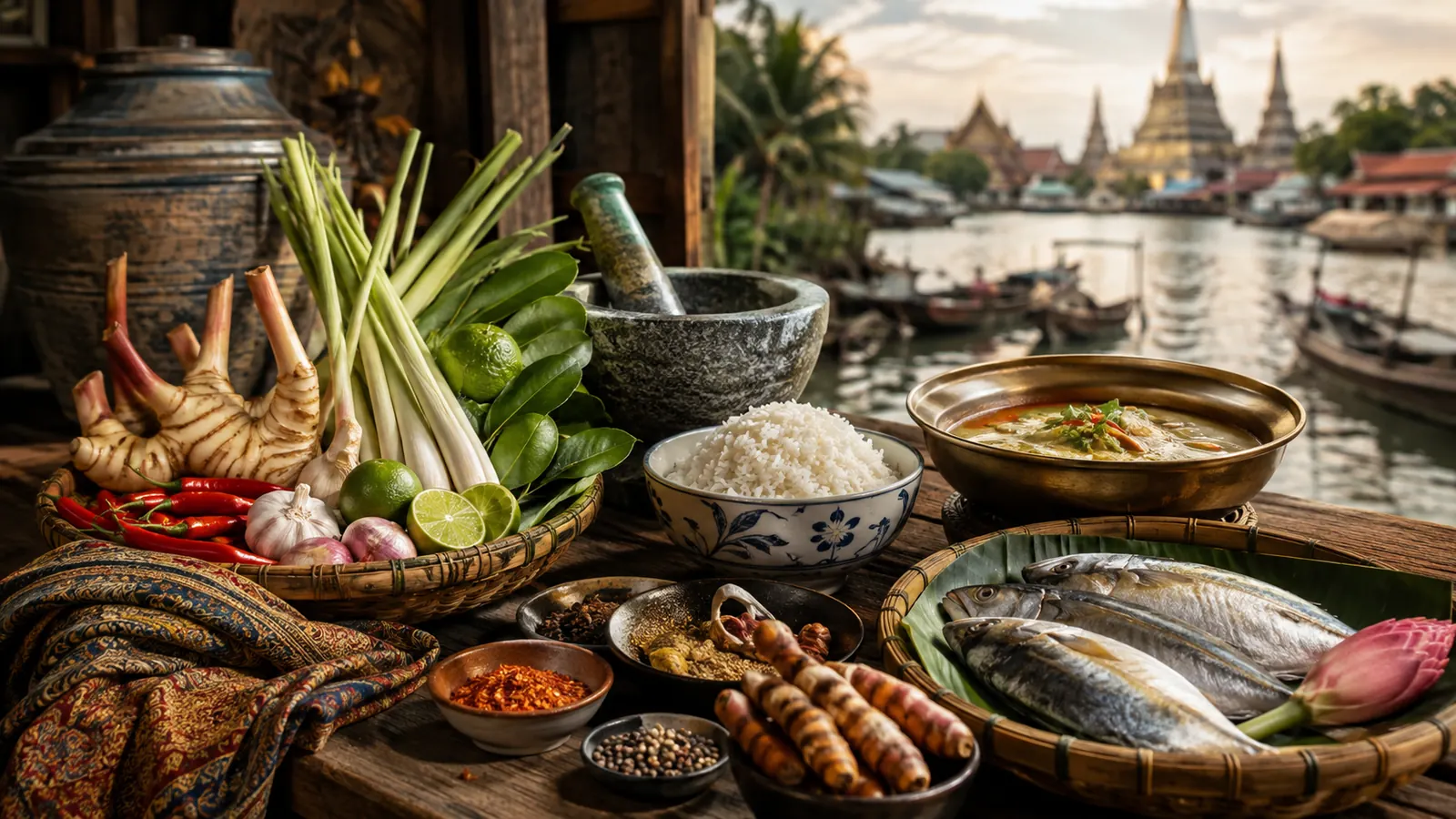
1. Thai Food Is Not One Recipe
Ask ten people what defines Thai food and you may get ten different answers.
One person will say chilli. Another will say fish sauce. Someone from Chiang Mai may think first of sticky rice, nam phrik and grilled sausage. Someone from Isan may think of pla ra, larb and som tam. A southerner may reach for turmeric, seafood and fiercely aromatic curry pastes. A Bangkok family may picture a table of central dishes shared around jasmine rice. A traveller might name pad Thai, green curry or tom yum.
All of them can be right.
That is the first thing to understand about the history of Thai food: there was never one original national cuisine waiting intact to be discovered.
Modern Thailand contains several regional food cultures, court traditions, household traditions, migrant influences and local specialities. Many developed long before the modern borders of the country were fixed. Others emerged as people moved, cities grew, new ingredients arrived and older techniques were adapted to new circumstances.
The word “Thai” therefore describes a culinary family rather than a single ancient recipe book.
What holds that family together is not purity. It is a recognisable way of working with ingredients, texture, aroma and contrast. Rice sits at the centre of much of the food culture. Fish, fermented seasonings, herbs, aromatics, vegetables and fruits have deep local histories. Meals are often composed so that different dishes complement one another rather than repeating the same flavour. And perhaps most importantly, Thai cooks have repeatedly shown an ability to take something encountered through trade, migration or neighbouring cultures and make it belong naturally within a Thai meal.
That process became one of the ways Thai cuisine grew.
The story begins long before restaurants, cookbooks or tourism campaigns — in the landscapes that fed communities around the Chao Phraya basin, the northern valleys, the Khorat Plateau, the southern peninsula and the waterways linking them to the wider world.
2. Rice, Water, Fish and the Local Foundation
Before discussing foreign influence, it is important to understand what was already here.
The ecological foundation of much of Thai food was shaped by water.
Central Thailand developed around river systems and floodplains suited to rice cultivation. Fish and other aquatic foods were abundant in rivers, canals, ponds and flooded fields. Vegetables, herbs and fruits could be gathered or cultivated in different seasons. Coconut, tamarind, citrus, galangal, lemongrass, garlic, shallots and many other ingredients became part of regional cooking traditions, although their importance varied from place to place.
Rice was more than a side dish. It was the organising centre of the meal.
In Thai, as in several neighbouring languages, the word khao can mean rice and appears throughout the vocabulary of eating. Different parts of the country developed different rice cultures. Central Thailand became strongly associated with non-glutinous rice, while sticky rice remained especially important in the North and Northeast. These patterns were shaped by ecology, agriculture, history and older regional relationships rather than a single national preference.
Fish was equally fundamental.
Foreign accounts from the Ayutthaya period repeatedly described Siam as rich in food. Research by Thai scholar Sukanya Sujachaya, drawing on records written by visitors to Ayutthaya, identifies rice and fish as the core of ordinary eating, accompanied by nam phrik-style preparations, fresh vegetables and abundant fruit.
This is a useful corrective to the modern assumption that Thai food has always been defined first by chilli-heavy curries.
The chilli had not even originated in Asia.
Long before it became one of the most visible ingredients in Thai cooking, heat could come from peppercorns, galangal and other pungent aromatics. Fermentation also mattered. Fish sauces, fermented fish preparations, shrimp paste and related techniques made it possible to preserve food, build savoury depth and extend the use of aquatic resources.
These were not primitive versions of later cuisine. They were sophisticated ways of cooking with the environment available.
The combination of rice, aquatic foods, herbs, vegetables, fermentation and shared dishes created a strong local framework. When new ingredients and techniques arrived later, they did not enter an empty kitchen.
They entered a food culture that already knew exactly how to make them useful.
3. Ayutthaya: A Port City With the World at Its Table
If there is one historical place that helps explain why Thai cuisine became so open to exchange, it is Ayutthaya.
From the fourteenth century until its fall in 1767, Ayutthaya developed into one of Asia’s major trading cities. Its commercial connections reached across the Indian Ocean and East Asia, linking Siam with China, Japan, Persia, South Asia, the Malay world and, later, European trading powers.
The city was not simply receiving occasional foreign visitors. It contained communities of merchants, officials, soldiers, religious figures and families from many backgrounds. Trade brought fabrics, ceramics, weapons and luxury goods, but it also brought ingredients, cooking ideas and new expectations about food.
Historical records give us rare glimpses of how lively that food environment was.
Sujachaya’s study of foreign descriptions of Ayutthaya notes that the city island had dozens of fresh markets — sixty-one are identified in the records she examined — operating through the day. Those same accounts mention shops selling sweets associated with Chinese and khaek communities, a broad historical Thai term that could refer to people connected with South Asian, Persian or Muslim worlds depending on context.
The detail is small, but the implication is enormous. People in Ayutthaya did not have to travel abroad to encounter foreign food. The world had come to the city.
That does not mean every dish immediately blended into one “fusion cuisine”. Communities maintained their own food traditions. Court kitchens developed differently from market stalls. Chinese, Muslim, Japanese, Portuguese and other residents could cook for themselves as well as for Siamese customers. Some techniques stayed within particular communities for generations before spreading more widely.
Exchange is rarely instant. But repeated contact changes what becomes familiar.
A spice that once signalled foreign food can become ordinary. A noodle can move from a migrant community into the daily diet of a city. A dessert technique can be adapted to local ingredients. A cooking method can become so natural that later generations no longer think of it as imported at all.
Ayutthaya’s importance to Thai food history lies precisely there. It created a setting in which local abundance and international contact could meet continuously for centuries.
4. Chinese Migration and the Everyday Kitchen
Chinese influence on Thai food did not arrive in one wave or through one single community.
Chinese merchants had been connected with Siam for centuries, and migration expanded significantly at different points during the Ayutthaya, Thonburi and Rattanakosin periods. By the nineteenth and early twentieth centuries, Chinese communities were deeply woven into the economic and urban life of Bangkok and many provincial towns.
Food travelled with them.
Noodles are the most obvious example. Several noodle words used in Thai have Chinese roots, and Chinese-style noodle traditions became deeply embedded in urban eating. Over time, Thailand developed an enormous range of its own noodle dishes — dry and soupy, stir-fried and dressed, mild and fiery, served from carts, shophouses and restaurants.
The result is a perfect example of culinary adaptation.
A bowl of noodles in Thailand may have a Chinese linguistic or technical ancestry without tasting like the same dish in Guangdong, Fujian or elsewhere in China. Broths changed. Garnishes changed. Condiments changed. Thai chillies, lime, fish sauce, sugar, herbs and local meat or seafood entered the equation. Regional preferences created further variations.
Stir-frying, soy-based seasonings, steamed buns, Chinese-style rice porridges and other foods also became familiar parts of the broader Thai culinary landscape.
But the most important Chinese contribution may be larger than any single ingredient. Chinese migrant communities helped shape the commercial food culture of Bangkok.
Research on Chinese restaurants in modern Thai history shows that Chinese food moved in more than one direction. Some dishes became integrated into everyday street and market food, while formal Chinese restaurants remained important social institutions for Chinese communities and also became meeting places connecting business and Thai elite society.
This is a useful reminder that “influence” does not mean disappearance. Chinese food could remain recognisably Chinese and, at the same time, help shape what people in Thailand ate every day.
That coexistence is central to the story of Thai cuisine. A cooking tradition can retain its own identity while particular techniques and dishes become so thoroughly at home in Thailand that they are simply part of the national food landscape.
5. Muslim, Persian and Indian Ocean Connections
Ayutthaya’s western trading routes brought another set of culinary relationships.
Persian and other Muslim merchants were present in Siam for centuries, and Iranian influence became particularly visible at the Ayutthaya court during parts of the seventeenth century. Historical scholarship documents Persian merchants and officials serving in important positions and participating in diplomatic, commercial and cultural exchange between Siam and the wider Islamic world.
Food formed part of that contact. Spice mixtures, fragrant rice dishes, dried spices, nuts, slow-cooked meats and Muslim dietary traditions entered the culinary environment of Siam through several routes — directly from Persian communities, through South Asia, through the Malay world and through other Muslim trading networks around the Indian Ocean.
It is tempting to turn this history into a neat family tree: Persia invented one Thai curry, India invented another, Siam copied them and the story is finished.
Real culinary history is rarely that tidy.
Massaman curry is the famous example. It clearly carries a Muslim and Indian Ocean history in its name, spice profile and older associations, and Persian connections to the Siamese court form part of the discussion around its development. But competing origin stories survive, and the evidence does not justify naming one individual as the undisputed inventor.
The more important point is what happened in Thailand. Dry spices associated with long-distance trade were combined with local aromatics. Coconut milk became part of some preparations. Sweet, salty, sour and fragrant elements were adjusted to local preferences. Dishes moved between court, Muslim households and wider society. What began within networks of contact eventually became recognisably part of Thai cuisine.
Southern Thailand tells a related but different story.
The peninsula has long connected mainland Southeast Asia with Malay, Indian Ocean and maritime trading worlds. Southern Thai food reflects those relationships alongside local forests, farms and seas. Muslim and Buddhist food cultures developed beside one another, while Malay, Chinese, Indian and Middle Eastern connections contributed to an especially diverse culinary region.
Calling these influences “foreign” can therefore be misleading when discussing communities that have lived in what is now Thailand for generations.
Their food is not an outside layer sitting on top of Thai culture. It is part of the history that made Thai culture what it is.
6. Portugal, the Chilli and New Ingredients
One ingredient demonstrates the speed with which a new arrival can become completely naturalised.
The chilli pepper originated in the Americas.
Capsicum species crossed the oceans after European contact with the Americas and spread extraordinarily quickly through existing trade networks. By the sixteenth century, chillies were moving through Africa, India and Southeast Asia.
Portugal played an important role in those maritime networks. Portuguese contact with Ayutthaya began in 1511, and a Portuguese community later settled near the capital.
For generations, popular histories have stated very confidently that Portuguese missionaries personally introduced chillies to Siam.
The broader direction is highly plausible: chillies reached Southeast Asia through Portuguese-linked and other maritime trading networks during the sixteenth century. But identifying the exact person, ship or year that first placed a chilli in a Siamese kitchen is much harder. Recent scholarship on the subject itself notes the absence of a surviving document that conclusively records that first introduction.
That uncertainty makes the story more interesting, not less.
Within a relatively short historical period, a plant from the Americas became so deeply embedded in Thai cooking that today it can feel almost impossible to imagine dishes such as many nam phrik preparations, curry pastes, som tam or tom yum without it.
Thailand did not merely adopt chilli. Thai cooks developed their own varieties, combinations, uses and ideas about heat. Chillies were pounded with local aromatics, eaten fresh, dried, fried, pickled, used in dips and turned into pastes. They joined older pungent ingredients rather than simply replacing them.
Portuguese contact also left other culinary traces.
Egg-yolk sweets are the best-known. Thai desserts such as foi thong, thong yip and thong yot are widely connected with Portuguese confectionery techniques that entered Siam during the Ayutthaya period and were adapted within royal and elite kitchens. Popular tradition often centres the story on Maria Guyomar de Pinha, the seventeenth-century woman of mixed Japanese, Portuguese and Bengali ancestry associated with the court of King Narai.
Her place in Thai culinary memory is important. But it is safer not to treat every Portuguese-derived sweet as the invention of one person.
What can be said confidently is that European techniques involving eggs and sugar were transformed in Siam using local ingredients, aesthetics and meanings. The “thong” or gold family of sweets became linked with auspicious occasions in a way that was distinctly Thai.
Once again, the pattern is adaptation rather than imitation.
7. Royal Kitchens, Household Knowledge and the Written Recipe
Not all Thai culinary development happened in markets or migrant communities.
Royal and aristocratic kitchens played an important role in refinement, documentation and presentation.
Court cooking could demand extraordinary attention to texture, aroma, appearance and ease of eating. Ingredients might be cut with precision. Bones, seeds and difficult skins could be removed before a dish reached the table. Fruits and vegetables were carved. Desserts were shaped, scented and coloured. Meals expressed hospitality, status and aesthetic discipline as much as flavour.
Foreign ideas entered the court as well.
During the nineteenth century, especially under King Chulalongkorn, Western dining practices, tableware and culinary techniques became more visible in elite settings. Research on the court of Rama V describes this not as a simple replacement of Thai practice, but as selective adaptation during a period when Siam was modernising its institutions and presenting itself confidently in international diplomacy.
The same era also changed how culinary knowledge was recorded.
For most of history, recipes were transmitted through practice — by watching, tasting and repeating. Quantities could be judged by experience rather than fixed measurements. Households, palace kitchens and professional cooks developed knowledge that lived in people rather than books.
Printed cookbooks began to alter that.
There is a small historical trap here. Mae Khrua Hua Pa by Lady Plian Phasakorawong is frequently called Thailand’s first cookbook, including in modern popular accounts. Yet academic work identifies an earlier published Thai cookbook, Tamra Kap Khao, first published in 1890.
The safest description is therefore that Lady Plian’s Mae Khrua Hua Pa, published in the early twentieth century, became one of the landmark early Thai cookbooks.
Its importance is difficult to overstate.
Lady Plian recorded techniques, ingredients and dishes in a systematic form at a moment when printing, education and domestic modernisation were changing Thai society. Measurements and written instructions helped turn knowledge previously dependent on direct apprenticeship into something readers could reproduce.
That did not freeze Thai food into one official form. Quite the opposite.
Once recipes could travel through print, they could move between households, regions and generations in new ways. Court food could become more accessible outside court circles. Home cooks could compare methods. New dishes could be recorded alongside old ones.
The written recipe became another tool through which Thai cuisine continued to evolve.
8. Four Regions — and Many More Local Kitchens
Any history of Thai food becomes distorted if Bangkok and the central region are allowed to stand for the whole country.
Thailand is often introduced through four broad regional cuisines: Central, Northern, Northeastern and Southern.
That framework is useful, but the borders between them are not culinary walls.
Northern food developed within the historical world of Lanna and along routes connecting communities with what are now Myanmar, Laos and southern China. Sticky rice is central, coconut milk is traditionally less dominant in savoury food than in many central dishes, and local herbs, forest ingredients, pork preparations, chilli dips and curries create a flavour profile distinct from Bangkok cooking.
Isan food reflects the Khorat Plateau and deep cultural relationships across the Mekong. Sticky rice, grilled foods, larb, som tam and fermented fish are important, but even within the Northeast there is considerable local and ethnic variety. The modern border between Thailand and Laos does not erase the older cultural landscapes from which these traditions developed.
Southern cuisine reflects an entirely different geography. The peninsula’s access to two seas, its forests, coconut-growing areas, spice routes and large Muslim communities contributed to foods rich in seafood, turmeric, herbs and intense curry pastes. Connections with Malay food cultures, Chinese communities and the Indian Ocean are part of the region’s identity rather than exceptions to it.
Central Thailand was shaped by the fertile Chao Phraya basin, royal courts, international trade and the extraordinary gravitational pull of Bangkok. Coconut milk, non-glutinous rice, elaborate curries, relishes and desserts became prominent in many central traditions. The capital also absorbed food from every other region as people moved there for work, education and opportunity.
Even these four categories cannot capture everything.
A dish from Chanthaburi may reflect coastal and Cambodian connections. A community in Mae Hong Son may have food traditions linked with Shan heritage. Muslim neighbourhoods along the Chao Phraya preserve recipes shaped by migration. Chinese-Thai families in Bangkok may cook dishes that belong simultaneously to family history and the wider Thai table.
Thai cuisine is therefore national without being uniform.
Its regional diversity is not something that needs to be smoothed away to make the cuisine more “authentic”.
The diversity is the authenticity.
9. Bangkok, Modern Life and the Food People Recognise Today
Bangkok changed Thai food because Bangkok changed Thailand.
After becoming the capital in 1782, the city grew into the country’s political, commercial and transport centre. Chinese migration expanded. Provincial communities arrived. Markets multiplied. Canals gave way increasingly to roads. Railways and later motor transport moved ingredients and people faster. Restaurants, shophouses, food carts and eventually department-store food courts created new places to eat away from home.
The modern Thai street-food landscape grew from this urban history.
It should not be reduced to one origin story. Chinese migrant commerce was important, but so were Thai markets, floating trade, temple communities, factory work, offices, schools, transport hubs and the simple need to feed a rapidly expanding city.
The twentieth century added another layer: the idea of a national cuisine.
As the modern Thai state developed, particular dishes became nationally recognisable beyond the regions in which they had first flourished. Print, radio, television, education, internal migration and tourism made it easier for people to encounter foods from elsewhere in the country.
Restaurants also changed what “Thai food” meant abroad.
From the late twentieth century onward, Thai restaurants expanded internationally. Government promotion in the early 2000s accelerated that visibility, but it did not create international Thai food from nothing. Migrants, restaurateurs, chefs and earlier overseas communities had already been carrying dishes abroad.
Global success inevitably simplified the picture.
A relatively small group of dishes — pad Thai, green curry, tom yum, massaman, satay, mango sticky rice — came to represent an entire national cuisine for many foreign diners.
That visibility was enormously valuable, but Thailand’s food culture has always been much larger than its export menu.
The interesting development today is that the picture is widening again. Regional Thai restaurants, specialist Isan cooking, northern dishes, southern curries, heritage recipes, modern Thai fine dining and new interpretations of street food are increasingly visible both inside Thailand and internationally.
The world first learned a convenient version of Thai food. It is now discovering how many Thailands were always inside it.
10. So What Makes Thai Food Thai?
After all these centuries of movement, the obvious question remains.
If noodles have Chinese histories, chillies came from the Americas, some sweets reflect Portuguese techniques, Muslim and Persian networks influenced parts of the court kitchen, and regional foods cross today’s national borders, what makes Thai food Thai?
The answer is not a list of ingredients. It is what generations of people in Thailand did with them.
Thai cooks selected what worked. They changed proportions. They substituted local ingredients. They combined dried spices with fresh aromatics. They adjusted sweetness, salt, sourness, bitterness, heat and fragrance. They fitted new dishes into the Thai structure of a shared meal. They gave foods new names, new meanings and new occasions. Families passed them down. Vendors made them practical. Court cooks refined them. Migrant communities kept their own traditions while also contributing to the wider table. Regional cooks continued to make food rooted in their own landscapes.
Eventually, origin became only one part of identity.
This is not unusual. Every great cuisine is the product of movement. Tomatoes transformed Italian food despite coming from the Americas. Potatoes reshaped European diets. Tea travelled across continents. What makes a cuisine distinctive is rarely that every ingredient originated inside a modern border.
What matters is the pattern of choices made over time.
Thailand’s pattern is especially rich because the country sat at the meeting point of mainland Southeast Asia, maritime trade and several powerful cultural worlds while maintaining its own political and culinary traditions.
That created a cuisine confident enough to absorb without disappearing.
The chilli became Thai because Thai cooks gave it a Thai life. Chinese noodles became part of Thailand because generations of vendors and diners turned them into Thai meals. Portuguese-derived egg sweets became Thai ceremonial desserts because their ingredients, appearance, names and social meanings changed here. Muslim and Indian Ocean influences became part of Thai curries and rice dishes because communities in Siam adapted them over generations. And regional food remains Thai without needing to become Bangkok food first.
This is why the search for a perfectly pure, untouched version of Thai cuisine misses the best part of the story.
Thai food became Thai through contact. Through memory. Through local ingredients. Through migration. Through the judgement of cooks deciding, meal after meal, what tasted right.
The result is not a cuisine diluted by the world.
It is a cuisine that made the world its own.