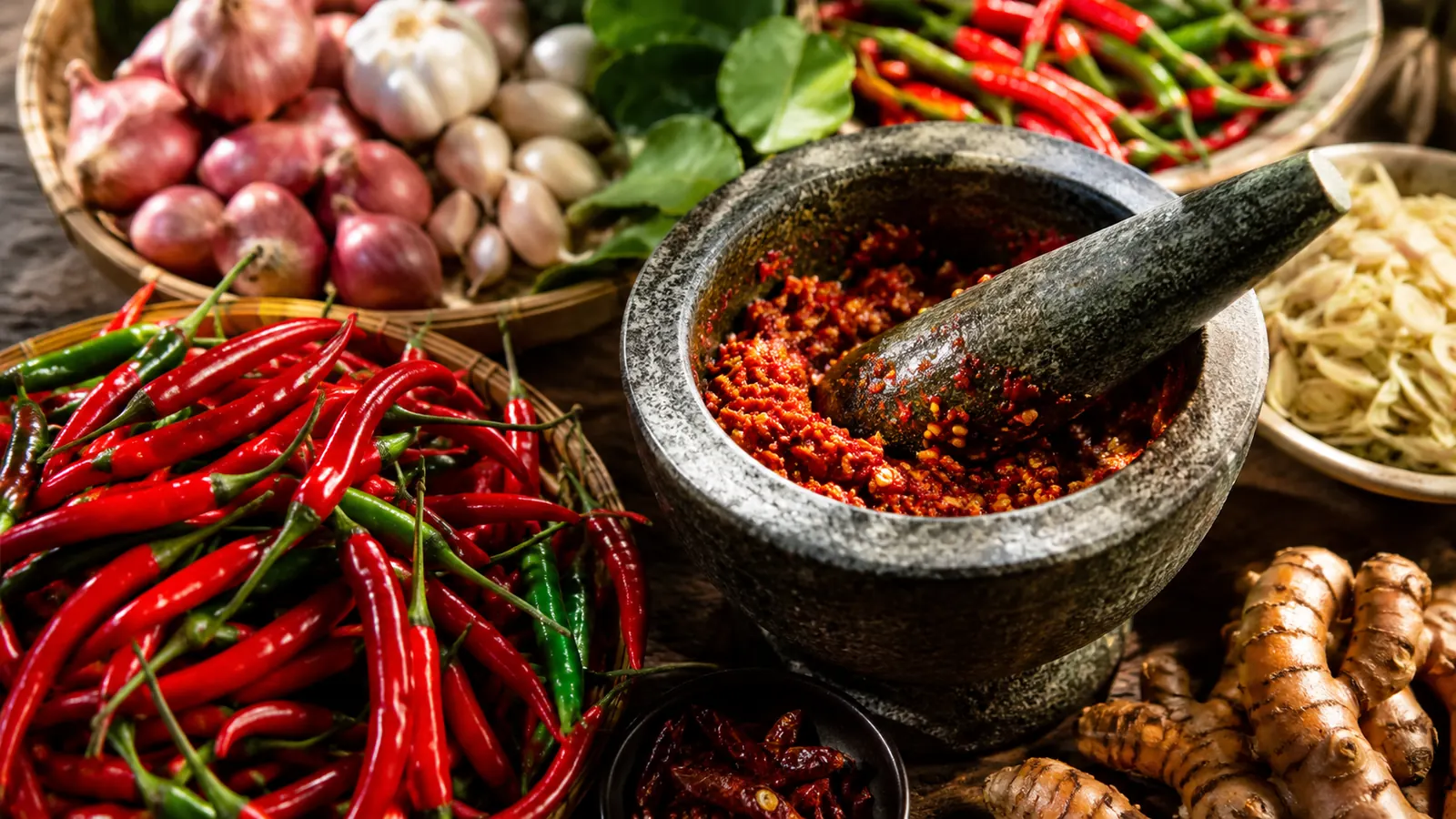
Few ingredients seem more inseparable from Thai food than chilli. It flashes red through a bowl of tom yum, perfumes curry paste, sharpens a spoonful of nam phrik, burns brightly through southern curries and gives som tam much of its famous energy. In markets across Thailand, chillies appear in every size and stage: green, red, fresh, dried, pounded, sliced, roasted and fried.
Yet the chilli plant did not originate in Southeast Asia. Capsicum belongs to the botanical world of the Americas, where people had been using and domesticating chillies for thousands of years before sustained contact with Europe and Asia began at the end of the fifteenth century.
That fact can easily be turned into the wrong kind of story. Thai cuisine did not simply receive a foreign ingredient and remain unchanged, and nor did chilli somehow create Thai food from nothing. Siam already possessed sophisticated food traditions built around rice, fish, fermented products, aromatic roots, herbs, sour fruits and older sources of pungency.
The more interesting story is what happened after Capsicum entered the connected trading world of the Indian Ocean and Southeast Asia. Thai cooks discovered an ingredient that grew well, could be used fresh or dried, worked beautifully in mortars and pastes, and could intensify dishes without erasing the flavours around it. Over generations, chillies were absorbed into very different regional cuisines and became part of the everyday vocabulary of Thai cooking.
Today they are a perfect example of how cuisines are made: not by remaining sealed from outside influence, but by selecting, adapting and transforming ingredients until they belong to a place.
1. Before Chilli, Thai Food Was Not Waiting for Heat
It is tempting to imagine pre-chilli Thai food as a mild version of modern Thai cuisine. That is too simple.
Long before Capsicum reached Asia, the region already knew pungent ingredients. Black pepper, Piper nigrum, had been traded around the Indian Ocean for centuries and was an important commercial spice in Siam. Other members of the pepper family, together with ginger, galangal, garlic, shallots and aromatic herbs, could create warmth, bite and fragrance in very different ways.
The historical vocabulary can itself be confusing. In Ayutthaya-era trade records, the Thai word phrik could refer to black pepper. Modern Thai distinguishes phrik thai, black or white pepper, from Capsicum chillies such as phrik khi nu or phrik chi fa, but older texts do not always offer that clarity, so a historical reference to "phrik" cannot automatically be treated as proof that a modern chilli was present.
The same caution applies to nam phrik. Simon de la Loubère, the French envoy who visited Siam in 1687, described a common sauce eaten with the Siamese meal when his account was published in 1691. His description included spices, garlic, onion-like aromatics and fermented shrimp paste. It is a valuable record of the long history of the nam phrik form, but it does not clearly identify Capsicum chilli.
That distinction matters because it reveals something more interesting than a date. Chilli entered a cuisine that already understood how to pound aromatics, combine salty fermented ingredients with fresh plants, and build contrast around a plate of rice, fish and vegetables. The new ingredient did not arrive in an empty kitchen. It entered a working culinary system.
2. A Plant From the Americas Enters a Global Trading World
All wild Capsicum species are native to the Americas. The domestication history is complex, and research continues to refine the map, but Capsicum annuum, today the world's most widely cultivated chilli species, was domesticated in what is now Mexico. Archaeological, genetic, ecological and linguistic evidence all point to a very long human relationship with chilli in Mesoamerica.
The global story changed dramatically after 1492. European voyages linked the Atlantic, Indian Ocean and Asian commercial worlds more tightly than before, moving plants as well as silver, textiles, ceramics, people and ideas.
Portuguese maritime networks became especially important in the early movement of Capsicum through the Indian Ocean. Portuguese-controlled and Portuguese-connected ports such as Goa and Malacca sat inside much older Asian trading systems, and from there chillies could travel through routes already used by Indian, Persian, Arab, Malay, Chinese and other merchants.
That is why the spread should not be imagined as a single European ship carrying chilli directly from the Americas to a Thai kitchen. Historical research on Capsicum's diffusion shows a much more complicated picture: Portuguese and Spanish networks helped move the plant between continents, but Asian merchants, farmers and consumers were crucial to its rapid spread after arrival.
Malacca is particularly important to the wider Southeast Asian context. After the Portuguese seizure of the port in 1511, it remained one of the great commercial junctions between the Indian Ocean and the South China Sea, with ships and merchants moving between the western coast of India, Ceylon, the Malay world, Siam, China and beyond.
Somewhere inside this mobile world, Capsicum reached the societies that would eventually make it fundamental to Southeast Asian cooking.
3. So When Did Chilli Actually Reach Siam?
This is where a good food history has to resist a satisfying answer.
Many popular accounts say the Portuguese introduced chilli to Siam in the sixteenth century. That is plausible: Portuguese contact with Ayutthaya began early in the sixteenth century, and Portuguese-linked networks certainly helped move American crops through Asia. But plausible is not the same as proven.
There is no securely established document that says, in effect, "this person introduced Capsicum to Siam in this year". Nor is there strong evidence for a single inventor, court figure or merchant who can be credited with transforming the Thai palate.
The written evidence is awkward. Foreign visitors to seventeenth-century Ayutthaya wrote about rice, fish, fermented foods, sauces, pepper and aromatics, but identifying Capsicum in those descriptions is difficult. La Loubère's nam phrik account is often repeated online as evidence for chilli, yet his published description does not explicitly name the American plant, and other seventeenth-century accounts also fail to provide the kind of unambiguous botanical reference historians would like.
One scholarly interpretation of Southeast Asian food history therefore suggests that chilli may not have become firmly established in Siamese cuisine until the eighteenth century. By the nineteenth century, however, foreign observers were describing the spicy sauces and foods of Siam much more clearly, and later Thai culinary texts leave no doubt that chillies had become deeply embedded.
The safest conclusion is therefore a range rather than a date. Capsicum entered the trading environment around Siam after the Columbian Exchange and was probably available through maritime networks during the Ayutthaya period, but the exact moment of introduction and the pace of its early culinary adoption remain uncertain.
That uncertainty is not a weakness in the story. It is a reminder that everyday food often spreads long before anyone thinks to document it carefully.
4. Why Chilli Fitted So Well
The speed with which chillies transformed cuisines across large parts of Asia was not accidental.
Capsicum offered practical advantages. It could be grown in warm climates, and different varieties could be harvested green or ripe. The fruit could be eaten fresh, dried for storage, crushed into flakes or powder, roasted, fried or pounded into paste, and a relatively small amount could have a dramatic sensory effect.
Its chemistry was also distinctive. Capsaicin and related compounds activate TRPV1 receptors involved in sensing heat, producing the familiar burning sensation even though the food itself does not need to be physically hot. That sensation is different from the pungency of black pepper, which comes largely from piperine.
For Thai cooks, however, chemistry was only the beginning. Chilli was useful because it could be made to behave differently in different dishes.
Fresh green chillies can taste sharp, vegetal and immediate. Ripe red chillies can add fruitiness as well as heat. Dried chillies develop another character and can contribute colour, aroma and depth to curry pastes. Roasting changes them again, and pounding chillies with garlic, shallots, shrimp paste, herbs or spices distributes their heat through a mixture rather than leaving it as a separate flavour.
Most importantly, chilli could join an existing Thai preference for combinations rather than acting alone. Heat could be balanced against sourness, saltiness, sweetness, bitterness, richness and fragrance. The result was not simply "hotter food". It was a new tool for constructing flavour.
5. Nam Phrik: An Old Form Learns New Tricks
Few parts of Thai cuisine show the process of adaptation better than nam phrik.
The broad idea of a pounded or mixed accompaniment eaten with rice, fish and vegetables has deep historical roots. The seventeenth-century description by La Loubère demonstrates that a recognisable sauce or dip occupied an important place at the Siamese table even when the exact ingredients of that version are difficult to map onto modern recipes.
Once Capsicum became established, it found an ideal home in this culinary form.
Modern nam phrik is not one recipe but an enormous family. Some versions are fresh and bright; others are roasted, fried, fermented, dry or almost relish-like. They can include shrimp paste, fermented fish, dried shrimp, garlic, shallots, tamarind, lime, local fruits, mushrooms, fish or meat. Chillies may provide the dominant heat, but their role depends on the whole mixture.
By the late nineteenth and early twentieth centuries, written Thai culinary sources clearly document this world. Mae Khrua Hua Pa, associated with Lady Plian Phasakorawong and published in book form in the early twentieth century after earlier serial publication, contains numerous recipes using dried chillies, phrik chi fa and small hot chillies. Its recipes show chilli not as a novelty but as a normal, differentiated ingredient: cooks selected particular kinds for particular effects.
That is a major historical shift. The important moment is not when a Capsicum seed first touched Siamese soil. It is when Thai cooks had developed enough familiarity to treat chillies as a family of ingredients with different culinary jobs.
6. From Curry Paste to Table Condiment
Chilli's integration went far beyond nam phrik.
The mortar is one of the places where the ingredient became thoroughly Thai in use. In curry pastes, dried or fresh chillies can be pounded with lemongrass, galangal, makrut lime peel, coriander root, garlic, shallots, shrimp paste and dry spices. The chilli contributes heat and often colour, but the paste works because the ingredients are processed together into a new aromatic whole.
Historical Thai cookbooks show dried chilli appearing alongside older aromatics and black pepper in curry preparations. This coexistence matters: the arrival of chilli did not cause earlier spices to disappear. Thai cooking layered new ingredients onto existing practices.
The same is true at the table. Sliced chillies can sit in fish sauce. Ground dried chilli can be offered with noodles. Fresh chillies can be pounded into salads. Roasted chilli pastes can introduce sweetness, smokiness and oil. Whole chillies can perfume soups without necessarily making them overwhelmingly hot.
This flexibility helps explain why talking about "Thai food being spicy" is both true and misleading.
Chilli is deeply important to Thai cuisine, but heat is not the goal of every dish. Some dishes are mild. Others use chilli for fragrance and colour more than aggression. Even in very hot dishes, the heat usually belongs to a broader balance.
Thai cooks did not merely discover how to make food burn. They discovered many different ways to make chilli useful.
7. One Country, Many Chilli Cultures
There is no single national level of chilli heat.
Thailand's regional cuisines developed under different ecological, cultural and historical conditions, and chillies became part of those cuisines in different ways.
In the North, many foods are comparatively restrained in chilli heat, but chilli dips remain fundamental. Nam phrik num, built around roasted green chillies, is a powerful example: its identity comes not from maximum heat but from the flavour created by roasting and pounding. Northern tables can use chilli alongside sticky rice, vegetables, pork, herbs and fermented ingredients in combinations distinct from central Thai cooking.
In Isan, chilli often works with sourness, herbs and fermented fish. Som tam, larb, jaew and many other dishes can carry considerable heat, but their character comes from the interaction of chilli with lime, tamarind, toasted rice, fish sauce or pla ra, fresh herbs and local ingredients. The chilli becomes part of a highly expressive regional grammar.
Central Thai cooking uses chillies across curries, nam phrik, soups, stir-fries and condiments, but it also contains many dishes where chilli is moderated by coconut, sweetness or other aromatics.
Southern Thai food is famous for assertive spice and heat, especially in curries and dry-fried pastes, yet even here the chilli is only one member of a larger aromatic system that may include turmeric, black pepper, lemongrass, galangal, shrimp paste and ingredients connected to the Malay Peninsula and Indian Ocean world.
Research on Thai regional food repeatedly shows these differences. The significance of chilli is national, but the way it is used is local.
8. Thailand Did Not Adopt One Chilli
"Chilli" sounds like a single ingredient. Thai markets make that illusion disappear.
Thailand cultivates and uses multiple Capsicum types, and even the everyday names do not always map neatly onto botanical species. Modern research has identified both Capsicum annuum and Capsicum frutescens among Thai cultivated chillies, while agricultural surveys show enormous variation in fruit size, colour, shape and pungency.
Small hot chillies grouped under names such as phrik khi nu are prized for intense heat. Longer chillies such as phrik chi fa can contribute colour, aroma and a different style of pungency. Milder large types such as phrik yuak or phrik num have their own regional and culinary uses.
Even within apparently similar groups there is substantial local variation. Thai agricultural research has collected hundreds of landrace accessions, while genetic studies show that folk names, appearance and formal species classification do not always line up perfectly.
That diversity is part of the story of naturalisation. Farmers selected plants suited to local conditions and markets. Cooks learned which chillies worked best fresh, dried, roasted or pounded. Consumers developed expectations around aroma, colour and heat.
An ingredient that arrived from another continent was no longer merely being imported. It was being grown, selected, named and differentiated within Thailand.
9. The Chilli in Everyday Thai Life
The strongest evidence that Thailand made chilli its own is not a famous court recipe or a disputed origin story. It is ordinary life.
Fresh markets pile chillies beside garlic, shallots, limes and herbs because they are daily ingredients. Home cooks adjust a nam phrik by adding another chilli or taking one away. Noodle customers season bowls with dried chilli to their own preference. Vendors know that two chillies of different varieties can produce very different results. Regional households maintain recipes whose balance would change completely if the wrong type were used.
Thai agricultural history reflects the same depth. Chilli became a major vegetable and spice crop, cultivated particularly across northern and northeastern production areas as well as elsewhere in the country, and researchers and plant breeders now work with Thai chilli germplasm as an agricultural resource in its own right.
Language also shows how embedded the ingredient has become. Thai names distinguish chillies by size, shape, colour, place, perceived resemblance and culinary use. The vocabulary is not that of a recent novelty. It is the vocabulary of long familiarity.
That familiarity should not be mistaken for timelessness. Chilli's American ancestry remains historically important. But origins and belonging are not opposites. A plant can come from elsewhere and still become inseparable from the culture that adopts it.
10. Made Thai Through Generations of Cooking
The history of chilli in Thailand is sometimes reduced to a surprising fact: chillies are from the Americas.
The surprise is real, but it is only the beginning.
Capsicum travelled into Asia through the extraordinary commercial transformations of the sixteenth and seventeenth centuries. Portuguese maritime activity was an important part of that movement, but the plant spread through wider Asian networks of merchants, farmers and ports. Exactly when it reached Siam and exactly when it became common in Siamese food cannot yet be pinned to one person or one year.
What can be seen much more clearly is the transformation that followed.
Thai cooks placed chilli inside older traditions of pounding, dipping, currying, fermenting and balancing flavours. Farmers cultivated different forms. Regional cuisines gave those chillies different roles. Written recipes eventually recorded a mature culinary vocabulary in which dried chillies, fresh chillies, large chillies and tiny hot chillies were no longer interchangeable novelties but purposeful ingredients.
Thailand did not need chilli in order to have a cuisine. It already had one.
What chilli offered was possibility.
Generations of Thai cooks turned that possibility into nam phrik, curry pastes, salads, soups, condiments and regional food traditions so deeply rooted that the ingredient now feels almost impossible to separate from Thai cooking.
That is what it means for a cuisine to make an ingredient its own.