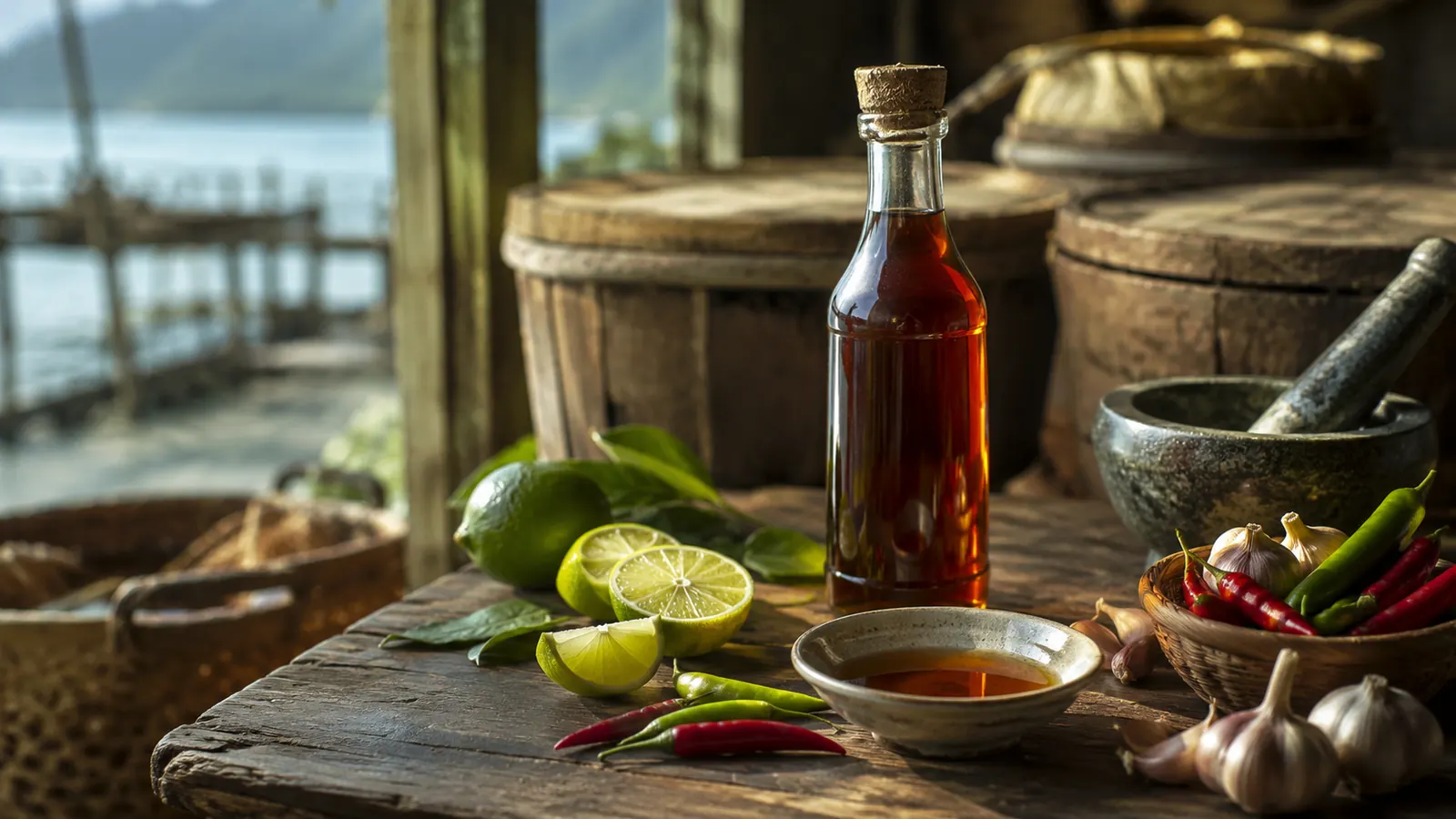
Fish sauce rarely arrives at the table with the drama of a curry, a bowl of tom yum or a plate of grilled seafood. It is more likely to appear as a bottle beside the stove, a spoonful disappearing into a wok, or a small dish of phrik nam pla placed within reach of everyone eating.
Yet few ingredients explain Thai food so efficiently.
Known in Thai as nam pla - literally "fish water" - fish sauce can provide saltiness, aroma and savoury depth at the same time. It seasons soups without making them taste simply salty. It can sharpen a stir-fry, deepen a curry, form the base of a dipping sauce or bring lime and chilli together in a table condiment. Often it does its work quietly. A diner may notice when it is missing before consciously noticing when it is there.
Its history is equally easy to oversimplify. Fermented fish has deep roots across Southeast Asia, and Thailand has many traditions built around preserving fish with salt. The modern bottled nam pla industry, however, has a more recent commercial history, connected to coastal fisheries, Chinese-Thai enterprise, regional trade and the growth of food manufacturing in the early twentieth century.
Those two histories belong together, but they are not the same story.
Fish sauce is therefore not best understood as an ingredient that suddenly appeared in Thailand on a particular date. It is part of a much older regional world of fish, salt and fermentation, while the clear amber liquid familiar from modern Thai kitchens took on its commercial form through a later period of adaptation and industrial growth.
That combination - old knowledge, new markets and generations of Thai culinary use - is what made nam pla the ingredient it is today.
1. Fish, Salt and Time
At its most basic, fish sauce begins with an extraordinarily simple idea: preserve fish with enough salt, then allow time to transform it.
In a traditional process, whole small fish or pieces of fish are mixed with a high proportion of salt and left to ferment for months. Modern Thai production commonly uses anchovies, although both marine and freshwater fish have been used in different places and periods. Thailand's Department of Fisheries describes traditional and small-scale production using fish-to-salt ratios ranging roughly from 2:1 to 5:1 by weight, with fermentation commonly lasting around 12 to 18 months for natural fish sauce production.
During that time the fish does not merely sit in brine. Enzymes naturally present in the fish, together with salt-tolerant microorganisms, break proteins down into smaller compounds including peptides and free amino acids. Among these are glutamic acid and other compounds associated with the savoury sensation now commonly described as umami.
The result is a liquid that can be powerfully salty but also much more complex than dissolved salt. Good fish sauce carries layers of aroma and a rounded savouriness created by fermentation itself.
This helps explain why nam pla is so useful in Thai cooking. A spoonful can perform several jobs at once: it seasons, but it also contributes fermented depth. In dishes where sourness, sweetness, chilli heat and aromatic herbs are already competing for attention, that depth can help pull the flavours together rather than simply making the food saltier.
The method also makes sense in the environments in which it developed. Southeast Asia has long combined abundant aquatic resources with salt production and climates in which fresh fish can spoil quickly. Archaeological and ethnographic research in Northeast Thailand has shown how closely salt, fish preservation and fermentation can be tied to landscape and everyday life. Where seasonal catches produced more fish than could be eaten immediately, salting and fermentation turned abundance into food that could last.
That is a practical technology - but over generations, practical technologies become cuisines.
2. A Southeast Asian World of Fermented Fish
Thailand's fish sauce belongs to a much wider family.
Across Southeast Asia, communities have developed fermented fish liquids, pastes and preserved fish products under many names and with many different techniques. Vietnam has nuoc mam. The Philippines has patis. Cambodia has a famous tradition of prahok. Laos and Northeast Thailand share closely related worlds of fermented freshwater fish. Southern Thailand and the Malay Peninsula have their own fermented fish traditions, including budu. Thai kitchens also use kapi, a fermented shrimp paste that performs a different culinary role.
The similarities can tempt food histories into looking for a single ancestor: one country invents fish sauce, another copies it, and the condiment moves neatly across a map.
The evidence is not that tidy.
Scholars of fermented fish products have instead described a broad East and Southeast Asian fermentation zone shaped by ecology, migration, trade and cultural exchange. Techniques could travel, but similar problems could also produce similar solutions. Fish, salt, heat, seasonality and the need for preservation existed in many places at once.
This is why comparisons with ancient Roman garum need care. Roman and Southeast Asian fish sauces demonstrate that salt-fermented fish liquids can emerge in very different culinary worlds. Their resemblance is fascinating, but resemblance does not by itself prove that Roman fish sauce travelled east and became nam pla.
The same caution applies within Asia. Chinese records contain ancient fermented fish preparations, while mainland Southeast Asia developed exceptionally rich fish-fermentation cultures of its own. Long-distance trade certainly connected these societies, but the history of a technique is rarely reducible to a single handover.
For Thailand, the stronger story is one of participation in a regional food world. People living around rivers, floodplains, coasts and rice fields had every reason to preserve fish, and different Thai regions then developed different fermented products, textures and culinary uses from that basic relationship between aquatic food and salt.
Modern nam pla is one branch of that much larger tree.
3. Before the Modern Bottle
One of the easiest mistakes in fish-sauce history is to treat modern bottled nam pla as if it represents every older Thai fermented-fish tradition.
It does not.
In Northeast Thailand, pla ra is a major culinary tradition in its own right. It is generally made from freshwater fish fermented with salt and commonly other ingredients such as rice bran or roasted rice. The finished product can retain fish solids and has its own flavour, texture and uses. It is central to many Isan dishes and closely connected to foodways across the Mekong region.
In southern Thailand, budu is another important fermented fish seasoning, particularly associated with Malay-influenced food cultures. Elsewhere, Thai cooks have long used kapi - fermented shrimp paste - in curry pastes, relishes and countless other preparations.
These products should not be arranged on an imaginary ladder in which a coarse fish paste eventually becomes a more "advanced" clear sauce. They are different answers to different culinary needs.
That distinction matters because older household fermentation and the later commercial fish-sauce industry overlap without being identical.
Thailand's Department of Fisheries describes fish sauce making as a long-established local practice using both freshwater and marine fish. In river and reservoir areas, small freshwater fish could be fermented in household or community production. Along the coast, marine fish - especially anchovies in modern high-quality production - supplied another raw material base.
Long before supermarket shelves standardised the appearance of nam pla, Thai food therefore already existed within a dense landscape of preserved fish, fermented seafood, salt, relishes and dipping condiments.
The modern bottle did not create that landscape. It entered it.
And once it did, it proved extraordinarily adaptable.
4. What the Old Written Sources Actually Tell Us
Written food history can be useful, but it can also create false certainty.
An ingredient may be eaten for generations before someone records it in a surviving cookbook. A familiar word may also change meaning over time. Fish sauce offers both problems.
A famous early-Rattanakosin literary phrase praises nam pla yipun - "Japanese fish sauce" - in a dish. It is tempting to read that phrase as proof that fish sauce exactly like modern nam pla was already established in Siam at that time. But scholars and food historians have disagreed over what the term referred to. One interpretation identifies it with Japanese soy sauce or shoyu; another argues that an actual Japanese fish-based seasoning remains possible. The safest conclusion is simply that the phrase is ambiguous.
A much clearer clue appears in Than Phu Ying Plian Phasakorawong's Mae Khrua Hua Pa, the great Siamese culinary work published in 1908. In at least one recipe, the ingredient list includes both nam pla yipun and nam pla dee - "good fish sauce" - as separate seasonings.
That distinction is important.
Whatever nam pla yipun meant, nam pla dee shows that the term nam pla was already being used in a Siamese culinary context before the dates usually given for the first modern fish-sauce factories.
It does not tell us when fish sauce was first made in Siam. It does not prove that the 1908 product was manufactured in exactly the same way as today's leading brands. And it does not settle the deeper origin of Thai fish sauce.
But it does rule out one very neat story: that a commercial producer in the 1910s or 1920s invented the very idea, the word and the culinary use of nam pla from nothing.
The historical record points instead to an existing food culture that would soon meet a new scale of production.
5. Chonburi and the Rise of Commercial Nam Pla
The clearest turning point in the modern history of Thai fish sauce comes on the eastern Gulf coast, especially around Chonburi.
Here the story becomes unusually specific - and unusually contradictory.
The family history published by Tiparos, one of Thailand's oldest major fish-sauce producers, says its founder Lai Chiang Sae Tang, a Chinese immigrant in Chonburi, began experimenting with fish and salt in 1913. According to the company, he compared different fish and found anchovies particularly suitable. As demand grew, he established the Tang Sang Hah fish-sauce factory at the Hokkien Pier in Chonburi in 1919.
A history of Thailand's modern food industry published by the National Science and Technology Development Agency repeats the 1913 experiments and 1919 factory date.
Yet another major source gives a different chronology. Naomichi Ishige and Kenneth Ruddle's extensive 1987 field study of Southeast Asian fermented fish products traced the beginning of commercial nam pla in Thailand to 1922 and linked the early industry to Teochew Chinese entrepreneurs in Chonburi, drawing on Vietnamese fish-sauce production as a commercial model.
These accounts cannot all be treated as the same exact date.
Rather than forcing them together, it is better to preserve the disagreement. What they strongly agree on is the larger transformation: in the early twentieth century, Chinese-Thai entrepreneurial networks in Chonburi helped turn fish sauce into a larger, organised commercial product. Coastal access supplied fish and salt. Trading communities supplied business knowledge, distribution networks and experience moving foods through markets.
Vietnamese nuoc mam was part of that commercial world, and Ishige and Ruddle recorded its importance to the emerging Thai industry. But that does not make modern Thai fish sauce simply "Vietnamese sauce with a Thai label". The 1908 cookbook evidence already complicates such a claim, while Thailand's own regional fish-fermentation traditions were much older than the factory era.
The more accurate picture is one of exchange and adaptation: established Southeast Asian fish-sauce knowledge, Chinese-Thai commerce, local coastal resources and Thai culinary demand coming together at industrial scale.
That is a much richer story than an invention myth.
6. From Coastal Industry to Everyday Ingredient
Once fish sauce could be produced reliably in larger quantities, its geography began to change.
A household fermentation is tied to a family, a village, a fishing season or a local market. A bottled commercial seasoning can travel by road, rail and ship. It can reach kitchens far from the coast, taste relatively consistent from one purchase to the next and become part of an expanding urban food economy.
Chonburi and neighbouring Rayong became particularly important production areas. Ishige and Ruddle's fieldwork in the 1980s found major concentrations of manufacturers along the Gulf coast, where fishing and salt-making supported the industry. Later Thai fisheries material also records commercial and community fish-sauce production in many other provinces, using both marine and freshwater species.
Industrial growth did not erase local food traditions. Isan cooks did not stop using pla ra because bottled nam pla became easy to buy. Southern fermented seafood traditions did not disappear. Instead, fish sauce joined a Thai pantry in which several fermented seasonings could coexist, each suited to particular dishes.
That coexistence is important when trying to understand why nam pla became so widespread. It was versatile.
Clear liquid was easy to measure and mix. It could disappear into soup, curry, stir-fry or dressing without changing the texture. It could also be served directly at the table. In restaurants, market stalls and home kitchens, a bottle could move between cooking and seasoning with almost no preparation.
By the late twentieth century, researchers studying Thai food consumption described fish sauce as a dominant everyday seasoning. Its importance was no longer confined to the coast that supplied much of the commercial product.
A regional preservation technique had become part of national everyday cooking.
7. What Happens Inside the Fermentation Vat
The transformation from fish to clear amber seasoning can look almost mysterious from outside the vat.
The science is more interesting than the mystery.
Fish proteins are large molecules. During long fermentation, enzymes break them into smaller peptides and amino acids. High salt levels suppress many organisms that would cause ordinary spoilage while allowing a specialised fermentation environment to develop. Research on Thai fish sauce has shown that the balance is delicate: fermentation that proceeds too quickly or under unsuitable conditions can produce undesirable aromas, while slow protein breakdown contributes to the characteristic flavour of a mature sauce.
Modern natural fermentation commonly lasts 12 to 18 months, although processes vary. After ageing, the liquid is separated from the fermented fish mass and filtered. Some traditional processes circulate the liquid back through the solids before final clarification, and a first extraction is generally richer than later extractions made by adding brine to the remaining fish material.
This is one reason quality grading matters.
Thailand has regulated fish sauce for decades, with industrial standards appearing by 1970 and later revisions, alongside Ministry of Public Health rules. Modern Thai regulations distinguish categories of fish sauce and set quality requirements, while the international Codex standard defines fish sauce as a translucent liquid product obtained from fermentation of fish or parts of fish with salt.
Chemistry also explains why the sauce tastes like more than salt water. Free amino acids build during fermentation, including glutamic and aspartic acids associated with savoury taste. Recent research has also shown that anchovies from different Thai coastal regions can produce different aroma profiles even when fermented under the same controlled conditions.
So the flavour of nam pla is not merely "fish plus salt".
It is fish species, fishing ground, salt ratio, enzymes, microorganisms, temperature, time, extraction and blending - a chain of decisions accumulated in a liquid that may finally be used one teaspoon at a time.
8. Why Thai Cooking Uses It So Well
Fish sauce became important not because every Thai dish tastes of fish sauce, but because it can become part of another flavour without announcing itself.
Consider phrik nam pla, one of the simplest condiments on a Thai table. At its core, fish sauce is combined with sliced chilli and often lime; garlic, shallot or other additions may appear depending on the cook. The fish sauce supplies salinity and savoury depth, lime brings acidity, and chilli brings heat and aroma. No single element needs to dominate.
The same principle works inside cooked dishes.
In a tom yam, fish sauce can support the broth beneath lime, herbs and chilli. In a curry, it can season coconut milk and curry paste while adding another fermented layer alongside ingredients such as shrimp paste. In stir-fries and fried rice, it can provide a quick savoury seasoning that integrates with wok aromas. In salads, it forms part of dressings where sour, salty, sweet and hot flavours meet.
This is why describing fish sauce only as "Thai salt" is helpful but incomplete.
Salt supplies saltiness. Fish sauce supplies saltiness plus compounds created through fermentation, and Thai cooks use both, choosing according to the flavour and texture required.
Nor does nam pla make a dish "more authentically Thai" simply by being added. Thailand has vegetarian traditions, regional dishes built around other fermented seasonings, recipes seasoned primarily with salt, and Thai-Chinese dishes in which soy-based sauces play major roles.
The point is not universality.
It is range.
Few ingredients can move so naturally from a clear soup to a dipping sauce, from a curry to a wok, from a home kitchen to a street stall and from a coastal factory to almost every part of the country.
9. Nam Pla, Pla Ra, Budu and Kapi Are Not the Same Story
The success of bottled fish sauce can make Thailand's fermentation landscape look simpler than it really is.
It is worth resisting that simplification.
Nam pla is a liquid fish sauce. Pla ra is a fermented fish product in which solids remain important and whose flavour is fundamental to Isan and Lao-linked foodways. Budu is a southern fermented fish sauce associated especially with Malay cultural regions. Kapi is made from shrimp rather than fish and has its own history, production methods and culinary roles.
All involve preservation and fermentation, but they are not interchangeable labels for one substance.
They also remind us that "Thai cuisine" has never been a single pantry used identically from Chiang Rai to Narathiwat. Coastal ecology, river systems, migration, religion, trade and local agriculture all shaped what people preserved and how they seasoned food.
Commercial nam pla became national partly because it could cross those boundaries. But its rise did not flatten them.
A cook in Bangkok may keep fish sauce, soy sauce and shrimp paste in the same kitchen. A cook in Ubon Ratchathani may use both nam pla and pla ra, depending on the dish. A southern kitchen may combine fish sauce with kapi or budu traditions that carry very different local identities.
Thailand did not arrive at one fermented seasoning.
It developed a vocabulary of them.
Understanding fish sauce properly means seeing it as one exceptionally successful member of that wider family.
10. The Ingredient Thailand Made Its Own
In the early 2010s, nam pla Thai - Thai fish sauce - was placed on Thailand's national inventory of intangible cultural heritage in the category of knowledge and practices concerning nature and the universe. The recognition is fitting because the ingredient contains much more than a recipe.
It contains knowledge of fish and seasons, salt and preservation, fermentation and time. It contains coastal industries and inland household practices. It contains trading communities and entrepreneurs who expanded production. It contains cooks who learned exactly how much to add to a broth, dressing or curry without measuring it on a laboratory scale.
And its history demonstrates why food origins are often better understood as processes than as moments.
Fermented fish is ancient in Southeast Asia. Thailand's own fermented-fish traditions are diverse and long established. Written Siamese culinary evidence shows nam pla terminology before the modern factory era. Then, in the early twentieth century, Chinese-Thai entrepreneurs on the eastern coast helped build a commercial industry whose precise first date is disputed but whose importance is not.
From there, the bottle travelled.
Thai cooks did what cooks always do with a useful ingredient: they found the places where it worked. It became part of soups, curries, salads, stir-fries, relishes and table condiments. It entered recipes so naturally that it can now seem timeless.
That does not mean its history is simple.
It means the integration was successful.
Fish sauce is a product of preservation knowledge, regional exchange, commercial adaptation and generations of culinary judgement. Its ingredients may be humble - fish, salt and time - but the food culture built around them is anything but.
A bottle of nam pla is therefore more than a shortcut to saltiness.
It is one of the quiet ways Thai food carries its history into almost every meal.