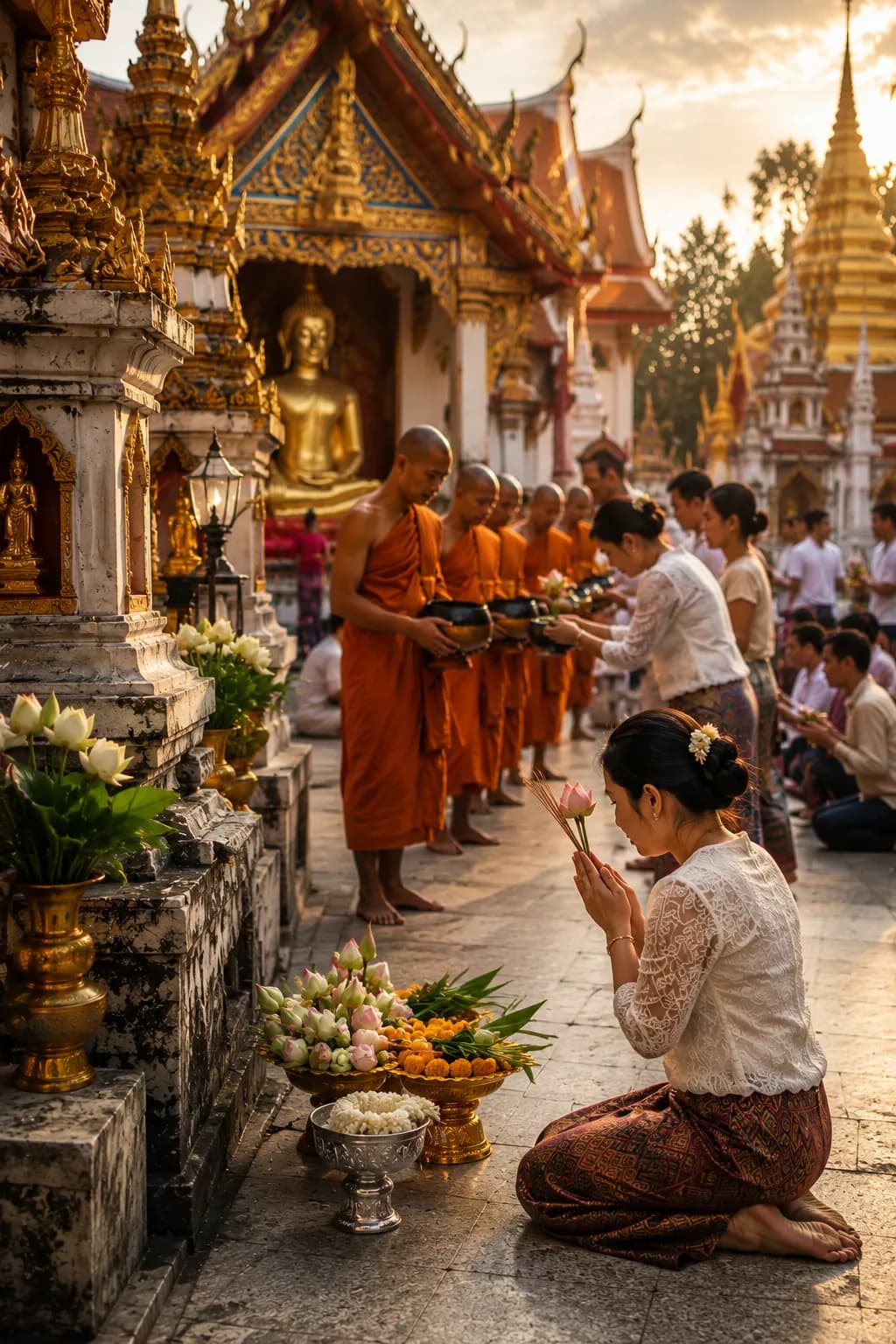
Buddhism in Thailand becomes visible long before you reach a famous temple such as Wat Pho. A monk walks past a convenience store at dawn. A woman waits outside her shop with food for the alms round. A family spends a birthday morning at a temple. A funeral takes place inside a neighbourhood wat. A document carries a Buddhist Era date. A young man temporarily ordains. Buddhism appears in ordinary Thai life because it is not confined to spectacular temples. At the same time, religion does not explain everything Thai people do. Understanding both sides is the key.
The Religion You Can See
Buddhism is unusually visible in Thailand. Monks wear distinctive robes, while temples occupy prominent places in cities and villages. Religious holidays affect national schedules. Buddha images appear in public and private spaces. That visibility can create the false impression that everyone is constantly engaged in religious practice. Thailand is a modern society where people work, commute, shop, scroll through social media and worry about bills. Buddhism operates inside that ordinary life rather than replacing it.
For many communities, the wat is more than a place for private worship. It may host funerals, ordinations, festivals and ordinary merit-making. Some temples support education or community activities. The wat can therefore function as both sacred institution and social infrastructure. Its importance varies with place. In a dense Bangkok neighbourhood, residents may have weaker ties to one specific temple. In a village, the local wat can remain deeply woven into community identity. Both realities exist comfortably within modern Thailand.
Monks in Public Life
Monks are one of the clearest signs of Buddhism outside temple walls. You see them on buses, walking through markets, visiting hospitals or receiving alms in the morning. Their presence is treated differently from ordinary civilian life. Public transport may have designated seats. People make space, while women avoid physical contact because of monastic discipline. These habits reveal religion through social behaviour. Nobody needs to announce “Buddhism is now happening.” The robe is enough.
The morning alms round is one of the most direct connections between religion and daily routine. A layperson offers food, the monk accepts it and the entire encounter may last only seconds. Yet it contains an entire religious relationship. The monastic community depends on lay support. The layperson practises generosity and makes merit. The ritual happens in ordinary streets before offices and shops have fully opened. Ancient monastic practice enters modern urban life without requiring a special festival.
Merit-Making
The Thai phrase tham bun, making merit, appears constantly. People make merit on birthdays. Families make merit for relatives who died. Temple donations and food offerings become part of important events. The idea connects Buddhist ethics with social life. Generosity can be religiously meaningful while also strengthening family and community relationships. A family temple visit can therefore be both Buddhist practice and family time. Trying to decide which motive is “the real one” misses how religion usually works.
Not every Thai birthday begins at a temple, but some do. A person may offer food to monks or make a donation as part of the day. This provides a useful contrast with birthday culture built entirely around receiving. The religious act points outward: do something generous, make merit and then celebrate. Modern Thai birthdays can include cake, social media and a temple visit without anyone finding the combination unusual. Tradition and modern consumer life easily share one day.
Ordination
Temporary male ordination remains another important point where Buddhism enters family life. When a son or relative ordains, the event can involve a large network of people. Family members organise ceremonies and friends attend. The ordination is understood as religiously meaningful for more than the person entering the monastery. Even families that are not intensely observant may take the event seriously. Monkhood can therefore be both a personal religious commitment and a family milestone.
Buddhism becomes especially visible around death. Thai Buddhist funerals commonly involve monks, chanting, merit-making and cremation. The temple becomes a place where grief, family and religious teaching meet. A person who rarely visits a wat during ordinary life may spend days there when a parent dies. This does not make the religion superficial. Important institutions often become most visible at moments of crisis. Funerals show how Buddhism helps structure experiences that ordinary daily routines cannot easily handle.
Calendars
Thailand commonly uses the Buddhist Era year in official and everyday Thai contexts. The familiar conversion for modern dates is 543 years ahead of the Gregorian year. So 2026 CE corresponds to 2569 BE. This means Buddhism appears even in numbers. A date on a document can carry the history of a religious calendar without anyone consciously thinking about theology. International business still uses Gregorian dates extensively. Thai life moves between the systems. Most Thai people do this far more easily than first-time foreigners.
Major Buddhist observances shape national time. Makha Bucha, Visakha Bucha, Asalha Bucha and Khao Phansa can affect public holidays and temple activity. Families may make merit, monks give sermons and evening candle processions take place. Some current laws restrict alcohol sales on major Buddhist days. Religion therefore affects both sacred practice and ordinary commercial routines. A traveller who does not know the calendar may experience only the practical side: the bank is closed or the bar cannot sell beer. Behind that inconvenience is a religious day.
The Wai Is Not Buddhist
This is where cultural explanations can become lazy. Thailand’s wai is often associated with respect, and monks receive particular forms of deference. That does not make the wai itself a Buddhist practice. Thai etiquette developed through multiple social and historical influences. Buddhism contributed to ideas about hierarchy, merit and respect, but it does not explain every gesture. The same caution applies to many aspects of Thai behaviour: religion matters, but it is never the only cause.
Visitors sometimes learn the concept kreng jai—a sensitivity to imposing on others—and immediately explain it through Buddhism. That explanation is too narrow because social values also develop through family structure, hierarchy, community norms and history. Buddhist teachings about restraint or compassion may reinforce certain behaviours. They do not create an entire national personality. A Thai person can be conflict-avoidant for the same reasons anyone else is: personality, workplace politics or simple exhaustion. Culture is context, not destiny.
Generosity
Buddhist emphasis on giving helps make generosity an important religious virtue. Food offerings to monks are the clearest example. Temple donations reinforce the same principle. Buddhism therefore cannot be credited as the cause of every generous act in Thailand. Family upbringing and ordinary human kindness matter too. The better conclusion is that Buddhism provides a respected moral language for generosity. It reinforces practices that can have many other motivations. That is how religion often shapes culture: not by creating behaviour from nothing, but by giving behaviour meaning.
Buddhism teaches impermanence: everything conditioned changes. Visitors sometimes use that teaching to explain the Thai phrase mai pen rai or a relaxed attitude toward problems. There can be overlap in the wider cultural environment. But saying “Thai people do not worry because Buddhism teaches impermanence” is fantasy. Thai people worry perfectly well. They worry about money, family, work, relationships and the future like everyone else. Religious ideas may provide ways of coping. They do not abolish human emotion.
Spirits and Everyday Religion
Everyday Thai religious life also includes practices that are not straightforward Theravada doctrine. Spirit houses stand outside businesses. People seek lucky numbers, while Brahmanic shrines attract devotees. Buddhist identity coexists with these practices. This layering helps explain why Buddhism’s influence should never be measured only by doctrinal purity. People live religion through inherited practices. The borders that matter to scholars may be much less important at home.
Walk from a shrine into a luxury mall and you have not left Thai culture. Modern Thailand comfortably contains Buddhism and intense consumerism. A person can make merit in the morning and spend the afternoon buying a new phone. This is not unique hypocrisy. Religious societies everywhere combine spiritual ideals with ordinary material desire. Buddhism itself recognises attachment precisely because humans experience it. Thailand does not need to look monastic in order to remain Buddhist.
Social Media Buddhism
Monks use smartphones, Dhamma teachings circulate online, temple events are promoted through social media and donations can move digitally. Young people encounter Buddhist content through the same devices used for entertainment. Technology changes the delivery system. It does not automatically determine the meaning. A Pali chant streamed through a phone is still a chant. A digital donation can still express generosity. Religious traditions survive partly because they learn how to inhabit new technologies.
Younger Thai people may relate differently to Buddhist institutions than older generations. Some question hierarchy, others prefer meditation to ceremony, and many participate selectively. Older generations were never uniform either. Religious change should therefore be described as shifting patterns rather than a dramatic story of young people abandoning tradition. Some practices weaken while others revive in new forms. That is what living religions do.
Buddhism Does Not Explain Thailand
This may be the most important section of the entire article. Buddhism has shaped Thailand deeply, influencing kingship, education, calendars, art, ethics and community institutions. But it does not explain the whole country. Thai culture also developed through regional identities, migration, Chinese influence, global capitalism, monarchy, politics, family structures and contact with neighbouring societies. A person’s behaviour cannot be reverse-engineered from religion alone.
“Because Buddhism” is not an explanation. It is the beginning of a question. Buddhism helps explain the public visibility of monks, the importance of temples, merit-making at major life events, the family meaning of temporary ordination, the Buddhist holiday cycle, Buddhist Era dates and the role of monks at funerals. These are concrete institutions and practices. That is where religion explains Thailand most reliably.
Tradition Meets TikTok
Modern Thailand does not choose between ancient tradition and digital life; it uses both. A temple can be hundreds of years old and appear in a livestream. A monk can teach impermanence while a teenager records the sermon on a smartphone. A family can order food through an app before leaving for a merit-making ceremony. This mixture is not evidence that tradition has failed. It is what tradition looks like when people continue living.
The most revealing Buddhist moments in Thailand are not always the giant Buddha, the royal temple or the spectacular candle festival. Sometimes it is a woman handing a bag of rice to a monk before work. A family quietly making merit after a death. A young man shaving his head before ordination. A neighbourhood wat preparing for a funeral. These small moments show how religion survives: not as constant ceremony, but as part of the structure of ordinary life.