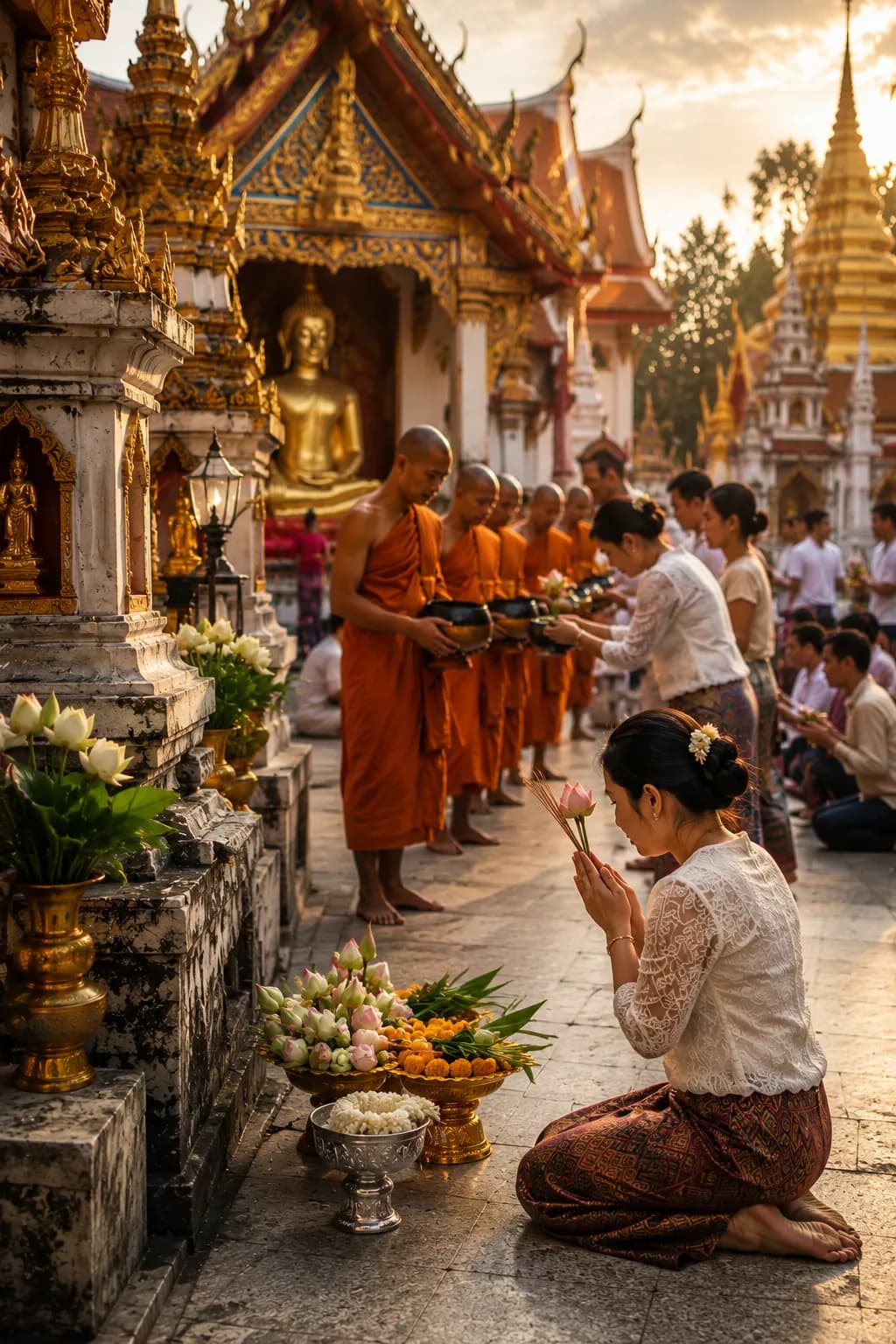
Death is one of the moments when Buddhism becomes most visible in Thai family life. Monks chant, relatives make merit and food is shared. The body may remain at a temple for several days before cremation. People come and go, sometimes in black, sometimes in white, sometimes speaking quietly and sometimes laughing over memories. To an outsider, the mixture can feel surprising. A Thai Buddhist funeral is neither one national script nor a uniformly solemn event. It is a religious and social process shaped by Buddhism, family custom, local tradition and the practical realities of grief.
There Is No Single Thai Funeral
Thailand is too diverse for one universal funeral format. Practices vary between regions, families and communities. A village funeral in Isaan can look different from a middle-class Bangkok funeral. A high-profile royal cremation belongs to another world again. The length of ceremonies varies. The number of monks and the local customs around them vary as well. Travel guides sometimes mistake one observed funeral for a national template, but practice varies too widely for that. There are recurring Buddhist themes.
Buddhism begins from the reality that everything conditioned changes. Bodies age, relationships end and death remains unavoidable. The teaching of impermanence does not make death unimportant. It gives death a context. Attachment produces suffering because people desperately want unstable things to remain stable. A funeral therefore sits naturally within Buddhist reflection. The loss is real even as the tradition reminds mourners that no life was ever permanent. That is not a command to stop grieving. It is a framework for understanding why grief exists.
Karma and Rebirth
Traditional Theravada Buddhism views death within a cycle of rebirth. Karma influences the conditions of future existence. The ultimate Buddhist goal is liberation from that cycle. For ordinary practitioners, ideas about future rebirth may provide one way of thinking about what happens after death. Belief varies, with some Thai people holding these ideas strongly and others relating to them more culturally. Others relate to them more culturally. A funeral ceremony can therefore carry religious meaning even among relatives with different levels of personal faith. Families rarely conduct theological interviews before grieving together.
One of the most important features of Thai Buddhist funerals is merit-making. Relatives perform wholesome acts and dedicate merit to the person who has died. Offerings to monks, temple donations and chanting can all become part of that process. The idea gives mourners something active to do. Merit-making gives mourners an active religious response to loss. The family responds through generosity and religious practice. Whatever philosophical explanation someone gives for merit transfer, the emotional logic is easy to understand. Love continues by doing something good in the person’s memory.
Monks and Chanting
Monks commonly participate in Thai Buddhist funerals. They chant Pali texts and receive offerings from the family. The chanting can sound solemn and repetitive to someone unfamiliar with the language. Its meaning is not limited to translating every sentence. The presence of the Sangha connects the death to Buddhist teaching and to a long ritual tradition. Senior relatives may understand parts of the chants. Others may experience the sound as inseparable from funerals even without understanding every word. Religious memory often lives in sound before it lives in explanation.
Many Thai Buddhist funerals take place at temples. A wat can contain dedicated funeral halls and a crematorium in addition to ordinary religious buildings. This can surprise tourists who think of a temple only as a place with Buddha images and ornate roofs. In Thailand, the wat often accompanies the entire life cycle. Ordination, merit-making and funerals all take place there. The temple functions as a community institution as well as a monument. It is an institution through which communities manage some of life’s most important transitions.
Several Days of Ceremony
Funerals may extend over several days. Monks can chant in the evenings. Relatives receive visitors, food is provided, and people may arrive after work and leave later. The schedule depends on family circumstances and local tradition. For this reason, it is better to avoid statements such as “a Thai funeral lasts three days.” A funeral might last three days, or it might not; prominent figures can have ceremonies lasting far longer. Other families choose simpler arrangements. Religion provides a framework that families adapt to their own circumstances.
Cremation is common in Thai Buddhist funerals. Many temples have crematoria, often housed in distinctive buildings. The cremation may become the final major public ceremony. Monks chant while family members and guests participate in farewell rituals. Flowers or symbolic items may be placed in connection with the coffin. The atmosphere can be intensely emotional. It can also contain moments of ordinary conversation. People do not remain frozen in grief every second. A funeral remains a human gathering, with all the emotional variety that implies.
Why Cremation?
Cremation fits comfortably with Buddhist ideas about impermanence and the body. Yet it should not be described as a universal Buddhist requirement. Practices differ across Buddhist cultures and particular circumstances. In Thailand, cremation became the dominant norm for many Buddhist communities. That cultural normality matters more to most families than abstract theological arguments about disposal of the body. The ceremony marks separation as the body returns to its elements and the family continues.
After cremation, families may handle ashes and bone remains according to local custom and personal preference. Some remains may be kept in a temple structure while others are dispersed according to family preference. Different families make different choices. This is not an area where visitors need a detailed ritual manual. If you are part of a funeral, follow the family. Religious etiquette becomes much easier when you stop trying to lead a ceremony you did not grow up with.
Spirit Beliefs
Thai funeral practices may also include ideas that are not straightforward Theravada doctrine. Beliefs about spirits, the presence of the deceased or protective rituals can appear alongside Buddhist chanting and merit-making. Families do not necessarily experience those layers as contradictory. Thai religious culture has long combined Buddhist frameworks with local spirit traditions. Death is exactly the kind of moment when several layers of belief can become visible at once. The safest description is not “Buddhists believe the spirit does X.” It is that popular beliefs around death vary and can coexist with Buddhist ritual.
Foreign visitors can be surprised by laughter at Thai funerals. People talk, food is served and relatives who have not met for months reconnect. Some funeral gatherings feel highly social outside the formal chanting periods. The social atmosphere should never be mistaken for an absence of grief. Human grief contains more than one emotion. A funeral can be sad and social. People can laugh at a memory ten minutes after crying. Thai families are not uniquely detached from death. They are human in exactly the same complicated way as everyone else.
Buddhism Does Not Eliminate Grief
A persistent stereotype says Buddhists accept death calmly because they understand impermanence. The idea sounds wise, but it places an unfair burden on real people. Knowing that everything changes does not make losing a parent painless. Monks themselves can grieve and families cry; Buddhist teachings provide language and ritual without cancelling the emotion. They do not turn mourners into philosophers untouched by emotion. Any article about Thai funerals should respect that distinction.
Dress expectations vary, but dark or subdued clothing is common at many modern Thai funerals. White also has traditional associations with mourning and religious observance. If you are invited, ask the person who invited you. They know the family and context. A royal or highly formal funeral can have specific protocols. An ordinary community funeral may be much more flexible. Generic internet etiquette loses quickly against direct family guidance.
What to Do at a Funeral
If you attend a Thai Buddhist funeral, you are not expected to understand every ritual. Follow the people you came with. Sit where indicated, keep your phone quiet and do not photograph mourners without permission. When monks chant, remain respectful. If guests participate in an offering or farewell ritual, wait and observe until you understand what is happening. Nobody needs you to improvise Buddhism. What matters most is being present without trying to perform expertise.
Guests may contribute to funeral expenses or make donations depending on local and family custom. The practice varies between families and communities. The appropriate contribution depends on family and context. If you are unsure, ask a trusted Thai friend or the person who invited you. This is exactly the sort of situation where a fixed “Thailand funeral price” would be culturally clumsy. Relationships and context matter more than a number.
Funerals and Community
A funeral reveals the social role of the Thai temple. Neighbours help, relatives return, monks participate, food is prepared and people contribute money or labour. The event surrounds one family with a temporary community. That social support can be just as important as the formal ritual. Buddhism provides the structure, while the community gives it life. Visitors often ask where Thai Buddhists believe the dead person has gone.
Traditional Theravada cosmology includes multiple realms of rebirth shaped by karma. Popular Thai religion adds other images and spirit beliefs. Individual belief still varies considerably. There is therefore no honest one-sentence answer. The Buddhist goal ultimately points beyond rebirth entirely. But ordinary funeral practice focuses less on mapping the afterlife than on making merit, remembering the person and moving through loss. That may be the most important thing to understand.
What the Funeral Is Doing
A Thai Buddhist funeral does several things at once. It honours the person who died. It gives family and community time to gather. It creates opportunities for merit-making. It brings monks and Buddhist teachings into the experience of loss. And through cremation or other final rites, it helps the family accept that a physical life has ended. Religion does not remove the pain. It gives the pain a form. That is why funerals remain one of the clearest places to see Buddhism functioning not as an abstract philosophy, but as part of everyday human life in Thailand.