A City of Ruins That Was Once Alive
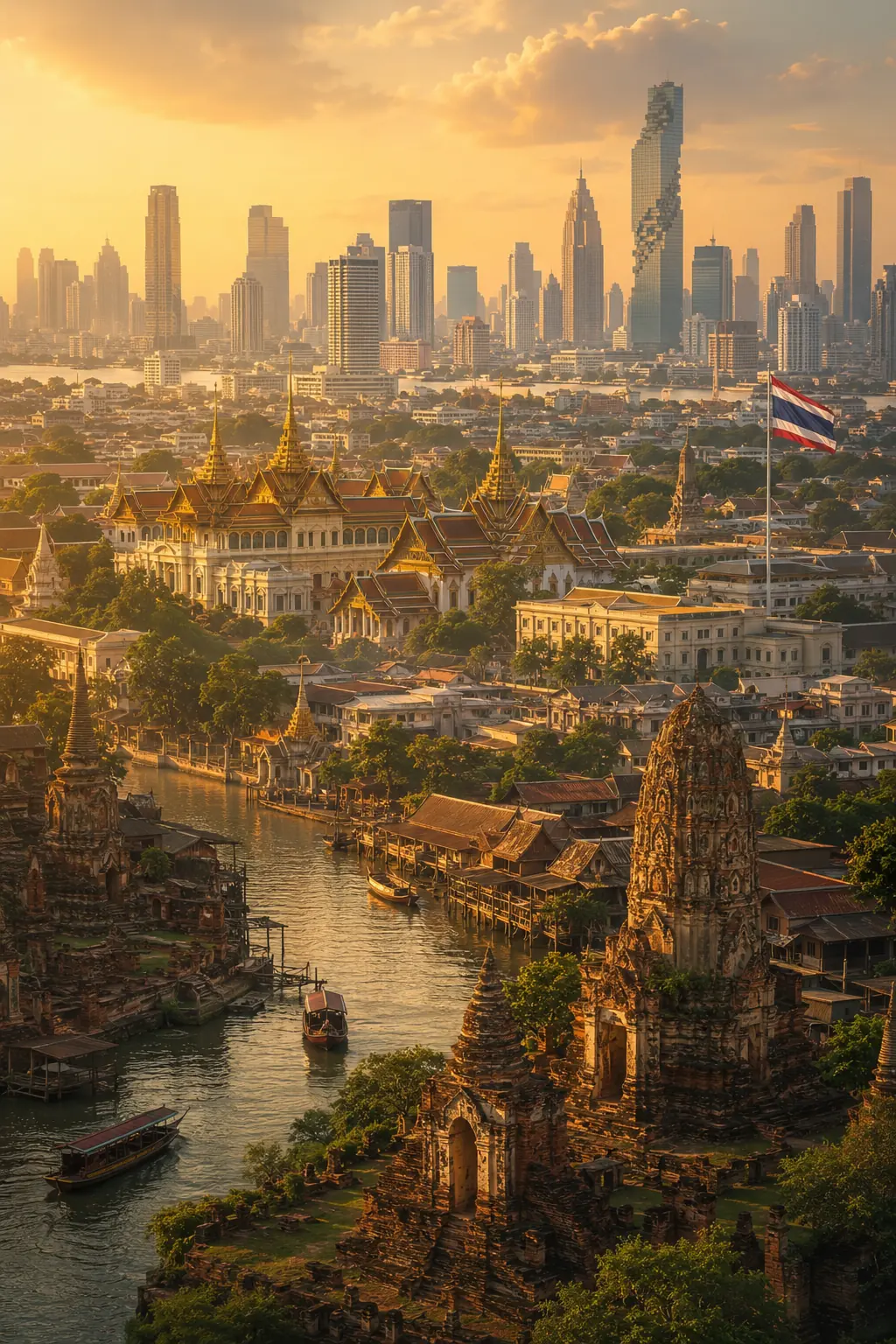
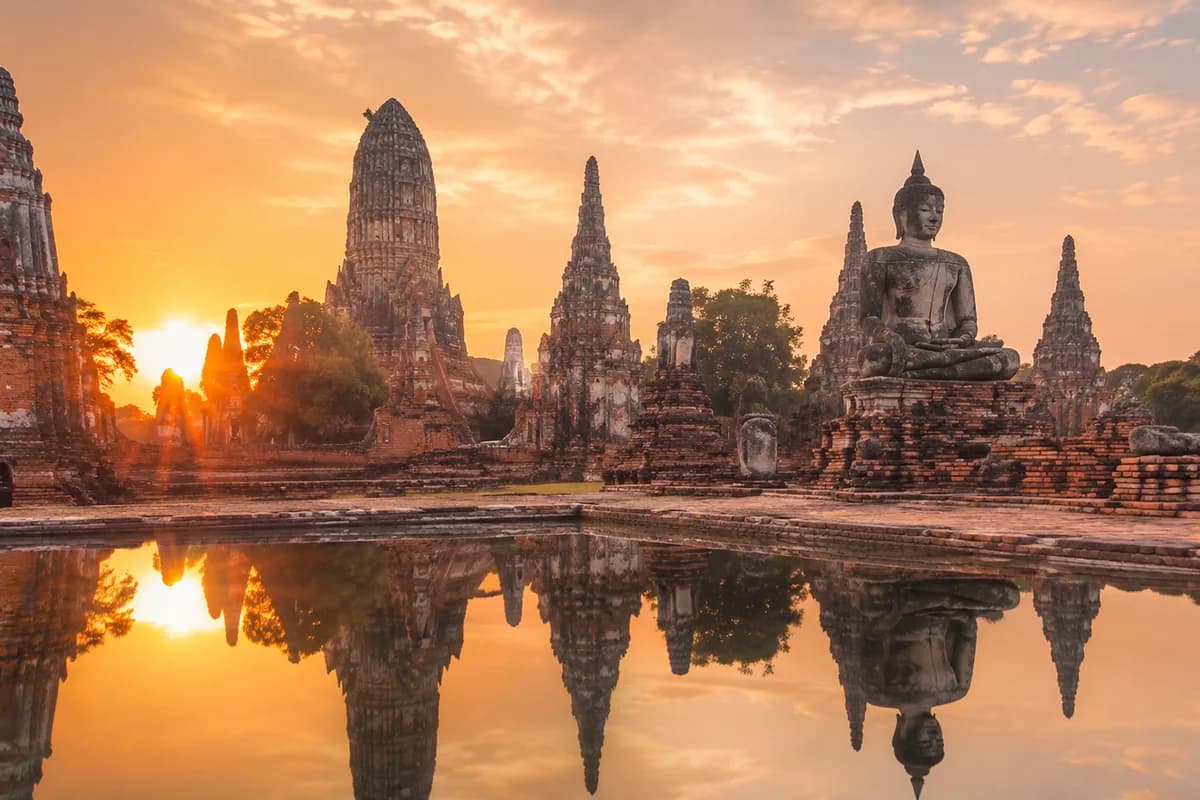
Today, Ayutthaya is a landscape of ruins — brick towers rising above open grass, headless Buddha images sitting quietly beneath trees, collapsed monasteries standing beside modern roads and shops. It can be genuinely difficult to picture what this place once was. For more than four centuries, Ayutthaya was the capital of one of Southeast Asia's most powerful kingdoms: a royal city, a Buddhist capital, a military centre, and an international trading hub where merchants and diplomats from across Asia, the Middle East and Europe regularly met. Then, in 1767, it was destroyed. Bangkok eventually replaced it as capital. But Ayutthaya never really disappeared — much of what became Siam, and eventually modern Thailand, was shaped inside its walls first.
Built Around Water
Ayutthaya was founded around 1350, and its location was chosen with real strategic intelligence. The city developed where major waterways met — the Chao Phraya, Lopburi and Pa Sak river systems converging around it — giving it access to transport, trade, agriculture and defence all at once, along with a clear route toward the Gulf of Thailand. In an age before railways or highways, rivers were the country's most important roads, and Ayutthaya was built directly into that network from the start.
Its foundation is traditionally associated with King U Thong, later known as King Ramathibodi I, though historians continue to debate some of the details surrounding both his origins and the exact circumstances of the city's founding. What's clear is that the kingdom built around Ayutthaya grew steadily more powerful through diplomacy, warfare, marriage alliances and control of regional trade networks — and it emerged into a region that was already far from empty. Central Thailand had long been home to Mon, Khmer and Tai-speaking communities and older political centres, and Ayutthaya inherited traditions from several directions rather than starting from nothing.
Thai national history often presents Sukhothai as the kingdom preceding Ayutthaya in a clean, sequential way, but the real transition was gradual rather than a simple handover — Sukhothai continued to exist while Ayutthaya expanded, and by the 15th century much of the former Sukhothai sphere had been absorbed into Ayutthaya's growing power. (Our short history of Thailand covers this earlier period in more depth.)
A World Without Fixed Borders
Ayutthaya wasn't a modern nation-state with permanently drawn borders. Power in premodern Southeast Asia typically worked through overlapping networks of allegiance rather than hard territorial lines — a pattern historians sometimes describe using the term "mandala," in which influence radiated outward from important centres, growing weaker with distance, and smaller cities could shift their loyalty between competing centres of power over time. Ayutthaya became extremely successful inside this system, building a network of influence that eventually reached across much of the territory now associated with modern Thailand, without ever functioning like a country with fixed edges on a map.
To the east lay the Khmer world historically centred on Angkor, and the relationship between Ayutthaya and Khmer power was never simply one of conflict. Ayutthaya fought Khmer states at various points, and also absorbed Khmer court traditions, vocabulary, architecture and concepts of kingship in the process — war and cultural exchange happened simultaneously rather than as separate chapters. Ayutthaya's forces campaigned toward Angkor during the 15th century as the regional balance of power shifted, and as the old Angkorian order weakened, people, craftsmen and court practices moved between centres; Ayutthaya grew not by staying culturally pure, but by absorbing whatever proved useful from its rivals, defeated or otherwise.
Court, Hierarchy and Buddhism
Ayutthaya's kings ruled through an elaborate court in which language, ceremony and formal systems of rank reinforced a strict social hierarchy, commonly associated with the concept of sakdina — a system of numerical ranks connected to status and administrative position, more complicated in practice than the land-unit numbers sometimes used to describe it, but consistently reflecting a society where hierarchy was formally built into the political order rather than merely implied. The king stood at the centre of this world, but effective rule still depended on nobles, provincial leaders, military commanders and powerful families around him — a court defined as much by political competition as by ceremony.
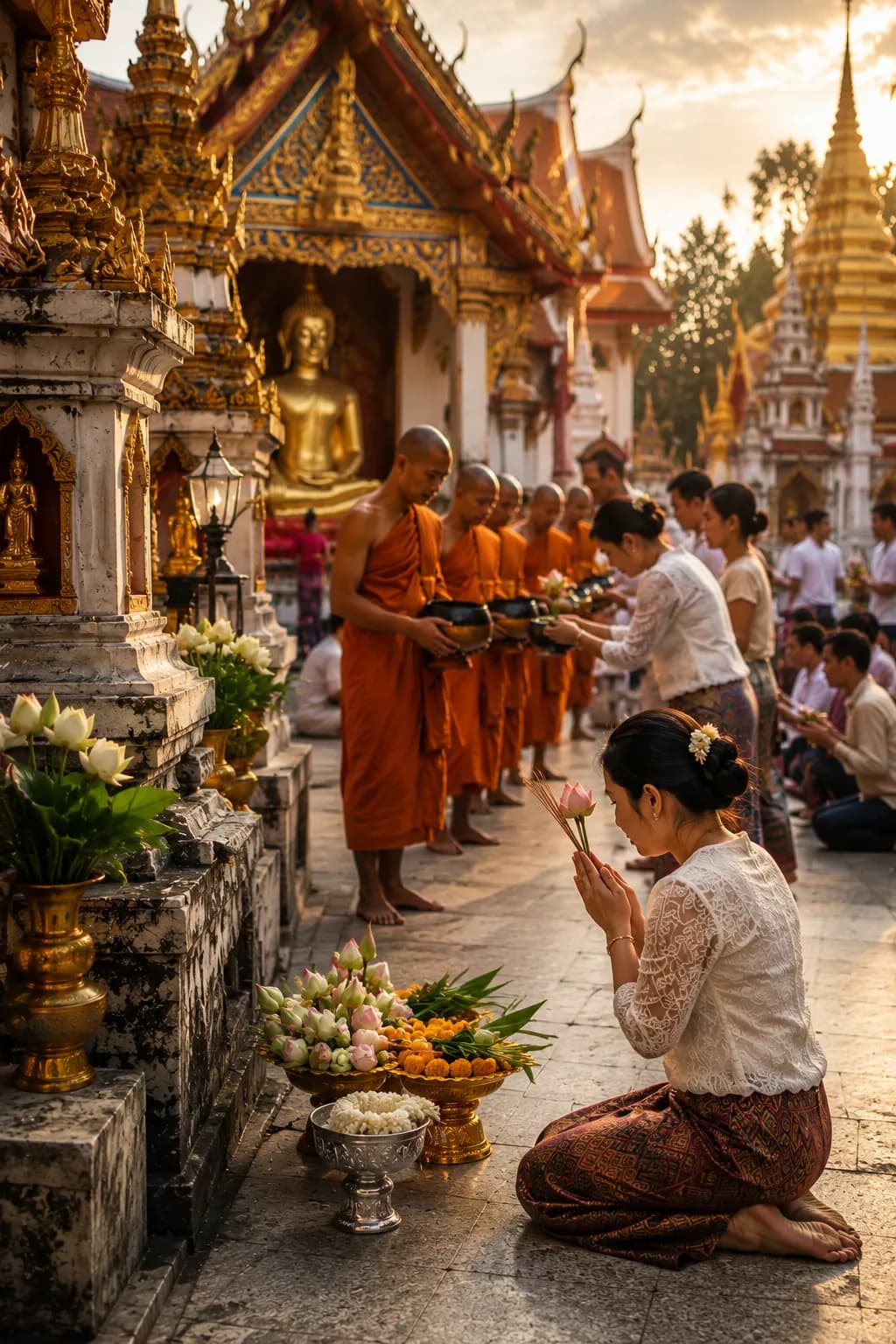
Theravada Buddhism became central to Ayutthaya's identity almost from the beginning. Kings sponsored monasteries, temples received land and royal support, and monks formed an important religious and educational community across the kingdom. Building a great temple communicated more than personal faith — it signalled royal legitimacy, wealth and power all at once, which is part of why the temple ruins that survive today are so monumental: they were built to project authority as much as to express devotion. (Our guide to Buddhism in Thailand explores this deeper relationship between religion and royal power.) Wat Phra Si Sanphet, standing within the old palace area, functioned as one of the most important royal temples in Ayutthaya, and its three large chedis remain among the city's most recognisable monuments — though in the Ayutthaya period they belonged to a far denser royal and ceremonial landscape than the open, empty space they now occupy. The old royal palace itself has largely disappeared, its structures damaged after the city's fall and later reused as construction material elsewhere, which is one reason visitors today encounter monumental temples far more easily than they encounter the full royal architecture that once surrounded them.
Wat Mahathat, one of Ayutthaya's great religious centres, is today famous internationally for something considerably smaller than its ruined main prang: a stone Buddha head, resting in the roots of a tree that gradually grew around it after the city's destruction and abandonment. The exact story of how the head came to rest there isn't fully certain, but it has become one of the most photographed scenes in Thailand — and it's worth remembering, when visiting, that it remains a sacred image rather than simply a striking photo opportunity; posing with your own head positioned directly above it is generally discouraged. Wat Ratchaburana, built in the 15th century, is associated with a royal succession struggle involving princes who died fighting for the throne, and its large central prang remains one of Ayutthaya's most impressive surviving structures — a physical reminder that succession in Ayutthaya could be genuinely dangerous, since the kingdom never operated under the automatic succession rules familiar from some European monarchies. Brothers, sons, uncles and senior princes, backed by military and court alliances, could all compete for power, and while strong kings stabilised the kingdom through these transitions, weak ones could expose it to real internal and external pressure.
An International City Long Before Modern Tourism
By its height in the 17th and early 18th centuries, Ayutthaya stood at the centre of an extraordinarily cosmopolitan kingdom. Chinese, Japanese, Persian, Indian, Malay, Portuguese, Dutch, French and English communities all had a presence in or around the city, generally settled in designated foreign quarters with their own religious institutions, homes and commercial networks — a map of old Ayutthaya would show mosques and churches alongside its Buddhist temples, evidence of genuine religious diversity built up around international trade even as Thai Buddhist kingship remained overwhelmingly dominant. (Our guide to Thailand and the farang traces this long relationship with foreign visitors from Ayutthaya through to the present day.)
Geography made this possible: the city sat far enough inland to gain some protection from direct seaborne attack, while remaining connected by river to the Gulf, so ships and goods could move between international maritime trade routes and the capital itself. Chinese trade networks, already well established in the region before Europeans arrived, connected Ayutthaya to one of Asia's largest economic systems, and that relationship carried directly into later Bangkok history. The Portuguese were among the earliest Europeans to establish formal relations, arriving in the early 16th century and eventually forming a settled community near the capital. Ayutthaya also held a significant Japanese community during the early 17th century, its most famous figure being Yamada Nagamasa, who entered Siamese service and became genuinely influential in court and military affairs — a reminder that the city's international character wasn't dominated by Europe at all. Persian merchants and officials held real influence at court too, connecting Siam westward through Muslim trading networks toward India and the wider Indian Ocean world, not only eastward toward China.
Relations with France reached a particularly dramatic high point during the reign of King Narai in the 17th century, when French diplomats and missionaries arrived in Siam and Siamese embassies travelled in the opposite direction — King Louis XIV famously received a Siamese embassy at Versailles, briefly placing Ayutthaya inside the diplomatic theatre of early modern Europe itself. Narai's court included one especially remarkable foreign figure, Constantine Phaulkon, a Greek-born adventurer who rose to extraordinary influence in Siamese service as an intermediary in foreign affairs, before political upheaval following Narai's death in 1688 led to his execution. That same upheaval saw growing unease among powerful Siamese factions about foreign influence at court, particularly French involvement; French military forces withdrew afterward, though foreign trade itself continued much as before. Ayutthaya never actually closed itself off from the world — the era of unusually close French political involvement simply ended.
Life Behind the Splendour
Ayutthaya was wealthy, but that wealth wasn't evenly shared. Most people lived within a strongly hierarchical society structured around manpower obligations that tied individuals to patrons and the state, and forms of slavery existed too — people could become enslaved through debt, birth or war captivity, in a system that differed from Atlantic plantation slavery but was still, unambiguously, a system of unfree labour. Those later Siamese reforms that gradually abolished slavery didn't arrive until the modernisation of the 19th and early 20th centuries. The spectacular temples that survive today were built inside a social world considerably harsher than the peaceful ruins might suggest.
Much of ordinary Ayutthaya, meanwhile, simply didn't survive to be excavated. Most homes were built from wood rather than brick — practical in a hot, flood-prone river environment, and easily raised above ground — which means archaeology preserves the sacred, elite parts of the city far more clearly than everyday life. The Ayutthaya visitors encounter today is inevitably biased toward what was built to last, a city of temples and ruins standing in for what was once a much larger, mostly wooden metropolis of markets, boats and canal-facing homes, its population estimated by some accounts to have reached around a million at its peak — a figure historians treat cautiously, though there's little doubt the city was very large and wealthy by the standards of its era.
The Final War
Ayutthaya had fallen once before, in 1569, becoming subordinate to Burmese power for a period before King Naresuan restored its independence and became one of the most celebrated warrior-kings in Thai national memory — his campaigns, including a famous royal elephant duel against a Burmese crown prince whose precise details remain debated by historians, are still deeply embedded in popular culture, monuments and school history. But 1767 proved to be the final crisis. The Burmese Konbaung dynasty grew into a major military force during the 18th century, and as war intensified through the 1760s, Burmese forces invaded from multiple directions, gradually isolating and then besieging the capital. After a long siege, facing shortages and immense pressure, the city fell in April 1767. The destruction was catastrophic — homes lost, families displaced, and the political and religious institutions of the kingdom collapsed almost overnight. It's worth resisting the temptation to romanticise the ruins purely as picturesque: what looks peaceful and atmospheric today, with sunlight hitting broken chedis and trees growing through brick, was, at the time, an outright catastrophe for the people living through it.
The Survival That Followed
This may be the single most important part of the story: Ayutthaya's destruction was not the end of Siamese civilisation. Within years, the kingdom had reorganised — first under King Taksin at Thonburi, then under the newly founded Chakri dynasty at Bangkok from 1782. Political leadership changed, the capital moved twice in quick succession, and yet many of the kingdom's institutions and cultural traditions carried straight through. (Our guide to the history of Bangkok picks up exactly where this story leaves off.) Look carefully at Bangkok today and Ayutthaya reappears constantly — in royal traditions, temple architecture, court culture, historical memory, and the enduring political importance of the Chao Phraya River itself. Some building materials from the ruined old capital were even physically transported south and reused in the new one. Bangkok was built after Ayutthaya, but it was also, in a very real sense, built from it.
Visiting the Ruins Today
Ayutthaya's historic park rewards more time than the standard Bangkok day trip usually allows; staying overnight lets you see the temples once the crowds have thinned and experience the modern town that has grown up around the ruins. The train from Bangkok remains one of the classic ways to arrive, and it makes a certain historical sense too — travelling north through the central plain follows roughly the same geographic relationship that has connected the two cities for centuries. The relatively flat terrain makes cycling a popular way to explore the historic park, though the heat can be more demanding than it first appears; carrying water and starting early matters more than any sense of stamina.
Many of the sites are active religious spaces as much as archaeological ruins, so dress and behaviour expectations vary by location — treat Buddha images with respect, don't climb where signs prohibit it, and remember that centuries-old monuments don't need to double as gym equipment or a backdrop for a risky photo. Visitors also frequently notice how many Buddha statues across the site are missing their heads. War damage explains some of this; looting and the international trade in stolen art objects explains a great deal more, since Buddha heads became genuinely desirable items on foreign art markets over the centuries following the city's fall. Removing even a small fragment from an archaeological site remains a serious offence and, frankly, an act of disrespect toward what the site represents — a brick is never simply a souvenir.
Why Ayutthaya Still Matters
Ayutthaya explains a great deal about how Siam became a major regional power, how deeply the kingdom was connected internationally long before modern tourism existed, and why rivers mattered so much to Thai political history. It explains where many of Bangkok's royal traditions actually originated, why Buddhism and state power became so tightly bound together in Thai political culture, and why Bangkok exists exactly where it does today. Standing among the ruins, it's worth trying to imagine past the modern silence — the bells, markets, boats, foreign languages, royal processions and crowded wooden neighbourhoods that once filled a skyline dense with temple towers. Ayutthaya wasn't created as a ruin. It was, for more than four centuries — longer than many modern states have existed at all — a living capital, generations of people born knowing no other. That is precisely what makes its disappearance carry so much weight, and why the ruins deserve to be understood as one chapter of a story that moved south, rather than as the end of one.