A City People Think They Already Know
Pattaya is one of those places visitors believe they understand before they even arrive: beach, bars, Walking Street, hotels, condominiums, tour buses, nightlife. That version is real — but it's only the most recent layer of a much longer story. Pattaya wasn't purpose-built as a tourist city from the outset. Its transformation happened remarkably fast, especially across the second half of the 20th century, as a fairly modest stretch of Chonburi coastline became connected to military activity, international tourism, Bangkok's expanding economy and, eventually, the global travel industry. Few places in Thailand demonstrate the sheer power of tourism as clearly as this one does.
Before the Resort City
The coastline that became modern Pattaya was historically home to small fishing, agricultural and trading communities. Naklua, to the north, grew up around fishing and salt-related work, and other small settlements stretched along the coast toward what later became central Pattaya and Jomtien. None of this was cut off from the rest of Siam — Chonburi had long been part of the eastern seaboard connecting Bangkok with coastal settlements further east — but there was nothing resembling the vast international tourism economy visible today. The name Pattaya itself predates the tourism boom; one traditional story connects it to King Taksin's movements through Chonburi during the chaotic recovery period following Ayutthaya's fall, while other explanations point toward local wind terminology. As with many place-name stories, confident versions are often repeated more often than the surviving evidence actually supports. What matters more than the precise origin is a simpler fact: the name existed long before foreign tourists gave it international meaning.
Bangkok's proximity mattered from the start, and still does. The capital supplied visitors, investment, workers, transport connections and government attention, and Pattaya grew partly because it sat close enough to Bangkok to function as an escape from it — a relationship that later Suvarnabhumi Airport only strengthened. By the 1950s, as roads improved and car ownership grew, coastal destinations within reach of Bangkok became increasingly accessible for domestic leisure travel. Pattaya was still nothing like the modern city, but the underlying conditions for tourism were beginning to take shape.
The Cold War Changes the Coast
Then came the Cold War. As the United States became deeply involved in Southeast Asia through the Vietnam War, Thailand became an important American ally, and air bases operated across several parts of the country — U-Tapao, south of Pattaya near Sattahip, became particularly significant. American military personnel stationed in or moving through the region brought real spending power and demand for leisure businesses, and American servicemen on rest-and-recreation leave — R&R — began travelling to Pattaya for short breaks, drawn by its beach location and proximity to military facilities. Accommodation, restaurants, bars and entertainment businesses expanded to meet the demand. (Our guide to Thailand and the farang looks at this same period from the perspective of foreign visitors more broadly, and our guide to how tourism changed Thailand covers the national picture.)
It's worth being precise about what this period did and didn't do. You'll sometimes encounter very specific stories claiming Pattaya's tourism began on one exact day with one particular group of servicemen — memorable stories, but difficult to verify, and cities rarely transform because of a single busload of visitors. The more accurate picture is gradual: domestic Thai visitors were already discovering the coast, military activity increased sharply, American demand accelerated an existing trajectory rather than inventing an economy from nothing, and businesses simply responded to money that suddenly existed in larger quantities than before. A visiting serviceman needed more than a beach — accommodation, food, transport, laundry, bars and entertainment — and businesses that opened to meet that need then attracted still more visitors on their own. That feedback loop, more than any single origin story, explains Pattaya's early growth.
South Pattaya developed into one of the city's most important entertainment districts during this period, with the street later known internationally as Walking Street growing gradually from an ordinary road and waterfront commercial area into a concentrated nightlife strip, its reputation eventually reaching well beyond Thailand itself. That reputation is genuinely misleading if taken as the whole picture: Walking Street is part of Pattaya, but Pattaya also contains residential neighbourhoods, schools, hospitals, temples, markets, office workers, families and ordinary domestic tourists, alongside the nightlife that dominates its international image.
From Military Market to Civilian Tourism
The Vietnam War ended in 1975, and American military demand fell away with it — but Pattaya didn't revert to its earlier coastal economy. By then the tourism system already existed: hotels had been built, road connections had improved, the name was internationally known, and workers had developed genuine tourism skills serving a market beyond the military. Civilian international tourists — Europeans, Australians, North Americans, and visitors from elsewhere in Asia — arrived on package holidays or independently, some staying for months, and the R&R-era infrastructure simply repurposed itself for an entirely new kind of visitor. Pattaya no longer needed soldiers. It had tourists instead, and the package-holiday model suited it particularly well: unlike a remote island, Pattaya was directly accessible by road from Bangkok, large hotels could accommodate group tours easily, and the city could genuinely handle volume from the start. (Our guide to how tourism changed Thailand covers the package-holiday era and its wider national effects in more depth.)
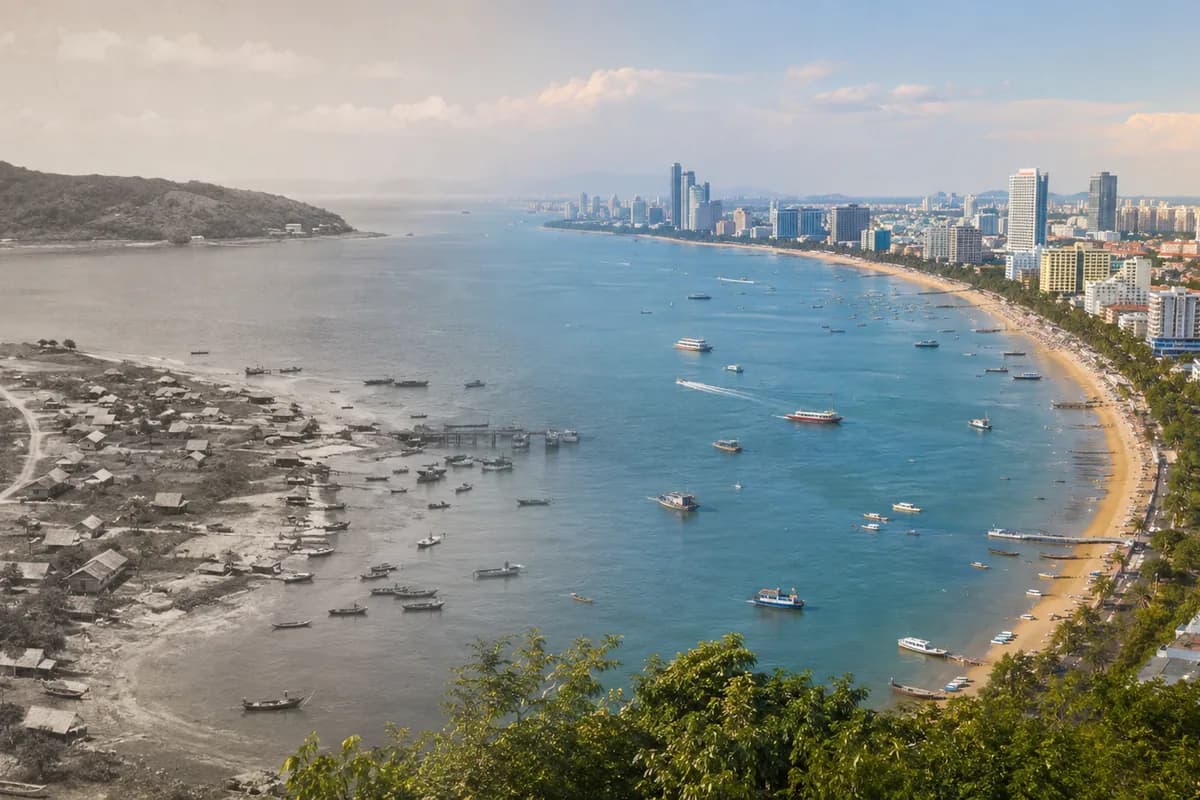
Pattaya Beach became the physical spine of the resort, with Beach Road developing hotels, restaurants, shops and entertainment along the waterfront and Second Road forming a parallel commercial corridor further inland — together, effectively a visible timeline of the city's evolution, decades of development lining one side of the road while the sea that first attracted anyone remains visible on the other. As development intensified, Central Pattaya grew into a dense mixed zone of tourists, long-term residents, shopping centres and nightlife, while North Pattaya and Naklua developed rather differently, retaining stronger connections to older fishing communities even as luxury resorts and condominium towers rose around them. The phrase "Pattaya was a fishing village" gets repeated often enough to become a cliché, but the deeper truth is more interesting than the cliché allows: fishing communities existed along this coast before tourism arrived, and some genuinely still exist today, particularly around Naklua, where markets and a working seafood economy coexist directly alongside expensive condominiums and international hotels. The tourist city grew beside and over the older coastal economy, not as a clean, instant replacement for it.
South of the centre, Jomtien developed into another major tourism and residential zone in its own right, its longer beach traditionally feeling less concentrated than central Pattaya, with hotels, condominiums and long-term foreign residents becoming increasingly common there over time. Between central Pattaya and Jomtien, Pratumnak Hill grew into a residential and hotel district with elevated coastal views, also home to the area's well-known Big Buddha — together, these districts illustrate how thoroughly Pattaya's development eventually filled nearly every piece of geographically useful land between its major beaches.
Infrastructure Locks the City In
Improved road connections steadily shortened the journey from Bangkok, turning what once felt like a distant coastal trip into a practical weekend drive, and the opening of Suvarnabhumi Airport east of Bangkok in 2006 strengthened Pattaya's accessibility further still — the airport sits considerably closer to Pattaya than central Bangkok does, and direct transfers now let international visitors reach the coast without entering the capital at all. U-Tapao, whose strategic importance during the Vietnam War era first put the wider area on the map, continues to serve civilian aviation today and ties Pattaya into Thailand's broader Eastern Economic Corridor development strategy, alongside Laem Chabang Port to the north, one of the country's most important commercial ports and also a growing cruise-ship destination. Pattaya, in other words, grew up beside industrial Thailand as much as beside tourist Thailand — a detail easy to miss from Walking Street, but visible everywhere in the wider region's economy.
As the city grew, it needed workers on a genuinely large scale, and people migrated in from across Thailand to fill hotel, restaurant, construction, retail and entertainment jobs — especially from Isaan. The connection between Pattaya and the northeast runs deep: money earned on the coast regularly travels back to provinces such as Udon Thani, Khon Kaen, Buriram and Korat, workers return home for Songkran and family events, and the tourist economy on the beach is quietly connected to households hundreds of kilometres inland. (Our guide to Isaan explores this same connection from the sending side.) Pattaya, more than most Thai cities, is a place built through arrival rather than through continuous local settlement — Thai workers from other provinces, foreign retirees, tourists, business owners and mixed families all layered on top of each other over just a few decades, giving the city a genuinely distinctive social character.
The Expat City and the Vertical Skyline
As tourism matured, some visitors simply stopped leaving. Foreigners retired in Pattaya, opened businesses, married Thai partners and settled permanently, and long-term expatriate communities grew large enough to support English-language newspapers, international supermarkets, clubs and dedicated medical services. Warm weather, international hospitals, affordable restaurants and easy transport to Bangkok made Pattaya especially attractive to retirees specifically, whose spending patterns — rent, healthcare, groceries, cars, visas — look very different from a typical tourist's, and the city developed a genuine residential economy for long-term foreign residents running alongside its tourism economy rather than separate from it.
The skyline changed accordingly. Condominium towers spread across Pattaya, Jomtien, Pratumnak and Wongamat, serving primary homes, holiday properties and pure investment in roughly equal measure, driven by foreign demand as much as by Thai investment and Bangkok's own appetite for weekend homes. Wongamat Beach in the north became particularly associated with higher-end condominium and resort development, its atmosphere noticeably different from Walking Street or central Beach Road — one of many reminders that talking about "Pattaya" as a single, uniform place misses a great deal of what the city actually contains. Naklua, Wongamat, North Pattaya, Central Pattaya, South Pattaya, Pratumnak and Jomtien each carry a different mix of local life, tourism and residential development, and the city genuinely changes character block by block rather than presenting one consistent identity throughout.
Nightlife, Honestly
Nightlife is impossible to leave out of Pattaya's history, and it deserves straightforward treatment rather than either sensationalism or evasion. Bars and entertainment businesses grew early because military and tourist demand supported them directly, and over the following decades the industry became one of the city's strongest international associations. Walking Street remains the most famous single stretch, but Pattaya's nightlife spread much further than that one street over time — open-air beer bars, clustered together and competing across short distances, became a genuinely characteristic Pattaya format, casual and visible in a way quite different from the enclosed nightclub model common elsewhere. Certain streets developed highly specific identities of their own, and as rents, visitor patterns and business models shifted over the decades, newer entertainment zones emerged alongside older ones rather than simply replacing them, with the centre of gravity of "foreign Pattaya" gradually moving inland from the beach as well as along it.
It's worth stating plainly what nightlife represents economically, beyond its visible spectacle: rent, electricity, wages, suppliers, security, transport, food, cleaning, music and advertising all sit behind it, and thousands of ordinary livelihoods depend on that economy continuing to function. Understanding that economic structure doesn't require romanticising every part of the industry built on top of it, and this history is offered here as exactly that — history, not a guide to the industry itself.
Pattaya's international reputation for adult-oriented nightlife has attracted visitors who specifically wanted it, and just as reliably discouraged others who didn't, and for decades the city has worked to broaden its image through family attractions, sports facilities, conventions, shopping, festivals and improved public spaces. This isn't pure marketing fiction — families genuinely do visit, and districts like Jomtien can feel entirely different from the nightlife-heavy core — but global reputations tend to shift more slowly than cities actually do, and Pattaya's remains one of the clearest examples of a tourism brand outliving the precise conditions that first created it.
The city built genuinely distinctive attractions beyond the beach and nightlife too. The Sanctuary of Truth, an enormous wooden structure covered in intricate Buddhist and Hindu-influenced carvings, began construction in the early 1980s and became one of Pattaya's most recognisable landmarks despite being entirely modern rather than ancient. Nong Nooch Tropical Garden, developed to the south, grew into a major landscaped attraction drawing both Thai and international visitors, while Koh Larn, just offshore and reachable by ferry or speedboat from Bali Hai Pier, offers a genuinely different beach experience from the city itself — and that pier, sitting directly beside Walking Street while also serving as the main gateway to the island, captures several of Pattaya's overlapping identities in a single location: nightlife, transport and island tourism, meeting at one spot on the map.
Shocks, Recovery and Constant Reinvention
Rapid growth on this scale inevitably created real urban strain — traffic, waste, drainage problems, beach erosion, rising construction pressure and land prices, and genuine economic inequality alongside genuine opportunity. Tourism booms rarely produce perfectly planned cities, and Pattaya is no exception. The COVID-19 pandemic delivered the clearest recent demonstration of just how dependent the city had become on constant arrivals: hotels and bars closed, streets that had never really stopped moving fell quiet almost overnight, and the images of an empty Pattaya became one of the more striking symbols of the pandemic's impact on Thailand's tourism economy nationally. (Our guide to how tourism changed Thailand covers this same shock at the national level.) Recovery afterward brought its own shifts — Indian and other Asian markets growing in importance, new restaurants and entertainment venues opening, major infrastructure projects continuing regardless — a reminder that Pattaya has absorbed disruption and reshaped itself repeatedly across its short history, rather than following any single straight line of growth.
Long-term visitors and residents reliably say Pattaya was better twenty years ago; people said much the same thing twenty years before that too, and probably twenty years before that. Some of the nostalgia reflects real change — quieter beaches, lower prices, lighter traffic at earlier points in the city's growth — and some of it is simply what happens when people remember being younger themselves. Either way, despite everything built up around it, Pattaya remains genuinely oriented toward the bay: Beach Road still follows the water, hotels still sell sea views, and sunset still reliably pulls people toward the promenade, whatever else has changed around it.
A City of Contradictions, on Purpose
Pattaya contains contrasts that regularly confuse first-time visitors — a temple standing near a bar district, a fishing market a short walk from a luxury tower, a family eating seafood beside a group just starting their night out, a retiree buying groceries beside a tourist on a two-day stopover. These aren't separate cities awkwardly sharing a name. They're simply Pattaya, and trying to compare it directly with somewhere like Chiang Mai or a quiet provincial capital tends to miss the point entirely — it was never trying to be a preserved historic city or an untouched island paradise. It's a tourism-driven coastal city that grew with unusual speed, judged more fairly on its own terms than against a template it was never built to match.
Behind the buildings, Pattaya's history is ultimately a story about movement: American servicemen arrived, then Thai workers from across the country, then European package tourists, then retirees, then property investors, then people from Isaan looking for work. Some stayed. Some moved on. The city exists, in the most basic sense, because people kept arriving, and each new wave of arrivals built businesses that made arriving easier for the next wave after them — visitors bring businesses, businesses bring infrastructure, infrastructure makes the destination easier to reach, and the cycle repeats itself at a larger scale each time it turns.
The Vietnam War-era R&R story matters because it kicked that cycle into motion early, at almost exactly the moment Thailand itself was becoming more connected to international travel generally. But stopping the story there badly understates everything Pattaya did in the six decades since — the modern city is a product of sustained, repeated reinvention, not simply one wartime chapter frozen in place. The biggest misunderstanding about Pattaya may be treating its history as only the history of its nightlife. Nightlife is genuinely central to that story and deserves to be discussed honestly rather than avoided. But the fuller history is one of tourism-driven urbanisation on a remarkable scale — roads, migration, hotels, property, airports, shopping and international community, with the entertainment economy forming one significant part of a much larger transformation rather than the whole of it.
To actually read the city today, start in Naklua and look at the fishing market, move south past the high-rise resorts of Wongamat, continue through North and Central Pattaya watching malls and hotels replace the older scale, follow Beach Road down to Walking Street, cross over Pratumnak, and finish in Jomtien. That short journey covers most of the different stages Pattaya has passed through in living memory — a version of Thailand that, more than almost anywhere else in the country, is what happens when geography, military history, tourism, migration, foreign money and relentless local reinvention all land on the exact same stretch of coastline at once.