1. The Sauce Everyone Thinks They Know
There are foods that travel abroad and remain recognisably attached to the country they came from.
Then there is Sriracha.
In much of the world, the word immediately brings up one image: a clear plastic squeeze bottle filled with bright red sauce, topped with a green cap and printed with a white rooster. It sits beside pho in Vietnamese restaurants, gets mixed into mayonnaise, squeezed onto burgers and pizza, stirred into noodles and copied by supermarket brands that may have no connection to Thailand at all.
The strange part is that the name does.
Sriracha comes from Si Racha, a coastal town in Chonburi Province on Thailand’s eastern Gulf coast. Long before the rooster bottle became a global cult object, chilli sauces carrying the town’s name were being made in Thailand and eaten especially as accompaniments to seafood and other dishes.
That creates a particularly revealing origin story.
The global product is not fake. The Thai product is not simply an earlier version of the American one. And there is no need to force both into a single straight line.
What happened is more interesting.
A Thai place name became attached to a style of chilli sauce. Different Thai producers developed their own versions. Decades later, David Tran — a Vietnamese refugee building a food business in Los Angeles — made a new Sriracha for the customers around him. His sauce exploded in popularity, became the version millions of people recognised first, and helped turn “sriracha” from the name of a Thai sauce into something close to a worldwide flavour category.
The world learned the word.
It just did not always learn where the word came from.
2. Before the Rooster: A Sauce From Si Racha
Si Racha was a logical place for a chilli sauce to become locally famous.
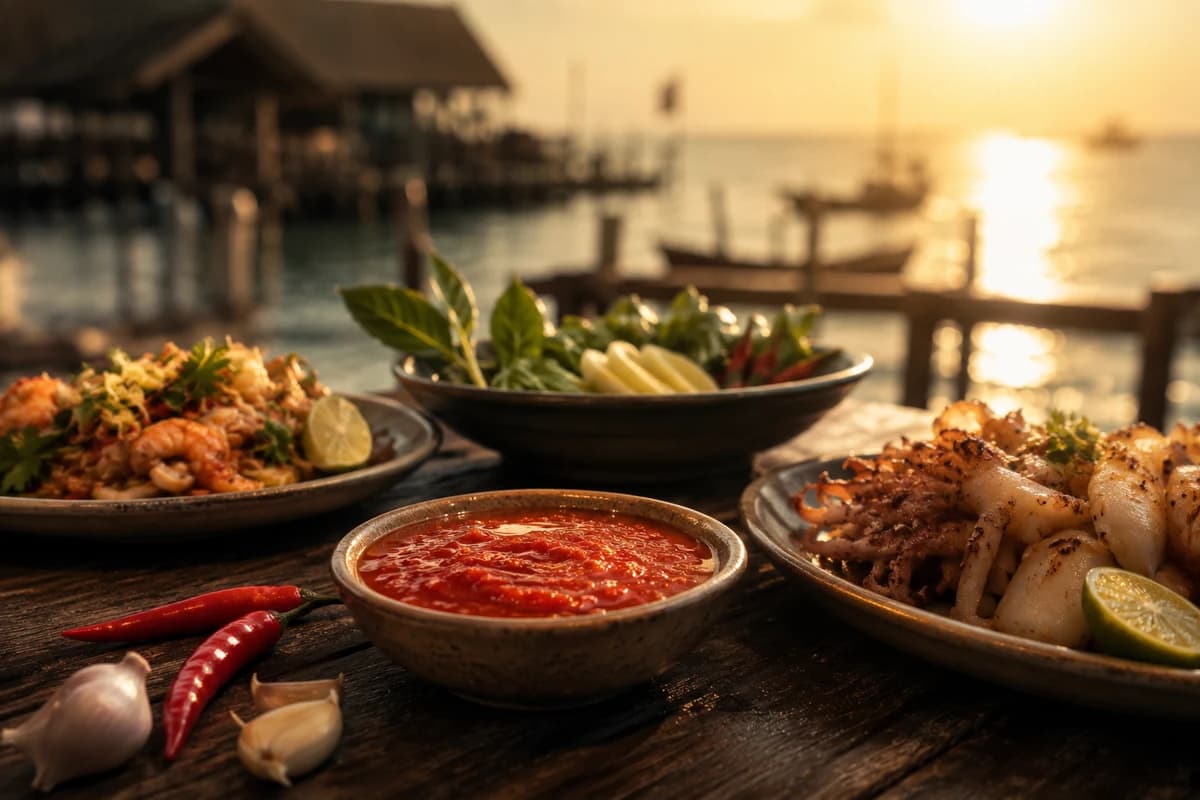
It is a coastal town, and the early Thai stories around Sriracha repeatedly place the sauce beside seafood. That matters, because traditional Thai-style sriracha is not merely a weapon for making food hotter. It is a dipping sauce built around balance — chilli heat, acidity, salt, sweetness and garlic — with a consistency and flavour profile that can differ noticeably from the thick American versions now familiar overseas.
Thai government-linked food material describes sriracha as especially associated with seafood and omelettes. Sriraja Panich, one of the oldest and most famous Thai brands, tells a similar story: a family sauce made in Si Racha to accompany seafood, before neighbours and customers encouraged wider production.
The basic formula sounds simple.
Chillies. Garlic. Vinegar. Sugar. Salt.
But “simple” recipes are often where local style matters most. The variety of chilli, treatment of garlic, proportions, fermentation or ageing, texture and balance can change the finished sauce substantially.
Sriraja Panich says its current process uses red goat peppers and Thai garlic pickled for seven days, together with sugar, vinegar and sea salt. Its chillies are aged for at least three months before the sauce is completed, and the company describes the target profile in very Thai terms: spicy, sour, salty and sweet working together rather than heat standing alone.
That is a useful clue to why foreign visitors can be surprised by Thai sriracha.
The sauce may be thinner. It may taste tangier. It can seem sweeter or less aggressively garlicky depending on the brand, and it is often treated as a table condiment for particular foods rather than something designed to be squeezed indiscriminately over everything in sight.
The global Sriracha story therefore begins with a warning.
There is also a broader historical caution here. Chilli itself is not ancient to Southeast Asia in the way rice is; Capsicum peppers reached the region after the Columbian exchange. Thai cooks absorbed them so completely that they now feel inseparable from the cuisine. Sriracha is therefore built on layers of movement even before its twentieth-century commercial history begins: an American-origin crop naturalised in Asia, local garlic and vinegar traditions, coastal eating habits and a Thai place name later carried onto bottles around the world. Calling the sauce “traditional” and calling it “global” are not opposites. Its tradition was already made through exchange.
There was never just one bottle.
3. Two Women, Two Brands — and an Origin Story That Refuses to Behave
Origin stories become uncomfortable when more than one family has receipts.
Sriracha has exactly that problem.
One official Thai source, Thai SELECT, traces the first commercial Sriracha sauce to La-Orr Suwanprasop, a woman from Si Racha who later lived in Bangkok. According to that account, she began selling her sauce in 1932. Her product later became known as Gold Medal Brand after success in food competitions, and the brand remains in existence.
A separate and very well-established tradition belongs to Sriraja Panich. Its own company history dates the sauce to 1935 and credits Thanom Chakkapak in Si Racha, who is said to have made the sauce for her family to eat with seafood before demand spread beyond the household. Thai Theparos acquired the business in 1984 and later expanded distribution in Thailand and overseas.
Sriraja Panich describes itself as the original producer of Sriracha chilli sauce.
Gold Medal’s history points three years earlier.
There is no need to “solve” that disagreement by choosing a winner.
The responsible conclusion is that the documentary and family histories around Sriracha preserve competing early commercial claims from the same period, both connected to women from Si Racha and both rooted in a local sauce culture that clearly existed before Sriracha became internationally famous.
There may have been even older household versions.
Food rarely waits for paperwork.
A sauce can circulate through homes, markets and restaurants for years before anybody thinks to register a brand, keep business records or write down a definitive recipe. Later generations then inherit not only the food, but the argument about who was first.
What we can say with confidence is enough.
By the early 1930s, chilli sauce carrying the Si Racha identity was being commercialised in Thailand.
The disagreement also tells us something about brands and food history. A company archive naturally remembers the story of its own founder. A family business preserves a different chain of memory. Government-linked culinary material may privilege the earliest documented sale date it can identify. None of those sources is useless, but they answer slightly different questions. “Who first sold a sauce under this name?”, “Which surviving brand became nationally famous?” and “When did people in Si Racha begin making this style of sauce?” are not necessarily the same question. Treating them as one question is how neat origin myths are manufactured.
The global story starts there — with more than one kitchen.
4. What Thai Sriracha Is — and What It Is Not
Outside Thailand, “Sriracha” is often treated almost like a flavour adjective.
Sriracha mayo. Sriracha crisps. Sriracha wings. Sriracha ketchup. Sriracha seasoning.
Inside Thailand, the word still has a more specific culinary memory.
Thai-style sriracha is a chilli sauce, but it belongs to the broader Thai habit of using condiments to finish, balance and personalise food. It is not the same thing as nam prik, not the same thing as sweet chilli sauce, and not interchangeable with every red bottle placed on a restaurant table.
The early Si Racha association with seafood is especially useful here. A dipping sauce for seafood has to do more than burn. Acidity cuts richness. Sweetness rounds the chilli. Salt reinforces savoury flavours. Garlic adds aroma. The sauce has to support the food rather than erase it.
That balance helps explain why Sriraja Panich’s own description emphasises four tastes rather than a Scoville number.
It also helps explain why a Thai bottle can surprise somebody raised on Huy Fong.
The American sauce is famous for its thick, smooth texture, strong garlic presence and direct chilli impact. Traditional Thai versions are often described as looser and tangier. Different Thai brands can also vary significantly from one another, which makes “the authentic Thai Sriracha taste” a dangerous phrase if it implies one universal formula.
What links them is not perfect uniformity.
It is the Si Racha name, a family resemblance of chilli-garlic-vinegar-sugar-salt combinations, and a Thai condiment tradition built around balance.
Then that family acquired a very famous relative in California.
5. David Tran Did Not Invent the Name — He Reinvented the Sauce
David Tran’s story begins nowhere near Si Racha.
Tran was born in Vietnam, built experience making chilli sauces there, and left the country as a refugee after the war. He eventually reached the United States and settled in Los Angeles in 1980. That same year, he founded Huy Fong Foods in Chinatown.
The company name came from the freighter that carried him out of Vietnam.
His best-known product took its name from Thailand.
Tran did not claim to have invented the word Sriracha. The sauce style was already associated with Si Racha, and contemporary reporting has repeatedly described his product as a version inspired by a hot sauce originating there.
What he created was a formulation for his own market.
Huy Fong’s Sriracha uses fresh red chillies, sugar, salt, garlic, acetic acid and stabilising or preserving ingredients. For many years the company famously relied on fresh red jalapeño-type chillies grown in California. The result was thicker, more assertive and particularly easy to squeeze straight from the bottle.
Its first customers were not mainstream American supermarket shoppers.
Tran sold sauces into the Asian food economy of Los Angeles. He bottled by hand, delivered orders himself and built a market among restaurants and communities already familiar with chilli condiments.
That route is important.
Huy Fong Sriracha did not become global because an American corporation discovered an exotic Thai sauce and launched a giant advertising campaign.
It grew through migration.
A Vietnamese refugee adapted a Thai-named chilli sauce in California, sold it into a multicultural food scene and created a product that then travelled through restaurants, word of mouth and obsessive customer loyalty.
Sriracha had already crossed one border before most Americans had heard its name.
6. The Rooster Bottle Becomes the Sriracha Bottle
Packaging can change culinary history.
Huy Fong’s bottle was almost aggressively practical: clear plastic, bright red sauce, green squeeze cap, multilingual text and a white rooster logo linked to Tran’s zodiac year.
Nothing about it looked like a luxury product.
That helped.
The bottle could sit on a restaurant table. Customers could try it without asking what it was. The colour showed through the plastic. The green cap made it instantly recognisable. Once enough Vietnamese and Chinese restaurants had it sitting within reach, diners started forming habits around it.
Then those habits escaped the restaurants.
By the 1990s and 2000s, Huy Fong Sriracha had become a cult condiment in the United States. Chefs used it. Food writers praised it. Home cooks put it on eggs, noodles, sandwiches and almost anything else that tolerated chilli. Eventually large restaurant chains, snack companies and food manufacturers began releasing products labelled “Sriracha.”
Huy Fong barely advertised.
The customers did the marketing.
This is where the visual identity became so powerful that many consumers made an understandable mistake: they assumed the rooster bottle was Sriracha itself, rather than one brand of sriracha.
In America, asking for Sriracha could effectively mean asking for Huy Fong.
In Thailand, asking for Sriracha could produce an entirely different bottle.
The same word had begun living two culinary lives.
Huy Fong’s scale eventually made that split impossible to ignore. The company moved from a small Chinatown operation to larger facilities in Rosemead and then Irwindale, while keeping only a small range of chilli products. Its own production material emphasised fresh chillies ground during a concentrated harvest season and stored as a chilli base for later use. That industrial scale was very different from the family-scale Thai origin stories, yet the product still sold itself as something almost handmade in spirit: no celebrity founder on television, no expensive ad campaign, just the bottle appearing on more tables until familiarity became brand power.
7. The Name Nobody Owned
Normally, when one product becomes this famous, a company tries very hard to own the name.
Huy Fong did not own “Sriracha.”
That turned out to matter enormously.
The word comes from a real place in Thailand, and David Tran never secured exclusive control over the name. He trademarked distinctive elements such as the rooster logo, but “sriracha” itself became available for competitors to use.
By the 2010s, the result was everywhere.
Large food companies released Sriracha sauces. Restaurants launched Sriracha burgers and pizzas. Snack brands released Sriracha-flavoured products. Bottles appeared with dragons, geese and other visual identities. The word could describe a sauce, a seasoning blend or simply the promise of chilli-garlic flavour.
A Los Angeles Times report in 2015 described the term as effectively too generic in the United States for Huy Fong to lock down by itself.
For brand consultants, that could look like a spectacular missed opportunity.
For the history of a Thai place name, it produced something almost surreal.
Si Racha became a flavour.
Millions of people who could not locate the town on a map could recognise the word on a packet of crisps.
The spelling travelled too. The town is commonly written “Si Racha” in English-language Thai usage, while “Sriracha” became the dominant international spelling on sauce bottles and menus.
Once a spelling is printed on enough bottles, language becomes difficult to recall.
The town stayed in Chonburi.
That linguistic journey matters because it changed what consumers thought the word meant. A geographical name can point to origin, as Champagne does, or it can loosen into a generic style. In the United States, sriracha moved strongly toward the second category. Competitors could use the term while differentiating themselves with logos, recipes and packaging. Huy Fong protected its rooster and other brand identifiers, but not the town-derived word itself. The result was an unusual kind of success: the company that popularised Sriracha in America helped make its own product name too broad to belong to one bottle.
Its name went everywhere.
8. When a Thai Sauce Became an American Cultural Object
Huy Fong Sriracha eventually moved beyond condiment status.
It became design.
The clear bottle, green cap and rooster were printed on T-shirts, phone cases, socks and novelty products. Cookbooks were devoted to it. Beer and popcorn collaborations appeared. Food media treated shortages like small national emergencies.
That is not normal behaviour for a bottle of chilli sauce.
Part of the appeal was culinary. The sauce combined heat, garlic, acidity and sweetness in a form that worked unusually well with American fast food, Asian-American restaurant food and home cooking.
Part of it was cultural timing.
American diners were becoming more interested in Southeast Asian flavours. Vietnamese food was becoming more familiar. Asian-American chefs and communities had greater influence on mainstream dining. A condiment that could move easily between pho, pizza and burgers arrived at exactly the right moment.
And part of the success came from the fact that Huy Fong did not behave like a conventional consumer brand.
Tran famously spent little on advertising and focused on making sauce. The company’s low-key approach created an authenticity of its own: customers felt they had discovered something rather than been sold something.
Yet this “American” Sriracha was culturally layered from the start.
Thai name.
Vietnamese refugee entrepreneur.
California chillies.
Multilingual bottle.
Asian-American restaurant network.
Mass American adoption.
Trying to force that into one national box misses the point.
Huy Fong Sriracha is American food precisely because American food is often made from migration.
9. Meanwhile, Thailand Kept Making Sriracha
The global fame of Huy Fong can make it sound as though Thailand somehow lost its own sauce.
It did not.
Thai producers continued making sriracha, and Sriraja Panich remains one of the best-known historical brands. Thai Theparos says it acquired the company in 1984 and has since distributed the sauce nationally and exported it internationally.
Gold Medal Brand also survived, carrying a different early-origin claim.
Other Thai producers entered the category too.
This is where tasting the sauces side by side becomes more useful than arguing about which bottle deserves the word.
Thai Sriracha and American Sriracha share a name and a broad chilli-garlic-acid-sugar structure, but they are products of different culinary environments. One grew from a Thai coastal dipping-sauce tradition. The other was redesigned inside the migrant food economy of Los Angeles and then scaled into an American cult brand.
Neither history cancels the other.
The more interesting question is what global consumers now expect when they see “Sriracha.”
For many, the expected flavour has been shaped more strongly by the California bottle than by any sauce made in Chonburi. That means the export story has partially looped back on the origin: the global category now influences how people imagine the Thai sauce from which the name came.
This happens often when regional foods travel.
Pizza outside Italy changes what foreigners expect in Italy.
Curry outside South Asia creates its own categories.
Sriracha followed the same rule.
Success does not preserve a food in amber.
It can also create reverse expectations. A traveller who first meets Sriracha through a thick American squeeze sauce may arrive in Thailand expecting the same flavour, then discover a bottle that is brighter, looser or more obviously suited to dipping seafood. That is not evidence that one version is “real” and the other is wrong. It is evidence that a name has travelled through different food cultures. The comparison becomes more useful when it asks what each sauce was designed to do: one to sit beside Thai dishes in a local condiment tradition, the other to move easily across a multicultural American menu.
It creates relatives.
10. From Si Racha to Sriracha
There is an easy way to tell this story.
A Thai woman invents Sriracha. A Vietnamese refugee copies it in America. The American version becomes famous.
Almost every part of that sentence is too simple.
The Thai origin story itself contains competing early commercial claims. The sauce belonged to a local food culture before any one surviving brand could own the entire tradition. Huy Fong did not merely copy a Thai bottle; David Tran created a distinct formulation for a different market, drawing on his own experience, migration story and the food culture around Los Angeles.
Then something even stranger happened.
The American version became so famous that it helped turn a Thai place name into a generic global food word.
That is what makes Sriracha’s origin story so revealing.
Not because Thailand can claim every bottle with the word printed on it.
Because Si Racha supplied the name and an early sauce tradition, and the rest of the world spent the following decades changing what that name could mean.
Today, Sriracha can be Thai, American, Asian-American, supermarket, artisanal, sweet, sharp, garlicky, thin, thick or mixed into mayonnaise.
The category has become bigger than any one recipe.
But buried inside every bottle is still a small piece of geography.
Before Sriracha was a global flavour, Si Racha was a place.
It still is.