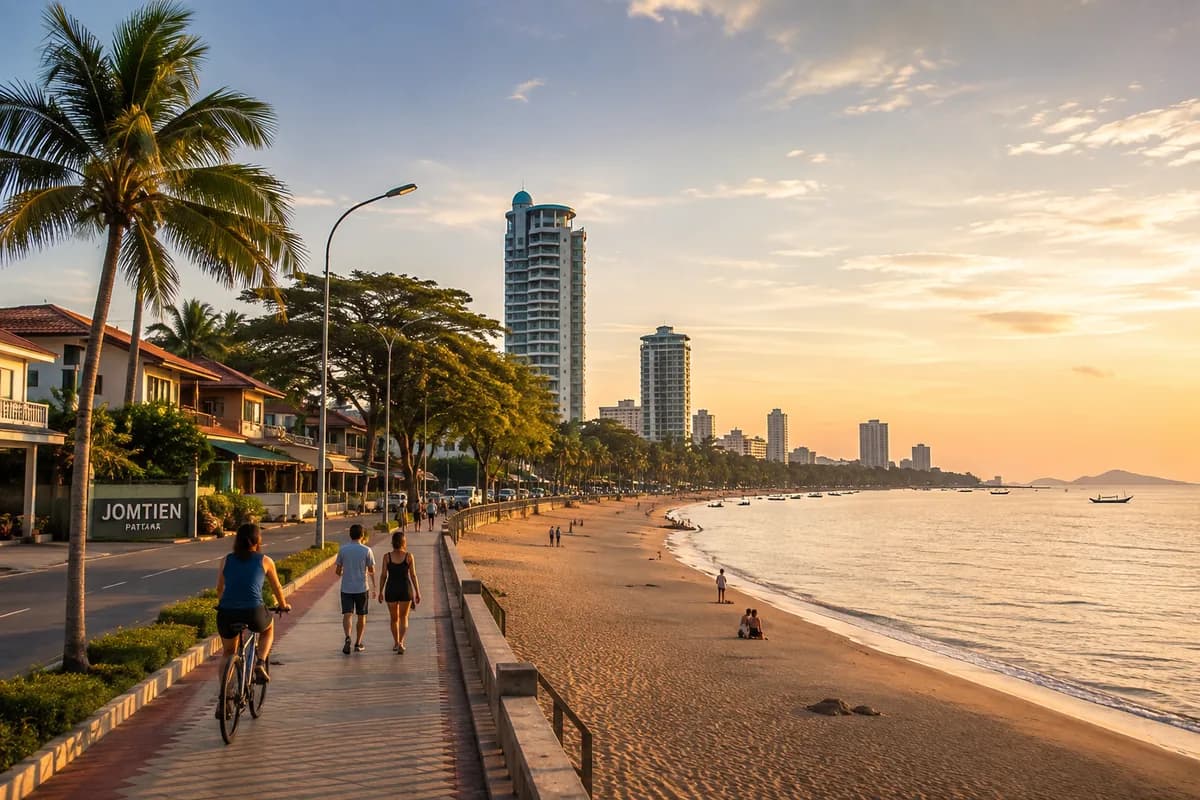
Many travellers first come for Pattaya's energy. Then they cross Pratumnak Hill and discover something different: a long beach, excellent food, easy evenings, a social scene of its own — and a place where doing less can quickly start to feel like exactly the right amount.
Almost nobody grows up dreaming of Jomtien.
They dream of Thailand. They hear about Bangkok, Phuket and Chiang Mai. Somewhere along the way they hear about Pattaya — the beach city with the famous nightlife, the endless choice and the reputation that arrived long before they did.
Then they come.
And some of them eventually cross the hill south of Pattaya and find Jomtien.
At first, the differences can seem small. The sea is still there. Pattaya is only minutes away. There are hotels, condominiums, restaurants, massage shops, bars and traffic. This is hardly an undiscovered tropical village.
Yet the rhythm changes.
Jomtien manages an unusual trick: it remains part of one of Thailand's liveliest resort cities while feeling sufficiently removed from the centre to develop a life of its own.
For some visitors, that is when a holiday begins turning into something else.
Just Over the Hill
Geographically, the separation between Pattaya and Jomtien is almost comically small.
Leave the southern end of central Pattaya, cross the Pratumnak area and the city opens onto another long stretch of coastline. The Tourism Authority of Thailand places Jomtien only a few kilometres from Pattaya Beach and has long presented it as the quieter resort alternative nearby, a stretch of former paddy fields that grew into a beach destination of its own.
But distance is not really what separates them.
Central Pattaya announces itself. Jomtien tends to reveal itself more slowly.
Beach Road follows the shore for kilometre after kilometre. Behind it sit small restaurants, convenience stores, cafés and condominium towers. Further inland, another layer of restaurants, markets, guesthouses and bars appears.
And unlike a destination built entirely around people staying for a few nights, Jomtien has the unmistakable signs of people who have unpacked.
Laundry hangs from balconies. Regulars have favourite tables. Restaurants serve customers who already know what they are ordering before they sit down.
It feels less like a resort designed for a single holiday and more like somewhere people have worked out how to live.
The Beach Is Not an Excursion
In some resort towns, visiting the beach is an activity.
In Jomtien, the beach is closer to a piece of everyday infrastructure.
People walk beside it in the morning. Vendors appear. Beach chairs fill. Families arrive with food. Others sit beneath umbrellas for hours with no particular objective beyond remaining exactly where they are.
As afternoon turns towards evening, the temperature drops and another shift takes over. People walk. They eat. They sit facing the Gulf. The beachfront becomes a place to spend time rather than something that needs to be "done."
That atmosphere is part of Jomtien's appeal. Nobody needs to plan a beach day because the beach is simply there.
The Tourism Authority of Thailand describes Jomtien as a thriving beach destination and continues to recommend it particularly to visitors looking for a quieter resort setting than central Pattaya.
It is still urban Thailand. It is just urban Thailand with several kilometres of sea running beside it.
Then There Is the Food
If the beach explains part of Jomtien's appeal, the food explains another large part.
Pattaya as a whole has one of Thailand's strangest and most extensive restaurant landscapes outside Bangkok. That comes partly from tourism and partly from the extraordinary mix of foreigners who have lived around the city for years. TAT highlights not only Pattaya's seafood but restaurants serving everything from Indian and Chinese to Scandinavian, German, Italian, Japanese and Middle Eastern food.
Jomtien concentrates much of that variety into an area where eating can become part of the daily routine rather than a special event.
There is seafood by the coast. There are straightforward Thai shops where dinner costs little more than a couple of beers elsewhere. There is Isaan food, noodles, grilled chicken, curries and som tam. Markets add another layer entirely, particularly once the evening begins.
Then come the restaurants built around Jomtien's international population: European breakfasts, Russian food, Scandinavian favourites, Indian restaurants, pubs serving familiar comfort food and cafés that seem designed for people who have nowhere urgent to be.
You can eat adventurously. Or you can eat exactly what you ate yesterday because it was good and the staff already recognise you.
Both approaches somehow suit Jomtien.
A Place Where Evenings Do Not Need a Plan
Then the sun goes down.
This is where comparing Jomtien with central Pattaya becomes interesting.
Pattaya has entire districts that can turn an evening into an event before you have even decided what you want to do. Jomtien does not demand the same commitment.
You can have dinner, walk along the beach and stop for one drink. You can play pool. You can find live music. You can sit at a small open-air bar and discover three hours later that the one drink became several because the same people kept talking.
The area's nightlife is smaller and more dispersed than Pattaya's major entertainment zones. Current Jomtien guides point particularly to areas around Jomtien Second Road, Rompho and the northern Jomtien/Thappraya end for clusters of bars and evening activity.
That scale changes the experience. The evening can become lively without the entire neighbourhood feeling as though it has been constructed around nightlife.
Yes, There Are Girls
There is little point pretending this is irrelevant to Jomtien's appeal for some visitors.
It is not.
Jomtien has beer bars and social nightlife where female staff are part of the atmosphere, just as they are elsewhere around Pattaya. Rompho in particular has long been associated with open-air bars, pool tables, regular customers and female hosts serving drinks, and current listings still describe dozens of small bars in the wider complex.
But the character is different from Pattaya's largest nightlife areas.
Jomtien does not need to compete with Walking Street. That is almost the point.
Someone who wants the full intensity of central Pattaya can get there quickly. Someone who simply wants a beer, a game of pool, some conversation and a social evening can stay closer to home.
For many regular visitors, the attraction lies precisely in having the choice. There is enough going on that the evening never has to be boring. There is not so much going on that every evening has to become a production.
The Regulars Change Everything
Spend enough time in Jomtien and another difference becomes apparent.
You start seeing the same people.
That sounds almost too ordinary to matter, but in a destination built around tourism it changes the atmosphere considerably.
A short-stay resort constantly resets itself. Guests arrive, stay three nights and leave. Tomorrow brings another group.
Jomtien also has that tourism cycle, but alongside it is a substantial population of long-stay visitors, retirees, expatriates and people who return for weeks or months at a time. Current area guides continue to identify this resident and long-stay population as one of Jomtien's defining characteristics.
The result is a neighbourhood where businesses can have regulars. The person drinking at the next table may have been sitting there every February for years. The restaurant owner remembers what someone orders. A pool game starts because two people played yesterday.
That creates a form of social life quite different from a nightlife district built almost entirely around strangers passing through.
Visitors can remain visitors while still becoming familiar faces.
The Luxury of Doing Nothing
Perhaps Jomtien's greatest attraction is something travel writing often struggles to sell.
Not much needs to happen.
A perfectly decent Jomtien day can consist of breakfast, a walk, several hours near the beach, lunch, a massage, a nap, dinner and a couple of drinks.
No temple checklist. No major attraction. No heroic itinerary.
And somehow the day does not feel wasted.
That is partly because Jomtien works unusually well as a place to exist rather than merely visit. Everything required for an easy day is nearby. Food is everywhere. The beach is everywhere. Convenience stores are everywhere. Transport into Pattaya is straightforward. Massage shops, cafés, restaurants and bars fill the gaps between.
There are certainly things to do — water sports, markets, excursions and the wider collection of attractions across Pattaya and Chon Buri — but Jomtien does not insist on them.
Sometimes the luxury is precisely that nobody cares whether you accomplish anything.
Pattaya Is Still Right There
None of this works quite as well if Pattaya is removed from the equation.
Jomtien's great advantage is not simply that it offers something different from Pattaya. It is that Pattaya remains right beside it.
Want shopping centres, bigger nightlife areas or the sheer concentration of central Pattaya? Go.
Want Walking Street? Go.
Want dinner somewhere completely different tonight? Go.
Then come back.
Jomtien never has to recreate everything Pattaya offers because it sits next door to it. That gives visitors an unusually attractive compromise: live at the easier pace and borrow the intensity whenever you feel like it.
A short ride over the hill can change the entire evening. The next morning, the beach is still outside.
Why Longer Stays Make Sense Here
This is probably where Jomtien stops being merely another neighbourhood and starts becoming addictive for certain travellers.
Central Pattaya can be extraordinarily entertaining. Jomtien can be extraordinarily easy.
For three days, the difference may not matter. For three weeks, it can matter enormously.
Longer stays change what people want from a destination. The question stops being simply What can I see?
It becomes: Where do I like having breakfast? Where can I walk? Can I get decent food without thinking about it? Do I like the neighbourhood after dark? Can I have a social evening without travelling across town? Can I disappear into my room for a day and not feel as though I have missed Thailand?
Jomtien answers those questions surprisingly well. That helps explain why its skyline contains so many condominiums rather than only hotels, and why the streets support businesses aimed at people living locally rather than simply passing through.
Holiday infrastructure gradually becomes everyday infrastructure.
Not Less Pattaya — Just a Different Amount
Calling Jomtien the quiet alternative to Pattaya is convenient. It is also slightly misleading.
Jomtien is not particularly quiet in absolute terms. It is a busy Thai resort district filled with traffic, restaurants, markets, hotels, condominiums, bars and visitors.
It merely sits beside Pattaya. That makes almost anywhere look calm.
The real appeal is not silence. It is balance.
Beach without isolation. Nightlife without needing a nightlife district every evening. International food without losing Thai street food. A large expat presence without becoming detached from Thailand. Pattaya nearby without having to live in the centre of Pattaya.
That combination is difficult to explain to someone who has never stayed there, because none of the individual ingredients sounds particularly remarkable. Together, however, they create something people become attached to.
The People Who Stop Looking
Ask someone why they return to Jomtien and the answer may sound disappointingly simple.
They like the beach. They know where to eat. They know a few bars. They have friends there. They can get into Pattaya whenever they want. They feel comfortable.
Travel usually encourages us to search for extraordinary things.
Jomtien's appeal may be the opposite. It can make the ordinary parts of a holiday unusually enjoyable.
Breakfast becomes a favourite breakfast. A random bar becomes your bar. The same stretch of beach becomes the place you walk every afternoon.
People who arrived planning to experience everything eventually discover the pleasure of having somewhere they do not need to experience at all.
They can simply return.
Pattaya Gets You Here
None of this diminishes Pattaya.
Without Pattaya, Jomtien would not be Jomtien. The energy just over the hill is part of the equation. So is the city's enormous restaurant scene, its entertainment, its shopping, its international population and the endless flow of people who keep this corner of Chon Buri moving.
Pattaya is often the reason someone first looks at the map. It is the famous name. The destination. The story they already know.
Jomtien tends to come later.
Maybe somebody recommends it. Maybe they take a ride south for dinner. Maybe central Pattaya is exactly what they expected but they become curious about what is on the other side of Pratumnak.
Then Jomtien begins doing what it does best.
Nothing particularly dramatic. A long beach. Good food. An easier evening. A familiar face at a bar. Another sunset. Another day when there was nowhere else you particularly needed to be.
And eventually the traveller who came to see Pattaya finds themselves spending more and more time just south of it.
Pattaya gets you here. Jomtien gives you a reason to stay.