Two Small Streets, One Enormous Reputation
Few places on earth carry as much international reputation relative to their actual size as Patpong. Two short private sois running between Silom and Surawong in central Bangkok became, over the course of a few decades, one of the most internationally recognised nightlife names on the planet — mentioned in films, novels, journalism and a thousand traveller stories, most of which never mention that the district began its life as an ordinary piece of post-war Bangkok real estate.
Understanding Patpong properly means setting aside the neon for a moment and asking a more useful question: why here, why the 1960s, and why did a small commercial street end up sitting so precisely at the intersection of the Cold War, American military policy, Thai entrepreneurship and the birth of Thailand's modern tourism economy.
Private Land, Ordinary Ambitions
Patpong takes its name from the Patpongpanich family, who acquired the land in 1946. Luang Patpongpanich, a Thai-Chinese businessman, developed the area in the years after the Second World War, and his son Udom later played a significant role in shaping the district further. What they built were privately developed commercial streets — Patpong 1, followed by additional buildings and Patpong 2 — intended as ordinary business premises in a part of Bangkok that was, at the time, considerably less developed than it is today.
This detail matters more than it might first appear. The world's most internationally famous nightlife street began life as private real estate speculation, not as a planned entertainment district. Bangkok in the late 1940s and 1950s was entering a new phase, increasingly connected to international business, with Silom and Surawong developing into major commercial corridors around it. Patpong sat conveniently between them, and its earliest tenants were offices and ordinary commercial businesses. The bars came later. For a real stretch of its early history, Patpong's daytime identity as a business address mattered more than anything happening after dark.
The Cold War Arrives
To understand why that changed, you need the Cold War. As Southeast Asia became one of the major arenas of confrontation between communist and anti-communist powers after 1945, Thailand aligned closely with the United States, and that relationship deepened considerably as conflicts in Laos and Vietnam intensified. American military personnel, government advisors and intelligence operations became an increasingly visible part of Thai life, and during the Vietnam War era the United States made extensive use of military facilities in the country — bases and installations operated in Korat, Udon Thani, Ubon Ratchathani, Takhli, U-Tapao and elsewhere. Thailand wasn't simply watching the war from a safe distance; its territory had become deeply woven into American military operations across the region.
Laos added a further layer of complexity. The conflict there involved extensive covert American activity, and the CIA-connected airline Air America became genuinely notorious for operations across Southeast Asia, with Thailand serving as an important logistical base for that activity. Cold War Bangkok, as a result, contained diplomats, soldiers, intelligence personnel, contractors, pilots and ordinary businesspeople all moving through the same relatively compact city — and accounts of Patpong's history describe offices connected with Civil Air Transport and, later, Air America operating in or around the district, part of a strange, half-hidden world of offices by day and bars by night.
It's worth resisting the temptation this creates, though. Once any connection to intelligence operations enters a district's story, every customer can start to feel like a character in a spy novel. That's simply not accurate. Patpong contained ordinary businesses, foreign employees, Thai workers, tourists and military personnel going about entirely unremarkable lives; some people passing through were genuinely connected to Cold War intelligence work, and most were not. The district became historically interesting because these different worlds overlapped in the same small space, not because every bar stool concealed a secret agent.
R&R Changes Everything
The single most important development for Patpong's transformation came down to two letters: R&R, rest and recreation. American servicemen serving in Vietnam were granted periods of leave in destinations across Asia and the Pacific, and Thailand became one of the most important R&R destinations available to them. Bangkok offered exactly what an exhausted young serviceman might want after time in a combat zone — hotels, restaurants, shopping, warm weather, entertainment, nightlife, and relative safety far from the fighting. Historical American diplomatic accounts describe Thailand becoming a major R&R centre during this period, and the effect reached far beyond nightlife alone: hotels expanded, restaurants benefited, transport services grew, and tourism infrastructure became considerably more sophisticated. The war, without anyone intending it, helped build parts of the civilian tourism industry that would long outlast American troops in the region.
It's worth being precise here, because Patpong's fame can distort the wider picture. Patpong never received every American serviceman visiting Bangkok, and it wasn't the era's only major entertainment zone — New Phetchaburi Road, sometimes called the Golden Mile, became especially famous during the same period as a major R&R strip in its own right. Bangkok nightlife was already spreading across multiple districts by the time Patpong became internationally known, and its later fame reflected durability and adaptability as much as any original dominance; several competing districts from the same era have since faded from memory almost entirely, while Patpong kept reinventing itself.
An Industry Built by Thai Entrepreneurs
It would be far too simple to describe this nightlife economy as something Americans single-handedly created. American demand mattered enormously, but Thai entrepreneurs built the businesses that actually served it — property owners rented space, managers developed new formats, workers moved into the city from the provinces, musicians performed, restaurants adapted their menus, and transport services expanded to move everyone around. Tourism economies are built by the people who respond to visitor demand, not by the visitors themselves, and Patpong's development is a particularly clear example of that basic economic truth.
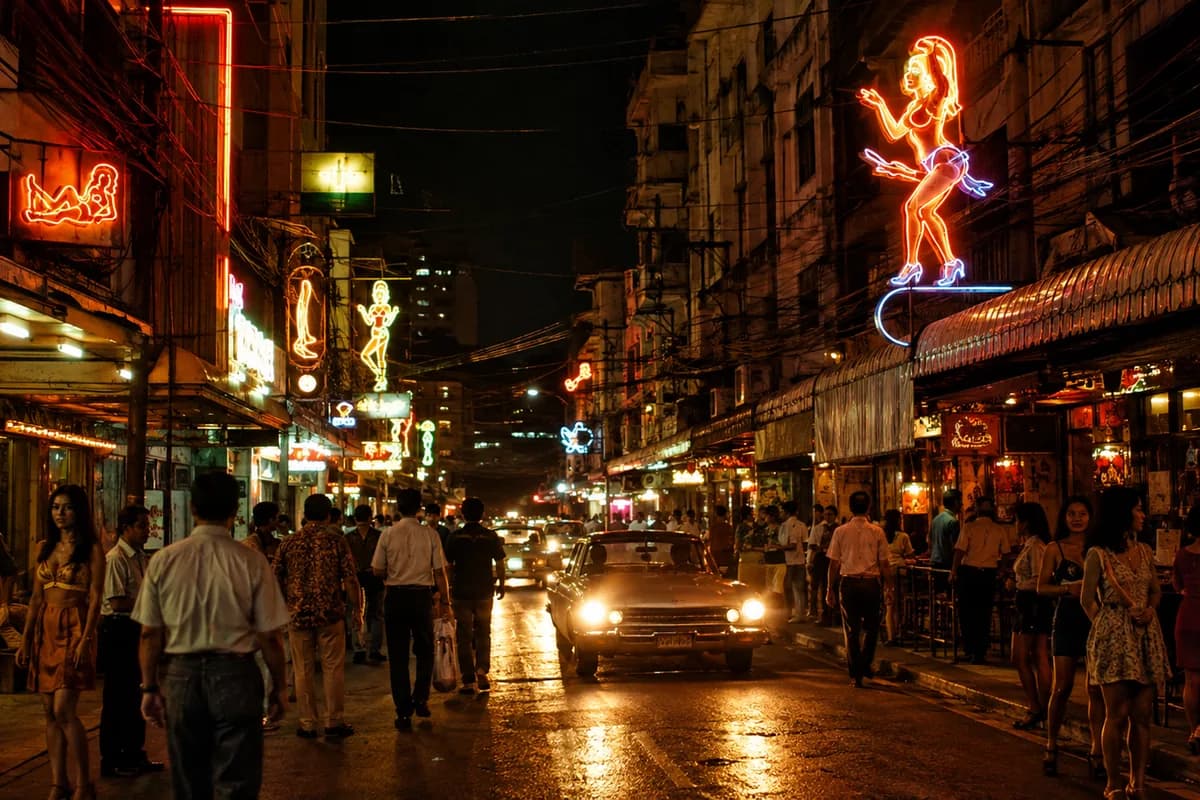
By the late 1960s and early 1970s, go-go-style entertainment had become increasingly associated with Patpong specifically. The exact history of individual early venues is wrapped in competing memories and promotional claims that are difficult to fully untangle, but the broader shift is clear enough: the district moved from being a business street that happened to have some nightlife into a nightlife street that happened to retain some business. That reversal transformed Patpong's identity for decades to come. The go-go bar format itself, incidentally, wasn't a Thai invention — the term describes an international nightclub style, built around music, a stage, dancers and drinks, rather than an ancient local tradition. Thailand adapted an imported format to its own tourism economy so thoroughly that many visitors now assume it originated here. It didn't — though what followed is a pattern that recurs constantly across modern Thai culture: a foreign concept arrives, Thai businesses adapt it, the adaptation develops genuinely local characteristics, and visitors eventually experience the result as uniquely Thai. (Our guide to modern Thailand explores this same pattern of absorption and adaptation across a much wider range of Thai culture.)
What Changed, and What Didn't, When the War Ended
The Vietnam War ended in 1975, and American R&R demand fell away almost immediately. If Patpong's nightlife economy had depended purely on soldiers, that might well have been the end of its story. Instead, international civilian tourism expanded to fill the gap: the customer changed, but the infrastructure — hotels, bars, restaurants, transport connections, a workforce experienced in serving foreign visitors — simply carried over into an entirely new market. Bangkok's growing role as a major international air hub, expanding package tourism and a steady flow of independent backpackers meant Patpong's bars discovered a civilian customer base almost as soon as the military one disappeared.
During the 1970s, Patpong's international reputation had already been growing rapidly, helped by foreign journalists and diplomats passing through Bangkok during the ongoing regional conflict. By the 1980s, that reputation reached extraordinary heights. Travel writers mentioned it, films used its atmosphere as a cinematic shortcut for "Southeast Asian nightlife" in general, books described it, and well-documented (and less well-documented) celebrity visits added to the mythology. A tiny handful of streets became a global symbol standing in for an entire city of millions — commercially powerful, and more than a little misleading about the Bangkok most residents actually experienced day to day.
An Honest Look at the History
This part of the story shouldn't be softened or hidden: Patpong became one of the best-known districts internationally associated with Thailand's commercial sex industry, and that reputation helped connect Bangkok, and eventually Thailand more broadly, with sex tourism in foreign media. That association became enormously powerful, and also enormously reductive — a whole city, and eventually a whole country, reduced in some foreign imaginations to a handful of neon-lit sois.
Two myths deserve correcting directly. First, commercial sex did not arrive in Siam or Thailand with American soldiers; urban prostitution existed long before the Vietnam War, and what the R&R era actually changed was scale, visibility, customer composition and the structure of foreign-oriented entertainment businesses built around it — the war accelerated and internationalised an existing phenomenon rather than inventing one. Second, treating every nightlife venue as functionally identical badly misrepresents the district's history: bars, dance venues, live-music spots, massage businesses, hostess venues and commercial sex work could and did overlap, but they were never automatically the same thing, and a responsible history recognises those overlaps without collapsing an entire economy into a single category.
Thailand's relationship with commercial sex has also long contained real legal contradictions — prohibited under Thai law in principle, while remaining visible in parts of the entertainment economy in practice, with entertainment venues themselves regulated through a separate legal framework entirely. Thailand4U's role here isn't to explain how to navigate that system; it's to note, as a matter of history, that Bangkok's nightlife economy developed inside the gap between formal law, everyday regulation, social reality and tourism demand — a gap that shaped the district for decades and still shapes discussion of Thai nightlife today.
The People Behind the Legend
Nightlife history gets told disproportionately through soldiers, bar owners and famous male visitors, which leaves out the people whose labour actually made the whole economy function. Women worked across this world as servers, dancers, hostesses, managers, cashiers, cleaners, musicians, vendors and business owners in their own right, and some also participated in commercial sex specifically — their individual experiences varying enormously, from genuine hardship to real entrepreneurial success, and reducing all of them to one stereotype erases the actual social history of the district.
Many workers came from outside Bangkok entirely, drawn by economic opportunity from rural provinces, with the northeast becoming especially significant as later decades progressed — money earned in the capital supporting families hundreds of kilometres away, linking nightlife districts directly to wider national patterns of migration and regional inequality. (Our guide to Isaan explores that migration story from the sending side.) The reasons individual women entered this world varied just as widely as the reasons anyone takes any job: higher wages, family income needs, following friends or relatives, temporary necessity that sometimes became a longer stay, and in some cases genuine business ambition that led to ownership. Human decisions rarely fit neatly into a simple morality tale in either direction, and the economic gap between foreign visitors' spending power and ordinary Thai wages shaped relationships, expectations and power throughout this history in ways that neither pure sentimentality nor pure cynicism captures accurately.
The Brand Becomes a Burden
The very reputation that made Patpong famous eventually became a genuine limitation. As Bangkok diversified and tourism diversified with it, new nightlife districts emerged to compete directly. Nana Plaza developed along Sukhumvit Road in a different urban context entirely, benefiting from the hotels, international restaurants and expat residences already clustered there as the city's commercial centre gradually shifted eastward. Soi Cowboy became another distinct, internationally recognisable nightlife street nearby, its compact size and neon signage giving it its own identity. Together, Nana, Soi Cowboy and Patpong became the three names most commonly associated internationally with foreign-oriented Bangkok adult nightlife — but Patpong had lost the monopoly it once held almost by default.
Patpong's own character shifted too. From the late 1980s into the early 1990s, a night market developed along the street itself — souvenirs, clothing, watches, bags — bringing enormous new pedestrian traffic and, with it, an entirely different kind of visitor: families and shopping tourists who came to browse rather than to enter a bar at all. The district became simultaneously more mainstream and less dominant as a pure nightlife destination, developing along the way a reputation for aggressive tourist scams around misleading show promotions and inflated bills — a reminder that tourism success can create incentives geared toward short-term customers who may never return, which tends to erode exactly the kind of long-term trust that sustainable local businesses depend on. None of that means every venue in the district shared the same reputation; long-running bars, restaurants, shops and genuinely reputable businesses existed alongside it, just as treating every tourist as identical would be equally inaccurate.
Bangkok Nightlife Was Always Bigger Than One Street
Foreign travel writing focused so heavily on Patpong for so long that it created a genuine distortion: "Bangkok nightlife," in much international coverage, effectively meant whatever foreign tourists happened to see. In reality, Bangkok held vast nightlife cultures serving Thai customers throughout this same period — live-music restaurants, dance clubs, pubs and entertainment complexes that had little to do with the Patpong story at all, later joined by huge modern entertainment districts such as RCA and Ratchada, oriented toward younger Thai customers and a growing Asian international clientele rather than the classic Western tourist. Nearby Thaniya Road developed its own distinct identity centred on Japanese customers, complete with Japanese-language signage, while Silom Soi 4 became important to Bangkok's LGBTQ+ nightlife — within a remarkably small area of the city, entirely different communities built entirely different nightlife geographies, a reminder that "foreign nightlife" was never one single, uniform culture even at its most internationally famous.
From Neon to Rooftop
Bangkok nightlife kept reinventing itself long after Patpong's peak visibility. Western tourists dominated the older international accounts, but later tourism became far more Asian, with Japanese, Korean, Chinese, Indian and Singaporean visitors becoming enormously important markets that businesses adapted to serve directly. The nightclub format itself evolved too — discos, then superclubs, electronic music, live bands, rooftop bars, speakeasy-style cocktail venues and beach-club aesthetics transplanted inland, alongside a genuinely serious craft-cocktail and fine-dining scene that had nothing to do with the R&R-era image at all. By the 21st century, Bangkok had built a radically different international nightlife reputation around sky bars, luxury rooftops and Michelin-recognised restaurants. Patpong's neon remained, visibly, but it was no longer the only story international visitors told about Bangkok after dark.
The internet changed the underlying mechanism too. Guidebooks had once given nightlife districts a kind of permanence — a traveller in Europe could read the Patpong name before ever setting foot in Thailand, and maps and reviews shaped expectations before arrival. Online information eventually broke that monopoly on knowledge entirely: visitors could compare Nana, Soi Cowboy, RCA, Thonglor and hundreds of independent venues directly, reviews exposed scams far more quickly, and Bangkok's nightlife fragmented into something genuinely plural. The famous street became one option among very many, in a city that had, by then, grown considerably larger, richer and more diverse than the one that produced Patpong's international reputation in the first place.
Walking Patpong Today
Modern Patpong still carries its history visibly, even as it's no longer the unquestioned centre of foreign Bangkok nightlife it once was — arguably making that history more interesting rather than less. Visit only expecting scandal and you'll miss the genuinely useful urban story sitting underneath it: notice how narrow the district actually is, look at Silom and Surawong bustling with ordinary commercial life on either end, and remember this was commercial property before it became a global nightlife legend. Walk through wider Silom during business hours and Patpong's strange geography becomes obvious — banks, offices, hospitals, embassies, restaurants and commuters everywhere, and then, within a few small sois, the night economy wakes up. Patpong never actually existed separately from serious, ordinary commercial Bangkok. It grew directly inside it, and in many ways it still does.
Nightlife districts, whatever their history, contain real workers rather than performers assembled for visitor entertainment, and a responsible visit treats them accordingly — no photographing people without permission, no assuming every person working in nightlife offers identical services, and no confusing simple curiosity with entitlement. The same basic common sense that applies to nightlife anywhere else in the world applies here too: know prices before ordering, check bills carefully, don't follow aggressive street solicitation, keep valuables secure, and use licensed or app-based transport where practical. The goal of visiting with any historical awareness at all is to understand the city more fully, not to become the subject of tomorrow's cautionary story.
Why the Story Matters
Patpong's real significance isn't that Americans arrived and simply invented nightlife from nothing — that framing badly oversimplifies a much more complicated chain of events. Bangkok was already changing rapidly in the post-war years; a private commercial district emerged out of ordinary real-estate ambition; the Cold War brought new foreign institutions and sustained military demand into the same small area; R&R accelerated the growth of tourism infrastructure well beyond anything the district's original developers had planned for; Thai businesses adapted with real speed and skill; nightlife became internationally famous almost by accident; civilian tourism smoothly replaced military customers once the war ended; and competing districts across the city copied, competed with and eventually overtook Patpong's early dominance. That is simply how industries actually grow, in Thailand as much as anywhere else.
There's something genuinely strange in how infrastructure built by geopolitical conflict ended up supporting decades of leisure tourism that followed it. American military strategy had nothing whatsoever to do with the backpackers who later drank on Sukhumvit, or the couples posing for rooftop cocktail photos decades afterward — yet the roads, aviation links, foreign-oriented services and basic international familiarity that the Cold War era built all fed directly into a tourism economy that comfortably outlived the war itself. History repeatedly produces consequences nobody actually planned, and Patpong is one of the clearest examples anywhere in Thailand of exactly that process at work. Walk its narrow sois today and several distinct eras genuinely overlap in the same small space: post-war business Bangkok, Cold War Bangkok, Vietnam-era R&R, 1980s neon mythology, 1990s night-market tourism, and a still-ongoing story of reinvention. The physical street remains small. The historical footprint it left on the country's entire tourism industry is anything but.