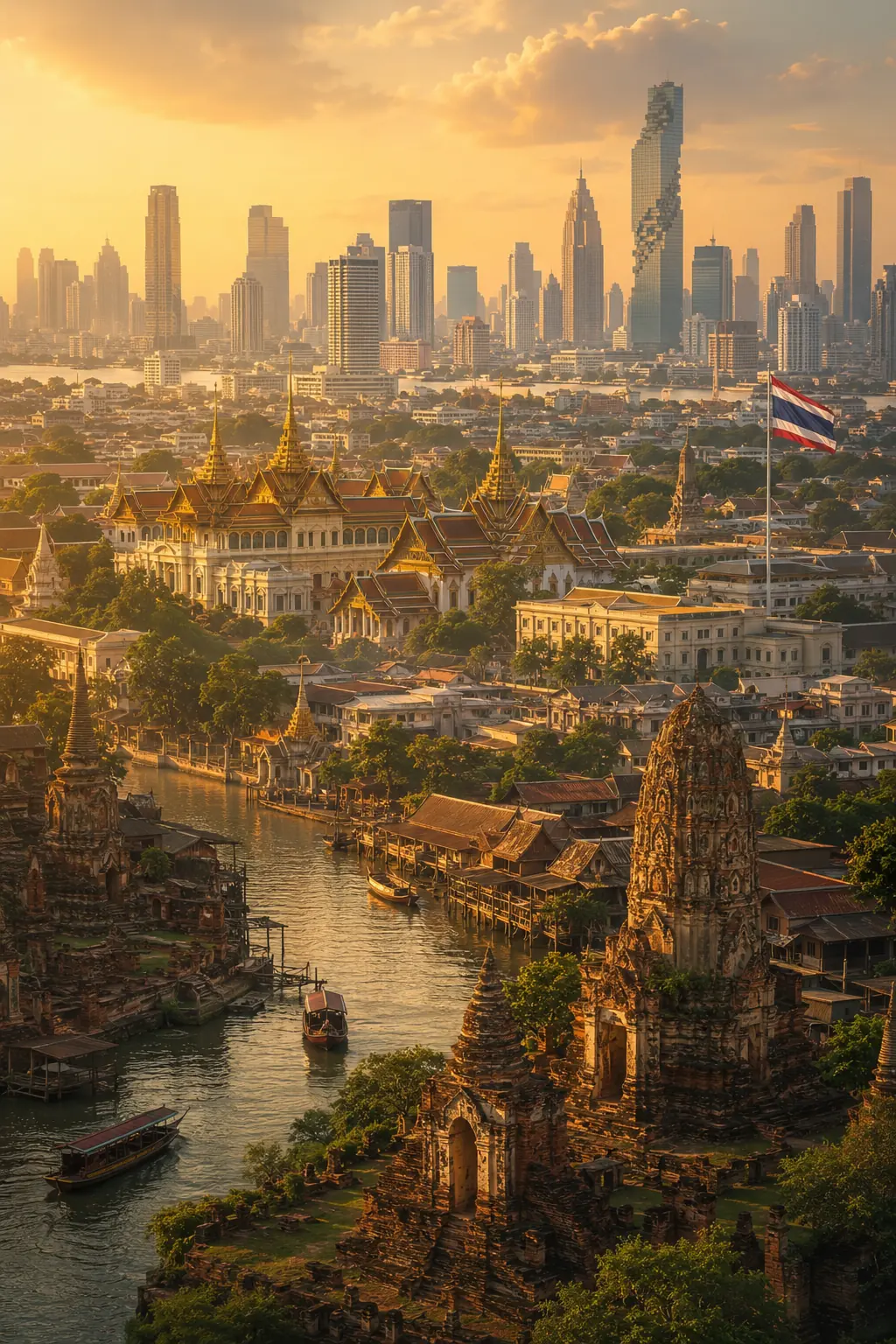
A Country That Feels Built for Visitors
Thailand can feel effortlessly designed for tourism — airports that connect efficiently, hotels at every price point, English signage in major destinations, street food and beaches and temples all within easy reach. None of that happened by accident. It was built, deliberately and gradually, over more than half a century, and it transformed fishing villages into international resorts, turned Bangkok into one of the world's great gateway cities, and connected remote islands to global travel culture. It also brought real pressure: rising land prices, changing communities, environmental strain, and destinations that became economically dependent on visitors who might, one day, simply stop coming. Understanding what tourism did to Thailand is essential to understanding the country most travellers actually encounter today.
Before Mass Tourism
Foreign visitors reached Siam long before modern leisure travel existed. Ayutthaya welcomed merchants, diplomats and missionaries from across Asia, the Middle East and Europe centuries before anyone thought of a "holiday," and 19th-century Siam attracted explorers, officials and scholars in similarly small numbers. But this was never mass tourism — travel was expensive, slow and difficult, and almost everyone who reached the kingdom had a reason beyond simple leisure. Modern tourism required a different set of ingredients entirely: cheap transport, commercial aviation, hotels, roads, international marketing, paid holidays, and a growing middle class abroad with both money and time to spend on travel.
Building an Industry on Purpose
Thailand began constructing an organised national tourism industry in the mid-20th century. The Tourist Organisation of Thailand was established in 1959 and formally opened in 1960, later becoming the Tourism Authority of Thailand — a detail worth pausing on, because it means Thailand's tourism boom wasn't simply an accident of geography and good beaches. The state actively promoted the country abroad, building beaches, temples, culture and hospitality into a coherent national tourism brand from an early stage.
Commercial aviation changed the scale of what was possible almost overnight. Bangkok grew into an increasingly important air-transport hub, and a journey that once took weeks by sea could be completed in hours. Hotels expanded, airlines added routes, and tour operators began building holiday packages — Thailand's geography made Bangkok a natural Southeast Asian gateway, and the country was positioned for international tourism at almost exactly the moment international tourism itself was exploding worldwide.
The Vietnam War Accelerates Everything
One chapter of this story has become almost legendary. As the United States became deeply involved in Southeast Asia through the Vietnam War, Thailand became an important American ally, and air bases operated in several parts of the country. American servicemen stationed in or passing through the region travelled to Thailand for rest and recreation — R&R — and Bangkok became a major destination, with Pattaya increasingly drawing military visitors too. The money spent by servicemen on hotels, restaurants, bars and transport didn't invent Thai tourism, but it dramatically accelerated the development of infrastructure and service industries that would later serve an entirely civilian clientele. (Our guide to Thailand and the farang looks more closely at this military-to-tourism transition through the lens of foreign visitors specifically.)
Few places show tourism's raw transformative power as clearly as Pattaya. Before becoming an international resort city, the area held small coastal fishing communities. As American military visitors arrived for recreation during the war years, accommodation, bars and restaurants expanded to meet demand, more visitors followed, more businesses opened, and development pushed steadily inland from the beach. Tourism there didn't simply create an industry — it created an entirely new urban landscape, one whose early nightlife-driven reputation proved remarkably durable even as the city later added shopping malls, hospitals, international schools and large residential communities around it. (Our dedicated guide to how Pattaya became Pattaya traces that transformation in full.)
Bangkok's role was different, but equally shaped by this period. The capital became Thailand's main international gateway, with hotels clustering around districts offering transport, business and entertainment — Silom, Sukhumvit, the riverside, and later Khao San Road each developing their own distinct character. A backpacker on Khao San Road and a corporate executive in Thonglor could, and still can, spend years in the same city experiencing almost entirely different versions of it.
Building the Infrastructure of a Holiday
Tourism transformed accommodation from the ground up. Simple inns gave way to international hotel chains, luxury riverside properties, beach resorts, backpacker guesthouses, island bungalows, and eventually boutique hotels, hostels, serviced apartments and online booking platforms — Thailand developed accommodation across nearly every budget imaginable, which became one of its lasting competitive strengths.
Package tourism changed the scale of travel itself. Instead of independently arranging every element of a trip, holidaymakers could buy flight, hotel and transfer as a single product, bringing Thailand within reach of people who might never otherwise have considered organising a trip to Southeast Asia. Beach destinations benefited enormously — Phuket, Pattaya, Koh Samui, and later Krabi and Khao Lak all grew rapidly once packaged travel made them accessible at scale.
Phuket demonstrates how quickly this could happen. Once an island economy built around tin mining, rubber and trade, Phuket saw tourism gradually become dominant as beaches like Patong, Kata and Karon drew growing numbers of international visitors, hotels multiplied, roads improved, and an international airport connected the island directly to foreign markets. Patong in particular became a case study in tourism-driven urbanisation, its accommodation, nightlife, shopping and restaurant scene expanding so completely around foreign arrivals that the modern town is almost impossible to describe without reference to tourism itself. Koh Samui followed a somewhat different path — from simple beach bungalows favoured by independent travellers toward an airport, high-end resorts and luxury villas serving everyone from budget backpackers to wealthy visitors on the same island.
The bungalow era deserves its own mention, because it shaped a generation's mental image of Thai travel: cheap wooden huts, a fan, a mosquito net, the beach just outside. As destinations grew popular, those simple bungalows often disappeared or moved upmarket, because tourism doesn't only change who visits a place — it changes what the underlying land is worth, sometimes turning a hundred-baht hut into a resort worth millions within a generation.
The Backpacker Circuit and Khao San Road
Independent backpackers created a second, parallel tourism revolution. Thailand became a core stop on the wider Southeast Asian travel route, helped by cheap transport, affordable food, an established guesthouse network and visa arrangements that made regional overland travel realistic. Khao San Road became one of the world's most famous backpacker hubs — cheap guesthouses, travel agencies, bars, laundry services and everything else a young traveller might need, concentrated into a few hundred metres of central Bangkok, a kind of self-contained staging ground for wider Southeast Asian travel. Before smartphones existed, guidebooks could transform entire destinations almost overnight: a small guesthouse mentioned in a popular book might suddenly fill with foreign travellers, and a beach once described as untouched could stop being untouched within a few short years. Koh Phangan's Full Moon Party grew through exactly this kind of word-of-mouth momentum, from a modest gathering into an internationally famous beach party drawing thousands of visitors specifically for one night a month — economically significant, but also a source of real environmental, safety and reputational challenges for the island around it.
Specialised Tourism Multiplies
As the industry matured, it stopped being one single market and became dozens of overlapping ones. Diving tourism turned Koh Tao into an internationally known training hub and made Phuket and Khao Lak gateways to Andaman dive sites. Medical tourism grew around Bangkok's private hospitals, which built international reputations for high-quality care at competitive prices, drawing visitors for everything from routine health checks to major procedures. Wellness tourism turned massage, yoga and retreat culture — drawing on genuine Thai tradition as well as imported international trends — into a travel product in its own right. Golf tourism brought a different visitor profile entirely, built around courses in Bangkok, Pattaya, Hua Hin, Phuket and Chiang Mai and a spending pattern with little in common with backpacking. Shopping tourism turned Bangkok's enormous malls into destinations that need no beach or temple nearby to justify a visit, while night markets grew into spaces where local life and visitor demand overlap rather than compete.
Nightlife became one of the most internationally visible parts of the whole industry, present in Bangkok, Pattaya, Phuket and Samui alike, and inevitably connected — for better and worse — with Thailand's international reputation for adult entertainment, a history that deserves its own careful treatment rather than a passing mention here. What matters for this article is simpler: tourism created demand for a night-time economy on an enormous scale, and that economy became a genuine part of how several Thai cities function and employ people.
Tourism Moved Thai People Too
Foreign visitors weren't the only people tourism set in motion. Workers migrated from Isaan, the north and other provinces toward tourism centres in huge numbers — hotel staff, chefs, construction workers, drivers, massage therapists, retail staff, tour guides, entertainers and managers, turning destinations like Pattaya and Phuket into genuine national migration hubs. The connection to Isaan is particularly strong: money earned in tourism centres travels back to home provinces, children are sometimes raised by grandparents while parents work elsewhere, and a single hotel room booked in Phuket can indirectly support a household hundreds of kilometres away. (Our guide to Isaan explores this migration pattern from the other end.)
Tourism created huge numbers of jobs for women specifically, across hotels, restaurants, retail, massage, administration and entertainment — genuinely expanding economic opportunity, while also creating industries where workers could face real inequality, insecurity or exploitation. Counting visitor spending alone doesn't answer the more important question of who actually receives that money and under what conditions.
At the same time, tourism proved remarkably entrepreneurial at a small scale, enabling enormous numbers of Thai families to start food stalls, guesthouses, laundry shops, taxi services, tour desks and small restaurants — genuine opportunities that simply didn't exist before visitors arrived in volume. Foreign investment entered too, through hotels, restaurants, property and international franchises, bringing capital and expertise alongside real debates about ownership and how much tourism income actually stays in the community that generates it. Land prices rose accordingly: a quiet coastal plot could become valuable virtually overnight once a hotel became possible there, creating clear winners and losers, sometimes within the same family.
Numbers, Then Collapse, Then Recovery
The scale Thailand's tourism industry eventually reached is genuinely extraordinary. By 2019, the country recorded roughly 39.9 million international tourist arrivals according to World Bank data — a level that turned tourism from a niche industry into a core pillar of the national economy. Then the COVID-19 pandemic arrived, border restrictions were introduced, and international tourism collapsed almost overnight. Hotels closed. Bars closed. Tour companies stopped operating. Beaches emptied. Workers lost income and many returned to their home provinces. Images of an empty Pattaya, a city built entirely around movement and suddenly stopped, were especially striking — a stark demonstration that the tourism machine only works when people actually arrive.
Thailand later experimented with controlled reopening programmes such as the Phuket Sandbox, allowing vaccinated international visitors to enter under specific conditions ahead of wider national reopening — effectively turning the island into a test site for rebuilding international travel. Visitors did eventually return, but the pandemic changed the underlying conversation: should the goal be maximum visitor numbers, or higher-value tourism? Should popular destinations limit crowds? How should environmental damage be managed, and how can local communities capture more of the benefit? "More tourists" stopped being treated as an automatically sufficient answer.
Not Only a Western Story
The picture of Thai tourism dominated by Western visitors is genuinely out of date. Travellers from China, Malaysia, India, South Korea, Japan, Singapore and elsewhere in Asia became enormously important markets, with China in particular growing into one of Thailand's largest sources of visitors. Restaurants, shopping, tour operations and payment systems adapted accordingly — hiring Chinese-speaking staff, adjusting menus, expanding group-tour infrastructure — and Thailand's tourism industry became sensitive to economic and political conditions across Asia as much as to conditions in Europe or North America.
Domestic tourism matters just as much, if quieter in international headlines. Bangkok residents travel to beaches, families visit temples, young Thais fly to Chiang Mai for a weekend, and Thai social media drives its own trends entirely independent of foreign visitors — a small café or a scenic viewpoint can become nationally famous through Thai TikTok alone. Domestic travel helps destinations survive periods when international arrivals weaken, and it's a useful reminder that Thailand's tourism culture wasn't built only for outsiders.
What Tourism Gave, and What It Cost
The benefits are substantial and genuine: jobs, foreign income, infrastructure, international connections, business opportunities, global recognition, and economic growth in areas that previously had few other options. The costs are equally real: environmental pressure, congestion, waste, higher land prices, economic dependence, overdevelopment, cultural simplification, and destinations left vulnerable to global shocks well beyond their control. The honest answer to "was tourism good or bad for Thailand" isn't a simple verdict in either direction — tourism is a tool, and depending on how it's managed, the same industry can fund conservation or damage coral, preserve traditional crafts or flatten them into souvenirs, create genuine independence for workers or create exploitative conditions for them.
Tourism can also change how a destination understands itself. Sometimes for the better: a regional dish gains national fame, a local festival draws wider attention, historic buildings get restored, young people find economic reasons to stay in their home province rather than leaving for Bangkok. Sometimes for the worse: old neighbourhoods become tourist districts, rents rise, long-time residents move out, local shops become souvenir stores, and culture starts to feel performed rather than lived. Both outcomes have happened in Thailand, sometimes in the same town at different points in its history.
The Country Behind the Holiday
Every visitor experiences a specific, curated slice of Thailand — backpacker Thailand, luxury Thailand, nightlife Thailand, temple Thailand, island Thailand, golf Thailand, medical Thailand. None of these versions is fake, and none is complete; they exist because businesses respond to what different kinds of visitors actually want. Someone who spends a week in Phuket may return home believing they understand the country; someone who spends ten nights in Pattaya may describe the whole of Thailand through Pattaya alone. Tourism creates strong impressions fast, faster than culture or context can usually correct them.
The next time a destination feels effortless — the room ready, the ferry on time, dinner inexpensive, the beach matching the photograph exactly — it's worth remembering that ease sits on top of a considerably more complicated system: decades of infrastructure, migration, investment, government policy and constant adaptation. Understanding that system doesn't make the holiday any less enjoyable. If anything, it makes the country a great deal more interesting, because the easy version of Thailand that tourists encounter was built, piece by piece, by people whose lives continue long after any given traveller has gone home.