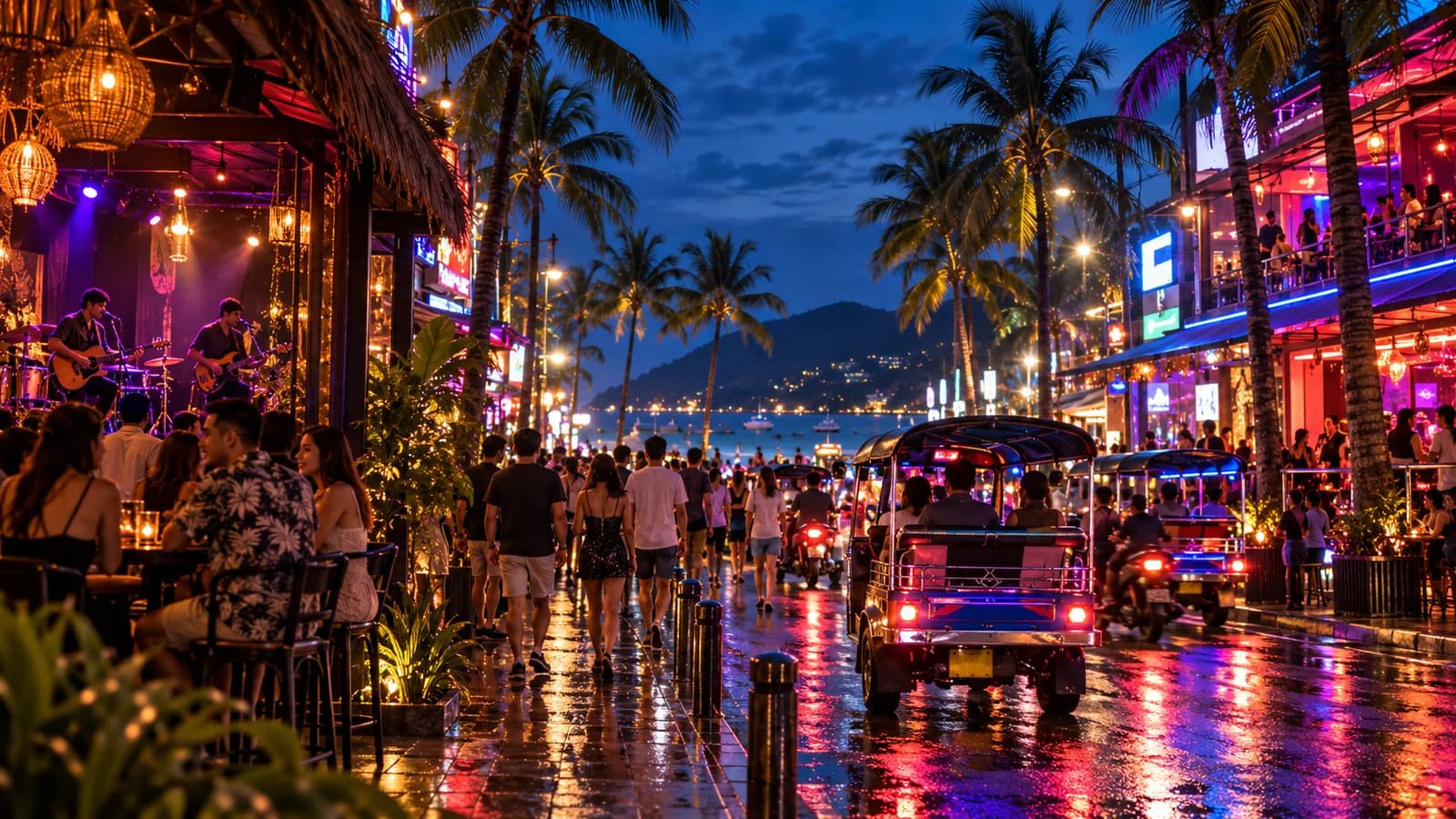
1. Patong Nightlife Was Never Just One Street
Bangla Road became the visual symbol of Patong after dark, but the history of nightlife in the resort is much larger than the history of Bangla itself.
By the 1990s, visitors could already choose between different forms of evening entertainment. There were discos, live music, small bars, hotel lounges, cabaret shows and a separate LGBTQ+ nightlife community developing around Paradise Complex. Later came larger multi-level clubs, international DJs, genre-specific venues and entertainment properties designed not only for independent travellers but also for tour groups.
That diversity matters because it changes the way Patong’s nightlife history should be understood.
It was not one industry serving one type of tourist.
Different businesses responded to different visitor markets, price points, languages, music tastes and social expectations. Some venues relied on repeat visitors. Others were designed for large crowds. Some built community. Others sold spectacle. Some disappeared after a few seasons, while others survived for decades.
The result was a nightlife ecosystem rather than a single district.
This broader history also helps explain why Patong remained resilient. When one type of venue lost popularity, another could grow. When one customer market weakened, businesses looked for another.
Patong after dark kept changing because Patong tourism kept changing.
2. By the Early 1990s, Patong Already Had Different Nightlife Formats
The early 1990s provide a useful starting point because the surviving evidence becomes much clearer.
Long-term Phuket resident Willy Thuan, who has documented Patong’s changes for decades, remembers the area around 1990 as far smaller and quieter than today. Small bars were concentrated in side lanes, while large nightlife venues were limited.
By 1994, his retrospective places Banana Disco and Tai Pan among the small number of established discos in central Patong.
The exact opening chronology of individual clubs is less certain. Some secondary sources date Banana Disco to 1993, but that date is not strong enough to use as the foundation of the story. What matters is that both Banana and Tai Pan were already recognised institutions by the mid-1990s and remained important enough that Phuket provincial authorities included both in a 2004 scheme recognising selected registered entertainment venues.
These were not the only forms of nightlife.
Patong’s growth created demand for entertainment that ranged from simple open-air bars to dance clubs and stage shows. The city was beginning to develop specialised places rather than asking every venue to serve the same crowd.
That specialisation is one of the most important shifts in the history.
Once visitors could choose what kind of night they wanted, Patong stopped being merely a beach resort with bars.
It became a nightlife destination.
3. Simon Cabaret and the Rise of Night-Time Show Tourism
One of Patong’s most durable entertainment institutions opened outside the bar-and-disco model.
Phuket Simon Cabaret dates its opening to 1991. Its purpose-built theatre, professional staging, costumes, lighting and large cast represented a very different kind of after-dark tourism from the small bars developing elsewhere in the resort.
The distinction is significant.
A cabaret theatre sells a scheduled performance rather than an open-ended night out. It can be marketed through hotels, travel agents and tour operators. It attracts visitors who might never enter a nightclub. The audience can include couples, groups and families as well as travellers already interested in nightlife.
That broadened the meaning of "night entertainment" in Patong.
It also demonstrated that the resort could support businesses requiring substantial fixed investment. A 600-seat theatre needed enough nightly demand to justify staff, production, costumes and technical equipment over many years.
Simon Cabaret’s longevity is therefore useful historical evidence.
By the early 1990s, Patong’s visitor economy was already large enough to sustain professional evening entertainment on a scale far beyond the improvised beach-town bars of the previous era.
The nightlife economy was beginning to become an entertainment industry.
4. Paradise Complex and a Different Kind of Nightlife Community
Another part of Patong’s history developed slightly away from Bangla Road.
Paradise Complex became the centre of Phuket’s LGBTQ+ nightlife. Its importance was not simply that it contained bars. It created a recognisable community district with guesthouses, restaurants, clubs, cabaret-style venues and businesses that served LGBTQ+ residents and visitors.
Community accounts place a major organisational turning point in the late 1990s.
Connect Guesthouse opened in the Paradise area in 1998, and local organisers later described it as one of the meeting points from which the first Phuket Pride event was organised in 1999. The first Pride involved cooperation among nightlife and hospitality businesses that had previously operated more independently.
That history is valuable because it shows nightlife creating community infrastructure.
Businesses promoted one another, organised events and helped make an otherwise small cluster visible to a wider audience. Pride later became a recognised part of Patong’s public event calendar.
The district also developed its own performance traditions, particularly cabaret and drag, which overlapped with but remained culturally distinct from the broader Bangla scene.
Patong’s nightlife identity was therefore already plural by the end of the 1990s.
Different communities occupied the same resort without needing to become the same nightlife market.
5. 2001-2004: Nightlife Becomes an Organised Industry
By the beginning of the 2000s, nightlife in Patong was large enough to act collectively.
In May 2001, around one thousand bar owners and workers gathered on the beachfront football field to protest enforcement of the national 2am closing time. Their argument was economic: they said Patong’s tourist trade operated later than many other places and that early closure damaged businesses dependent on international visitors.
The protest is useful historical evidence even without taking a position on the policy.
It demonstrates scale.
Patong nightlife was no longer a loose fringe of small businesses. It had enough operators and workers to organise, petition government and present itself as a major part of the local tourism economy.
The following years brought repeated debate over closing hours, licensing and the government’s Social Order policy. In 2004, more than two hundred entertainment businesses in Patong were affected by revised closing rules, while a formally defined entertainment zone covered much of the resort’s central nightlife geography.
These regulatory battles helped professionalise the industry.
Business associations became more important. Venues had to think more carefully about licensing, security, age restrictions and their relationship with local authorities.
Nightlife was becoming part of destination management rather than merely something that happened after the rest of the tourism day had ended.
6. Live Music and the Mid-2000s Search for a Broader Audience
The mid-2000s brought another visible strand of Patong nightlife: large live-music venues aimed at international rock audiences.
Rock City is a useful example.
A 2007 Phuket Gazette report described the club as a popular Patong nightclub and quoted its managing director saying he had been working with one of the investors on the project since December 2003. The exact opening date is less important than what the venue represented.
Rock City built its identity around live bands, tribute acts and rock culture rather than the standard dance-club formula.
This appealed to a different visitor.
The resort’s nightlife was increasingly segmented by taste. A traveller who wanted live rock no longer had to treat a general disco as the only late-night option. Music itself could define the venue.
This was also the period when Patong attracted increasing foreign investment in nightlife businesses. Scandinavian and other European entrepreneurs became visible in several parts of the hospitality sector, working alongside Thai partners, managers and staff.
That internationalisation did not make the industry less Thai.
It made Patong a meeting point of investment, labour, music cultures and tourist expectations from several countries.
The nightlife economy was becoming more global in both audience and ownership.
7. Seduction 2006: The International Club Model Arrives
A particularly clear marker of change arrived in November 2006.
The Phuket Gazette introduced Seduction as Patong’s newest disco and described it as a large, polished two-level club opened by a Finnish company that already operated dozens of clubs in Finland and Estonia.
This was a different model from the informal bar clusters associated with older Patong.
The owners imported parts of the lighting system, emphasised design, DJs and professional club presentation, and deliberately positioned the venue as a more conventional international nightclub.
The significance is not that Patong had never seen a modern disco before.
It is that nightlife investment was now benchmarking itself against European club markets.
Businesses were no longer asking only what worked in Phuket. They were asking what could compete with nightlife experiences travellers already knew from elsewhere.
Seduction also shows how quickly Patong venues could evolve.
The brand later expanded into a larger complex and changed repeatedly over the following decade. Individual formats and owners came and went, but the idea behind them endured: larger investment, stronger production, more deliberate branding and greater competition over music, atmosphere and design.
The resort’s nightlife was becoming less improvised and more engineered.
8. From Clubs to Entertainment Complexes
By the 2010s, the scale of Patong nightlife had changed again.
Illuzion, which opened in December 2014, illustrates the shift.
Contemporary Phuket reporting described a project of around 4,000 square metres with a reported investment of roughly 244 million baht. The original concept combined a large theatrical show with a nightclub, using major sound, lighting and visual systems.
More revealing than the hardware was the intended audience.
The operators explicitly talked about changing Phuket tourism demographics. They wanted to work with tour operators and attract groups who were curious about Patong nightlife but did not necessarily identify with the traditional bar scene. Multilingual staff and organised services for tour groups were part of the business model.
That represented a major historical change.
Patong nightlife was no longer relying only on independent travellers wandering into venues from the street.
At least some operators were trying to package nightlife as a structured tourism product.
The line between nightclub, theatre and attraction was becoming less clear.
This was a long way from the small beach-town discos of the early 1990s.
Patong’s largest nightlife businesses were now competing for customers through spectacle, scale and professional tourism distribution.
9. Genre-Specific Clubs and a More Global Nightlife Market
The next stage was increasing musical specialisation.
Large Patong clubs had traditionally mixed mainstream dance music, pop and familiar international hits to appeal to the widest possible tourist audience. By the late 2010s, businesses were increasingly confident that individual music genres could support major venues of their own.
Sugar Club Phuket is a useful example.
The Phuket branch officially celebrated its grand opening in February 2019 with an explicitly hip-hop identity, bringing the Bangkok brand to Patong and promoting both Thai and international performers.
This is historically significant for two reasons.
First, it shows the size of the market. A nightclub could now narrow its musical identity rather than trying to please everybody.
Second, it shows how connected Patong had become to wider nightlife networks. Brands, performers and club concepts could move between Bangkok, Phuket and international markets.
The audience was changing too.
Patong no longer served mainly the European holidaymaker image associated with earlier decades. Phuket had become a genuinely global tourism destination, with visitors arriving from Russia, China, India, the Middle East, Australia, Europe and across Asia.
Not every group used nightlife in the same way.
The response from businesses was diversification rather than one universal formula.
Patong after dark was becoming a collection of parallel markets.
10. COVID-19 Breaks the System
The COVID-19 pandemic exposed how much the whole system depended on travel.
Bars, clubs and entertainment venues were ordered closed in March 2020. When nightlife was allowed to reopen from July, the return was hesitant. Patong Entertainment Business Association estimated that only around twenty per cent of Bangla-area venues would initially reopen because operators were uncertain whether enough customers existed to make trading viable.
The deeper problem was not simply regulation.
International customers were absent.
A nightclub built for thousands of people could not simply substitute a few local residents for mass tourism. Cabaret theatres, live-music venues, small bars, restaurants, transport workers, suppliers and hotel businesses were all connected to the same visitor economy.
The disruption lasted far beyond the first lockdown.
Phuket reopened to vaccinated international tourism under the Sandbox programme in July 2021, but pubs, bars and entertainment venues initially remained closed. Restrictions eased in stages, with more normal operating hours returning only in 2022.
The pandemic therefore interrupted almost every nightlife model at once.
Small flexible venues suffered because their cash reserves were limited.
Large venues suffered because their scale became a liability without crowds.
Community organisations and business groups became important in distributing food, negotiating support and lobbying for reopening.
For two years, Patong learned what its nightlife economy looked like without nightlife.
The answer was an economy with a large hole in it.
11. What Patong’s Nightlife Evolution Actually Shows
The easiest way to tell Patong nightlife history is as a story of getting bigger.
That is true, but incomplete.
The more important change was diversification.
In the early 1990s, the resort already contained small bars, a few recognisable discos and professional cabaret. By the end of the decade, Paradise Complex had developed a distinct community identity and Phuket Pride had begun. The early 2000s showed nightlife acting as an organised economic sector. Live-music venues widened the music culture. Seduction brought a more international club model. Illuzion pushed scale and production into a different category. Sugar Club showed that a genre-specific international brand could find a market in Patong.
Then COVID demonstrated that all of these apparently different businesses were connected by the same thing: tourism.
That is the central lesson.
Patong nightlife was never one street, one type of venue or one visitor group.
It became successful because it could offer several versions of a night out within the same compact resort.
Some people wanted a stage show.
Some wanted live music.
Some wanted a dance floor.
Some wanted a small social bar.
Some found community in a particular district.
And as Phuket’s visitor economy became more global, those markets multiplied.
Bangla Road became the symbol.
Patong after dark became the system behind it.