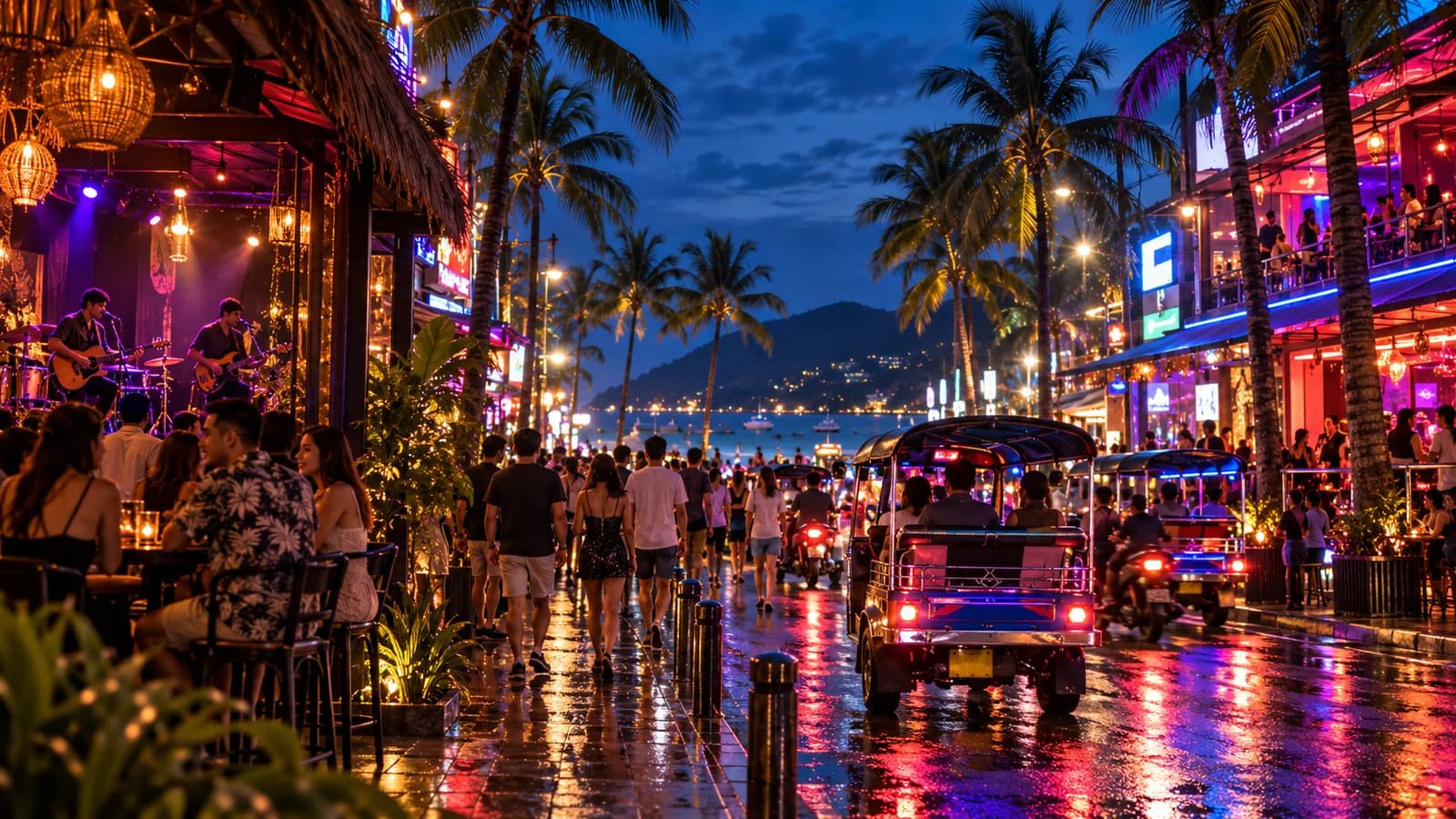
1. The Street That Came to Represent Patong
Bangla Road is now so closely associated with Patong that it can seem almost inevitable.
A short road linking the beach with Rat-U-Thit 200 Pi Road became the island’s best-known nightlife address, a place recognised by visitors who may know little else about Phuket after dark.
But Bangla was not designed from the beginning to play that role.
Its history is the result of concentration. As Patong grew, accommodation, restaurants, shops and entertainment businesses gathered around the beach and the streets immediately behind it. Bangla sat in exactly the right place: close to the sand, close to hotels, and later close to major shopping and transport flows.
Over time, small side-soi bars became denser. The main road became more commercially valuable. Authorities began experimenting with removing vehicles. The street became a destination in its own right rather than merely a route between destinations.
That distinction matters.
Bangla Road is not the origin story of all Phuket nightlife, and it should not be written as though one bar, one decade or one group of visitors suddenly created it. Patong’s development stretched across decades and involved Thai entrepreneurs, migrant workers, hotel investors, foreign visitors, local authorities and thousands of small tourism businesses.
Bangla became famous because those forces ended up compressed into a few hundred metres of road.
2. Before Bangla Was Famous: Patong’s Tourism Take-Off
The background begins with Patong rather than nightlife.
A major Stockholm Environment Institute study describes Phuket’s tourism development as beginning in the 1970s around two small settlements on Patong Bay. At the time, tin mining remained an important source of livelihood, alongside fishing, palm cultivation and rubber.
The island already possessed wealth accumulated through mining, and as the tin economy weakened, some of that capital helped support tourism development.
Several events accelerated the change.
The international exposure created by The Man with the Golden Gun, released in 1974 and filmed partly in nearby Phang Nga Bay, helped place the region in front of Western audiences. Tourism promotion expanded during the late 1970s. Phuket Airport and international air connections became increasingly important during the 1980s.
Patong initially attracted backpackers and budget travellers. As visitor numbers rose, larger hotels and higher-end investments followed, especially from the early 1990s.
This wider chronology is important because it gives Bangla Road its proper setting.
The nightlife street did not create Patong’s tourism boom.
Patong’s tourism boom created the conditions in which a nightlife street could emerge.
3. The 1980s and Early 1990s: Small-Scale Patong
The early Bangla landscape looked very different from the modern street.
The strongest surviving description comes from long-term Phuket resident Willy Thuan, who has documented Patong since the 1990s and compared later development with his memories and older images.
His account describes Bangla around 1990 as relatively quiet on the main road, with much of the nightlife activity concentrated in small side lanes. Bars were simple, often open-air or lightly built, and the overall scale was modest compared with later decades.
By 1994, the street was growing but was still recognisably part of a low-rise beach town. The number of bars had increased, while the nightclub scene remained limited compared with what would follow.
This should be treated as eyewitness and specialist local history rather than a formal business census.
Even so, the broad picture is consistent with Patong’s wider tourism development: a resort moving from backpacker and budget-tourist origins toward a more intensive international market.
Bangla’s early advantage was not grandeur.
It was location and flexibility.
Small units could change use quickly. Side sois could hold clusters of bars without requiring major redevelopment. A visitor staying near Patong Beach could reach the area on foot.
The street grew because it was easy to use, easy to find and increasingly surrounded by the people it served.
4. By the Late 1990s, the Road Itself Was Becoming the Attraction
A nightlife district changes when people begin caring about the street rather than only the businesses on it.
By 1999, that transition was clearly underway on Bangla.
In May of that year, the Phuket Gazette ran an online poll asking whether Soi Bangla should be closed to vehicles and designated for pedestrians. Just under two thirds of respondents supported the idea, although Thai and foreign respondents differed noticeably in their views.
The poll did not create a policy, but it shows that pedestrianisation was already a public issue.
Two years later, in December 2001, Deputy Prime Minister and Tourism Minister Pitak Intrawitayanunt inspected Patong and publicly proposed converting all of Soi Bangla, together with part of the beach road, into a pedestrian zone on weekends.
His reasoning was explicitly connected to tourism: visitors would have more space to walk and businesses could benefit from a more attractive public environment.
The proposal was not yet the nightly Walking Street system known today.
But the direction was clear.
Bangla was becoming more than a road lined with nightlife businesses.
Authorities, businesses and visitors were beginning to imagine the road itself as tourism infrastructure.
5. Regulation and the Entertainment Zone
By the early 2000s, Bangla was already important enough to be treated as part of Patong’s formal nightlife geography.
In September 2004, the Phuket Gazette reported on new national closing-time rules affecting more than two hundred entertainment businesses in Patong. The report identified Soi Bangla, Thaweewong Road, Rat-U-Thit 200 Pi Road and the Sainamyen area as falling within Patong’s designated entertainment zone.
This did not make every venue identical, nor did it remove the complexity of licensing and enforcement.
What it did show was institutional recognition.
Bangla was no longer simply an informal cluster that had grown beside the beach. It sat inside a defined area whose economic role was acknowledged by government and whose operating conditions were shaped by national policy.
The same year, the Patong Carnival used Bangla as a traffic-free event space, with the road closed to vehicles for festival activities.
That temporary closure was another glimpse of the future.
The street already worked when treated as a pedestrian public space.
The question was whether that arrangement could become normal rather than exceptional.
6. December 2004: The Tsunami Reaches Patong
On 26 December 2004, the Indian Ocean tsunami struck Thailand’s Andaman coast.
Patong was badly affected, although the physical destruction was lower than in places such as Khao Lak and Phi Phi. Research published by the Stockholm Environment Institute estimates that less than twenty per cent of Patong’s built environment suffered structural damage, while the coastal tourism economy still endured severe human, financial and psychological consequences.
Bangla Road was close enough to the waterfront to be directly part of the crisis.
A Swedish business owner contacted immediately after the disaster described his Bangla Road bar as heavily damaged by the water, while the building structure remained standing. Five days after the tsunami, the Phuket Gazette reported a memorial service at the western end of Soi Bangla near the waterfront.
The speed of physical recovery was remarkable.
The SEI study says basic services in Patong were restored within days, businesses more than roughly 150 metres from the beachfront reopened quickly, and Soi Bangla itself was operating again within days. Within three weeks, around ninety per cent of Patong’s pre-tsunami hotel rooms were available.
Tourists returned much more slowly.
That difference is crucial.
Buildings can reopen before confidence returns.
For Bangla and Patong, recovery meant not only repairing property but persuading an international tourism market that the destination was ready to receive visitors again.
7. 2005-2006: Bangla Becomes a Nightly Walking Street
The pedestrian Bangla familiar today was not born in one clean planning decision.
It emerged through experiments.
The 1999 poll showed public interest. The 2001 proposal put pedestrianisation on the political agenda. Carnival and special events periodically removed traffic.
Then, in 2005, the nightly closure began as a trial.
A Phuket Gazette year review published at the end of 2006 described Soi Bangla’s nightly transformation into a pedestrian thoroughfare as a continuing success. According to that report, the 2005 trial was initially introduced partly because of security concerns about dense nightlife crowds, particularly during U.S. Navy visits.
The outcome reached far beyond the original security logic.
Without cars and motorcycles moving through the centre of the road, pedestrians gained the full width of the street. Businesses faced a continuous flow of people. Side sois became easier to explore. The transition from ordinary daytime road to nighttime entertainment space became much more dramatic.
Pedestrianisation changed the economics of Bangla.
A street with bars became a shared attraction made up of dozens of independent businesses.
This is one of the most important moments in the history.
Bangla Road’s modern identity depends as much on the absence of traffic after dark as it does on any individual venue.
8. Jungceylon and the Reinvention of Central Patong
At almost the same moment, the area around Bangla was changing physically.
Jungceylon shopping centre opened fully in December 2006 after a long development process. The scale of the project signalled a new stage in central Patong: larger retail, dining and leisure developments were now being inserted into a resort once dominated by smaller hotels, shophouses and independent tourism businesses.
The mall sat close to the inland end of Bangla.
That location mattered.
Bangla was no longer simply a strip running from nightlife toward a quieter second road. Its eastern end now connected directly into one of Patong’s major commercial zones.
The combination strengthened the street’s position.
During the day, central Patong could function around shopping, hotels, food and the beach. At night, Bangla converted the same dense visitor population into a pedestrian nightlife market.
This also widened the audience.
The street increasingly became something people walked through even when nightlife was not the only purpose of their evening. Families, tour groups and curious visitors could encounter the road as part of central Patong’s broader tourism geography.
Bangla’s international image still centred on nightlife.
Its urban role had become larger.
9. The 2010s: From Small Bars to Large-Scale Nightlife
The next transformation was one of scale.
Bangla did not lose its small open-fronted bars and side-soi businesses, but they were increasingly joined by larger entertainment properties, more elaborate facades, stronger sound and lighting systems, and businesses designed for international club audiences.
Illuzion is one useful marker.
The venue opened on Bangla Road in December 2014 as a large combined show and nightclub project. Contemporary Phuket reporting described a multi-thousand-square-metre development with substantial investment in staging, lighting and sound. The original format later shifted more fully toward nightclub use.
The significance is not the success of one club.
It is what such a project says about Bangla’s market.
In the 1990s, the street could be described through small bamboo-style bars and a limited number of discos. By the 2010s, investors believed a large, internationally marketed entertainment complex could be sustained on the same road.
That is an extraordinary change in commercial confidence.
The street also became more vertical.
Nightlife moved upstairs, into multi-level buildings and larger complexes. Retail, accommodation and entertainment increasingly occupied the same dense central blocks.
Bangla had evolved from a low-rise beach-town bar street into an international urban nightlife corridor.
10. COVID-19: When Bangla Went Dark
COVID-19 interrupted a business model built around international movement.
In March 2020, Phuket authorities ordered bars and clubs closed as part of public-health measures. On 28 March, the provincial government went further and closed Bangla Road itself to almost all people and vehicles, except local residents in the area.
For a street whose identity depended on nightly crowds, the effect was unprecedented.
Businesses closed. Workers lost income. Hotels emptied. The wider Patong economy - restaurants, transport, shops, laundry services, suppliers and informal businesses - suffered alongside nightlife venues.
Bangla officially began reopening in July 2020, but contemporary reporting said only a minority of venues were ready to resume at that stage.
Further closures and restrictions followed.
In 2021, some businesses attempted to operate under restaurant rules as Phuket’s tourism economy tried to restart. The situation remained unstable until broader nightlife restrictions were progressively relaxed in 2022.
By June 2022, The Phuket News reported that almost all entertainment businesses in the Bangla area were open again as operating restrictions eased.
The pandemic demonstrated the same lesson the tsunami had revealed in a different way.
Bangla’s physical street could survive.
Its economy required people to move.
11. A Street Built From Constant Change
Bangla Road is sometimes described as though it were a permanent institution.
Its history shows the opposite.
The individual businesses are remarkably impermanent. Bars change names. Side sois are rebuilt. Large venues replace smaller ones. Shopping centres alter pedestrian flows. Regulations change. International visitor markets rise and fall.
Yet the street becomes more recognisable each time it changes.
That is the paradox at the centre of Bangla’s history.
Patong grew from two small coastal settlements into one of Thailand’s most established tourism destinations. Bangla grew inside that process. Its early nightlife was modest and concentrated in side lanes. By the end of the 1990s, people were already debating whether vehicles should be removed. After years of proposals and temporary closures, nightly pedestrianisation took hold in 2005. The tsunami tested the district’s resilience. Large retail development reshaped central Patong. The 2010s brought nightlife businesses of a scale that would have been difficult to imagine in the early years. COVID emptied the road, then tourism filled it again.
No single moment created Bangla Road.
Tourism created demand. Geography concentrated it. Businesses adapted to it. Local authorities gradually reorganised the street around it.
That is why Bangla deserves its own place in Thailand’s nightlife history.
It is not simply Phuket’s answer to a famous street in Bangkok or Pattaya.
It is a specifically Patong story: a short road between the beach and the commercial centre that kept absorbing each new stage of Phuket tourism until the road itself became one of the reasons people came.