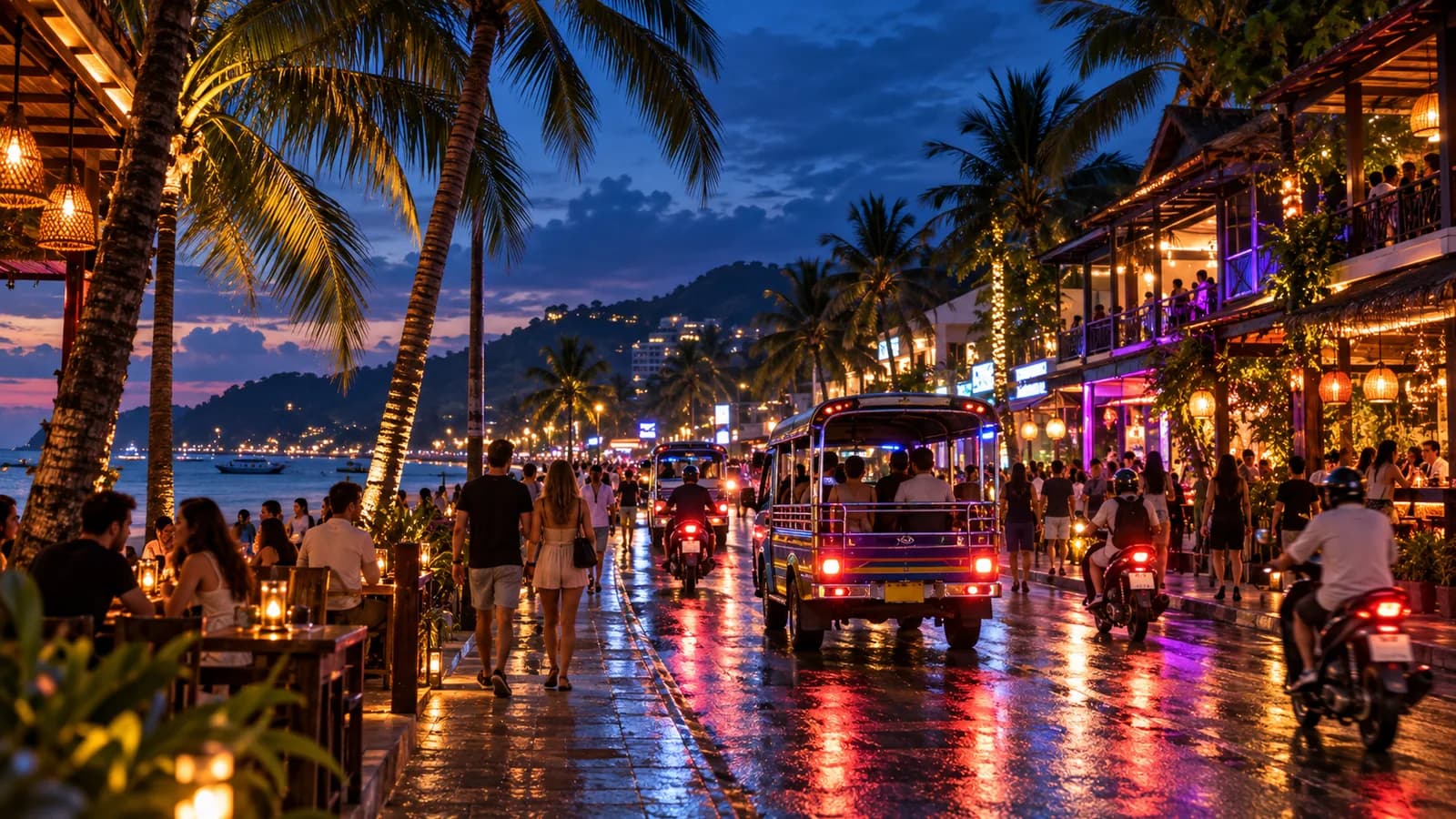
1. Before Chaweng Became the Nightlife Centre
Today, Chaweng is the name most closely associated with nightlife on Koh Samui.
That was not always inevitable.
For much of the island’s history, Samui’s economy centred on coconuts and other local livelihoods rather than tourism. Roads were limited, travel from the mainland took time, and the island’s first foreign visitors encountered a place that was far less connected to Bangkok and the international tourism system than it later became.
Tourism began to grow more seriously during the 1970s and 1980s. Chaweng, with its long beach and expanding accommodation, became one of the first places where that growth concentrated.
Academic research on Chaweng describes the transformation clearly. Before Samui Airport opened in 1989, the island was reached mainly by ferry and tourism remained comparatively limited. After the airport opened, visitor numbers and associated development increased rapidly, particularly in Chaweng.
This is the foundation of the nightlife story.
Bars and clubs did not create the tourism boom.
They followed it.
As more visitors stayed in Chaweng, more restaurants, shops and entertainment businesses became viable. The nightlife district emerged from a beach-resort economy that was already changing at extraordinary speed.
2. The Late 1980s: A Beach Town Starts Staying Up Late
The strongest nightlife evidence begins in the late 1980s.
Reggae Pub is the most useful landmark, although even its exact opening date needs careful treatment. Several long-running tourism sources and archived venue material give 1988 as the beginning, describing a tiny bar with around fifteen seats on Chaweng Beach. Some long-term resident recollections instead place the opening around 1990.
The difference is small historically but important editorially.
The safe conclusion is that Reggae Pub emerged around the end of the 1980s, when Chaweng itself was still a much smaller resort.
Older visitors remember gaps of coconut land between bungalow properties, basic roads and simple accommodation along the beach. Nightlife was similarly modest: small bars, informal music venues and places that could grow organically rather than opening as fully engineered entertainment businesses.
Long-term residents also remember Lamai as an important island nightlife area during the 1980s, with Chaweng’s dominance becoming clearer later.
That makes the early Reggae Pub significant.
It was not merely an old bar.
It belonged to the moment when Chaweng began changing from a place where travellers slept beside the beach into a place where they also expected to stay out after dark.
3. 1989: The Airport Changes the Scale of Everything
On 25 April 1989, Samui Airport opened for commercial service.
Bangkok Airways had built the airport while Koh Samui was being developed as an international tourist destination. The company itself describes the airport as a major turning point in the island’s development.
For Chaweng, the effect was structural.
Flying reduced the friction of reaching Samui. The island no longer depended on travellers willing to make the slower combined journey by road, rail and ferry. Shorter holidays became more practical. Higher-spending visitors could arrive directly. Hotels and tour operators could market the island more easily.
Academic research links the years after the airport opening to rapid development in Chaweng.
Nightlife benefited from the same change.
A club can only grow as large as the market around it. More flights meant more hotel rooms, more restaurants, more employees, more visitors and more demand for evening entertainment.
The airport therefore did not create a specific venue.
It changed the scale at which venues could succeed.
The small island bar economy of the late 1980s was being connected to mass tourism.
4. Reggae Pub Moves to the Lake - and Becomes an Institution
Reggae Pub’s own history reflects the transformation.
Archived descriptions say the original beach bar later relocated toward Chaweng Lake and expanded dramatically. Long-term resident accounts generally place that move in the early 1990s.
The setting became part of the legend.
Visitors remember reaching the lake-side nightlife area by a narrow wooden bridge and moving between open-air venues in a Chaweng that still felt unfinished compared with the town that followed.
The exact details vary between recollections, which is why they should be treated as community memory rather than a precise municipal record.
The broad story is much stronger.
Reggae Pub grew from a small bar into a large nightlife venue during the same years in which Chaweng was expanding from bungalow tourism toward a more intensive resort economy.
A fire in the mid-1990s destroyed the wooden venue and forced rebuilding. Sources disagree on whether this happened in 1995 or around New Year 1996-97, so the article should not pretend the surviving chronology is exact.
What matters historically is the recovery.
The venue returned.
That ability to rebuild after destruction became a recurring feature of Samui’s nightlife economy - individual structures could disappear while the nightlife identity around them survived.
5. Green Mango Gives the District a Name
The second great Chaweng institution emerged in the early 1990s.
Green Mango’s exact opening year is difficult to establish from strong primary sources. Long-term visitors consistently remember it operating by the early-to-mid 1990s, while specialist nightlife histories generally place it after Reggae Pub.
That uncertainty does not weaken its historical importance.
Green Mango became so closely associated with central Chaweng that the lane around it came to be known as Soi Green Mango.
This is one of the clearest examples in Thailand of a nightlife business giving a piece of urban geography its everyday name.
The club’s open-air form also suited the island.
Rather than reproducing a sealed European nightclub, Green Mango developed around timber, open space, bridges and multiple levels - an entertainment format that felt connected to the tropical resort setting even as the music and crowd became increasingly international.
By the mid-to-late 1990s, visitor recollections repeatedly pair Green Mango with Reggae Pub as the central late-night circuit of Chaweng.
The relationship between the two mattered as much as either venue alone.
A nightlife district becomes durable when customers move between several places.
Chaweng had reached that point.
6. The 1990s: Backpacker Chaweng Becomes a Party Town
The 1990s are remembered with unusual intensity by long-term Samui visitors because the changes were visible from one trip to the next.
Simple bungalows remained along the beach, but gaps between them filled with resorts, restaurants and businesses. Roads improved. More travellers arrived by air. The nightlife map became denser.
Community recollections mention venues such as Green Mango, Reggae Pub, The Doors, Sweet Soul, small roadside bars and beach establishments operating as a loose circuit rather than one formally planned entertainment district.
The details are necessarily anecdotal.
The pattern is not.
Chaweng nightlife was becoming a network.
Someone could begin at a small bar, move to a larger club, cross toward the lake, continue to an after-hours venue and finish with food near the beach. That movement created an economy around the nightlife businesses themselves: late-night restaurants, taxis, songthaews, convenience retail and other services benefited from the same crowds.
This was also the period when Chaweng began losing some of the physical simplicity that early visitors associated with Samui.
That change is often described nostalgically as a loss.
A more neutral historical interpretation is that the resort was moving from one tourism phase into another.
Backpacker infrastructure had helped establish Chaweng.
Mass tourism was now rebuilding it.
7. 2000: The Beach Becomes Part of the Nightlife Product
The next important shift happened on the sand itself.
ARKbar dates its opening to 2000. The business describes its beginnings as a modest beach bar that later developed into a resort and major beach-club destination.
The date gives us a useful marker.
By the beginning of the new century, Chaweng nightlife was no longer only about bars and clubs behind the beach road.
The beach itself could become an entertainment venue.
DJ-led evenings, beach parties, fire performances and a resort-with-nightlife model created a different relationship between daytime and nighttime tourism. Guests did not necessarily leave the beach environment when the sun went down. The same property could sell accommodation, food, drinks and nightlife as one continuous experience.
This was a natural fit for Samui’s image.
Bangkok nightlife was urban.
Pattaya’s beer bars and Walking Street were street-based.
Chaweng could build nightlife around the thing that had attracted visitors in the first place: the beach.
That idea became increasingly important in the 2000s and 2010s as beach clubs and lifestyle hospitality spread across Thailand’s island destinations.
8. The 2000s: Chaweng Becomes a Mature Resort Nightlife District
By the middle of the 2000s, contemporary travel reviews were already describing Chaweng as a dense nightlife town.
Green Mango and Reggae Pub were established landmarks. Bars and restaurants lined the main road and side sois. Beach nightlife had expanded. Different venues served different musical tastes and different stages of the evening.
What had once been a small island scene was becoming a mature resort nightlife economy.
This was also when the cost of Chaweng’s transformation became more visible.
Academic research on community perceptions documented rapid environmental and social change associated with tourism development. Chaweng’s population grew, migration increased and the built environment changed quickly.
Nightlife was only one piece of that development.
But it was a highly visible one.
The same tourism density that made large clubs viable also increased pressure on roads, waste systems, housing and public infrastructure. Workers and entrepreneurs arrived from elsewhere in Thailand and neighbouring countries to participate in the wider tourism economy.
A responsible nightlife history has to include that scale.
Chaweng after dark was not floating separately from the island.
It depended on the same labour, land, transport and infrastructure that made the entire resort function.
9. 2014: A Shopping Centre Shows How Far Chaweng Has Travelled
On 29 March 2014, CentralFestival Samui opened in central Chaweng.
Central Pattana’s own property information lists a project area of thirty-one rai, approximately 90,000 square metres of retail floor area and an investment of around 3.1 billion baht.
The shopping centre is not a nightlife venue.
That is why it is historically useful.
Its opening shows what Chaweng had become.
A resort once associated with simple beachfront bungalows could now support one of Thailand’s major retail developers placing a large shopping and leisure complex directly inside the tourism centre.
For nightlife, this changed the surrounding urban environment.
Restaurants, cinemas, retail and organised public space brought more people into central Chaweng through the evening. The boundary between shopping, dining and nightlife became less distinct. A visitor could spend an entire night within the same compact commercial district without ever needing to treat a nightclub as the only destination.
The location also reinforced Chaweng’s position as Samui’s central commercial hub.
Nightlife had helped make Chaweng famous.
By 2014, it was operating inside a much larger visitor economy.
10. Chaweng and the Full Moon Generation
Chaweng’s nightlife also existed beside another famous Gulf of Thailand party culture: the Full Moon Party on Koh Phangan.
The two should not be confused.
The Full Moon Party developed its own history and identity on another island. Chaweng was never simply an extension of Haad Rin.
But the growth of easy ferry connections and backpacker travel meant the two scenes often shared customers. Older visitor recollections describe travelling from Chaweng to Koh Phangan for Full Moon events and returning to Samui’s own nightlife circuit.
That relationship helped position Samui as a practical base for a wider island nightlife trip.
Chaweng offered a more developed resort infrastructure - airport, hotels, restaurants, shopping and nightly club options - while Phangan offered the periodic large beach event.
Over time, this created two complementary forms of nightlife tourism in the same region.
The distinction is important editorially.
Samui did not need to copy the Full Moon Party to become a nightlife destination.
It built a more continuous nightlife economy: clubs open throughout the week, beach bars, restaurants and resort entertainment integrated into a large tourism centre.
11. COVID-19: The Nightlife Machine Stops
The pandemic exposed how dependent Chaweng had become on international travel.
Thailand’s nightlife shutdowns in 2020 emptied streets built around visitors. Photographs from July 2020 documented the reopening of Soi Green Mango after the first lockdown period, but the return of local trading did not mean the return of the international market.
For Samui, the problem was especially severe.
The airport that had accelerated Chaweng’s rise could not deliver normal visitor numbers while borders and travel were restricted. Hotels closed or operated at very low occupancy. Bars and clubs lost their customer base. Workers left the island or found other income.
The disruption lasted far beyond the first reopening.
Community reporting from April 2022 recorded ARKbar reopening at the start of the month and Green Mango preparing to reopen shortly afterwards.
Those dates are useful because they show the length of the interruption.
The nightlife economy did not simply switch back on in 2020.
It returned in stages as tourism returned.
COVID therefore became the largest break in Chaweng nightlife since the district emerged in the late 1980s.
For the first time in a generation, the island had the buildings without the crowds.
12. What Chaweng’s Nightlife History Actually Tells Us
Chaweng’s nightlife story is sometimes told as nostalgia: dirt roads, simple bungalows and legendary old bars replaced by a more commercial resort.
The history is richer than that.
Tourism created the conditions. The airport changed the scale. Reggae Pub and Green Mango gave the emerging nightlife district durable landmarks. A network of smaller venues created a late-night circuit. ARKbar helped move the party onto the beach. Resorts, retail and larger investment turned Chaweng into a mature tourism centre. COVID then demonstrated how completely the entire system depended on mobility.
The important pattern is adaptation.
Chaweng did not begin as a nightlife capital.
It became one because several forms of tourism kept reinforcing one another.
People came for the beach and stayed for the evening.
Nightlife gave visitors another reason to remain in Chaweng rather than moving elsewhere on the island.
More visitors justified more accommodation.
More accommodation supported more restaurants, clubs and services.
The airport made the cycle larger.
That is why the story belongs separately from the broader history of Koh Samui.
The island’s transformation from coconut economy to global resort is one story.
Chaweng after dark is another: the story of how one beach town learned to turn nighttime into part of the destination itself.