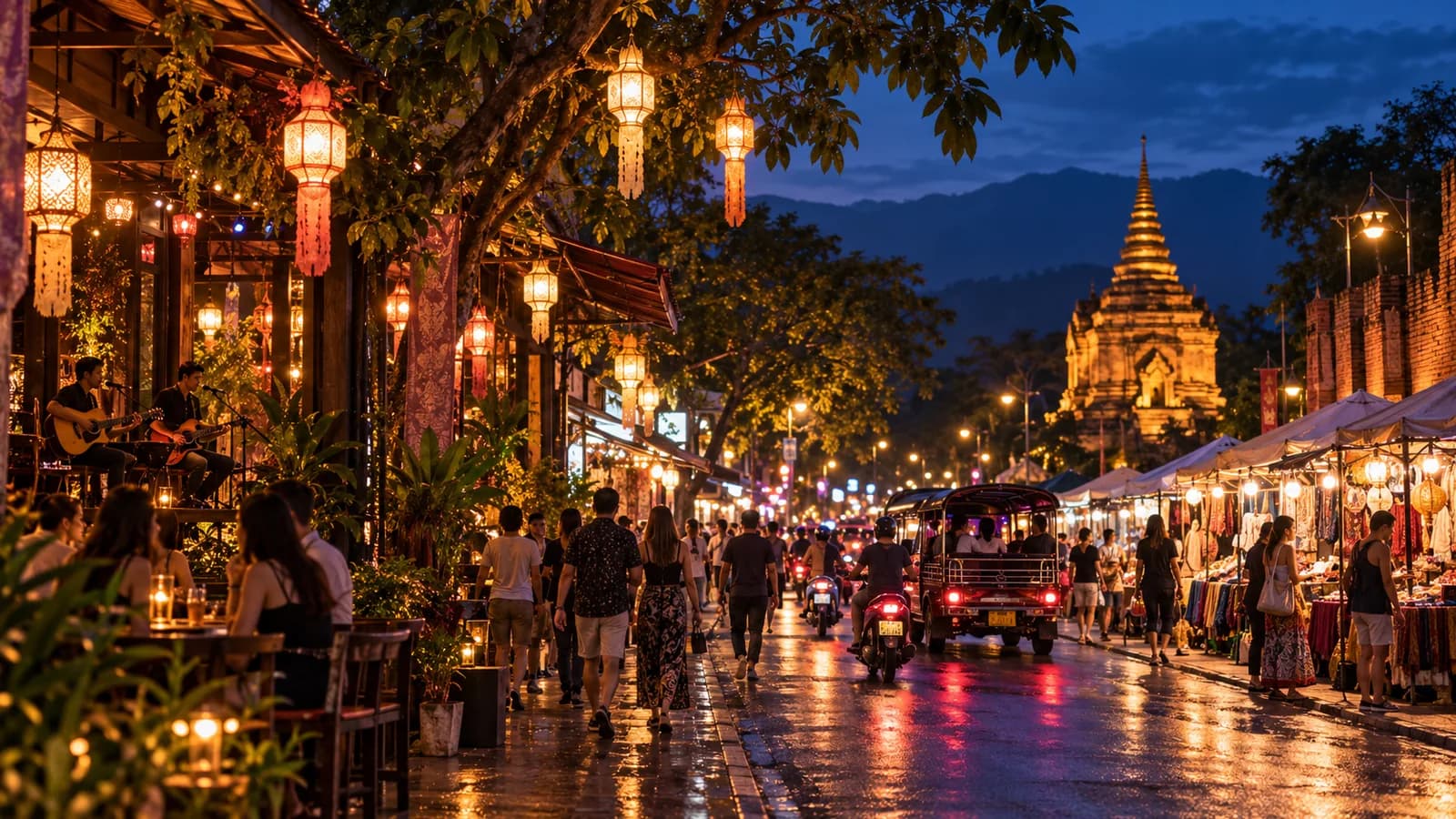
1. A Nightlife City Without One Nightlife Capital
Chiang Mai after dark has always been harder to reduce to one postcard image than Bangkok, Pattaya or Patong.
There is no single road that explains the city. Instead, nightlife developed in several overlapping centres, each serving a different audience and each reflecting a different stage in Chiang Mai’s urban history.
The Night Bazaar grew from the tourist economy of Chang Klan Road. Loi Kroh later became the best-known foreign-oriented bar street. Tha Phae and the Old City attracted backpackers and independent travellers. The Ping River developed its own restaurant and live-music culture. Around Chiang Mai University, a younger Thai scene helped transform Nimmanhaemin from a residential and university-adjacent district into a major pub, restaurant and club zone.
These areas were never completely separate. Visitors moved between them, businesses copied successful ideas, and venues opened or closed as rents, regulations and customer groups changed.
That fragmented geography is the central fact of Chiang Mai nightlife history.
The city did not build one giant entertainment district.
It built several smaller ones - and their relative importance kept changing.
2. Tourism Comes East of the Moat: The Night Bazaar
The modern story begins with tourism rather than bars.
Academic research on Chang Klan Road shows how the area east of the Old City became one of Chiang Mai’s major tourism and commercial corridors during the second half of the twentieth century. The Night Bazaar developed as souvenir and handicraft selling followed the growth of hotels and organised tourism.
Sources disagree slightly on the exact beginning. One urban-development study places the Night Bazaar’s formation around 1974, while a detailed Citylife history describes vendors gathering around the Chiang Inn hotel from 1977 as tour buses began bringing more visitors to Chang Klan Road.
The safest conclusion is that the modern tourist-market district took shape during the mid-to-late 1970s rather than on one precise opening day.
What matters for nightlife history is what followed.
Hotels, restaurants, shops, bars and evening markets increasingly shared the same customer flow. By the late 1980s and early 1990s, the Night Bazaar zone had become one of Chiang Mai’s strongest visitor magnets. Kalare expanded, Anusarn Market developed a larger food component, and major hotels concentrated around Chang Klan.
Nightlife grew beside this tourist infrastructure.
The market did not exist to create nightlife, but it created the foot traffic that nightlife businesses needed.
3. 1987: Loi Kroh Was Still Not the Street People Remember
One of the most useful corrections to Chiang Mai nightlife mythology comes from an eyewitness account of the city in 1987.
The recollection, later published by Chiang Mai Citylife, describes Loi Kroh as a road of temples rather than the bar street it would later become. The foreign-oriented evening scene was remembered as being concentrated more around Moon Muang Road and Tha Phae Gate, where backpacker accommodation and a small number of foreign-run bars served independent travellers.
This matters because today’s geography can make the past look inevitable.
Loi Kroh now links the Old City side of town with the Night Bazaar and is one of Chiang Mai’s most recognisable foreign-oriented nightlife corridors. But that identity was not fully formed in the 1980s.
The street’s later success makes geographical sense. It sat between two strong tourist zones: the Old City and Tha Phae on one side, Chang Klan and the Night Bazaar on the other. Hotels, restaurants and visitor businesses gradually filled the route between them.
As that happened, bars followed.
By the mid-1990s, specialist eyewitness histories remember Loi Kroh and its Bar Beer Centre as established nightlife territory. The precise sequence of individual bars is difficult to reconstruct reliably, but the broader transformation is clear.
A street that had not been a major nightlife strip in 1987 became one within the following decade.
4. Loi Kroh and the Small-Bar Economy
Loi Kroh developed through concentration rather than monumental development.
Its nightlife businesses were typically small: open-fronted bars, pubs, restaurants and later a compact bar complex around a Muay Thai ring. The street never became a multi-storey entertainment plaza like Nana, nor a giant pedestrian corridor like Walking Street or Bangla Road.
That smaller scale suited Chiang Mai.
The city attracted backpackers, long-stay foreign residents, retirees and repeat visitors as well as conventional tourists. A small bar could survive on a mix of regulars and passing trade without needing the volume required by a major nightclub.
The Night Bazaar end also gave the street a constant supply of visitors who had come primarily for shopping or food.
Over time, Loi Kroh became the clearest foreign-oriented nightlife strip in the city, but it remained mixed-use. Hotels, restaurants, temples, shops and ordinary local businesses continued to exist alongside bars.
That distinction is important.
Loi Kroh was never a sealed entertainment compound.
It remained a normal Chiang Mai street that had acquired a highly visible nightlife layer.
5. The Riverside: Live Music Becomes a Chiang Mai Tradition
Another branch of the city’s nightlife developed along the Ping River.
Long before Nimman became fashionable, riverside restaurants such as The Riverside and The Good View helped establish a distinctly Chiang Mai style of evening entertainment built around dinner, live bands and social drinking rather than a conventional nightclub.
Citylife’s recollections of 1987 already describe The Riverside as a destination worth crossing the Ping for. Over the following decades, the riverside became one of the city’s durable evening zones, particularly popular with Thai customers, expatriates and visitors looking for music and food rather than a bar-strip experience.
This live-music tradition matters because it fed directly into later Chiang Mai nightlife culture.
The city’s successful pub model often combined restaurant service, live bands and DJs within the same business. Customers could arrive for dinner, stay for music and move into a more energetic late-evening atmosphere without changing venue.
That hybrid format would become especially important around Nimmanhaemin.
Chiang Mai nightlife was beginning to develop a local identity that was not simply imported from tourist bar districts elsewhere in Thailand.
6. Chiang Mai University Changes the City’s Nightlife Map
The most important long-term force behind the westward shift of Chiang Mai nightlife was the university.
Chiang Mai University opened in 1964 and became the first major university established outside Bangkok. Its growth created a large population of students, graduates, academics and young professionals around the western side of the city.
Nimmanhaemin Road developed beside that world.
Urban research describes the district as beginning with residential development associated with university personnel and relatively affluent households before evolving through artistic, creative and increasingly global commercial identities.
Nightlife was part of that transformation.
A large student and young-professional population created demand for inexpensive restaurants, music venues and places to socialise that did not depend on international tourists.
This was a fundamentally different customer base from Loi Kroh.
The result was that Chiang Mai gradually acquired two broad nightlife economies operating at the same time: tourist-oriented nightlife east and inside the Old City, and a younger Thai-oriented scene growing west of the moat.
The balance between them would shift dramatically around the turn of the century.
7. 1999: Warm Up and the Rise of Nimman
Warm Up Cafe provides one of the clearest documented markers in the rise of modern Nimman nightlife.
Chiang Mai Citylife records that Warm Up first opened on 19 February 1999 near the Ping River with only eight tables. The business was created by a group of young friends who initially wanted a place to meet before going on to a disco.
It grew quickly.
The owners moved through larger riverside premises before eventually settling on Nimmanhaemin Road. Citylife’s later profile described Warm Up as one of Chiang Mai’s biggest and most influential pubs, employing more than eighty people and attracting customers from beyond the city.
The story is useful because it captures a wider change.
Nimman nightlife was not built primarily for foreign tourists. It was driven strongly by young Thai customers, university culture, live music and the desire for a more contemporary pub-and-club environment.
Monkey Club became another important early institution in the same district. Later venues followed, creating a nightlife cluster dense enough that Nimman itself became a destination.
By the 2010s, the neighbourhood was no longer simply residential or university-adjacent.
It had become one of Chiang Mai’s defining modern lifestyle districts.
8. From Backpacker Bars to Zoe: The Old City Reinvents Itself
While Nimman was growing, the Old City developed a different nightlife identity.
Tha Phae Gate and the eastern side of the moat had long attracted backpackers and independent travellers. Guesthouses, inexpensive restaurants and small bars created a social environment in which visitors often met one another rather than remaining inside large hotels.
By the 2000s and early 2010s, clusters such as Zoe in Yellow had turned parts of the Old City into a more concentrated international party zone.
Citylife material from 2010-2011 documents Zoe expanding into multiple adjoining spaces with a garden, dance area, live music and DJs. By the following decade, the surrounding complex had become one of Chiang Mai’s best-known backpacker nightlife locations.
This was a different model again.
Loi Kroh relied heavily on a traditional foreign-oriented bar economy. Nimman drew young Thai customers and urban lifestyle crowds. Zoe and nearby Old City venues mixed backpackers, short-stay tourists, expatriates and local customers in a more informal international setting.
The coexistence of these areas made Chiang Mai nightlife unusually decentralised.
A person could experience three very different versions of the city after dark within a relatively short distance.
9. Regulation, Closing Times and a Smaller Nightlife City
Chiang Mai’s nightlife scale has also been shaped by regulation.
The city has generally not operated with the same late-night intensity associated with Bangkok or Pattaya. Closing-time enforcement, licensing rules, proximity to residential areas, schools and temples, and periodic police inspections have repeatedly affected where nightlife could operate and how late it could continue.
Citylife reporting from 2015 illustrates the pattern. Officials inspected both Nimmanhaemin and the Loi Kroh/Sompet Market areas, checking closing times and other legal requirements. The report described venues cooperating with authorities and closing relatively early.
The same period also brought stricter alcohol-related enforcement around educational institutions, affecting businesses near Chiang Mai University more directly than some other parts of town.
These policies did not end nightlife.
They influenced its form.
Restaurants with music, early-evening pubs and multi-purpose venues were often better suited to the city’s operating environment than clubs depending entirely on very late trading.
Noise complaints also became more significant as Nimman grew denser and more expensive. Monkey Club, once described as a pioneer of the Nimmanhaemin party scene, closed in 2015 after fifteen years, with local commentary pointing both to increased competition and growing residential noise pressure.
Success changed the neighbourhood that nightlife had helped create.
10. COVID-19 Reveals How Many Economies Nightlife Supported
The pandemic temporarily erased the differences between Chiang Mai’s nightlife districts.
In March 2020, pubs, bars and entertainment venues were ordered closed. Citylife’s photographs from the first night of the shutdown showed Warm Up closed, Loi Kroh largely empty, the Night Bazaar without normal customer flows and tuk-tuk drivers waiting for passengers who were no longer arriving.
The effect reached far beyond venue owners.
Street-food vendors, drivers, market traders, hotel staff, musicians, cleaners and suppliers all depended to some degree on the same evening economy.
Reopening came in stages. Bars and pubs were permitted to resume in July 2020 under health restrictions, only for later outbreaks to trigger further closures and limits. In April 2021, Chiang Mai again ordered entertainment venues, pubs, bars and karaoke businesses closed.
Warm Up itself became one of the venues directly affected by outbreak-linked shutdown orders.
By 2022, local reporting described a nightlife sector still struggling with changing rules, reduced tourism and permanent business closures.
COVID therefore accelerated a process Chiang Mai had experienced before: venues disappeared, customer patterns shifted and nightlife geography had to rebuild itself around whoever returned.
11. What Chiang Mai Nightlife History Actually Shows
Chiang Mai nightlife is easy to underestimate because it has never looked like the biggest nightlife cities in Thailand.
Historically, that difference is what makes it interesting.
The Night Bazaar grew from organised tourism and souvenir commerce in the 1970s. Loi Kroh only later developed into a major foreign-oriented bar street. The Old City built a backpacker nightlife culture around guesthouses and social bars. Riverside venues created a durable live-music tradition. Chiang Mai University generated a large young local audience, while Warm Up and Monkey Club helped turn Nimman into a modern Thai nightlife district. Zoe and similar venues later gave international travellers a different Old City party scene.
No single district replaced all the others.
Instead, nightlife followed the city.
When tourism concentrated around Chang Klan, businesses followed tourists. When students and young professionals reshaped the west side, nightlife followed them. When Nimman became more expensive and residential pressure increased, venues changed again. When COVID removed both tourists and crowds, the whole network contracted.
That is the central Chiang Mai story.
Nightlife here has never been one giant attraction imposed on the city.
It has been a collection of smaller economies growing out of the city’s different identities: tourist city, university city, music city, backpacker city and modern northern metropolis.
After dark, all of those Chiang Mais have existed at the same time.