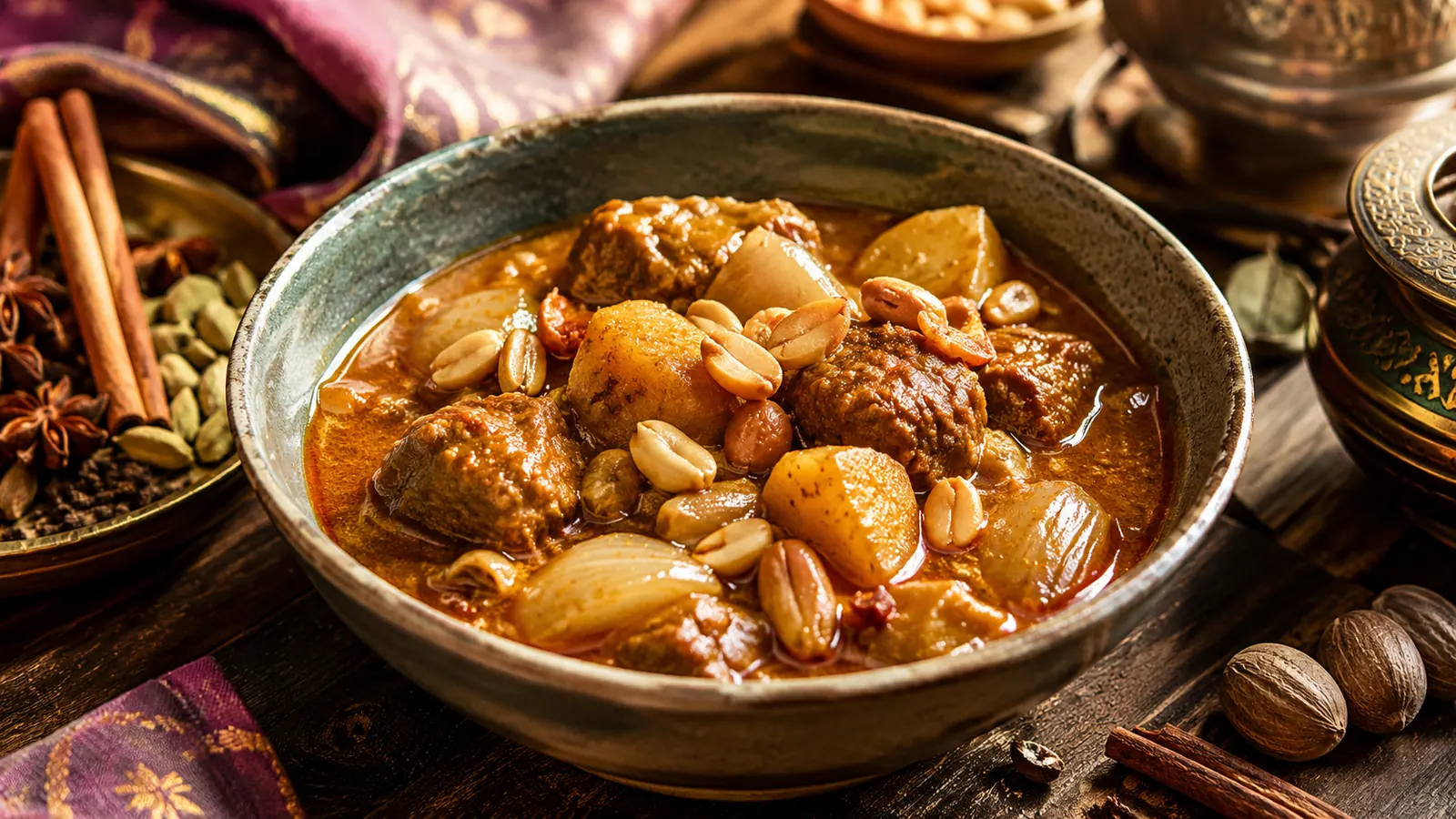
1. The Thai Curry That Immediately Feels Different
Set a bowl of massaman beside a green curry or a red curry and the difference is obvious before the first spoonful.
The aroma is warmer and deeper. Cinnamon, cardamom, cumin, coriander seed, cloves, nutmeg or mace may appear alongside the familiar Thai world of dried chillies, lemongrass, galangal, shallots, garlic and coriander root. Coconut milk gives the sauce body. Tamarind and palm sugar create a rounded sweet-sour balance. Potatoes, onions and peanuts often sit beside slowly cooked beef or chicken.
The result is rich rather than aggressively hot.
That combination has made massaman one of Thailand’s most recognisable curries internationally. It has also encouraged a very simple origin story: the dish came from somewhere else, Thailand adopted it, and that is the end of the explanation.
The real history is far more interesting.
Massaman developed in a Siam that was already connected to Persia, India, the Malay world and other parts of maritime Asia. Muslim merchants and communities lived in Ayutthaya and later Bangkok. Spices moved through trade networks. Royal kitchens encountered foods from different communities. Thai cooks then adjusted those ideas with local ingredients, local techniques and local preferences.
No surviving document gives us a single inventor, and no reliable source records one moment when a Persian, Malay, Indian or Siamese cook first produced the curry we know today.
What the evidence does show is a long process of contact followed by transformation.
By the early nineteenth century, massaman was already established enough in Siamese court culture to be celebrated in royal poetry. By the late nineteenth century, recipes appeared in print. Over time, the curry continued to evolve into the versions now cooked across Thailand.
That makes massaman a particularly good dish through which to understand Thai food history.
Its origins are international. Its identity is Thai.
2. Even the Name Points Towards a Muslim History
The name massaman is itself part of the historical clue.
Older spellings vary considerably: matsaman, mussaman, musaman and other forms appear in English and Thai transliteration. Scholars have long connected the word with older Persian, Arabic and European terms for Muslim — forms related to musalman, musulman or “Mussulman”.
That does not tell us exactly where the curry was invented. It does tell us how the dish was understood. The name appears to mark an association with Muslim food culture.
This is important because the Muslim presence in Siam was never one single community. Indian Muslims, Persians, Malays and other trading groups arrived through different routes and at different times. Some lived in southern port regions. Others settled around Ayutthaya and later Bangkok. Some became closely connected with court and government service.
The food traditions attached to those communities were therefore equally varied.
Dry spices such as cumin, coriander seed, cardamom, cinnamon and cloves were already familiar across the Indian Ocean and Persianate culinary worlds. Fragrant rice dishes, slow-cooked meats and complex spice mixtures moved along the same commercial routes that carried textiles, ceramics, precious goods and religious ideas.
Massaman belongs within that environment.
But describing it simply as “Muslim curry” can also hide how much changed in Siam. The Thai dish eventually combined those dry-spice traditions with ingredients and techniques deeply rooted in local cooking: coconut milk, fresh curry-paste aromatics, tamarind, palm sugar, fish sauce in many non-halal household versions, and Thai methods of frying curry paste until aromatic.
The name remembers one part of the story. The bowl tells the rest.
3. Ayutthaya Was Already a Meeting Place
To understand how a curry like massaman could develop, it helps to picture Ayutthaya at its height.
From the fourteenth century until 1767, the Siamese capital was one of Asia’s great trading cities. Its commercial links stretched across the Chao Phraya basin and outward towards China, Japan, South Asia, Persia, the Malay world and Europe.
Foreign communities were not simply temporary visitors. Research based on Persian, Thai and European sources documents established Muslim communities in Ayutthaya from at least the sixteenth century. Indian Muslim merchants were present through connections with the Coromandel Coast and the wider Bay of Bengal. Persian Shi’ite communities became especially prominent in the seventeenth century, with their own religious and social institutions.
This matters for food because daily contact is more powerful than a single dramatic introduction.
Merchants needed food. Families cooked. Religious communities maintained dietary practices. Court officials entertained guests. Markets sold ingredients to people from many backgrounds. Local cooks encountered unfamiliar spices and techniques repeatedly rather than once.
Historical research on Ayutthaya’s food culture confirms that the capital contained a dense market life and food associated with different ethnic communities.
A curry such as massaman therefore did not need to arrive as a complete foreign recipe. Its components could enter Siamese cooking gradually. A dry spice might first be associated with a Muslim household. A slow-cooking method might be used for meat in one community and adapted elsewhere. Coconut milk, fresh aromatics and local souring agents could alter the dish further. Court kitchens could refine a version and spread its prestige.
By the time a dish received a Thai name, the original route could already be difficult to reconstruct.
That is why the strongest history of massaman is not a story about importation. It is a story about a cosmopolitan Siamese city creating the conditions for culinary exchange.
4. The Persian Connection Is Real — but It Is Not the Whole Story
Persia occupies an important place in most serious discussions of massaman.
That connection is not invented. Persian merchants had commercial relationships with Siam, and a substantial Iranian community became part of seventeenth-century Ayutthaya. The figure most often associated with this history is Sheikh Ahmad, remembered in Thai historical tradition as an influential Muslim merchant and court official whose descendants became connected with the Bunnag family.
Persian cultural influence at the Siamese court extended beyond trade. Historical scholarship describes Persian participation in diplomacy, administration, architecture, dress and elite life. Contemporary accounts also suggest that Persian culture influenced aspects of dining at the court of King Narai.
It is therefore entirely reasonable to see Persian foodways as one strand in the ancestry of massaman.
What should be avoided is turning that strand into a neat invention story. Popular accounts sometimes state that Sheikh Ahmad personally introduced or invented massaman for the court. The surviving evidence does not prove that. Even details of Sheikh Ahmad’s exact birthplace are debated by historians.
The culinary world around him was also broader than Persia alone. Indian Muslim merchants had already been connected with Ayutthaya. Malay Muslim communities were important across the peninsula and in Siam. Spices moved through networks in which Persian, Indian, Arab, Malay and other merchants interacted.
The safest historical description is therefore wider. Massaman emerged from the Muslim and Indian Ocean connections of Siam, with Persian influence playing a particularly important role in the Ayutthaya court and central Thai context.
That wording may be less dramatic than naming one inventor. It is also much closer to how food actually travels.
Cuisines are rarely handed from one nation to another in a finished form. People meet, eat, adapt and remember.
5. Southern Thailand and the Malay World Belong in the Story Too
Massaman is often described as a southern Thai curry. That description is understandable, but it needs context.
Southern Thailand has long been connected with the Malay world, maritime trade and large Muslim communities. Curries using meat, coconut, dried spices and Muslim cooking traditions are therefore deeply at home in the peninsula. Modern Thai regional guides commonly include massaman among southern specialities.
At the same time, the strongest early literary evidence for the dish sits in the royal culture of Bangkok, while Persian and Indian Muslim histories connect it strongly with Ayutthaya and central Siam.
These facts do not contradict one another. They show that a dish can have more than one historical pathway.
Food moved through waterways, trade routes, marriages, court service and migration. People from Muslim communities relocated from Ayutthaya to Bangkok after 1767. Southern and Malay culinary traditions continued to interact across borders that were much less fixed than the modern national map.
Massaman therefore resists being reduced to one region. Some versions are associated with central Thai and court cooking. Others belong strongly to southern Muslim food traditions. Malay and Indian connections can be visible in particular preparations. Family recipes may preserve details that never entered printed cookbooks.
This variety is not evidence that the dish lacks an identity. It is evidence that the identity is old enough to have travelled.
What connects the versions is a recognisable use of warm dry spices within a Thai curry structure. That structure is what eventually allowed massaman to become national rather than merely regional. It could be cooked differently in different places and still be recognised by the same name.
6. By the Time of Rama II, Massaman Was Already Worth Writing Poetry About
One of the most beautiful pieces of evidence for massaman appears not in a cookbook but in poetry.
King Rama II, who reigned from 1809 to 1824, is associated with Kap He Chom Khrueang Khao Wan, a celebrated poem admiring savoury dishes and sweets.
Among the dishes praised is massaman. The verse famously draws attention to the aroma of cumin and the strength of its spices. The curry is described through affection and desire, linking food with the person who prepared it.
The poem is often associated with Princess Bunrot, later Queen Sri Suriyendra, whose cooking is remembered in Thai culinary history.
Whether every later romantic detail attached to the story can be documented is less important than what the poem itself establishes.
Massaman was already familiar within elite Siamese food culture by the early nineteenth century. It was also distinctive enough for its cumin aroma to be singled out.
That is significant. Many Thai curry pastes depend heavily on fresh aromatics. Massaman’s use of toasted dried spices gives it a different perfume. The Rama II verse suggests that this difference was already recognised and appreciated long before modern tourism or international Thai restaurants.
The poem also shows something else. A dish with Muslim and international connections had already become part of a Siamese literary world. It was not being described as a curiosity on the edge of the culture. It was being praised as desirable food.
By the time massaman entered the written culinary archive more systematically later in the century, its cultural integration was already well under way.
7. The First Printed Recipes Show a Curry Still Changing
The late nineteenth century gives us a much clearer view of massaman because Thai culinary knowledge began appearing in print.
Even here, the chronology requires care.
Lady Plian Phasakorawong published a food column in 1889 before later producing her landmark Mae Khrua Hua Pa volumes. An early massaman preparation associated with her work is commonly described as chicken matsaman seasoned with bitter orange.
Around the same period, Mom Somchin Rachanupraphan’s Tamra Kap Khao — usually dated to around 1890 — recorded a beef massaman. Modern Thai culinary archives identify the book as Siam’s earliest known printed cookbook.
These records are valuable because they prove that massaman existed in multiple written forms by the end of the nineteenth century. They do not show one fixed recipe. One historical version could use bitter orange where a modern cook might reach for tamarind. Meat choices differed. Spice combinations and cooking methods could vary.
Later publications preserved still more versions. This is exactly what should be expected from a living dish.
Before recipes were printed, culinary knowledge was transmitted through kitchens, households and professional practice. A written recipe captured one cook’s method at one moment. It did not automatically become a national standard.
The early texts therefore give us snapshots rather than commandments.
They also reveal the creativity of Siamese cooks. Massaman was no longer simply a collection of imported dry spices. It had been worked into a Thai culinary language of coconut, sourness, sweetness, fresh aromatics and careful balancing.
By the time the recipe reached print, the process of localisation was already generations old.
8. The Curry Paste Is Where Two Culinary Worlds Meet
The most revealing part of massaman may be the paste.
A typical Thai curry paste begins with fresh aromatics: chillies, shallots, garlic, galangal, lemongrass, coriander root, citrus peel and shrimp paste depending on the recipe.
Massaman keeps much of that architecture, then adds a striking collection of toasted dry spices. Coriander seed and cumin are common. Cinnamon, cardamom, cloves, nutmeg or mace may appear. Some preparations include white pepper or other spices. The exact mixture changes from one cook to another.
This is the point where the history becomes visible in the mortar. Fresh Southeast Asian aromatics meet ingredients associated with Indian Ocean and Persianate spice traditions.
Thai cooks did not simply pour imported spice powder into coconut milk. The spices were roasted to develop aroma. Fresh ingredients could also be roasted or fried. The mixture was pounded into a paste using the same patient technique that defines many other Thai curries.
The paste was then cooked in coconut cream until fragrant before the meat and liquid were added.
That technique matters. It transforms the ingredients into a distinctly Thai curry structure.
The final sauce develops through another set of decisions: sourness from tamarind or, historically, other fruits; sweetness from palm sugar; salt from fish sauce or salt depending on the household and dietary tradition; richness from coconut; texture from onions, peanuts and potatoes in many modern versions.
Massaman is therefore not defined by one “foreign” spice. It is defined by the way two culinary vocabularies were taught to speak Thai together.
9. Beef, Chicken and the Importance of Muslim Context
The meat in massaman also tells part of the story.
Beef and chicken are among the most familiar versions in Thailand today, and both fit naturally within Muslim dietary traditions.
That does not mean every bowl of massaman in modern Thailand is prepared according to halal requirements. Thailand is home to Buddhist, Muslim and other communities, and the curry moved well beyond the households in which its Muslim associations first developed. Non-Muslim cooks may use ingredients or kitchen practices that would not meet halal standards.
For visitors, the distinction is simple but important. A dish having Muslim historical roots does not automatically make every restaurant version halal.
At the same time, the Muslim heritage should not be treated as a decorative historical footnote. It helps explain the name, the traditional meat choices and the dry-spice profile that makes massaman unusual among Thai curries.
Some discussions of Thai food have historically tried to sort dishes into neat categories of “Thai” and “foreign”. Massaman shows why that approach is limiting.
Muslim communities have been part of Siam and Thailand for centuries. Persian descendants, Malay-speaking communities, Indian Muslim merchants and Thai Muslim families are not external to the country’s history.
Their cooking helped shape the national table. Recognising that contribution makes the story of Thai cuisine larger, not less Thai.
10. How a Global Past Became a Thai Classic
Massaman is now famous far beyond Thailand.
International rankings and travel media have repeatedly celebrated its gentle heat and aromatic complexity. Thai restaurants around the world have made it one of the easiest curries for newcomers to recognise. Commercial pastes have made it possible to cook a convincing version thousands of kilometres from Bangkok, Ayutthaya or the southern peninsula.
Yet global fame is not the most interesting thing about the dish.
Massaman was global long before modern globalisation. Its history belongs to the Indian Ocean. To Persian and Indian merchants. To Muslim communities in Siam. To Malay connections. To the markets and courts of Ayutthaya. To the kitchens of Bangkok. To royal poetry. To women who recorded culinary knowledge in the first generations of Thai print.
And most of all, to generations of cooks who made decisions that no trade route could make for them.
How much cumin? How dark should the spices be roasted? Should sourness come from bitter orange or tamarind? How sweet should the sauce become? How slowly should the beef cook? When should the potatoes go in?
Those choices are where influence becomes cuisine.
Massaman is therefore best understood not as a simple handover of a finished dish, but as a story of transformation.
The curry carries memories of Muslim and international connections, but it no longer needs an origin label to belong in Thailand. It has been part of Siamese and Thai culinary life for centuries.
Its history reaches outward. Its flavour was shaped inward.
And that is why a curry whose name still remembers an older Muslim world now tastes unmistakably like Thailand.