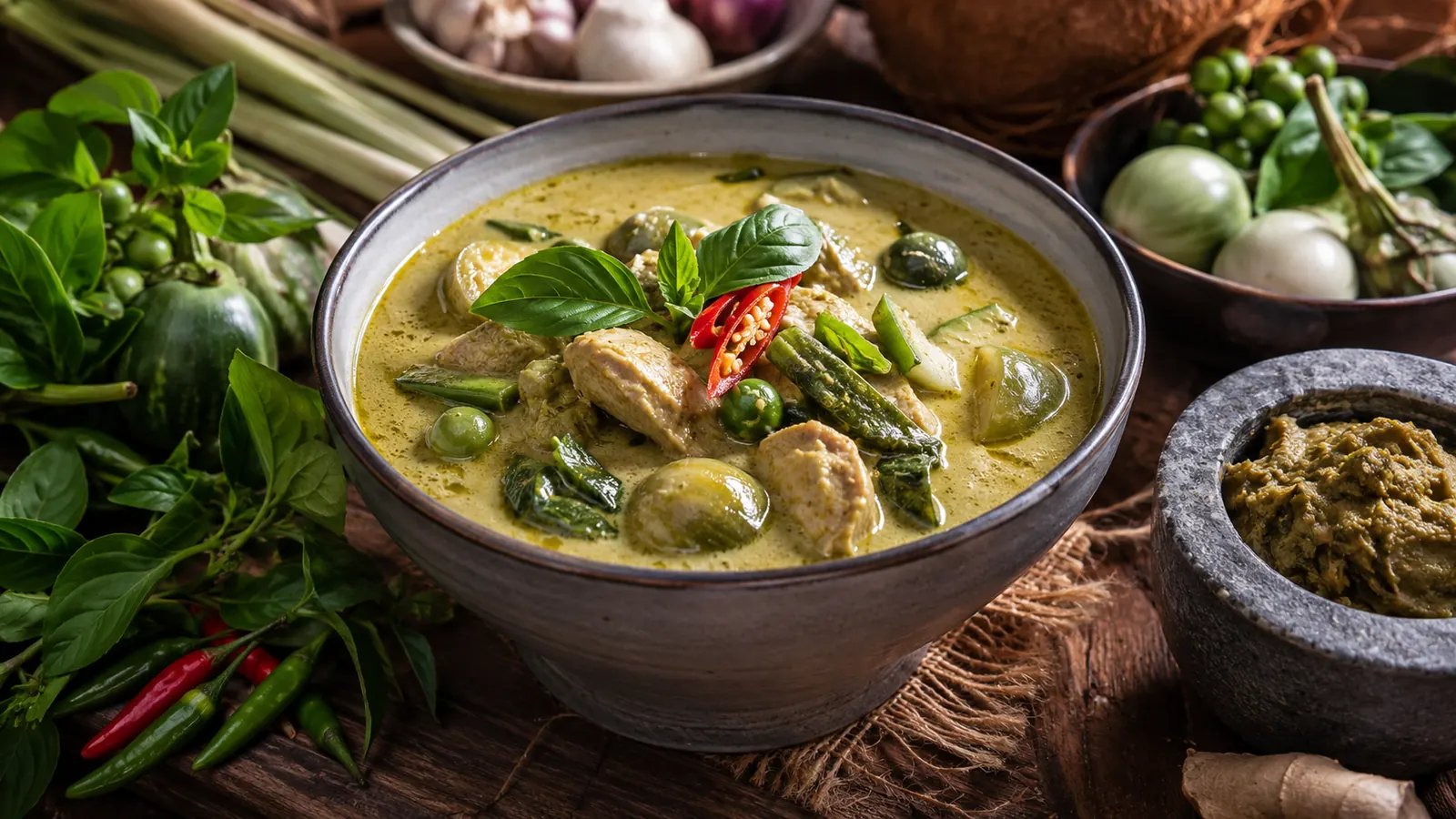
1. A Thai Classic With a Surprisingly Young Paper Trail
Green curry can feel as though it must have been part of Thai cooking for centuries.
Its colour is instantly recognisable. Its aroma — coconut, basil, chilli, galangal, lemongrass and makrut lime — feels inseparable from the idea of Thai curry. It appears in homes, restaurants, markets and hotel dining rooms across Thailand, and it became one of the dishes through which millions of people abroad first encountered Thai food.
Yet when historians look for kaeng khiao wan in early Thai cookbooks, the trail becomes unexpectedly short.
Older nineteenth- and early twentieth-century culinary records contain many curries. They describe dishes made with fresh herbs, dried chillies, coconut, fish, meat and spices. They show that Siam already possessed a highly developed curry culture.
But the clearly named green curry familiar today does not stand out in the earliest major printed collections.
Food historians have therefore placed its emergence somewhere around the opening decades of the twentieth century. A 1926 cookbook published under the pen name L. Phaehtraarat is frequently cited as the earliest known written record so far identified for a curry explicitly belonging to the green-curry family.
That date is important. It is not an invention certificate.
A recipe only proves that somebody wrote a dish down by that moment. Thai culinary knowledge was commonly transmitted by demonstration, memory and household practice, so a preparation may have existed before it appeared in print.
The safest conclusion is therefore also the most useful one: green curry seems to be a relatively modern Thai development built from much older culinary foundations.
That makes it no less traditional.
If anything, it makes kaeng khiao wan a perfect example of how Thai cuisine creates tradition — through adaptation, skill, repetition and the gradual recognition that a new idea has become part of the table.
2. The Name Does Not Mean a Sweet Curry
The Thai name is แกงเขียวหวาน — kaeng khiao wan.
Taken word by word, an English speaker might translate it as “sweet green curry”. That translation has caused an enormous amount of confusion.
Wan certainly means sweet in Thai, but in the name of the dish it is traditionally explained as describing the quality of the green colour: a soft, gentle or creamy green rather than a statement that sugar should dominate the flavour.
Official Thai cultural material is very clear on this point. The national heritage description of kaeng khiao wan characterises the curry as led by chilli heat, with saltiness and the richness of coconut contributing to the balance. It also notes that modern adaptations can become sweeter than older styles.
So the word wan is not an instruction to turn the curry into dessert. The colour is the clue.
Fresh green chillies distinguish the paste from the dried red chillies used in many red curry pastes. Some traditional preparations also use chilli leaves or other green plant material to deepen or brighten the colour. Once that paste is cooked with coconut milk, the finished curry develops the pale, luminous green associated with the dish.
This is why a proper kaeng khiao wan does not need to be neon green. The colour can range from soft green to a deeper herbal shade depending on the chillies, leaves, coconut and cooking method. What matters is that the colour comes naturally from the ingredients.
The misunderstanding abroad is understandable. Many international restaurant versions have been made milder and sweeter to suit different customers. Coconut milk naturally brings richness and some sweetness, and palm sugar can be used as part of the seasoning.
But sweetness is supposed to support the curry. It is not the reason the curry is called khiao wan.
That small linguistic detail opens the door to the larger history: green curry was conceived first as a distinctive Thai curry, not as a mild alternative for people afraid of chilli.
3. Before Green Curry, There Was Already a Thai Curry World
Green curry did not appear from nowhere.
By the time it entered the written record, cooks in Siam already had centuries of experience with dishes that Thai describes broadly as kaeng.
The English word “curry” is convenient, but it can hide how varied the Thai category is. Some kaeng are clear and broth-like. Others are rich with coconut. Some rely heavily on fresh herbs and chillies; others include dried spices such as coriander seed, cumin and pepper. Some are sour. Some are fiery. Some are associated with particular regions, communities or historical periods.
Kaeng khiao wan belongs to the coconut-milk curry tradition most strongly associated with central Thai cooking. Its paste shares much with red curry paste: shallot, garlic, galangal, lemongrass, makrut lime peel, coriander root, pepper, shrimp paste and spices such as coriander seed and cumin can all appear.
The decisive visual change is the chilli. Instead of relying primarily on dried red chillies, the green curry paste uses fresh green chillies.
That sounds simple. Culinarily, it changes a great deal.
Fresh chillies bring a different colour, fragrance and character. They interact differently with the other fresh aromatics. The paste looks different in the mortar and behaves differently when cooked into coconut cream.
Thai cultural sources therefore describe green curry as closely related to kaeng phet, the red or “hot” curry family, but transformed through the use of fresh green chillies and the pursuit of a green finished sauce.
This does not require us to identify one moment when a cook suddenly decided to replace red with green. That story would be too neat.
A more realistic picture is gradual experimentation in a culinary world where cooks already understood curry paste deeply. The ingredients were familiar. The technique was familiar.
What was new was the particular combination and identity. A different chilli created a different curry. And eventually that curry acquired a name of its own.
4. Between Mae Khrua Hua Pa and 1926
One of the best ways to understand the timing is to look at what the cookbooks do — and do not — show.
Lady Plian Phasakorawong’s Mae Khrua Hua Pa, published in the early twentieth century, is one of the landmarks of Thai culinary writing. It documented a remarkable range of Thai and international foods and helped move cooking knowledge from memory and apprenticeship into measured written recipes.
The book contains many kinds of kaeng. Yet food historians examining the early editions have not found a clearly named kaeng khiao wan matching the later dish.
Then, by 1926, a green curry appears in another cookbook.
That gap has encouraged historians to place the emergence of the named dish roughly between those points.
The wording matters. We can say that the documentary record suggests green curry took recognisable form in the early twentieth century. We cannot say that it was definitely invented between two publication dates.
A household cook could have been making a green-chilli coconut curry before a publisher printed the name. A court or aristocratic kitchen might have developed a variation before it entered a commercial cookbook. Different versions could have existed simultaneously.
The archive only tells us when the trail becomes visible.
It also tells us something about Thai food culture at the time. The early twentieth century was an energetic period for culinary documentation. Printed recipes were becoming more important. Bangkok brought together palace traditions, elite households, markets, migrant communities and provincial ingredients. Cooks were recording, refining and circulating techniques in new ways.
Green curry fits naturally into that environment. It was not a break with Thai food. It was an innovation produced inside a mature Thai culinary system.
By the late 1920s and early 1930s, written green-curry recipes were beginning to multiply. One particularly elaborate 1929 preparation known as “Green Curry of the Sultan” combined the green-curry idea with beef, potatoes, okra, almonds, raisins and aromatic finishing techniques.
That unusual recipe should not be treated as the origin of all green curry. What it does show is that, only a few years after the first known printed record, Thai cooks were already treating green curry as a form open to interpretation and refinement.
5. What Makes the Paste Green
The heart of kaeng khiao wan is not the coconut milk. It is the paste.
A traditional green curry paste is built by pounding fresh ingredients together until they become one aromatic mass. The exact proportions vary by cook and recipe, but the central family is recognisable: fresh green chillies, shallots, garlic, galangal, lemongrass, makrut lime peel, coriander root, pepper, shrimp paste and salt, often joined by coriander seed and cumin.
Each ingredient has a different job. The chillies bring heat and colour. Galangal and lemongrass give the paste its lifted, fresh fragrance. Makrut lime peel adds an intense citrus perfume. Coriander root contributes another layer of aroma. Shrimp paste adds fermented savoury depth that disappears visually into the curry but remains fundamental to its flavour.
The spices matter too. Coriander seed and cumin connect the paste to the older spice vocabulary found in several central Thai curries. They do not make green curry “foreign”. Ingredients and spice traditions had been moving through Siam for centuries and had long since become tools available to Thai cooks.
Colour can require careful judgement. Fresh green chillies alone do not always create the vivid green diners expect. Thai heritage descriptions mention the use of liquid extracted from chilli leaves to strengthen the colour. Some cooks use other leaves or particular chilli combinations. Southern versions may include turmeric, producing a different shade and aroma.
That variety is useful because it reminds us that “traditional” does not mean chemically standardised. A paste pounded in one household will not look identical to another.
What links them is technique. The ingredients are reduced until their flavours stop behaving as separate pieces and become a curry paste. When that paste meets coconut cream and heat, the aromas open again in a new form.
The mortar does not merely mix ingredients. It builds the curry’s identity.
6. Beef Before Chicken Became the International Default
Ask an international diner to picture green curry and chicken is likely to appear automatically.
In older Thai descriptions, the picture is more varied. The Department of Cultural Promotion’s national heritage material notes that beef was traditionally common enough for the curry to be associated with the name kaeng nuea phrik khi nu — a beef curry emphasising bird’s-eye chilli.
Today, beef remains a classic choice, but it is far from the only one. Chicken, pork, fish and fish balls all appear in Thai green curry. Fish-ball green curry is especially familiar, and Mahidol University’s Institute of Nutrition presents kaeng khiao wan luk chin pla krai as a standard central Thai preparation.
Duck also has a long place in the documented green-curry family.
The important point is not to search for one original protein. The curry is the structure. Its paste, coconut base, seasoning and aromatic finish can accommodate different main ingredients. Thai eggplants and pea eggplants are common additions. Makrut lime leaves and Thai basil provide fragrance. Fresh chillies can be sliced over the finished curry.
The protein changes the character of the bowl. Beef can produce a deeper, richer result, particularly when simmered until tender. Chicken gives a lighter meat flavour and became especially familiar internationally. Fish balls absorb the sauce while adding their distinctive springy texture. Duck can be paired with fruit or other ingredients in more elaborate versions.
This flexibility is one reason green curry travelled so successfully. A cook did not need to preserve one sacred ingredient list to preserve the dish. The identity was strong enough to survive substitution.
That does not mean anything placed in green sauce automatically becomes traditional kaeng khiao wan. It means Thai cooks developed a curry framework with enough clarity to allow variation without losing itself.
7. The Technique Is About More Than Boiling Everything Together
A list of ingredients cannot explain why one green curry tastes flat and another fills a room with aroma.
Technique matters.
In many traditional coconut-curry methods, the richest coconut cream is heated until its fat begins to separate. The curry paste is then fried in that coconut fat until fragrant.
This stage transforms the paste. Raw chilli sharpness softens. The oil carries aromatic compounds from herbs and spices. The paste darkens slightly and its perfume becomes rounder and deeper.
More coconut milk is then added to create the sauce. How far the coconut is allowed to “crack” or separate depends on the cook, the coconut product and the desired style. Freshly squeezed coconut behaves differently from some modern packaged products, so contemporary cooks may add a little oil when needed.
The sequence is more important than rigid choreography. Build fragrance first. Then develop the sauce.
Seasoning traditionally relies on fish sauce and restrained sweetness, with the coconut contributing much of the curry’s roundness. Eggplants are added so they cook without collapsing completely. Makrut lime leaf and basil are handled in ways that preserve their aroma.
The final curry should feel layered rather than muddy. The paste gives depth. The coconut gives body. The herbs remain recognisable. The chillies retain energy.
This is also where colour and flavour can pull against each other. Frying the paste develops aroma, but excessive cooking can dull the green. Adding large amounts of extra leaf purely for colour can distort flavour.
Experienced cooks therefore balance appearance against taste.
Green curry became famous for its colour. It survives because the flavour underneath that colour is far more sophisticated than green alone.
8. Rice, Khanom Chin, Roti — and the Thai Meal Around the Curry
Green curry is rarely best understood as an isolated bowl. It belongs to a meal.
Steamed rice is the obvious companion because it absorbs the rich sauce and provides a calm base for the chilli and aromatics. But khanom chin — fermented rice noodles — is another deeply established pairing.
The Department of Cultural Promotion specifically records green curry eaten with khanom chin and notes traditional salty accompaniments such as fried salted fish, fried pla salid and salted egg.
That detail tells us something important about Thai meal composition. Balance does not require one curry to contain every taste at maximum intensity. The surrounding dishes can do part of the work.
A spicy coconut curry beside rice, noodles or a salty accompaniment becomes a different experience from the curry tasted alone. Texture changes. Heat is moderated. Saltiness is redistributed across the meal.
Roti is another familiar partner, particularly in contexts shaped by Muslim and southern Thai food traditions.
Green curry also changes regionally. The official heritage record notes that southern cooks may include turmeric in the paste. A southern green curry can therefore look and taste different from the pale central Thai version that became internationally standard.
Neither variation cancels the other. They show how a dish identified nationally can still be interpreted through local culinary languages.
Modern Thailand has pushed those interpretations even further. Green curry has appeared with spaghetti, pizza, fried rice, pastries and countless other forms. Some are restaurant experiments; others have become familiar comfort foods in their own right.
Traditionalists do not need to declare every adaptation equal to the classic curry. But experimentation itself is hardly un-Thai.
The history of kaeng khiao wan began with cooks modifying an existing curry vocabulary. Its descendants are still doing the same thing.
9. From National Heritage to an International Thai Signature
By the late twentieth century, green curry had achieved something remarkable.
A dish with a relatively recent written history had become one of the global symbols of Thai cuisine.
Thai restaurants carried it abroad. Tourism introduced visitors to it in Thailand. Cookbooks translated it. Commercial curry pastes made the dish easier to reproduce far from Southeast Asia.
Government-supported promotion of Thai cuisine also helped give a consistent international platform to dishes such as green curry. Academic research on Thailand’s culinary diplomacy shows that green curry became one of the standard dishes associated with Thai restaurant certification and overseas promotion. It repeatedly appears alongside tom yum, pad Thai, som tam and pad kra pao as part of the recognisable international Thai menu.
This global success inevitably created new versions. Some restaurants reduced the chilli. Some increased sugar. Some made the curry extremely thick. Others turned it fluorescent green. Ingredients difficult to source abroad were replaced or omitted.
But the international story should not be told as a decline from a perfect Thai original. Thai food has always travelled by adapting to circumstances. The more interesting question is whether the character of the dish survives.
In Thailand, green curry was formally registered as part of the nation’s intangible cultural heritage in 2012 under knowledge and practices concerning nature and the universe. The official record treats it not merely as a recipe but as accumulated culinary knowledge: ingredients, paste-making, seasoning, accompaniments and ways of eating.
That recognition came after the curry was already internationally famous. In other words, green curry travelled outward and was simultaneously being documented inward as cultural heritage.
The two stories belong together. One explains why the world knows the dish. The other preserves the deeper Thai knowledge behind the name.
10. A Tradition Does Not Have to Be Ancient
Green curry offers a useful challenge to one of the most persistent ideas about traditional food.
We often assume that authenticity is measured by age. The older the dish, the more “real” it must be.
Kaeng khiao wan tells a different story.
Its ingredients reach far back into Thai culinary history. Its curry-paste technique belongs to an older cooking tradition. Coconut curries were already established. Fresh herbs, shrimp paste, fish sauce and chillies were familiar tools.
Yet the particular curry we now call green curry seems to have become visible only in the early twentieth century.
Within a few generations it moved from culinary innovation to household favourite, from cookbook recipe to national heritage, and from Thailand to menus around the world.
Nothing about that journey makes it less Thai.
Tradition is not created only by surviving unchanged for hundreds of years. It can also be created when people recognise something as worth repeating.
Thai cooks repeated green curry because it worked. They refined the shade of the paste. They adjusted the chilli. They paired it with beef, chicken, fish and fish balls. They served it over rice and khanom chin. They adapted it across regions and passed their preferred methods to the next cook.
Eventually nobody needed to explain why the curry belonged. It simply did.
That may be the most interesting thing about its history.
Green curry was not preserved because it was ancient. It became traditional because Thailand embraced it.
The dish entered the written record relatively late, but it entered Thai culinary identity with extraordinary confidence.
Today, the soft green sauce carries more than chilli and coconut. It carries a century of cooks proving that a cuisine can create something new — and make it feel timeless.