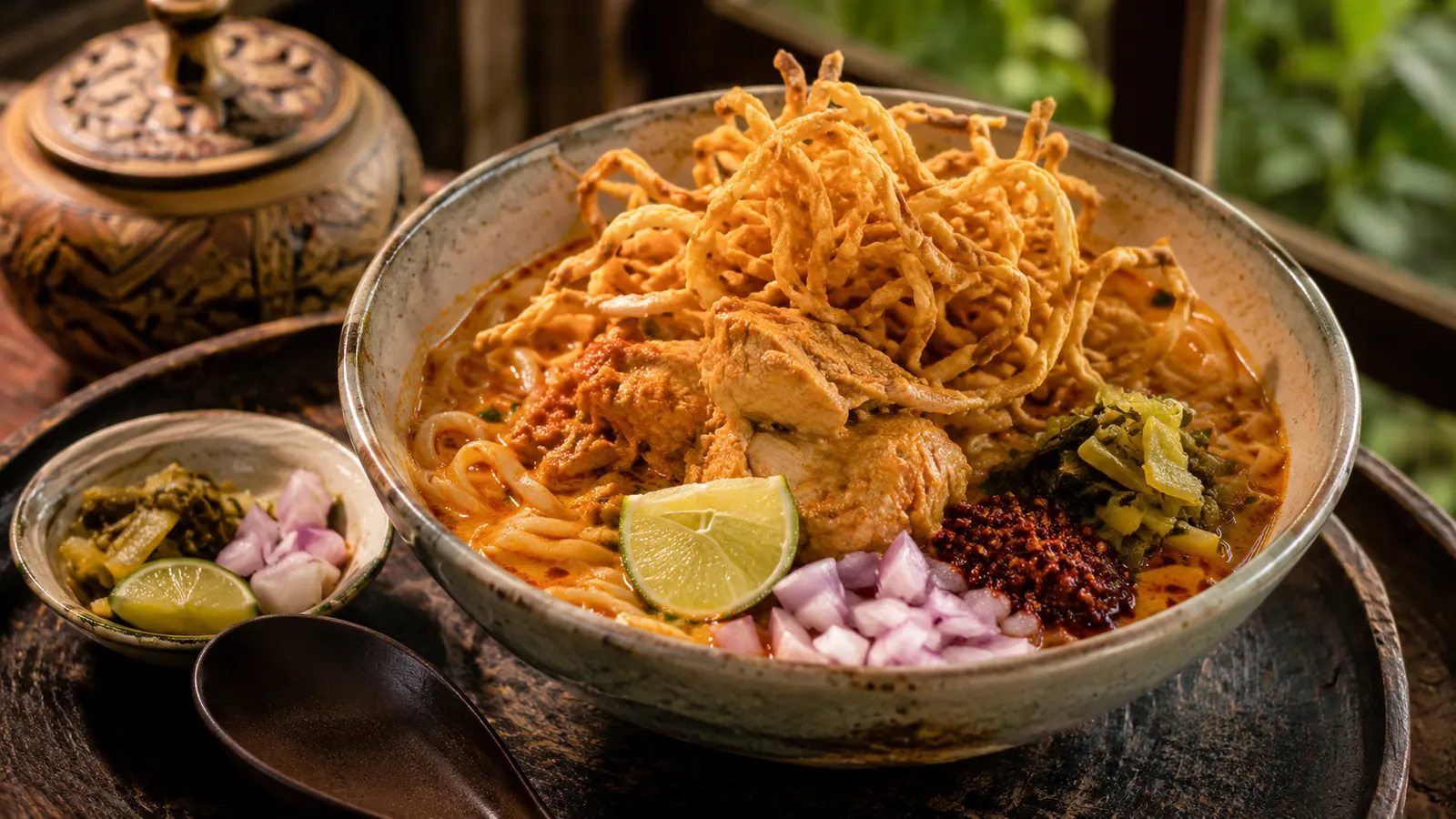
There are dishes that seem inseparable from a place. In Chiang Mai, khao soi is one of them. A bowl arrives with soft wheat noodles beneath a fragrant curry broth, often enriched with coconut milk, and a crown of crisp fried noodles above. Chicken or beef is common, while pickled mustard greens, shallots, lime and chilli oil wait at the side for the diner to adjust the balance.
Today it is one of the foods most strongly associated with northern Thailand. Yet its history does not fit neatly into a story about one inventor, one migration or one moment of creation. Khao soi belongs to a part of mainland Southeast Asia where people, goods, languages and cooking traditions moved across mountains and borders long before modern national boundaries fixed themselves on maps.
The strongest evidence points not to a single birthplace but to a meeting of worlds: Yunnanese Muslim trading communities, the food cultures of Myanmar and the Shan region, the commercial life of Chiang Mai, and generations of Lanna and northern Thai cooks who adapted the dish to local ingredients and tastes. That is not a complication that makes khao soi less Thai. If anything, it is what gives the dish such a rich Thai story to tell.
1. A Bowl That Looks Simple Until You Ask Where It Came From
At first glance, the modern Chiang Mai version of khao soi has an obvious identity. It is a noodle curry: boiled egg noodles, a rich aromatic broth, meat, crisp noodles and sharp condiments. The combination is distinctive enough that travellers can learn to recognise it almost immediately.
History is less tidy.
Older and regional forms called khao soi are not identical to one another. Some Yunnanese Muslim and northern Thai communities preserve clear-broth versions. In northern Laos, khao soi can refer to a very different rice-noodle dish, often topped with a tomato-and-meat mixture and fermented soybean. Shan and Burmese noodle traditions add further relatives and lookalikes, and even the name itself has competing explanations.
Part of the difficulty is that food history is often written backwards. Once a dish becomes famous, later writers go looking for a clean beginning that explains the finished form. But khao soi did not appear in a finished modern bowl; it took shape inside a moving regional food system.
A 2024 study by researchers at Suan Dusit University describes northern Thai khao soi as a product of multicultural Lanna food wisdom, identifying Chinese, Islamic and Lanna influences and linking its development to ingredients and spices circulating through trade by the end of the nineteenth century. Chiang Mai University's Northern Thai Information Center likewise records khao soi as a dish closely connected with Muslim and Chinese Muslim Ho communities.
Together, those sources support a broad historical picture. What they do not support is naming a single creator or assigning the dish a precise birthday.
2. Northern Thailand Was Connected Long Before Khao Soi Became Famous
To understand the dish, it helps to forget modern borders for a moment.
Northern Thailand sits within a highland world connected to what are now Myanmar, Laos and Yunnan in southern China. Chiang Mai was never an isolated inland city; it was tied to river commerce, overland caravan routes and neighbouring political and cultural regions. Traders carried cloth, medicines, forest products, tea, animals and other goods through networks that linked Yunnan, Kengtung and the Shan areas with towns in northern Siam.
Yunnanese traders known in northern Thailand as Ho or Haw were part of those networks. Historical work on Yunnanese Muslim communities shows that caravan traffic expanded significantly during the nineteenth century. Some merchants travelled seasonally and returned north; others eventually settled. By the late nineteenth and early twentieth centuries, permanent Yunnanese Muslim communities had become visible in Chiang Mai and other northern towns.
The Baan Ho community in Chiang Mai is especially important here. The Sirindhorn Anthropology Centre traces clearer Yunnanese Muslim settlement in the city from the late nineteenth century onwards and describes the development of a community around trade and, later, the Baan Ho mosque. Other historical studies place Yunnanese Muslim networks in Chiang Mai, Chiang Rai, Mae Hong Son and across the Myanmar border.
This was exactly the kind of environment in which food could travel without travelling as a fixed recipe. Merchants ate on the road. Families settled. Neighbours learned from neighbours. Ingredients available in one town differed from those available in another, so a noodle technique, a spice mixture or a way of serving meat could move independently and later combine with something local.
Seen against this landscape of circulation, khao soi makes far more sense than it would if it were treated as a recipe carried intact from Point A to Point B.
3. The Yunnanese Muslim Connection Is Real - but It Is Not the Whole Story
The Chinese Muslim connection is one of the best-supported parts of khao soi's history.
In northern Thailand, the term Ho has long been associated with people from Yunnan, including Muslim caravan traders. Chiang Mai University's Lanna food archive identifies khao soi as a Muslim dish and notes that Chinese Muslims known as Ho called it khao soi ho, or Islamic khao soi. The traditional preference for beef or chicken also fits a Muslim culinary setting in which pork would not be used.
Community history preserves the connection just as strongly. The Sirindhorn Anthropology Centre describes Baan Ho as a Yunnanese Muslim community with inherited khao soi traditions, including a clear-broth style remembered as part of older community food culture. Cultural Mapping Thailand has documented similar family histories among Yunnanese Muslim khao soi sellers in northern Thailand.
It is therefore reasonable to say that Yunnanese Muslim communities were central to the history of khao soi in the North. It is much harder to say that they simply invented the exact modern dish in Yunnan and delivered it unchanged to Chiang Mai.
The caravan routes passed through places with their own noodle traditions, especially in the Shan areas and Myanmar, and Muslim Yunnanese cooks themselves had long histories of mobility and exchange. A dish served by a community in Chiang Mai could already contain influences gathered along that route, and once settled in northern Thailand, it could change again.
The safest historical conclusion, then, is not that the Chin Haw invented khao soi. It is that Yunnanese Muslim movement and settlement formed one of the most important channels through which the noodle traditions behind khao soi became rooted in northern Thailand.
That distinction matters. It gives proper weight to the Muslim communities who helped carry and preserve the dish, without turning a complicated regional history into a slogan.
4. Myanmar, Shan Food and a Family of Noodle Traditions
The resemblance between northern Thai khao soi and noodle dishes in Myanmar is too strong to ignore.
One of the closest comparisons is ohn no khauk swè, a Burmese dish of wheat noodles served with chicken in a coconut-milk-based curry broth. Depending on the cook, it may include onions, chilli, lime, eggs, fritters or crisp components. It is not identical to Chiang Mai khao soi, but the family resemblance is clear: wheat noodles, spiced broth, coconut, chicken and contrasting garnishes.
Shan food adds another layer. Shan noodle dishes often use rice noodles and can be served with tomato, meat, fermented soybean, pickled mustard greens and other condiments. These are not simply prototypes of the Chiang Mai bowl, but they show how densely connected noodle culture was across the upland region.
This is why several food historians and specialist writers have described khao soi as an amalgam of Yunnanese Muslim, Burmese and Shan influences. The evidence supports relationship and exchange far more strongly than it supports a single one-way line of descent.
The language is equally complicated. Burmese khauk swè is a general word for noodles, and the sound has often been proposed as a source or relative of the Thai name khao soi. Another explanation connects the Thai words to the action of slicing noodle sheets into strips, and similar names also appear in Shan and Lao food traditions.
No single etymology is secure enough to present as settled fact. For Thailand4U, the useful point is not to force a winner: the shared or similar terminology is itself evidence of a culinary zone in which noodles, words and techniques crossed linguistic boundaries.
The story becomes clearer, in other words, once we stop asking which modern country can claim the first bowl and start asking how northern communities influenced one another.
5. What the Older Khao Soi May Have Looked Like
A common northern Thai oral and institutional history says that older Ho or Yunnanese Muslim khao soi was lighter than the coconut-rich version most visitors know today.
Chiang Mai and other northern sources preserve references to khao soi nam sai - clear-broth khao soi - in Yunnanese Muslim communities. The Baan Ho community record maintained by the Sirindhorn Anthropology Centre notes that traditional clear versions continue to be remembered and prepared, and Cultural Mapping Thailand has also recorded family testimony from Muslim khao soi businesses describing inherited clear-broth styles.
This makes it plausible that coconut-heavy curry khao soi was not the only early form in northern Thailand, and that some older community versions were considerably clearer and simpler.
But this is where caution is essential.
The surviving evidence does not establish a precise sequence in which one universally standard "original" clear khao soi became one universally standard coconut khao soi on a known date. Different communities may have been cooking related noodles in different ways at the same time, written culinary records are much thinner than the living traditions themselves, and oral family history cannot always provide exact chronology.
There is also an internet story that credits a named Yunnanese Muslim trader with experimenting first with animal milk and then replacing it with coconut milk, thereby creating modern khao soi. Versions of this story are repeated across Thai websites, but at present the claim does not have strong enough independent primary evidence to treat that individual as the inventor of coconut khao soi.
So the responsible version is broader: clear-broth Yunnanese Muslim forms are genuinely part of the northern khao soi tradition, and over time richer curry-and-coconut versions became deeply established in Lanna cooking. Exactly who made that transition first remains uncertain.
6. Chiang Mai Did More Than Receive the Dish
Describing khao soi as something that merely "arrived" in Chiang Mai misses what happened next.
The city in the late nineteenth and early twentieth centuries was changing rapidly. River trade, new roads, markets and expanding commercial districts brought different communities into closer contact, and the Ping River and the neighbourhoods around Wat Ket, Charoen Rat, Charoen Prathet and the later Warorot Market area became spaces where merchants, residents and travellers from different backgrounds met.
Yunnanese Muslims were part of that urban world, but so were local Lanna residents, other Chinese communities, Burmese and Shan people, South Asian Muslims, Sikhs and Western trading and missionary networks. Chiang Mai's food culture developed inside this cosmopolitan environment.
As khao soi entered wider local consumption, northern cooks adapted it. The modern bowl uses techniques and flavours that sit comfortably within Thai curry cookery: fresh aromatics, dried spices, chilli, coconut milk and carefully balanced salty, rich, sour and spicy elements. Pickled mustard greens provide acidity and texture, shallots add bite, lime brightens the broth, and chilli oil lets the diner push the heat further.
The two-texture noodle structure became one of the dish's signatures - soft boiled noodles below, crisp fried noodles above - though even this should not be projected backwards unchanged into every early version.
What matters historically is the process. The dish passed from community food into a broader northern repertoire, and local cooks did not simply preserve an imported object. They selected, altered, balanced and standardised elements until khao soi became recognisably part of the culinary identity of Chiang Mai and the wider North.
That is adaptation in its most ordinary and creative form - the same process by which cuisines everywhere grow.
7. The Modern Bowl Is a Record of Those Encounters
A present-day Chiang Mai khao soi can be read almost like an edible map.
The wheat and egg noodles point towards noodle traditions that became widespread through Chinese and regional exchange. The Muslim history remains visible in the long-standing importance of chicken and beef and in the continuing khao soi traditions of Yunnanese Muslim communities. Curry spices connect the bowl with the wider movement of spices through South and Southeast Asian trade, and coconut milk places the modern dish firmly within the tropical culinary world of Southeast Asia and Thai curry cookery.
Then there are the condiments. Pickled mustard greens are important in Chinese, Yunnanese, Shan and northern Southeast Asian food cultures. Raw shallot is sharp and fragrant, lime supplies fresh acidity, and chilli oil adds heat without forcing every bowl to leave the kitchen at the same intensity. Together they make the diner part of the final preparation.
No single ingredient proves an origin story - food ingredients travel too easily for that. What the combination shows is something more interesting: by the time the modern Chiang Mai style had taken shape, it had become a coherent local dish rather than a loose collection of foreign parts.
That coherence is the product of generations of cooking. A modern bowl does not taste like a historical argument. It tastes like a cuisine that has had time to settle into itself.
This is also why the language of "authenticity" needs care. A clear Yunnanese Muslim khao soi can be historically meaningful, and so can a coconut-rich Chiang Mai version. A beef bowl from a Muslim shop and a pork version from a northern Buddhist household may simply belong to different strands of the same regional history.
The existence of variation does not weaken the tradition. It is evidence that the tradition lived.
8. One Name, Several Northern Traditions
Visitors often encounter khao soi as though it were one fixed recipe, but northern Thailand offers more diversity than the tourist shorthand suggests.
Chiang Mai's best-known style is the coconut curry noodle soup with boiled and fried wheat noodles. Chicken and beef are classic choices, while pork appears widely in non-Muslim versions. Shops differ in the thickness of the broth, the strength of coconut, the amount of curry spice, the sweetness and salt balance, and the texture of the noodles.
Muslim khao soi shops preserve their own lineages, sometimes with broths and spice profiles that differ noticeably from mainstream versions. Clear-broth khao soi remains part of Yunnanese Muslim memory and can still be encountered in northern communities, while Chiang Rai and border areas add further styles shaped by their proximity to Myanmar, Yunnan and other Tai-speaking populations.
Northern Lao khao soi should be treated carefully. Despite the shared name, it is usually a different dish built around hand-cut rice noodles and a savoury topping that may contain tomato, meat and fermented soybean. Shan noodle dishes provide still more related techniques and flavours.
It is tempting to arrange all of these in a family tree with one ancestor at the top, but the historical record does not justify that level of certainty.
A better model is a network. Related communities used similar ingredients, names and noodle-making practices across a connected highland region. Some traditions influenced others directly; others may have developed in parallel while sharing the same trade routes and food vocabulary.
Northern Thailand's khao soi emerged from that network and then developed its own unmistakable identity.
9. From Community Food to Symbol of Chiang Mai
Khao soi did not always carry the promotional weight it carries today.
Its rise as a symbol of Chiang Mai reflects the growth of the city itself. As urban markets expanded and restaurant culture developed, foods once associated more strongly with particular communities became available to a wider public. Family businesses helped establish recognisable local styles, and later, domestic tourism and international travel turned regional dishes into markers of place.
By the late twentieth and early twenty-first centuries, eating khao soi had become part of the expected Chiang Mai experience. Restaurant guides, travel writing, television and social media amplified that association: visitors arrived looking for "the best khao soi", while long-running neighbourhood shops found themselves transformed into culinary landmarks.
Academic work at Chiang Mai University has begun examining this process directly. Research presented in 2025 describes khao soi as a culinary symbol whose meaning has been shaped not only by older community histories but also by urban identity, modernity and the tourism economy, and recent Thai research likewise treats the dish as a form of Lanna multicultural culinary heritage.
The important point is that tourism did not invent khao soi's northern identity. It magnified an identity that had already been built through local adoption and everyday eating.
There is a useful distinction here. A dish can have cross-border roots and still become a genuine symbol of one place. Cultural belonging is not determined solely by the location of the earliest imaginable ancestor; it is built through repetition, memory, family businesses, local preference and the meanings people attach to food over generations.
By that measure, khao soi's place in Chiang Mai is not difficult to understand at all.
10. The Real Story Is Better Than a Single Origin Myth
Khao soi is sometimes introduced with a dramatic sentence: it came from China, or Burma, or the Muslim caravans, and then became Thai. The problem is not that those influences are imaginary. The problem is that the sentence is too small for the evidence.
Northern Thailand was part of a connected culinary region. Yunnanese Muslim traders moved through it. Shan and Burmese communities had rich noodle traditions of their own. Chiang Mai grew as a commercial city where different populations met. Muslim families settled and maintained distinctive foods. Northern cooks adopted and adapted those foods. Coconut curry versions became locally beloved. Restaurants and households developed their own balances. Tourism later carried the dish far beyond the communities in which its earlier forms had circulated.
No credible evidence currently identifies one inventor. No secure historical record fixes the birth of modern khao soi to one year. The etymology of the name remains open to competing explanations, and even the transition from clear-broth forms to the familiar coconut curry bowl is better understood as a process than as a single documented event.
That uncertainty does not make the story weaker. If anything, it makes it more representative of how food actually evolves.
Khao soi is Thai not because every component originated within the borders of modern Thailand, but because northern Thai communities made the dish part of their own culinary life. They cooked it, changed it, sold it, remembered it and passed it forward. Today it carries the history of Muslim traders and borderland exchange while also standing confidently as one of the defining foods of the North.
A bowl of khao soi therefore tells two stories at once. One is about movement across Yunnan, Myanmar, the Shan world and Lanna. The other is about belonging: how a dish can gather influences from many journeys and, over time, become unmistakably at home.