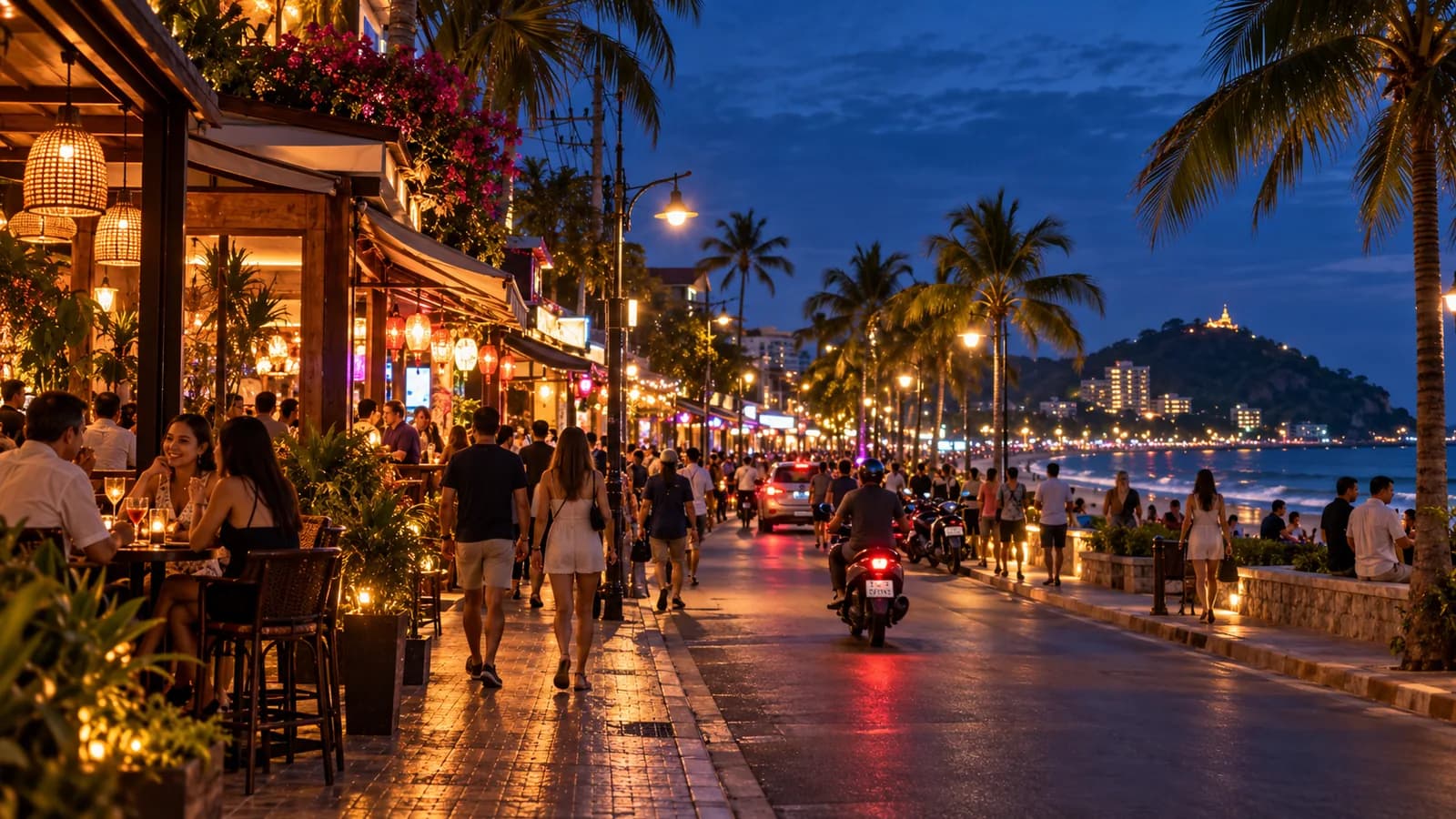
1. The Resort Came First
Hua Hin’s nightlife history starts with a useful fact: nightlife was never the reason Hua Hin became famous.
The town developed as a seaside resort through the railway, royal patronage, the Railway Hotel, golf and holiday homes. Its early social life revolved around hotels, restaurants, tea, sport and the routines of a fashionable resort rather than a concentrated entertainment district.
That background matters because Hua Hin followed a different path from Pattaya.
Pattaya’s modern tourism economy was accelerated dramatically by the Vietnam War-era military market. Hua Hin already possessed an older resort identity and remained strongly connected to domestic visitors from Bangkok. Academic research on Thai hotels notes that, by the early 1980s, more than half of visitors to Hua Hin and nearby Cha-am were from Bangkok.
The same research also gives us an early nightlife clue.
A 1983 study cited in the hotel-development literature listed nighttime entertainment among the attractions drawing visitors to the Hua Hin-Cha-am area. That does not tell us exactly where those venues were or what form they took, but it establishes something important: evening entertainment was already part of the resort economy by the early 1980s.
Hua Hin after dark therefore did not appear suddenly in the 2000s.
It grew quietly inside a resort that had been entertaining visitors for generations.
2. The 1980s and 1990s: Tourism Changes the Centre
The clearest evidence for the next stage comes from land use.
A Chulalongkorn University study compared Hua Hin municipality in 1986 and 1996 and found substantial growth in tourism-related and commercial uses. Guesthouse land increased, commercial activity expanded, and interviews indicated that much of the new income was generated by tourists and related businesses.
Another Chulalongkorn study focused on Naresdamri Road, one of Hua Hin’s oldest community areas near the waterfront. By the late 1990s, tourism had brought major physical change: older buildings had been adapted for commercial use, larger buildings had appeared, and restaurants and visitor businesses increasingly occupied the historic centre.
This is the urban setting from which Hua Hin’s best-known nightlife quarter emerged.
The area around Naresdamri, Dechanuchit, Poonsuk and the short lane known as Soi Bintabaht sat between several powerful visitor magnets: the beach, central hotels, restaurants, the night market and the old commercial core.
It did not require a purpose-built entertainment zone.
It already had tourists on foot.
Small bars, pubs, restaurants and guesthouses could fit into existing buildings and narrow lanes, creating a nightlife district through gradual conversion rather than wholesale redevelopment.
By the end of the 1990s, the town centre was no longer simply an old resort neighbourhood.
It was an increasingly dense tourism economy.
3. Bintabaht Becomes the Tourist Nightlife Centre
Soi Bintabaht eventually became the name most closely associated with Hua Hin nightlife.
The precise beginning is difficult to document. There is no strong source establishing a first bar, founding year or single person who created the district.
What we can document is that Bintabaht was firmly established by the early 2000s.
A 2004 travel feature described the lane as already full of bars. A 2005 travel magazine likewise treated Soi Bintabaht as an obvious nightlife stop and specifically noted its beer-bar concentration. By that point, the district was not emerging. It was recognised.
Its location explains much of the success.
Bintabaht sits in the old centre, close to the waterfront and immediately beside some of Hua Hin’s largest hotels. It is also within walking distance of the night market and the railway-station side of town. Visitors staying centrally could reach the area without planning a separate journey.
The district remained physically small.
That became part of its character.
Rather than a huge nightlife avenue, Hua Hin developed a compact maze of short lanes containing open-front bars, pubs, restaurants, live music and small clubs. The scale suited a resort whose international nightlife market was significant but far smaller than Pattaya’s.
Bintabaht became Hua Hin’s nightlife centre not because it overwhelmed the town.
It fitted inside it.
4. Why Hua Hin’s Beer-Bar Culture Stayed Small-Scale
The beer-bar format became important in Hua Hin for many of the same reasons it succeeded elsewhere in Thailand: it was flexible, relatively small and well suited to warm-weather streets.
But Hua Hin’s version developed differently from Pattaya’s.
The town never needed hundreds of bars concentrated in giant compounds to create a viable nightlife economy. Visitor numbers, land patterns and the older central street network encouraged smaller clusters.
A short frontage could become a bar without rebuilding an entire block. Several neighbouring bars created enough foot traffic to make a lane feel like a destination. Pubs and restaurants could operate beside them, so the district did not depend on one single business model.
That mixed character is visible in descriptions from the 2000s and 2010s.
Bintabaht and the surrounding streets contained beer bars, Irish-style pubs, restaurants, live music and nightclubs within the same compact area. Some businesses were aimed mainly at foreign tourists; others attracted both visitors and local customers.
This is an important distinction in the history.
Hua Hin nightlife did include adult-oriented businesses, but the district should not be reduced to them. The evening economy also depended on food, sport, music, hotel guests, long-stay residents and ordinary social drinking.
The small scale allowed several different versions of nightlife to occupy the same streets.
5. Soi 80: A Second Bar Street Emerges
By the end of the 2000s, Hua Hin clearly had more than one foreign-oriented nightlife area.
Soi 80, on the inland side of Phetkasem Road near the railway, had developed its own concentration of bars. A 2009 issue of the local English-language publication AWOL recorded a Hua Hin nine-ball pool league with a team moving to a bar beside the 7-Eleven near Soi 80. By 2010 and 2011, resident discussions referred to Soi 80 as an established bar street.
Again, the sources do not justify an exact founding year.
They do show that the area was established by the late 2000s.
Soi 80 also served a somewhat different market from Bintabaht.
Contemporary and later descriptions repeatedly associate Bintabaht more strongly with short-stay tourists in the old centre, while Soi 80 became especially familiar to long-stay foreign residents and repeat visitors.
That difference shaped the atmosphere and economics.
A bar relying heavily on residents can operate around repeat customers rather than constant tourist turnover. Pool leagues, televised sport and familiar social routines become especially valuable. The street can remain viable even when it is not a major sightseeing stop.
Hua Hin nightlife was becoming geographically divided by customer type.
Bintabaht had the hotel-and-tourist location.
Soi 80 had the regulars.
6. A Parallel Thai Nightlife Continued Outside the Tourist Sois
The foreign-oriented bar streets were never the whole story.
Hua Hin also had pubs, restaurants and live-music venues serving predominantly Thai customers. Older visitor discussions describe Thai-oriented clubs and music venues away from the compact Bintabaht area, while later guides continued to distinguish tourist beer-bar streets from venues built around Thai live music and nightlife culture.
This parallel market is historically important.
Foreign visitors often experience a destination through the venues that advertise in English and sit close to hotels. That can create the illusion that the tourist district is the city’s entire night economy.
Hua Hin did not work that way.
Thai residents, workers and weekend visitors from Bangkok had their own entertainment preferences. Live bands, Thai popular music, restaurants and larger pub-style venues existed alongside the small foreign-oriented bars.
The two worlds sometimes overlapped.
Thai customers went to central clubs. Foreign residents visited Thai live-music venues. Mixed pubs attracted both.
But the distinction helps explain why Hua Hin nightlife never needed one dominant entertainment street.
The town served several audiences at once, and much of its evening economy was spread across ordinary commercial roads rather than contained inside a single branded district.
7. Soi 94: From Dirt Road to Food-and-Drink District
The most dramatic geographical change happened farther south.
In January 2016, Hua Hin’s AWOL newspaper looked back at the transformation of Soi 94. Its description is unusually useful because it provides a long-term local comparison: around fifteen years earlier, the area had been little more than a dirt road with scattered houses and overgrown land.
By 2016, AWOL counted at least forty food-and-drink businesses in and around the soi.
The change was not originally a nightlife-only story.
Restaurants were central. The street developed an increasingly international mix of Thai, Indian, Japanese, British, Scandinavian, Mediterranean, Italian, Russian and French food, alongside pubs and bars.
That mixture made Soi 94 different from the older Bintabaht model.
It was becoming an evening district where nightlife could begin with dinner and continue into bars and live music. It also benefited from Hua Hin’s residential growth: condominiums, long-stay foreign residents and a town expanding beyond the old centre.
This is another reason Hua Hin’s nightlife history cannot be told as a simple succession of bar streets.
Soi 94 became important because the whole city was spreading.
Nightlife followed.
8. COVID-19 Accelerates a Shift Already Underway
The pandemic did not create the movement toward Soi 94, but it accelerated it dramatically.
Bintabaht was especially vulnerable because of its dependence on foreign tourist foot traffic and the high cost of central commercial space.
In February 2021, Hua Hin Today reported that many Bintabaht businesses had closed during the tourism collapse. The same report described construction of a new complex on Soi 94 known as Wonderland, with twenty-one small bars and a shared kitchen area.
The timing was striking.
Even while international tourism was severely restricted, investment was moving toward a newer nightlife cluster.
Local reporting attributed part of the attraction to rents. Bintabaht’s central-location costs had become difficult for small operators, while Soi 94 offered space at far lower prices.
This was not simply the replacement of one famous street by another.
It was a change in urban economics.
Bintabaht sat beside expensive hotels and prime central land.
Soi 94 could provide larger bar compounds, parking, restaurants and lower-cost commercial units in an area with a substantial resident customer base.
COVID turned those differences into survival factors.
9. 2022: The Bar-Complex Model Expands in Soi 94
The post-pandemic reopening made the shift even more visible.
In November 2022, Hua Hin Today reported another major beer-bar complex opening off Soi 94 with approximately forty bars. A smaller project nearby, The Nice 94, was being built with plans for roughly thirty more units.
The article explicitly described Soi 94 as increasingly established as Hua Hin’s main nightlife entertainment area.
These figures should not be treated as permanent venue counts. Small bars change tenants and names quickly.
What matters historically is the scale of the development.
Hua Hin had moved from compact rows of bars inserted into old central streets toward purpose-built or organised multi-bar compounds in a newer part of town.
That resembles a pattern seen elsewhere in Thailand, but on a distinctly Hua Hin scale.
The complex format gives small operators shared foot traffic while keeping individual businesses relatively small. Restaurants and coffee shops around the area widen the audience beyond bar-only customers. Long-stay residents provide repeat trade.
By the early 2020s, Hua Hin’s nightlife geography had become unmistakably polycentric.
Bintabaht remained the old tourist landmark.
Soi 80 retained its established bar-street identity.
Soi 94 had become the major growth area.
10. The Nightlife Map Follows the Town
The movement from Bintabaht toward Soi 80 and Soi 94 is not a story of one district simply killing another.
It is a story of Hua Hin becoming larger.
The old centre was built for an earlier resort. Its narrow lanes and walkable relationship between beach, market, hotels and restaurants made Bintabaht a natural nightlife cluster.
As the town expanded inland and southward, new residential and commercial districts gained their own customer bases.
Soi 80 benefited from long-stay residents and its position near central transport routes.
Soi 94 developed around restaurants, condominiums, bars and a broader evening economy. By 2026, municipal traffic measures were being introduced there because the street had become one of Hua Hin’s busiest dining and entertainment areas.
That is a revealing endpoint.
A road remembered as near-empty around the beginning of the century had become busy enough to require formal traffic management.
Nightlife was part of that transformation, but not the only part.
Food, housing, tourism and resident life grew together.
11. What Hua Hin’s Nightlife History Actually Tells Us
Hua Hin’s nightlife history is easy to underestimate because it lacks the giant origin myths of Thailand’s larger entertainment cities.
There is no single Patpong-style R&R story, no Walking Street-scale pedestrian landmark and no Bangla Road-scale club corridor.
That absence is exactly what makes Hua Hin interesting.
Its nightlife developed incrementally inside an older seaside resort.
Nighttime entertainment was already part of the visitor economy by the early 1980s. Tourism-related commercial land expanded strongly between 1986 and 1996. Bintabaht emerged in the old centre and was firmly established by the early 2000s. Soi 80 provided a second cluster by the end of that decade. Soi 94 transformed from a lightly developed road into a major food-and-drink district, then became the centre of large new bar-complex investment during and after COVID.
The pattern is one of decentralisation.
As Hua Hin grew, nightlife moved with it.
That also explains why the town’s after-dark identity remained different from Pattaya or Patong. Hua Hin’s nightlife was rarely large enough to dominate the whole destination. It had to coexist with beaches, golf, family tourism, domestic weekenders, long-stay residents, restaurants and an older resort culture.
The result was not one nightlife capital.
It was several small worlds.
And over time, those worlds created a nightlife history that was unmistakably Hua Hin’s own.