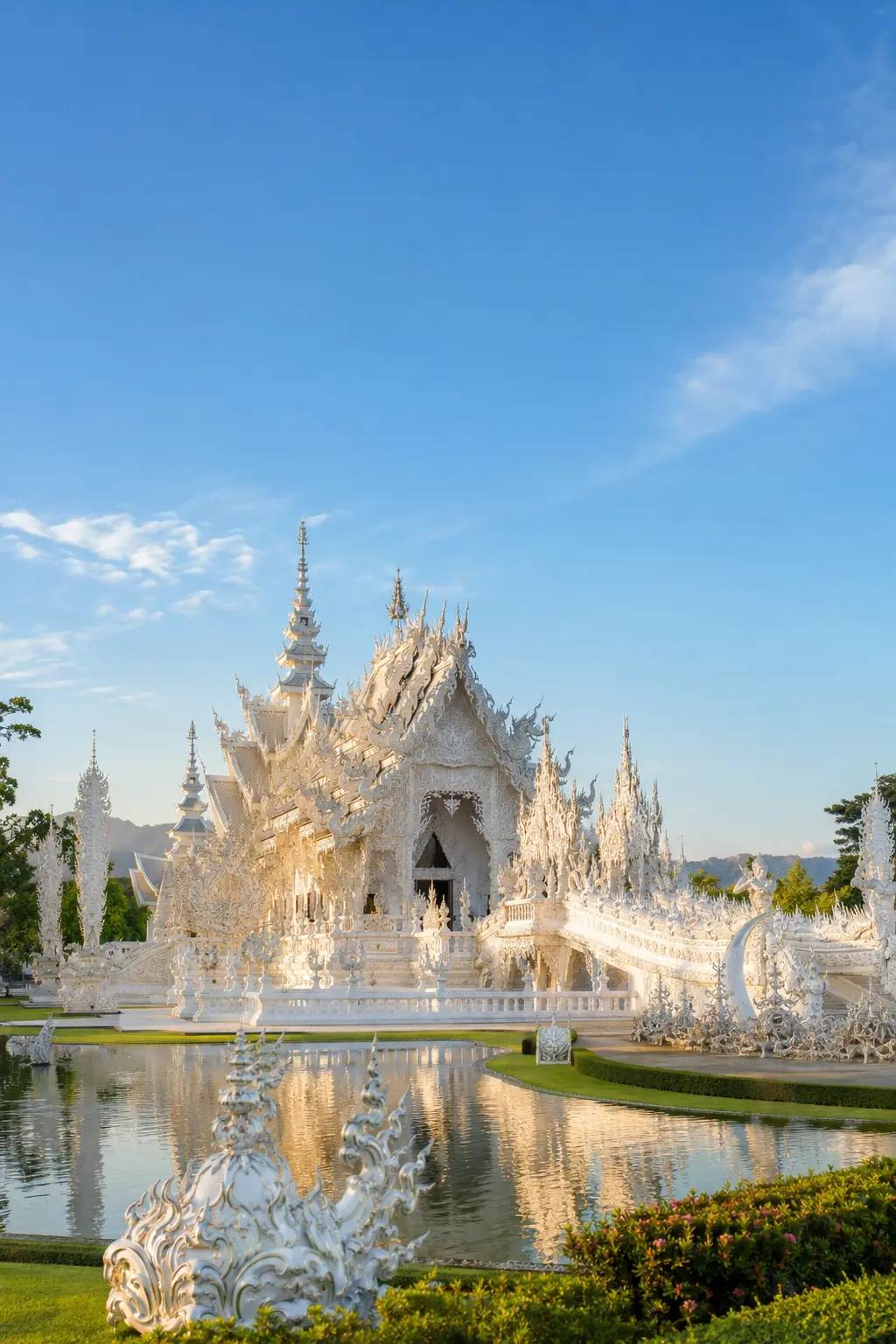
Three colours have come to define how much of the world now pictures Chiang Rai: gleaming white, deep black, and vivid blue. A temple built entirely in white, its surfaces embedded with mirrored glass, catching light like nothing else in Thai religious architecture. A dark timber compound of soaring, monumental buildings filled with art, bone and horn, sculpture and collected objects from across the world. And a newer temple, bold blue and gold, rising on the far side of the Kok River. None of these three places existed a century ago. All three are now among the most recognisable images associated with this northern Thai province.
It would be easy to tell Chiang Rai's story as though contemporary art simply appeared out of nowhere and put the city on the map. That would miss the more interesting truth. Chiang Rai already had a map of its own, drawn many centuries earlier, rooted in Lanna history and northern frontier life. What happened over the past few decades was not the invention of an identity, but the addition of a strikingly new one — built, in large part, by a handful of Thai artists who chose to root their most ambitious work in this particular corner of the country.
This distinction matters more than it might first appear. A city that gains international recognition through contemporary art can easily be mistaken, by outsiders unfamiliar with its longer history, for a place that simply had nothing much going on before the artists arrived. Chiang Rai's story is genuinely different from that pattern, and it is worth telling it that way from the very start.
Historic Chiang Rai Before the Modern Art Boom
Chiang Rai is Thailand's northernmost province, and it carries a long and well-established connection to Lanna history and culture. The Tourism Authority of Thailand describes it as a province of valuable Lanna culture, sitting at the junction of Thailand, Myanmar and Laos. The city is traditionally associated with King Mangrai and the formation of the Lanna world in the thirteenth century, a period frequently linked to a founding date of 1262, though the precise date matters far less to this story than the underlying fact it represents: Chiang Rai has stood as a significant northern centre for the better part of eight hundred years.
This is worth establishing clearly before any mention of contemporary art, because the story of Chiang Rai's modern reinvention only makes sense once it is understood as an addition to an existing identity, not a replacement for one. Long before any artist arrived with a vision for a temple unlike any other in the country, Chiang Rai was already a place with its own deep-rooted Lanna heritage, its own architectural traditions, and its own settled sense of what it was. Generations of families here lived within that Lanna world long before any question of international recognition entered the picture, and that older identity did not fade or weaken as the newer one emerged alongside it.
A Frontier Shaped by Movement and Exchange
Part of what makes Chiang Rai distinctive is its geography. Its far-northern location places it close to borderlands, mountain communities and the wider Mekong region, and the Tourism Authority of Thailand highlights the Golden Triangle and the meeting point of Thailand, Myanmar and Laos as defining features of the province. This frontier setting gives Chiang Rai a historical character shaped by movement, exchange and proximity to neighbouring cultures, rather than by isolation. It is a backdrop worth noting for context, though the story that follows has little to do with the region's more notorious border history and everything to do with what a handful of artists chose to build within it.
Chiang Rai Beside Chiang Mai
Any account of Chiang Rai's modern identity eventually has to address its more famous northern neighbour. Chiang Mai has long held a larger international tourism profile and a bigger urban footprint, a difference best understood as one of relative visibility rather than any kind of hierarchy between the two cities. For much of the twentieth century, visitors travelling north tended to think of Chiang Mai first, with Chiang Rai occupying a quieter, less internationally recognised position further along the same route.
What changed this dynamic was not a shift in Chiang Rai's underlying importance, but the emergence of a series of contemporary art landmarks that gave the city a visual identity distinctly its own — one that did not depend on comparison to Chiang Mai at all. Chiang Rai did not need to become a larger or busier version of its neighbour. It needed, and eventually found, a completely different reason for people to come.
Chalermchai Kositpipat and Wat Rong Khun
That reason begins with a single, extraordinary building. Wat Rong Khun, widely known outside Thailand as the White Temple, was designed and built by the Thai artist Chalermchai Kositpipat, a connection the Tourism Authority of Thailand confirms directly. It is essential to be clear about what this building actually is: a contemporary project, not an ancient temple complex handed down from Chiang Rai's Lanna past. Its gleaming white surfaces, embedded with countless fragments of mirrored glass, and its highly individual interpretation of Buddhist visual language, made it globally recognisable in a way few modern religious buildings anywhere have managed.
Why the White Temple Matters
It would be a mistake to treat Wat Rong Khun as simply a striking photo opportunity, impressive to look at but disconnected from any deeper meaning. It is better understood as contemporary Buddhist art carrying genuine religious significance, built by an artist working within, rather than against, established Thai artistic and spiritual traditions. What makes the project so significant to Chiang Rai's broader story is that it demonstrates modern identity being constructed through a fresh interpretation of existing cultural material, rather than through the wholesale import of some generic international architectural style. Chalermchai did not look outward for inspiration in designing something that would eventually become known across the world; he looked inward, into Thai Buddhist symbolism, and reshaped it into something entirely his own. The result is a building that could only have come from this particular cultural context, even as its fame has long since spread far beyond it.
Thawan Duchanee and Baan Dam
If Wat Rong Khun represents one pole of Chiang Rai's contemporary art identity, Baan Dam represents the other entirely. The Tourism Authority of Thailand lists Baan Dam Museum among Chiang Rai's major cultural attractions, associating it with the artist Thawan Duchanee. It is important to be precise about what Baan Dam is: an art museum and artistic environment, not a Buddhist temple. Often referred to as the Black House, it consists of dark timber architecture spread across numerous structures, filled with art, sculpture and an extensive collection of objects — a very different kind of creative statement from the luminous, mirror-studded surfaces of Wat Rong Khun.
The contrast between the two sites could hardly be more striking. Where the White Temple offers something luminous and instantly photogenic, built around a coherent religious vision, Baan Dam presents a darker, more monumental and more experimental artistic world, built around collection, accumulation and a very different visual language entirely. There is no need to invent any sense of rivalry between the two artists to make this contrast meaningful; the work itself speaks clearly enough on its own terms. What is genuinely remarkable is that both projects emerged from the same province, within a comparable stretch of decades, offering visitors two entirely different kinds of encounter with contemporary Thai art depending on which direction out of the city centre they chose to travel.
Two Artists, Two Visual Worlds
Taken together, Chalermchai and Thawan demonstrate something important about Chiang Rai's modern creative identity: it was never built around a single unified style. Both artists drew on Thai and northern cultural references, yet produced radically different bodies of work, each recognisably its own. Their combined prominence helped establish Chiang Rai as somewhere travellers came specifically to experience contemporary art and architecture, rather than as a place people simply passed through en route to somewhere else in the north. That distinction — a destination visited for its creative output, rather than merely for its scenery or its history — represents a genuinely new role for the city, one that few other Thai provinces have carved out in quite the same way, built not around a single landmark but around an accumulating body of independently conceived work.
Wat Rong Suea Ten and a Younger Generation
The most recent addition to this trio of landmarks came from a younger figure working in a similar creative tradition. Wat Rong Suea Ten, better known internationally as the Blue Temple, is identified in Tourism Authority of Thailand material as the work of local artist Phuttha Kabkaew, also referred to as Sala Nok. TAT material notes that he learned from, and worked with, Chalermchai Kositpipat — a lineage worth acknowledging, though it would be a disservice to describe Phuttha simply as "Chalermchai's student," as though his own artistic identity were secondary to his mentor's. According to Tourism Authority of Thailand regional material, the principal temple building at Wat Rong Suea Ten was completed in 2016, and its bold blue-and-gold design stands as its own distinct contribution to contemporary Buddhist art in the province.
What Wat Rong Suea Ten demonstrates, more than anything else, is continuity. A creative language first established by artists like Chalermchai and Thawan did not end with their own individual projects; it continued to develop through a younger generation of local artists finding their own voice within it, extending Chiang Rai's contemporary art identity rather than simply repeating what had come before.
White, Black and Blue
There is a useful shorthand in these three landmarks, though it should not be allowed to flatten the real differences between them. White refers to Wat Rong Khun, Chalermchai's contemporary Buddhist art project. Black refers to Baan Dam, Thawan's art museum and artistic environment, distinct from any temple. Blue refers to Wat Rong Suea Ten, Phuttha's functioning modern Buddhist temple with its own striking contemporary design. The deeper story beneath this shorthand is that several highly individual, independently conceived projects, built by different artists across different periods, collectively reshaped how outsiders perceive Chiang Rai — not through any coordinated plan, but through the cumulative weight of genuinely original creative work.
Art Becomes Part of the Destination
The scale of this shift is visible in how Chiang Rai now presents itself to visitors. The Tourism Authority of Thailand's current destination material for the province prominently features Wat Rong Khun, Wat Rong Suea Ten and Baan Dam among its highlighted attractions. This is clear evidence that contemporary art now sits at the centre of how Chiang Rai markets itself, rather than functioning as a secondary curiosity alongside more traditional historical sites. There is no need to reach for unsupported visitor figures to make this point convincingly; the plain fact that these three landmarks now anchor the province's own official tourism presentation says enough on its own. These artists fundamentally changed what outsiders expect to find when they arrive in Chiang Rai.
UNESCO Creative City of Design
This transformation received a significant form of international recognition in 2023, when Chiang Rai joined the UNESCO Creative Cities Network as a Creative City of Design. UNESCO announced Chiang Rai among fifty-five new Creative Cities on 31 October 2023, and the Tourism Authority of Thailand states that Thailand's Designated Areas for Sustainable Tourism Administration submitted Chiang Rai's application specifically in the Design category. It is worth being precise about this distinction, since it is easily confused: Chiang Mai holds its own UNESCO Creative City designation, but in the separate category of Crafts and Folk Art, not Design. The two northern cities, in other words, have each earned distinct forms of international creative recognition, reflecting genuinely different aspects of their respective cultural identities.
What "Design" Actually Means
It would be a mistake to read Chiang Rai's UNESCO designation as simply an award for having built some visually striking temples. UNESCO Creative City status is concerned with something broader: the use of creativity, culture, innovation and design as tools within sustainable urban development. Tourism Authority of Thailand material notes that Chiang Rai's designation came with associated five-year roadmaps and a commitment to stakeholder participation, signalling that the recognition is tied to an ongoing process of civic and cultural development, not simply a static honour granted for existing landmarks. The White Temple, Baan Dam and the Blue Temple stand as visible, internationally recognisable symbols of what creative work in Chiang Rai can look like, but the creative-city programme itself extends considerably further than tourism promotion alone.
Old Lanna and New Art Are Not Opposites
None of Chiang Rai's contemporary art movement represents a rejection of the region's older Lanna identity. Quite the opposite: the modern art most closely associated with the city draws heavily on Buddhist, Lanna and northern Thai visual traditions, reworking and extending them rather than discarding them in favour of something imported from elsewhere. Chiang Rai did not become creative by abandoning its local culture. The more accurate framing is that contemporary artists found genuinely new forms for cultural material that was already deeply rooted in the region — taking centuries-old Buddhist symbolism and Lanna aesthetic sensibility and channelling them into structures and artworks that had never existed in quite that form before.
Chiang Rai Beside Chiang Mai, Revisited
Returning to the comparison between Chiang Rai and its better-known southern neighbour, it is worth stating plainly that Chiang Rai's modern reinvention was never really about competing with Chiang Mai for the same kind of tourism attention. Chiang Mai's own UNESCO recognition in Crafts and Folk Art reflects a different, equally legitimate creative tradition centred on established craft practice. Chiang Rai's recognition in Design reflects something distinct: a province that has become known specifically for architectural and artistic innovation, expressed through a handful of landmark projects built within living memory. Neither city's creative identity diminishes the other. They simply represent two different, complementary expressions of northern Thai culture finding contemporary international recognition through very different routes.
What a Visitor Sees Today
A visitor moving through modern Chiang Rai today can trace this entire story in a single, coherent journey. There are the province's historic Lanna temples and city centre, carrying the weight of eight centuries of northern Thai history. Heading south of town, there is Wat Rong Khun, its white towers and mirrored surfaces visible from some distance away. North of the centre sits Baan Dam, its dark timber structures standing in deliberate visual contrast to everything nearby. Across the Kok River, the Blue Temple offers a third, equally distinct interpretation of contemporary Buddhist art. And beyond all of these landmarks, the mountain and border landscapes that have always defined this frontier province continue much as they always have. This sequence, moving between old Lanna heritage and strikingly new artistic landmarks, keeps the modern art story properly embedded within the wider context of a city that was never defined by contemporary art alone.
Reinvention Without Discarding Northern Identity
Chiang Rai did not become a creative city by forgetting its past. It had already been a Lanna centre, a northern frontier, and a regional crossroads for centuries before any of its now-famous artists picked up a brush or laid a foundation stone. What modern artists added was another layer entirely: an international visual identity that could be recognised instantly, by people who might know nothing else about the province's much longer history.
The White Temple did not create Chiang Rai. Baan Dam did not replace Lanna culture with something imported from elsewhere. The Blue Temple did not turn the city into a theme park built purely for visitors. Together, these three landmarks, and the artists behind them, showed something more interesting than any single building could demonstrate on its own: that a historic northern city could keep producing genuinely new cultural landmarks, generation after generation, rather than simply preserving the old ones it already had.
Chiang Rai found a new identity not by becoming less northern, less Lanna, or less itself in any sense at all. It found that identity by becoming creatively, unmistakably itself — a province whose oldest traditions and newest artistic visions turned out, in the end, to belong to exactly the same story.