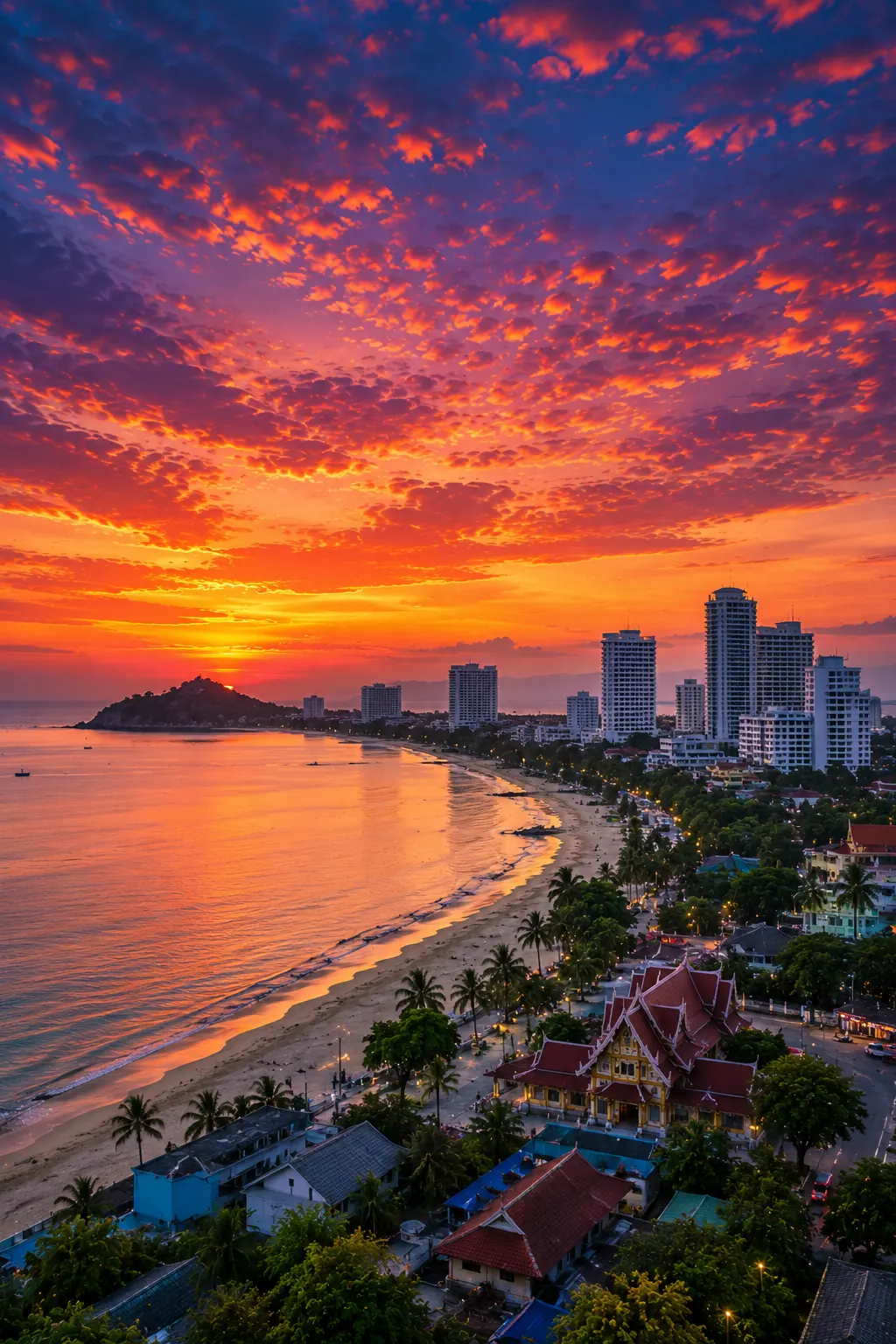
Step off near Hua Hin's railway station today and the modern town surrounds you almost immediately — traffic, hotel shuttles, the smell of grilled seafood drifting from a nearby stall. But look past the station forecourt for a moment and the older layer of Hua Hin is still standing in plain sight: the timber-trimmed station building itself, a century-old hotel a short walk toward the water, and beyond it, the same stretch of Gulf coastline that first drew Bangkok's elite south more than a hundred years ago.
Hua Hin is often introduced to visitors as a beach town. It is more accurately described as Thailand's original seaside resort — a place where rail access, royal interest, a purpose-built hotel and one of the country's earliest golf courses came together earlier, and more deliberately, than anywhere else in Thailand.
Before the Resort
Long before it appeared in any tourism brochure, Hua Hin was a modest coastal settlement on the Gulf of Thailand, its life built around fishing and agriculture rather than holidaymakers. Some local histories trace an earlier name for the area, Samore Riang or Samo Riang, referring to rows of rocks along the shore, and older English-language accounts sometimes use variants such as Lan Hin when describing the coastline. The exact moment the district settled on the name Hua Hin is not the kind of detail worth pinning down precisely; what matters for this story is simpler. Before the railway era, this was a small Gulf coast community, not yet a name known across the country.
That would change with a single piece of infrastructure.
The Train Arrives in 1911
The southern railway reached Hua Hin in 1911, and it is difficult to overstate how much that changed the town.
Academic research into Hua Hin's tourism development identifies the arrival of the railway as the decisive trigger in its transformation from a small fishing settlement into a beach resort. The Tourism Authority of Thailand describes Hua Hin in similar terms, as the country's first beach resort destination to develop out of the extension of the railway system. The line itself was part of a much larger project, extending Thailand's rail network south toward the Malay Peninsula, and Hua Hin found itself sitting conveniently along that route.
Sea travel to the coast had existed before the railway, and it would be an overstatement to say rail was the only way to reach Hua Hin. But scheduled train service changed the practical scale of access. A journey that had once required a boat trip could now be made on a predictable timetable from Bangkok, and that predictability is what turned an obscure stretch of coastline into a realistic weekend destination for people living in the capital.
It is worth pausing on just how significant that shift was for a country where reliable long-distance transport was still relatively new. The southern line connecting Bangkok toward the Malay Peninsula was a major infrastructure project in its own right, built to serve trade, administration and movement across the country, not tourism specifically. Hua Hin's transformation into a resort was, in that sense, something of a by-product — a coastal town that happened to sit conveniently along a route built for much larger national purposes, and that was well placed to take advantage of the access that route created.
Royal and Bangkok Elite Interest Turns the Coast into a Retreat
Once rail access improved, Hua Hin began attracting a very particular kind of visitor: members of the royal family, the aristocracy and wealthy residents of Bangkok, looking for a place to rest by the sea.
Royal residences and private holiday houses built along the coast helped give the town its early prestige. Local histories associate Prince Nares Varariddhi with an early royal residence near the shore and with the wider use of the name Hua Hin during this period. The details of individual titles and family connections matter less here than the broader pattern: elite interest in this particular stretch of coastline established Hua Hin, quite early, as a place for sea bathing, rest and leisure, rather than only a working coastal settlement going about its existing business.
This is also the point at which Hua Hin's identity began to diverge from a typical fishing town. It was becoming somewhere people chose to go.
That distinction — a place people travelled to for pleasure rather than a place people simply lived and worked — is really the beginning of Hua Hin as a resort in any meaningful sense. Plenty of coastal communities along the Gulf of Thailand had beaches, fishing boats and rural life in the early twentieth century. What set Hua Hin apart was that Bangkok's elite specifically began choosing it, ahead of other stretches of coastline, as somewhere worth building a second home or a holiday residence.
The Railway Hotel: The State Railway Actively Builds Tourism
What makes Hua Hin's early development unusual, even by international standards, is how deliberate it was. The railway did not simply deposit passengers at a station and leave the rest to chance. The Royal State Railways itself built the tourism infrastructure that would make Hua Hin a destination.
The Railway Hotel was built in 1922 and formally opened in early 1923 according to the hotel's documented history. It was designed by the Italian architect Alfredo Rigazzi in a European-influenced style, with the wide verandas well suited to the tropical climate — a building intended from the outset to be comfortable, elegant and distinctly suited to its coastal setting. It opened as a relatively small but high-standard property, aimed at affluent Thai and international travellers rather than at mass tourism, which did not yet exist in Thailand in any recognisable form.
The hotel survives today, operating as the Centara Grand Beach Resort & Villas Hua Hin. Few resort towns anywhere can point to a hotel built at the very start of their tourism story that is still welcoming guests a century later. In Hua Hin, that continuity is not a metaphor. It is a working hotel a short walk from the station.
There is something quietly remarkable in that fact once it is stated plainly. Hotels built to serve the very first wave of tourism in a destination are, in most parts of the world, long gone — replaced, demolished, or rebuilt beyond recognition as tastes and standards changed across a century. The Railway Hotel's survival, under new ownership and a new name but on the same site, gives Hua Hin a physical anchor to its origin story that most resort towns simply cannot offer their visitors.
Golf by the Tracks: Thailand's Pioneering Golf Resort Culture
Golf arrived in Hua Hin almost as early as the hotel did, and it deserves more than a passing mention, because it says something important about how comprehensively the resort was planned from the start.
The Royal State Railways developed a golf course at roughly the same time as the Railway Hotel. The original nine holes opened in 1922, and research on the course's history points to the layout being expanded to eighteen holes by 1928. Royal Hua Hin Golf Course is widely described in historical and tourism material as Thailand's first golf course, and it sits close enough to the railway station that the connection between the two is easy to see on the ground even today.
Put together, the sequence is striking: arrive by train, stay at the railway hotel, play a round of golf, walk to the beach. That formula — transport, accommodation, leisure facility, coastline — is essentially the template of a modern resort town, assembled in Hua Hin in the early 1920s, decades before anything resembling mass tourism existed in Thailand.
It is also worth noting how unusual it was, in this period, for a national railway operator to be in the business of building golf courses and hotels at all. The Royal State Railways was not simply providing transport and letting private investors decide what to build around it. It was actively constructing the destination itself, treating tourism infrastructure as a natural extension of the rail network it was already expanding. That level of coordinated planning helps explain why Hua Hin's early resort identity feels so complete, even by today's standards, rather than assembled piecemeal over subsequent decades.
The Station Becomes an Icon
Hua Hin's railway station is one of the clearest physical symbols of this whole era, and it has become a heritage landmark in its own right rather than simply a functional stop on the line.
While rail service reached the town in 1911, the station's present, widely photographed architecture is associated with later rebuilding during the 1920s, with 1926 commonly cited for the Victorian-influenced building visitors see today. Its Royal Waiting Room, a distinctive small pavilion associated with the station, is one of its best-known features. The finer points of exactly when the pavilion took its current form and location vary across secondary sources, and are not essential to the town's story. What matters is the simpler, well-supported point: the station stopped being purely transport infrastructure and became part of Hua Hin's visual identity, a building that still signals the railway era to anyone arriving today.
Palaces by the Sea: Royal Association Strengthens the Destination
As Hua Hin's reputation as a coastal retreat grew, royal interest in the wider area only deepened it.
Maruekhathaiyawan Palace was built under King Rama VI in the early 1920s, with the Tourism Authority of Thailand dating its construction to 1923. It is important to be precise about its location: the palace sits between Cha-am and Hua Hin, in Phetchaburi Province, and belongs to the broader royal seaside story of this stretch of coast rather than to Hua Hin itself.
Within Hua Hin, King Rama VII chose the town for Klai Kang Won Palace, built in the late 1920s. The name is often translated as meaning something close to "far from worries" — a fitting choice of name for a royal residence built specifically as a retreat from the pressures of the capital.
These royal residences reinforced what the railway and the hotel had already begun: a sense that this particular coastline was a place of genuine prestige, worth the investment of both infrastructure and personal attention from the country's highest levels. The point here is not to dwell on the private lives connected to these buildings, but simply to register how thoroughly royal association became woven into Hua Hin's early identity as a resort.
Hua Hin Becomes Thailand's Original Seaside Resort
Put the pieces together — the railway in 1911, growing royal and elite interest, a purpose-built hotel from 1922, one of the country's first golf courses from the same year, and royal residences reinforcing the coast's prestige through the 1920s — and it becomes clear why Hua Hin is so often described as Thailand's first, or original, seaside resort.
The Tourism Authority of Thailand has explicitly called it the country's first beach resort destination, and academic research on Thai tourism history uses similarly direct language, describing Hua Hin as the country's pioneering seaside resort. This is not a claim that no one in Thailand had ever holidayed by the sea before Hua Hin existed. The more precise and better-supported claim is that Hua Hin became the country's earliest purposefully developed, nationally prominent modern seaside resort — one that combined rail access, quality accommodation, dedicated leisure facilities and elite patronage into a single, recognisable package, years before any other Thai beach town did the same.
After the Railway Age: Roads, Cars and a Wider Public
Hua Hin's early resort identity was closely tied to royalty, aristocracy, expatriates and affluent Bangkok society — a relatively narrow slice of Thai society, by necessity, given the cost and formality of travel in that era.
That began to change gradually in the decades that followed, as post-war improvements to Thailand's road network and the growth of private car and bus travel reduced the country's dependence on rail. There is no single year that marks this shift; it unfolded steadily rather than at any one identifiable turning point. What is clear is the overall direction: Hua Hin became increasingly accessible to middle-class Bangkok residents and families, laying the groundwork for the weekend-resort role the town still plays today.
It is worth noting the slight irony in this: even though most of today's visitors arrive by car, bus or plane rather than by train, the railway remains the true origin story of Hua Hin's identity as a resort. The mode of arrival changed. The destination it built did not disappear.
This gradual broadening is worth understanding as an expansion rather than a dilution. The elite, royal-inflected version of Hua Hin from the 1920s did not need to disappear for a more accessible version to emerge alongside it; the two have coexisted for decades. Bangkok families making a weekend trip by car in more recent generations were, in an important sense, following the same coastal draw that had once pulled royal households south by train — just travelling by different means, and in far greater numbers.
The Modern Resort Town: Family, Weekend, Second-Home and Golf Identity
Hua Hin's development path looks different from the later resort booms seen in places like Pattaya, Phuket or Koh Samui, largely because its tourism identity began so much earlier — rooted in the railway and royal-retreat era of the early twentieth century, well before international mass tourism reshaped Thailand's coastline.
Over time, that early identity broadened into something more familiar to visitors today: a town associated with long stays, family holidays, second homes, golf, seafood, beach life and weekend trips from Bangkok. Modern Hua Hin includes a wide range of hotels and condominiums, restaurants, night markets, shopping centres, wellness facilities, golf courses and a substantial residential and long-stay population.
None of this should be read as a comparison designed to declare Hua Hin superior to Thailand's other resort destinations, or as evidence that they somehow lack Hua Hin's character. The genuinely interesting point is historical distinctiveness rather than ranking: Hua Hin simply got there first, and it got there by a different route — through rail and royal patronage rather than through the later waves of beach tourism that built Thailand's other coastal destinations.
Each of Thailand's major beach destinations has its own origin story, shaped by its own combination of geography, timing and circumstance. Hua Hin's happens to be the earliest, and it happens to be unusually well documented and unusually visible on the ground today, which is part of what makes it such a rewarding place to explore with this history in mind rather than a reason to rank it above anywhere else.
What Remains: Station, Hotel, Golf Course and Seafront
What makes Hua Hin's history feel unusually alive, rather than confined to historical plaques, is how much of the original resort infrastructure is still standing and still in use.
The railway station and its heritage architecture remain a functioning stop on the line as well as a recognisable town landmark. The former Railway Hotel continues to operate as the Centara Grand Beach Resort & Villas Hua Hin, on essentially the same site where it opened a century ago. Royal Hua Hin Golf Course still occupies its original position close to the tracks. The area's royal association continues into the present. And the beach itself sits within easy reach of all of these landmarks — a compact geography that lets a visitor walk between the station, the historic hotel and the seafront in the space of a short afternoon.
These are not reconstructions or recreations built to evoke an earlier era. They are the same buildings and grounds, still doing much of what they were built to do, which gives a visitor to Hua Hin something increasingly rare: the chance to physically trace the beginning of a resort town rather than simply read about it in a guidebook.
Hua Hin Helped Write Thailand's Beach-Holiday Template
Hua Hin became famous before Thailand had anything resembling a mass-tourism industry. Its basic resort formula — railway, beach, hotel, golf and royal prestige — was assembled unusually early, and unusually deliberately, in the early 1920s.
Modern Hua Hin is, of course, much larger than it was then, and open to a far broader public than the Bangkok elite and royal households who first made it fashionable. But the first resort town has not been erased by that growth. It is still visible inside the modern one. A traveller can arrive in a thoroughly contemporary town, then stand at a century-old railway station, walk past a hotel that has been welcoming guests since the 1920s, and reach the very same Gulf coastline that drew the town's earliest holidaymakers.
Hua Hin did not simply become a beach destination somewhere along the way. It helped define, at a remarkably early stage in Thailand's modern history, what a Thai beach destination could look like — and much of that original blueprint is still standing for anyone willing to walk a few minutes from the platform to find it.