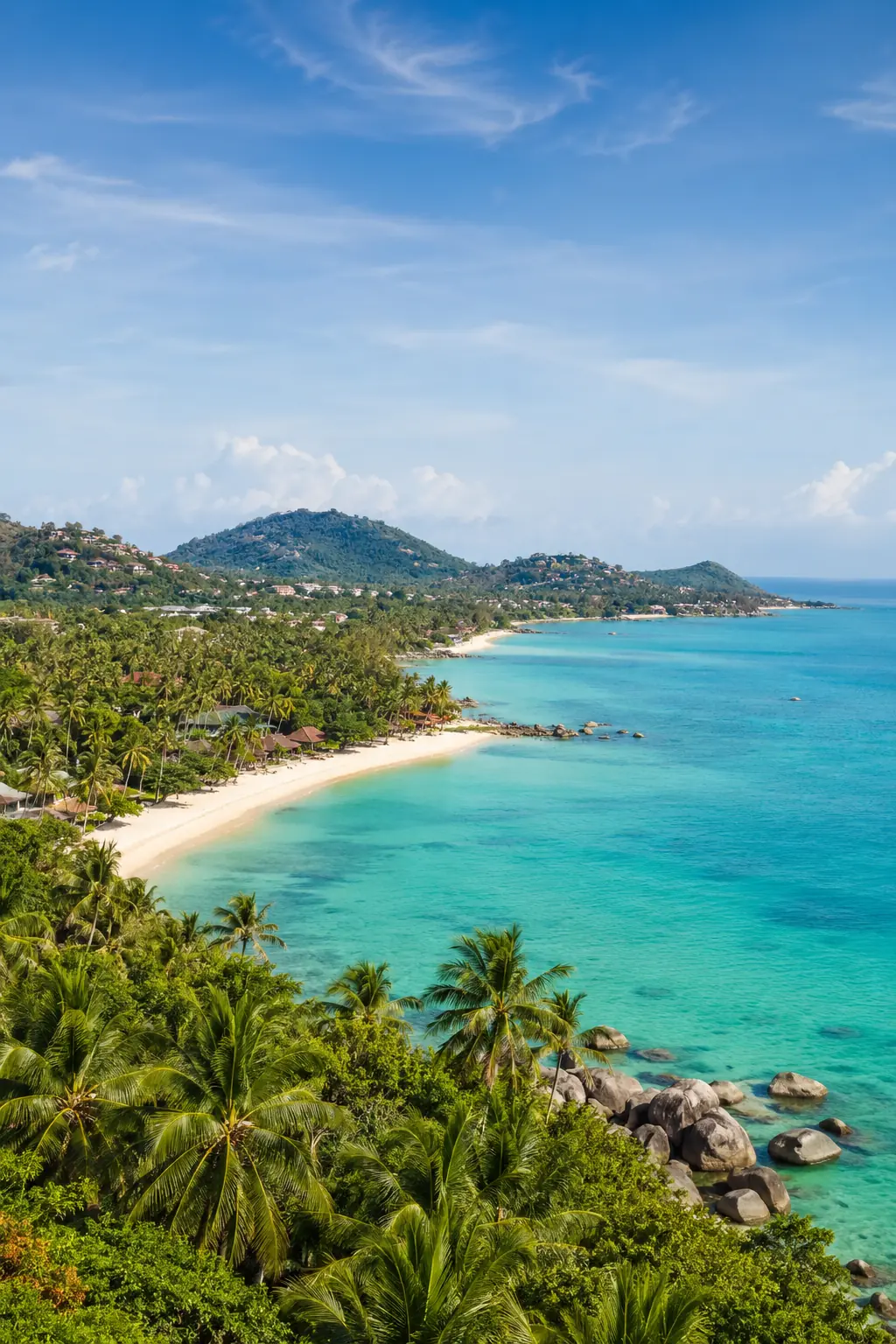
Fly into Koh Samui today and the first thing you notice, before the beaches or the resorts, is the palms. They line the runway. They frame the open-air terminal. They lean out over the coast as the plane banks toward land, exactly the way they do on every postcard the island has ever produced.
It is easy to assume those palms were always there for the view. They were not. For generations before anyone thought of Samui as a resort island, its coconut palms were working agricultural land — the basis of household incomes, daily labour and the island's connection to markets beyond its own shores. The postcard image came later. The plantation came first.
Koh Samui's story is not one of an empty tropical island suddenly discovered by tourism. It is the story of one working island economy gradually giving way to another, with the landscape of the first still visible, quite literally, running through the second.
Before Tourism, Samui Was an Agricultural Island
Koh Samui has a long history of maritime settlement, connected over time to seafaring peoples and patterns of regional migration around the Gulf of Thailand. The exact details of the island's earliest settlement are not simple enough to pin to a single date, and this City Story is not the place to try. What matters more for understanding the island as it exists today is a later, better-documented period: the nineteenth and twentieth centuries, when coconut cultivation became central to island life.
Academic research on Samui describes migrants from southern China and the Thai mainland settling on the island during the nineteenth century, with coconut farming emerging as one of the island's principal economic activities. That agricultural economy remained fundamental to Samui well into the twentieth century, right up until tourism overtook it as the island's dominant source of revenue in the century's later decades.
It is worth holding onto that sequence as the article moves forward. Samui's famous palm-covered landscape was not created for visitors. It was already there, shaped by generations of farming families, long before the first tourist ever set foot on the island.
The Coconut Economy — How Palms Shaped Work and Landscape
Coconut farming on Samui was never a decorative sideline to some other, more important economy. Fieldwork on the pre-tourism island repeatedly identifies coconut plantations as the primary livelihood on which many local families depended, shaping everyday work and household income across the island in a very direct way.
That economic reality also shaped the physical landscape that later visitors would come to associate so closely with Samui. Coconut groves were planted, tended and harvested across large parts of the island, producing the palm-lined scenery that would eventually become one of Thailand's most recognisable tropical images. And the coconut economy reached well beyond the island itself — copra, coconut oil and whole coconuts connected Samui's farmers to markets on the mainland and further afield, making the island a working part of a wider agricultural trade rather than an isolated subsistence economy.
The postcard image of palms leaning out toward the sea, in other words, began its life as agricultural land captured almost by accident in a photograph. It became an icon of tropical tourism only afterward.
An Island Harder to Reach
Part of what shaped Samui's slower entry into tourism, compared with some other Thai destinations, was simply how difficult it was to reach.
Before the island had an airport, getting to Samui meant travelling by boat or ferry from the mainland. Peer-reviewed research on the island's development describes the pre-1989 journey as involving a ferry crossing of roughly two hours, a detail the research links directly to the limits it placed on tourism during that period compared with what followed once air access arrived. Movement within the island itself was also considerably less convenient than it is now, with road infrastructure limited and internal travel much slower than a modern visitor would expect.
None of this means Samui was cut off from the world. It means the island's relative remoteness set a real ceiling on how much tourism could grow, at least until the transport picture changed. That remoteness helps explain why large-scale international tourism reached Samui later than it reached destinations with easier mainland connections.
Backpackers Arrive in the 1970s
Despite that remoteness, travellers found their way to Samui well before any airport existed. Research on the island's tourism history places the beginnings of Western backpacker tourism in the 1970s, with early visitors arriving on an island still dominated economically by coconut farming, fishing and village life.
What these first travellers found was correspondingly simple: small beach bungalows, basic guest accommodation and modest restaurants, built to serve a slow but steady trickle of independent visitors rather than any organised tourism industry. Academic work focused on Chaweng notes that many of these early establishments were owned and run by local residents as a supplementary source of income alongside their existing coconut farming — not as a replacement for it.
This is one of the more important points in Samui's story. Tourism did not arrive and sweep the island's existing economy aside. It grew up alongside it, inside the same households and often on the same land, for years before it became the dominant activity it is today.
That gradual, overlapping quality is worth dwelling on, because it shapes how the rest of Samui's story should be read. There was no single morning when the island "became" a tourism destination. A farming family adding a few bungalows behind their coconut grove, a fisherman's household opening a small restaurant for passing travellers — these were incremental decisions, made one household at a time, long before anyone on the island could have described what Samui's tourism economy would eventually become.
Chaweng and Lamai — Bungalows Before Resorts
Two beaches in particular became the early public face of Samui's tourism: Chaweng and Lamai.
Chaweng developed from what had been a small settlement and agricultural coastal community into what would eventually become the island's largest tourism centre. Peer-reviewed research on Chaweng's early years describes a landscape of small beach bungalows and restaurants catering to backpackers, many of them locally owned — a modest, low-key version of what visitors encounter there today. As word of the island spread among travellers, accommodation, restaurants and visitor services gradually expanded to meet growing demand.
Lamai followed a broadly similar trajectory as a beach-tourism destination, while retaining its own distinct scale and character rather than simply becoming a smaller copy of Chaweng. Together, these two beaches became the new economic front door of the island — the places where Samui's coconut-farming communities first began building an additional livelihood around visitors, one guesthouse and one restaurant at a time.
Tourism Grows, But Access Still Limits Scale
By the 1980s, Samui already had a real, if modest, tourism identity. Backpackers and independent travellers had been arriving for a decade or more. Ferry access, while slow, had allowed a growing base of simple accommodation to take root along beaches like Chaweng and Lamai.
But this growth still operated within the limits set by the island's remoteness. A two-hour ferry crossing from the mainland, followed by whatever onward travel was needed to reach a particular beach, was never going to support the scale of visitor numbers that faster transport could eventually bring. Samui's reputation was growing faster than its infrastructure could accommodate — a gap that would not close until the island's transport situation changed fundamentally.
1989: Samui Airport Opens
That change arrived on 25 April 1989, when Samui Airport officially opened for service.
According to Bangkok Airways, which built and operated the airport, construction began in 1984, and Bangkok–Samui services began with the airport's opening in 1989 — the company's first airport project. Bangkok Airways' own account of this period notes that Samui was already beginning to develop as an international tourist destination by the time the airport opened, which is an important detail: the airport did not create Samui's tourism appeal out of nothing. It accelerated a reputation that backpackers and independent travellers had already been building for close to two decades.
What the airport did change, dramatically, was travel time. A journey that had previously required hours by ferry, often as one leg of a longer trip from Bangkok, could now be completed by a single flight. That shift opened Samui to a far larger tourism market than the ferry-dependent decades before it had ever allowed.
From Coconut Plantation to Runway
One detail from this period captures Samui's transformation almost too neatly to be believed, and it happens to be entirely true: according to Bangkok Airways, the land the airport was built on, in Bo Phut, had previously been coconut plantation.
Construction on that former plantation site began in 1984. The airport that eventually opened there became known for its open-air terminal design, built around natural ventilation, greenery and an island aesthetic rather than the conventional enclosed terminal buildings found at most airports — a deliberate design choice that has since become part of the airport's own identity.
There is no need to overstate the symbolism here, but it is hard to ignore. Land that had spent generations producing the island's coconut economy became, quite literally, the infrastructure that carried Samui's next economy into being. Coconut farming did not disappear because of this — plenty of plantation land remained in production elsewhere on the island — but the image of one economy's ground becoming the runway for the next is a genuinely apt symbol for what was happening across Samui more broadly.
International Access and the Tourism Economy Accelerate
Samui Airport initially served domestic routes, with Bangkok as the dominant connection. Over the following years, its international capability expanded: Bangkok Airways states that the airport received customs-airport status in 1996, with international-flight facilities expanding further during the 1990s.
The precise sequence of these corporate and regulatory milestones matters less than the overall direction they point in. Through the 1990s, Samui increasingly became a destination that travellers could reach directly, rather than an island accessed only through Bangkok and a lengthy ferry crossing. That shift connected Samui into wider regional and international travel networks in a way that simply had not been possible during the ferry-only decades.
Alongside this, the island's economic centre of gravity shifted decisively. Academic research on Samui describes this period as the point at which the island's economy moved from being primarily agricultural to being primarily driven by tourism. New kinds of work opened up in accommodation, food service, transport, construction and retail, drawing workers from other parts of Thailand as well as from Samui's existing communities. This was not a story of loss so much as one of a labour market and a set of livelihoods broadening considerably beyond what coconut farming alone had offered. And importantly, that shift did not happen at a single fixed moment — agriculture and tourism overlapped on the island for years, and coconut farming never disappeared entirely.
From Bungalow Island to Global Resort
The physical shape of Samui's tourism industry evolved in a fairly clear sequence over the following decades: basic, locally run bungalows gave way to larger hotels, which in turn gave way to organised resort development, eventually including international hotel brands and high-end luxury properties.
The Tourism Authority of Thailand's current material presents Samui as an island offering a genuinely wide range of experiences — lively beaches such as Chaweng and Lamai sitting alongside quieter areas and high-end resorts. Around this core beach-tourism identity, the island also developed strengths in diving, boating, wellness, yoga, golf, dining and longer-stay tourism.
The most useful way to understand this expansion is not as a list of amenities to visit, but as evidence that Samui learned, over time, to serve several quite different kinds of traveller at once — the backpacker tradition it began with, families and couples seeking a beach holiday, and visitors drawn by wellness, luxury or long stays — all while retaining a recognisable island identity underneath the variety.
Older Village Layers: Bo Phut and Beyond
Not every part of Samui's tourism landscape grew out of raw beachfront development. Bo Phut, the same area where the airport now stands, offers a good example of an older settlement being incorporated into modern tourism rather than swept away by it.
The Tourism Authority of Thailand highlights Bo Phut's old Chinese shophouses as part of the area's appeal today — a visible, walkable reminder that Samui's history includes trading and commercial life well beyond coconut farming and beach bungalows. It is a useful corrective to any assumption that the island's pre-tourism story was purely agricultural and nothing else, and a good example of how a modern visitor area can carry an older layer of the island's history within it rather than erasing it.
Coconuts Never Completely Left the Story
Even after tourism became the island's dominant economic activity, coconut palms remained a defining visual and cultural feature of Samui. Older groves survive between roads, houses, villas and resorts, still recognisable to anyone who knows what they are looking at. Coconut products remain part of local food and everyday island identity, not simply a heritage display for visitors.
It would be a mistake to romanticise this into a claim that some "real Samui" exists only within the surviving plantations, separate from and superior to the tourism economy around it. The more accurate and more interesting way to put it is this: the coconut economy left behind a landscape and a cultural memory that tourism inherited, rather than replaced. The palms that once represented the island's main livelihood are the same palms that now frame its resorts.
Chaweng as the Clearest Transformation, Not the Whole Island
Chaweng remains the clearest visual symbol of just how far Samui has changed. Peer-reviewed research traces its path from a scattering of small beach bungalows and backpacker restaurants to a dense, fully developed visitor centre — arguably the most complete illustration anywhere on the island of the shift from agricultural coastal community to global resort destination.
But Chaweng should be read as a case study, not as a stand-in for the whole of Samui. The island also includes quieter beaches, long-established villages, agricultural zones, temples and communities that move at a very different pace from the busiest tourist strip. Chaweng shows just how far change can go on Samui. The rest of the island shows how uneven and layered that change actually was — and, in many places, still is.
Why Samui's Development Story Is Distinct
Samui and Phuket both became major international resort destinations, and it is tempting to tell their stories as versions of the same script. They are not.
Phuket's pre-tourism international economy was built heavily around tin mining, regional trade and an established urban commercial centre in what is now Phuket Town. Samui's pre-tourism identity was something quite different: a far more agricultural, dispersed island landscape shaped by coconut plantations, reaching international tourism markets later and by a different route — through backpacker word of mouth first, and only later through the kind of infrastructure investment that had shaped Phuket's development earlier on.
Neither path is better than the other; they are simply different origin stories that happen to arrive, decades later, at broadly similar destinations. Recognising that difference is part of what makes each island's history worth telling on its own terms, rather than as a repeated formula.
It is worth noticing, too, how differently each island's infrastructure story unfolded. Phuket's transformation was built substantially on bridges and roads connecting it directly to the mainland. Samui's turning point was an airport built specifically to solve the problem of a two-hour ferry crossing that no amount of road-building could shorten. Geography set each island a different problem, and each island's development history is, in large part, the record of how that particular problem got solved.
One Island Economy, Layered Over Another
Samui did not become an international destination because someone suddenly discovered that it had good beaches. Travellers had already been finding their way to the island for close to two decades before Samui Airport ever opened. What changed, decisively, was access, scale, and the island's ability to build a new economy around qualities — its coastline, its climate, its character — that had always been there, underneath a working agricultural economy that came first.
The coconut palms are the perfect symbol of that continuity. They once represented the island's main livelihood, planted and tended by generations of farming families. Later, almost without anyone planning it that way, they became part of the image that helped sell Samui to the rest of the world. Today they stand beside resorts, roads, restaurants and an airport built, quite literally, on what used to be plantation land.
Koh Samui's transformation was never a story of nothing becoming something. It is the story of one working island economy giving way to another — and the landscape of the first still runs, visibly, through the second, in every row of palms that lines a road, a runway, or a resort.