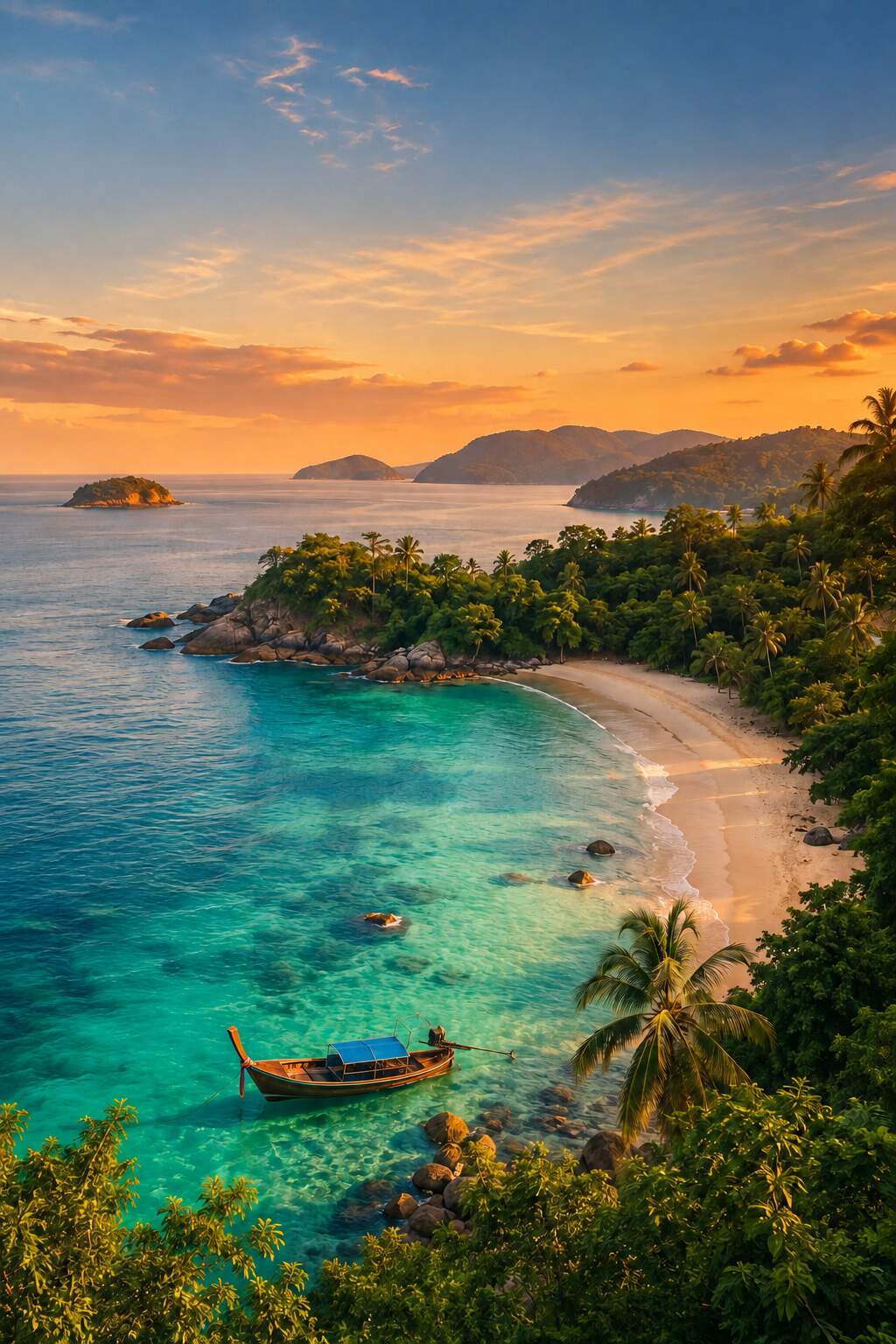
Long before Phuket became synonymous with beaches, resorts and international holidays, the island was already looking outward. Tin, trade and migration connected it to the wider world; later, roads, bridges, aviation and tourism gave that outward-looking character a completely new form. This is the story of how Phuket reinvented itself without losing the traces of what came before.
Ask someone today what Phuket means to them and the answer will probably involve a beach. Patong. Kata. Karon. A resort overlooking the Andaman Sea. A flight arriving from another country. A speedboat leaving for an island. For millions of travellers, Phuket is one of the names that defines a tropical holiday in Thailand.
But Phuket did not begin with beaches.
Long before sun loungers appeared along the west coast, the island was already connected to a much wider world. Ships moved through the waters between India, the Malay Peninsula and China. Traders knew the island and the surrounding coast. Beneath the ground was tin, a resource that would shape Phuket's economy, attract migrants and leave a cultural imprint still visible in the streets of Phuket Town.
The modern tourist island did not replace a place that had been isolated from the world. In many ways, it inherited an island that had been outward-looking for centuries. Phuket has simply changed what it sends out, what it welcomes in and what makes people cross the sea to reach it.
Before the Resorts
Phuket sits just off the west coast of southern Thailand, facing the Andaman Sea. Its location placed it along maritime routes linking South and Southeast Asia with China, and historical accounts describe the island — and the older Thalang area — as known to sailors and traders long before modern tourism existed.
Tin became the great economic prize. The mineral had been worked in the region for generations, but demand and production expanded dramatically during the nineteenth century. Mining activity around Kathu and Thalang grew through the 1800s, and by the middle of that century Phuket was developing into an increasingly important trading centre on the Andaman coast. Mining brought money, labour and commercial connections.
The island's geography helped make those connections possible. Penang, further south in what is now Malaysia, was an important regional port and commercial centre. Chinese workers and traders, especially Hokkien Chinese, moved through these networks and settled in Phuket. Some came directly because of mining. Others came as merchants, contractors, shopkeepers or members of families whose lives crossed the modern borders of Thailand and Malaya.
That migration would become one of the foundations of Phuket's distinctive local culture.
This is an important part of the Phuket story because the island's first great international economic boom was not built around hotels. It was built around tin.
The Town the Mines Helped Build
If the beaches tell the story of modern Phuket, the streets of Phuket Old Town tell much of the story that came before.
During the height of the tin economy, successful Chinese mining and trading families invested their wealth in homes, businesses and urban buildings. Rows of narrow shophouses appeared along streets such as Thalang Road, Dibuk Road and the surrounding blocks. Larger mansions reflected both wealth and the mixture of cultural influences moving through the region. Phuket's provincial government dates much of this old town character to the era around King Rama V and the early twentieth century, closely tied to families who built their fortunes from tin.
The architecture is often described as Sino-Portuguese, though "Sino-European" also appears in official tourism material, and it is worth resisting the urge to over-explain the exact taxonomy. What matters more is the visual story: colourful facades, covered walkways, narrow-fronted shophouses and decorative combinations of Chinese and European forms, echoing the trading cities that grew up around the Straits of Malacca.
Phuket was not copying one place in isolation. It belonged to a regional world of movement and exchange. Penang mattered. So did Chinese networks. So did European commercial influence and the broader culture of port cities across the Malay Peninsula.
The result was something recognisably Phuket.
Today, a visitor can walk through the Old Town and treat the buildings as a photogenic break from the beach. But they are more interesting when understood as evidence. They show that Phuket had an urban, commercial and multicultural identity long before international tourism became the island's dominant industry. The wealth beneath the ground helped shape what appeared above it.
A Culture That Stayed
Mining did more than change buildings. Chinese migration became woven into Phuket's families, food, religious life, festivals and traditions.
Over generations, a distinctive Baba, or Peranakan, culture developed on the island — one strand within a broader, multicultural island history rather than the whole of it, and linked to related communities elsewhere around the Malay Peninsula while carrying its own local character.
That heritage survives in ways that are easy for a traveller to encounter without necessarily knowing where they came from. Chinese shrines remain part of the urban landscape. Local dishes reflect Chinese, Malay and southern Thai influences, sitting alongside older Muslim and Thai culinary traditions found elsewhere on the island. Family recipes carry memories of trade and migration. Ceremonies and clothing traditions remain part of Phuket's cultural identity.
The Phuket Vegetarian Festival is one of the most visible examples. Its roots are associated with the Chinese community that grew around the mining economy, and the festival remains one of the island's best-known cultural events.
Food has become so important to Phuket's identity that UNESCO designated Phuket a Creative City of Gastronomy in 2015, recognising the importance of its culinary heritage and intercultural exchange.
That designation is a useful reminder of how the island works. Phuket may be internationally famous for its coastline, but some of its strongest local identity is found at a dining table in town rather than on a beach.
The old economy faded. The culture it helped create did not.
An Island Becomes Easier to Reach
For an island to become one of the world's great tourism destinations, beauty is not enough. People have to be able to get there.
For much of Phuket's history, the short water gap separating the island from the mainland was a real transport barrier. Historic images from Thailand's Department of Highways show vehicles being ferried across between the mainland at Tha Nun and Tha Chatchai on Phuket.
Then came a major change. Sarasin Bridge opened in 1967 as the first permanent road bridge linking Phuket directly with Phang Nga and the Thai mainland. Cars, buses, goods and people could now travel onto Phuket without relying on the ferry crossing. The island had become physically connected to Thailand's growing road network.
Aviation added another layer. Phuket had earlier aviation facilities, and by 1979 the Thai government had established an international airport on the island. Through the 1980s, expanding air connections helped move Phuket from a relatively distant southern destination into the international travel system.
Road access and air access worked together. This was the infrastructure behind the postcard. Without it, Phuket's beaches might still have been beautiful. They simply would not have been accessible to millions of people in anything like the same way.
When Travellers Began Looking West
The geography of Phuket tourism is almost a reversal of the older economic map.
Phuket Town, on the southeastern side of the island, had been the commercial centre of the mining era. The tourism boom increasingly looked toward the west coast — toward long beaches facing the Andaman Sea.
During the 1970s, Phuket began attracting small numbers of international travellers, including the backpackers and independent travellers who were exploring beaches across southern Thailand. Tourism was still modest. Mining, rubber, fishing and agriculture remained important parts of island life, and the shift away from a raw-material economy was gradual rather than sudden. But something was changing.
Academic studies of Phuket's tourism development describe the 1970s as the beginning of that transition. International arrivals were still only around 20,000 in 1976, but planners and investors were already paying attention.
In the late 1970s, Thailand's tourism authorities developed plans to encourage larger and higher-quality tourism investment on Phuket. Patong, Kata and Karon were among the west-coast locations identified for development — this was tourism being actively planned and encouraged, not something that simply happened on its own.
The island had found its next great economic asset. This time it was not below the ground. It was the coastline.
Patong Before Patong
Today Patong is so closely associated with Phuket that it can be difficult to imagine one without the other. Yet the Patong of the modern era is remarkably young.
Research describing the area's early tourism period presents a very different place: small settlements around the bay, with mining, fishing and agricultural livelihoods, and only limited accommodation for visitors. Before the rapid development that began around the end of the 1970s, the beach was far removed from the dense resort town travellers know today.
Small bungalows and guest accommodation came first. Then more investors arrived. Hotels followed. Restaurants, travel businesses, shops and entertainment expanded around them.
By the 1980s, Phuket was no longer simply a place discovered by a relatively small number of adventurous travellers. It was becoming a destination sold internationally. The numbers show how quickly the transition happened: figures drawn from Tourism Authority of Thailand statistics record roughly 20,000 international arrivals in 1976 and more than half a million by the end of the following decade.
In barely more than a decade, Phuket had moved onto the international tourism map.
Patong became the most visible symbol of that transformation, but it was not alone. Kata and Karon developed their own hotel and resort areas, and other beaches followed at different speeds and with different characters. What emerged was not one tourist town but an island with several tourism centres, each connected to Phuket Town, the airport and the mainland by an increasingly developed transport network.
From Tin to Tourism — But Not Overnight
It is tempting to tell Phuket's history as a clean handover: mining ended, tourism began. Reality was more gradual.
Tin prices weakened. Mining became less central. Rubber, agriculture and fishing continued. Tourism grew alongside the older economy for some time before eventually becoming far more important to the island's international identity and economic life.
The transition gathered real momentum during the 1980s. Research on Phuket describes that decade as the period when the island stepped decisively onto the international tourism stage. Investment accelerated, accommodation expanded and the west coast became increasingly urbanised.
That change also shifted the island's centre of attention. For generations, commercial wealth had been associated with mines, trading networks and Phuket Town. Now the west coast — Patong in particular — attracted investment, workers and visitors from across Thailand and around the world.
Phuket had reinvented itself once again. But the earlier Phuket did not disappear. The two economies left different maps layered onto the same island. One can still walk between them today.
The Airport and the World
As tourism grew, Phuket International Airport became one of the most important pieces of infrastructure on the island. Flying removed distance in a way roads alone could not.
A traveller from Bangkok could reach Phuket without a long journey down the peninsula. International services increasingly connected the island directly with overseas markets, and expanding scheduled networks allowed tourists to arrive in Phuket without treating Bangkok as the essential first stop.
That helped transform the island from a destination within a Thailand trip into a destination that could be sold in its own right. Phuket became a gateway as well as an island. Travellers flew in for Phuket itself, but the airport also fed tourism across the wider Andaman region — Khao Lak, Phang Nga, Krabi and the islands offshore.
Today, Airports of Thailand describes Phuket International Airport as the country's third busiest, after Suvarnabhumi and Don Mueang, and as a principal gateway for tourism in southern Thailand — a scale that would have been difficult to imagine when early international travellers were finding simple accommodation along Phuket's beaches.
The airport did not create Phuket's attraction. It multiplied its reach.
A Global Island
By the 1990s and 2000s, the direction was unmistakable. Phuket had become one of Southeast Asia's best-known resort destinations. Hotels ranged from simple guesthouses to international luxury brands. Restaurants served both local Phuket food and cuisines from around the world. Diving, boating, shopping, nightlife, wellness and excursions joined the beaches as reasons to visit.
The tourism economy also reshaped the physical island. A 2025 academic study using satellite imagery examined Phuket's urbanisation between 1987 and 2024 and found a dramatic long-term expansion of developed land associated with tourism, infrastructure and economic change, with urban growth spreading from established centres and along major transport corridors as coastal areas became increasingly built up.
That transformation is visible even without satellite data. Drive across Phuket today and the island changes constantly. There are dense urban areas, resort strips, shopping centres, local neighbourhoods, rubber trees, old shophouses, marinas, temples, mosques, Chinese shrines and stretches of green hillside — sometimes within a surprisingly short distance of one another.
That mixture is part of what Phuket has become. It is not simply a resort built beside a beach. It is a functioning Thai province, a historic trading island and a global tourism centre occupying the same space.
Phuket Town's Second Life
One of the more interesting turns in the story is what happened to Phuket Town.
The rise of beach tourism could have left the old commercial centre as little more than a reminder of a previous economy. Instead, its historic character eventually became an attraction of its own.
Old shophouses were restored. Cafes, restaurants, galleries and boutique accommodation moved into historic buildings. Street art appeared. Sunday walking streets and cultural events brought new life to roads whose architecture had been shaped by the mining era.
The very history that tourism once seemed to move away from became part of the modern visitor experience. This is one reason the story should not be reduced to "old Phuket versus new Phuket." The two keep meeting. Tourism helped create renewed interest in the Old Town. Food traditions rooted in earlier communities became part of Phuket's modern global identity. Historic architecture became a reason to visit. Younger businesses found new uses for buildings created by an economy that had peaked generations earlier.
Phuket reinvented the inheritance of its first boom inside its second.
More Than Patong
Patong deserves its place in this story because no location better demonstrates the scale of Phuket's tourism transformation. But equating Phuket with Patong misses the point.
The island contains communities with very different histories and rhythms. Phuket Town retains its commercial and cultural role. Thalang connects the modern island with some of its oldest historical narratives. Chalong and Rawai have their own maritime identities. Muslim communities form an important part of life in several parts of the island. The north developed differently from the dense west-coast centres. Luxury resorts, local neighbourhoods, agricultural land and older villages all exist within the same province.
That variety helps explain Phuket's staying power. It can accommodate very different ideas of a Thailand holiday without becoming only one of them. A visitor can spend a morning among Old Town shophouses, an afternoon on a beach and an evening eating a local dish whose roots reach back through generations of migration.
The distances are short. The historical distance between those experiences is enormous.
Reinvention Is the Phuket Story
It would be easy to romanticise one version of Phuket and treat everything that came later as a loss. That is not the most useful way to understand the island.
Phuket has always changed. Trade changed it. Tin changed it. Migration changed it. Roads and bridges changed it. Aviation changed it. Tourism changed it. Each period brought new people, new businesses and new influences while leaving traces that became part of what followed.
Even the international character often associated with modern Phuket has deep roots. The languages and passports are different, but the basic pattern is familiar: people arriving from elsewhere, commercial links crossing borders and an island adapting to opportunities created by its location.
In the nineteenth century, that opportunity lay in tin and trade. In the late twentieth century, it lay in beaches and tourism. Today it lies in a far broader economy built around travel, hospitality, food, services, property, culture and Phuket's role as a gateway to the Andaman coast.
The Phuket Beneath the Postcard
For a first-time visitor, the beach is still an excellent place to begin. The Andaman coastline is the reason many people come, and there is no need to pretend otherwise. Patong, Kata and Karon helped transform Phuket into a name recognised across the world.
But the island becomes much more interesting when the beach is understood as the latest chapter rather than the first.
Walk through Phuket Old Town and the mining era is still present in the shape of the buildings. Visit a Chinese shrine and the story of migration is still alive. Eat local Phuket food and centuries of cultural exchange appear on the plate. Drive north across the bridges and it becomes easy to forget that vehicles once crossed the same narrow channel by ferry. Watch aircraft descend over Mai Khao and you are seeing the infrastructure that turned a distant tropical island into one of Thailand's main international gateways.
The beaches made modern Phuket famous. But they did not make Phuket outward-looking. That part came much earlier.
Long before the first resort boom, Phuket had already learned how to connect itself to the world. Tin, traders and migrants created one global island. Tourism created another.
Today's Phuket is both of them at once.