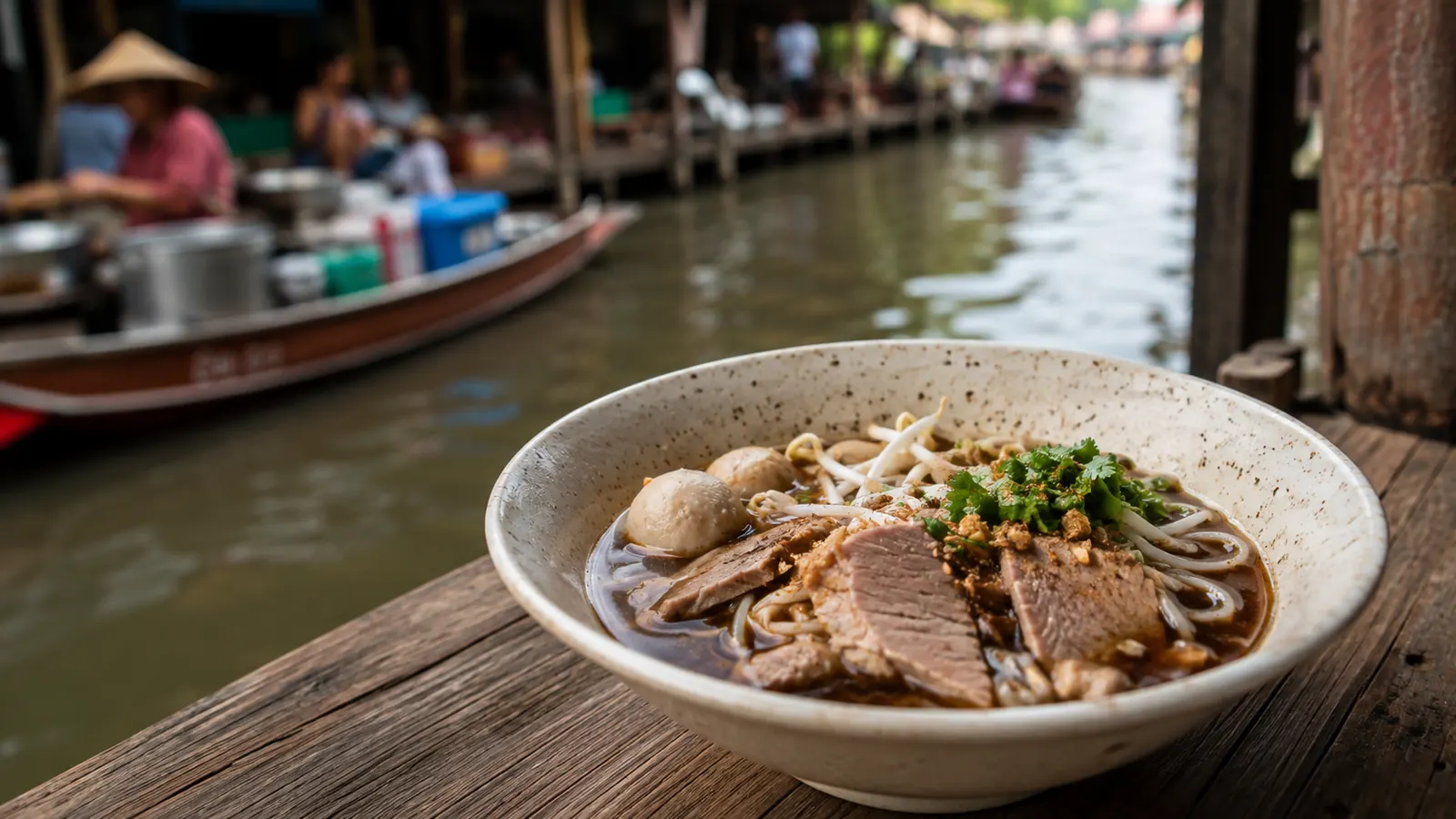
A bowl of boat noodles rarely looks grand. It is often small enough to finish in a few minutes, dark with a deeply seasoned broth, crowded with noodles, slices of meat, meatballs, greens and herbs. In many shops, the sensible response to finishing one bowl is simply to order another — then another.
That modest size is part of the dish’s identity, and so is its name. Kuaitiao ruea — boat noodles — remembers a time when the kitchen itself could float. Vendors once prepared and sold noodles from small boats moving through the canals and rivers that carried much of everyday life in Central Thailand.
The story is sometimes told more neatly than the evidence allows. One version sends boat noodles all the way back to the Ayutthaya Kingdom. Another gives the dish a single inventor. A third makes the noodle campaigns of Field Marshal Plaek Phibunsongkhram the moment when Thai people first encountered noodles. None of those simple stories fits the historical record particularly well.
A better story is also a more interesting one. Noodles had already become part of everyday life in Siam through Chinese migration and long processes of local adaptation, while Central Thailand’s waterways created a mobile market for cooked food. Ayutthaya developed a strong boat-vending tradition, Rangsit formed its own celebrated lineage, and vendors later carried the style into Bangkok, where Khlong Samsen and Victory Monument became famous for it. As roads replaced canals as the main arteries of commerce, the boats came ashore — but the food kept the memory of the water.
Boat noodles are therefore not the product of one moment. They are a dish shaped by movement: people moving, ingredients moving, boats moving through canals, and businesses moving from water to road. Their history is a particularly Thai story of adaptation.
1. A Bowl Built for the Water
The Thai name is wonderfully literal. Kuaitiao ruea combines the familiar Thai term for noodles with ruea, boat. The name does not describe a decorative serving style invented for restaurants; rather, it points to the conditions under which the dish became known: noodles cooked and sold from boats.
That changes how the bowl makes sense.
A boat vendor did not have the space of a permanent kitchen: pots, bowls, noodles, seasonings, meat and utensils all had to fit into a narrow working area while the boat remained balanced, and customers might be on a riverbank, a landing, another boat or close to the canal’s edge. In that environment a compact portion was practical, and the familiar explanation — that small bowls were easier to hand over and less likely to spill — is entirely plausible, although surviving evidence does not let us reduce the size to one single documented reason.
The modern dish is equally resistant to a single formula. Boat noodles may use beef or pork, and some shops specialise in one while others serve both. The broth can be dark, aromatic and intensely seasoned, often carrying warm spices as well as the salty, sweet and sour balance familiar in Thai noodle cookery. Meatballs, sliced meat, offal, morning glory or bean sprouts, garlic, herbs and chilli may all appear, and different noodle types can usually be chosen.
Many of the best-known versions are nam tok style, in which blood is used to enrich the broth, adding body, colour and a distinctive depth. Yet even here, it is safer to speak of an important tradition rather than a universal rule. Recipes have moved through families, neighbourhoods and businesses, and there is no single surviving document that can be treated as the original boat-noodle recipe for all Thailand.
That variety matters. Boat noodles became recognisable not because every vendor followed one fixed recipe, but because a family of practices — small bowls, strong broth, noodles, meat and the memory of mobile canal vending — travelled together.
2. Before Boat Noodles: How Noodles Became Everyday Food in Siam
To understand boat noodles, it helps to begin before the boat.
The Thai word kuaitiao has Chinese roots, and noodle culture in Siam was closely connected with Chinese communities, particularly the large migrations from southern China that became central to the commercial and social life of Bangkok and other towns. Teochew-speaking communities were especially influential in the noodle trade.
But influence is not the same as a finished dish arriving intact and remaining unchanged. Noodle foods entered a culinary landscape that already had its own ingredients, tastes, markets and eating habits, and Thai cooks and vendors adapted broths, seasonings, garnishes and methods to local preferences. Noodles became one of the clearest examples of how migration can expand a cuisine without making it less local.
By the early twentieth century, noodle sellers were already part of ordinary urban and waterside life — which matters, because a persistent popular story credits the government of Field Marshal Plaek Phibunsongkhram with introducing noodles to Thailand during the 1930s or 1940s. The historical record shows something different.
Phibun’s government did promote noodle consumption and noodle selling as part of a wider programme of economic nationalism, nutrition and domestic commerce. The campaign mattered greatly for the scale and visibility of noodles, but it did not create the food from nothing.
The distinction is more than academic. It gives credit to the cooks, migrants, vendors and customers who had already spent generations turning noodle eating into an everyday part of Thai life. By the time the state encouraged people to eat more noodles, the foundation was already there.
Boat noodles grew from that established noodle culture — and from another equally important feature of Central Thailand: water.
3. When the Waterway Was the Marketplace
Before modern road networks transformed Bangkok and the Central Plains, canals and rivers were not simply scenery. They were routes to homes, temples, fields, workplaces and markets. A boat could be transport, shop, storeroom and kitchen at the same time.
Food fitted naturally into this world.
Historical recollections of Ayutthaya describe vendors moving on the water with prepared foods including noodles, rice dishes, sweets, coffee and other refreshments. The practice makes sense in a floodplain society where homes and livelihoods were closely connected to waterways. Rather than requiring customers to travel to a fixed restaurant, the seller could travel to the customers.
One especially useful body of evidence comes from memories of twentieth-century Ayutthaya. The writer S. Plai Noi, recalling his childhood, described a waterside environment with numerous boat vendors and remembered eating boat noodles more often than land-based noodles because his home was by the water. Local oral histories collected from former vendors likewise describe noodle selling from rafts and boats.
One account captures the flexibility of the system particularly well. A vendor might normally sell from a fixed waterside point or raft, but when high water changed where customers were working and living, the cooking equipment could be moved into a rowing boat and taken along the canals to reach them.
This is the economic logic behind boat noodles. The boat was not a gimmick; it connected a noodle business to a moving waterside population.
That does not mean every noodle boat served exactly the dark, blood-enriched bowl associated with boat noodles today. Food changes even when a name survives. What the evidence gives us with confidence is the existence of a real waterborne noodle-vending culture in Central Thailand, from which recognisable boat-noodle traditions developed.
4. Ayutthaya: A Strong Tradition, but a Date We Should Not Invent
Ayutthaya is central to the history of boat noodles, and modern Ayutthaya remains famous for them. The temptation is therefore obvious: push the story all the way back to the Ayutthaya Kingdom and declare that the dish was invented there centuries ago.
That claim appears frequently in travel writing and popular food histories, but it is much stronger than the evidence currently allows.
Ayutthaya was one of the great riverine cities of Southeast Asia. Its waterways supported trade, transport and daily food exchange, so the wider environment for boat-based food selling has deep roots. Yet an environment in which a dish could have existed is not the same as documentation that the modern dish did exist in a particular century.
The strongest evidence in the current research set is later. Twentieth-century recollections and oral histories show a well-established Ayutthaya culture of noodle vending from boats and rafts before the post-war transformation of the city. They are valuable because they describe living practices, not because they provide a medieval invention date.
This distinction protects the history rather than diminishing it. We do not need a 600-year-old origin story to make boat noodles culturally important. Their significance comes from how closely they were tied to the real economy of Central Thailand’s waterways, and how effectively vendors adapted when that economy changed.
Ayutthaya also offers an important bridge to Bangkok. Research drawing on local histories records that, after the Second World War, some noodle vendors from Ayutthaya travelled or migrated toward the capital. Around the late 1940s and into the 1950s, sellers associated with Ayutthaya communities were operating in the Khlong Samsen area near Victory Monument.
In other words, Ayutthaya’s role does not need to be turned into a single birth certificate. Its better-documented contribution is as one of the strongest centres of a waterborne noodle tradition that later travelled.
5. The 1940s Noodle Campaign Changed the Scale, Not the Birth Story
Few episodes in Thai food history are repeated as often as Phibun’s noodle campaign. It deserves a place in the boat-noodle story — but in the right place.
On 7 November 1942, Phibun used a government radio broadcast to encourage Thai people to eat noodles and to make and sell them. The message presented noodle eating as economical, nutritious and capable of circulating money through the domestic economy. It followed broader policies encouraging the use and production of Thai goods.
The campaign helped turn noodles into a symbol of modern everyday food and encouraged small-scale noodle businesses, creating favourable conditions for noodle vending to grow further.
But chronology matters. Sources discussing the campaign also make clear that noodle eating and selling already existed. Ayutthaya memories of waterborne vendors belong to a tradition that cannot sensibly be treated as something invented by the 1942 broadcast. Chinese noodle culture had been present in Siam much earlier.
For boat noodles specifically, the campaign is best understood as an accelerator rather than a starting gun.
That also explains why noodle culture could take so many local forms. State promotion did not force every seller into a single national recipe: existing vendors continued working within local food traditions while new sellers entered the trade, broths, meats, noodles and seasonings varied, and regional and neighbourhood identities developed.
The result was not one government-created noodle dish but an increasingly dense Thai noodle landscape. Boat noodles were one particularly memorable branch of it — a branch already adapted to life on the water and ready to adapt again when roads and cities changed.
6. From Ayutthaya to Khlong Samsen and Victory Monument
Victory Monument is now one of Bangkok’s great traffic landmarks. Buses, vans, roads and the BTS define the modern experience of the area. Yet the history of its boat noodles belongs to an older geography running beneath and beside that transport system: Khlong Samsen.
The foundation stone was laid in 1941, and Victory Monument was officially opened on 24 June 1942. In the years after the Second World War, the surrounding district grew as a transport, institutional and commercial centre. Local histories cited by the Pridi Banomyong Institute describe groups of noodle vendors connected with Ayutthaya arriving around the late 1940s. Some settled near Khlong Samsen, Wat Makok and the area behind what is now Phramongkutklao Hospital, then paddled out to sell noodles.
One remembered vendor, Sunthorn Yenklao — known as Lung Ouan — described Ayutthaya sellers bringing sampans to Bangkok and operating in this canal environment. Such accounts are not a complete census of every vendor in the city, but they give the Victory Monument tradition something much stronger than a vague legend: a plausible line of migration tied to named places, remembered businesses and the actual waterways of Bangkok.
As the district became busier, boat noodles found a large urban audience. Khlong Samsen eventually supported a dense cluster of vendors, and later land-based shops around Victory Monument preserved the identity. Over the following decades, the area became widely recognised as a major boat-noodle centre.
The irony is appealing. A food shaped by mobility on water became famous at one of Bangkok’s most important nodes of mobility on land.
Victory Monument did not have to invent boat noodles to transform their reputation. It gave the dish extraordinary visibility. Office workers, students, hospital visitors, commuters and travellers could encounter the same basic format that had once followed canal communities: quick, affordable bowls designed to be eaten without ceremony.
The audience changed. The principle survived.
7. Rangsit Builds Its Own Boat-Noodle Legend
North of central Bangkok, Rangsit tells a related but distinct story.
The Rangsit canal system was created during the late nineteenth-century transformation of the Thung Luang floodplain, and the new waterways helped reshape rice cultivation, settlement and commerce. Over time the area became home to a varied population, including Thai, Chinese, Mon, Lao/Isan and Muslim communities. Oral-history research describes Rangsit as a dynamic, hybrid community whose history can be understood through three broad phases: the older Thung Luang landscape, the canal-development period and the later age of roads.
Boat noodles belong perfectly within that sequence.
Local memory gives an especially prominent place to Gohub, a noodle vendor remembered for paddling along Khlong Rangsit Prayunsak. Cultural-mapping projects and family histories present him as an early, even the first, celebrated boat-noodle seller in the Rangsit canal. But the details are not consistent enough to turn Gohub into the inventor of boat noodles as a whole. Dates attached to his career vary between sources, and later retellings contain contradictions over prices and chronology.
The safest and most useful conclusion is also the most respectful: Gohub is an important figure in Rangsit’s local boat-noodle tradition, preserved through community memory. That is significant without making him the sole origin point of a much wider Central Thai practice.
Rangsit’s transition from water to land is particularly well documented in local storytelling. As roads became more important in the mid-twentieth century, noodle businesses began to meet customers beside the road rather than only from the canal. Some accounts describe a fascinating intermediate stage in which the boat itself was lifted onto land or placed beneath a roadside shelter, allowing vendors to continue cooking in the familiar workspace while serving motorists and pedestrians.
Eventually the restaurant replaced the moving boat. Yet the name, recipes, family stories and visual presence of boats remained. Rangsit boat noodles became a local identity strong enough to survive the disappearance of the original business environment.
8. The Dark Broth: No Single ‘Original’ Recipe
Food-history myths often become most confident where recipes are most variable.
Modern boat noodles are famous for broth with unusual depth: savoury, slightly sweet, aromatic and often dark in colour. Beef versions may include sliced beef, meatballs and offal; pork versions follow their own lineages. Aromatic spices such as cinnamon and star anise appear in many recipes, alongside soy-based seasonings, garlic, herbs and other ingredients. Some formulas use fermented bean curd; others add coconut cream. Garnishes and noodles vary from shop to shop.
Then there is blood.
In many nam tok boat noodles, a small amount of fresh beef or pork blood is mixed into the hot broth, enriching and thickening it. This is one of the features that distinguishes the style for many diners and helps create the characteristic body of the soup. Yet it should not be turned into an absolute definition. Thailand contains multiple boat-noodle lineages, and not every bowl labelled boat noodles is prepared in precisely the same way.
The term nam tok itself attracts colourful explanations online. Some connect it to blood dripping from meat; others offer different folk etymologies. Without stronger linguistic evidence, an article about boat-noodle history should resist pretending that one of those explanations is settled fact.
The same caution applies to the small bowl. It is easy to imagine why a compact serving suited a vendor balancing a kitchen in a sampan: less weight, easier handover, quick service and less chance of losing a large meal to a sudden movement. Those practical advantages are persuasive, but they are not a licence to invent an exact moment when one vendor supposedly created the small bowl for one specific reason.
What survives more clearly than a single original recipe is a culinary grammar: concentrated broth, noodles, meat, fast assembly, bold seasoning and small portions closely associated with the boat-vending tradition. Individual cooks filled in that grammar differently.
That is how living cuisines usually work.
9. When the Boat Came Ashore
The twentieth century changed the physical map of Central Thailand: roads expanded, cars, buses and trucks became more important, canal-side settlements shifted toward road frontages, and Bangkok grew outward. Rangsit’s history moved, in the words of oral-history researchers, from the canal era into the era of road development.
A business tied too rigidly to one form of transport could have disappeared.
Boat noodles did the opposite.
Vendors moved onto banks, into sheds and eventually into permanent shophouses and restaurants. In Bangkok, the famous Victory Monument cluster kept the boat-noodle name even after selling from actual boats became exceptional. In Rangsit, local histories remember the transition so vividly that the boat itself became a symbol: sometimes preserved at or near the shop, sometimes evoked through the restaurant’s design, always present in the name.
This is one reason the dish spread so successfully. Boat noodles were never dependent on tourists seeking nostalgia; they were everyday food first, and their intense flavour, modest portions and quick service translated easily from canal traffic to road traffic and from waterside workers to office workers, students and commuters.
The small-bowl culture also created its own social ritual. Ordering several bowls at once or building a stack of empties turned a practical portion into part of the pleasure of eating the dish. Modern restaurants can celebrate that ritual without pretending customers are still sitting beside a sampan.
Today boat-noodle shops can be found far beyond Ayutthaya, Rangsit and Bangkok. Some are polished chains; others are family businesses. Some keep the classic compact bowls, while others serve larger portions. Beef and pork traditions coexist. The cooking continues to change.
What remains stable is the story carried in the name: a Thai noodle dish that learned how to leave the boat without losing the boat.
10. A National Favourite Made Through Adaptation
Boat noodles bring together several histories that are sometimes told separately.
There is the history of Chinese migration and the arrival and growth of noodle culture in Siam. There is the history of the Central Thai floodplain, where boats and canals organised work, travel and commerce. There is the history of Thai cooks reshaping noodle broths and seasonings to create local styles. There is the economic history of mobile vendors. There is the state noodle campaign of the 1940s. And there is the twentieth-century shift from water transport to roads and mass urban movement.
No single one of those stories explains boat noodles on its own.
That is precisely why the dish is such a useful window into Thai food history. It shows cuisine as an active process. A noodle form connected with Chinese communities became integrated into Thai everyday eating. Canal vendors made it work within the practical limits of a floating kitchen. Ayutthaya developed a particularly strong remembered tradition. Rangsit created its own local lineage. Vendors carried the style into Bangkok, where Victory Monument turned it into one of the city’s most recognisable noodle experiences. When the economic geography changed, sellers changed with it.
The result was not a foreign dish preserved unchanged, nor a recipe invented on command by the state, nor a creation that requires a legendary single founder. It was something built over time by the people who cooked, sold and ate it.
That is also why the safest historical answer is not the least exciting one.
We may not know the first person who ladled boat-noodle broth, the first canal where a bowl was handed ashore, or the exact year when all the elements of the modern style came together. What we can see is the larger movement with unusual clarity: migration becoming integration, waterways becoming marketplaces, vendors becoming restaurateurs, and a practical canal meal becoming part of Thailand’s national food vocabulary.
The boats mostly disappeared from everyday service.
The noodles travelled on.