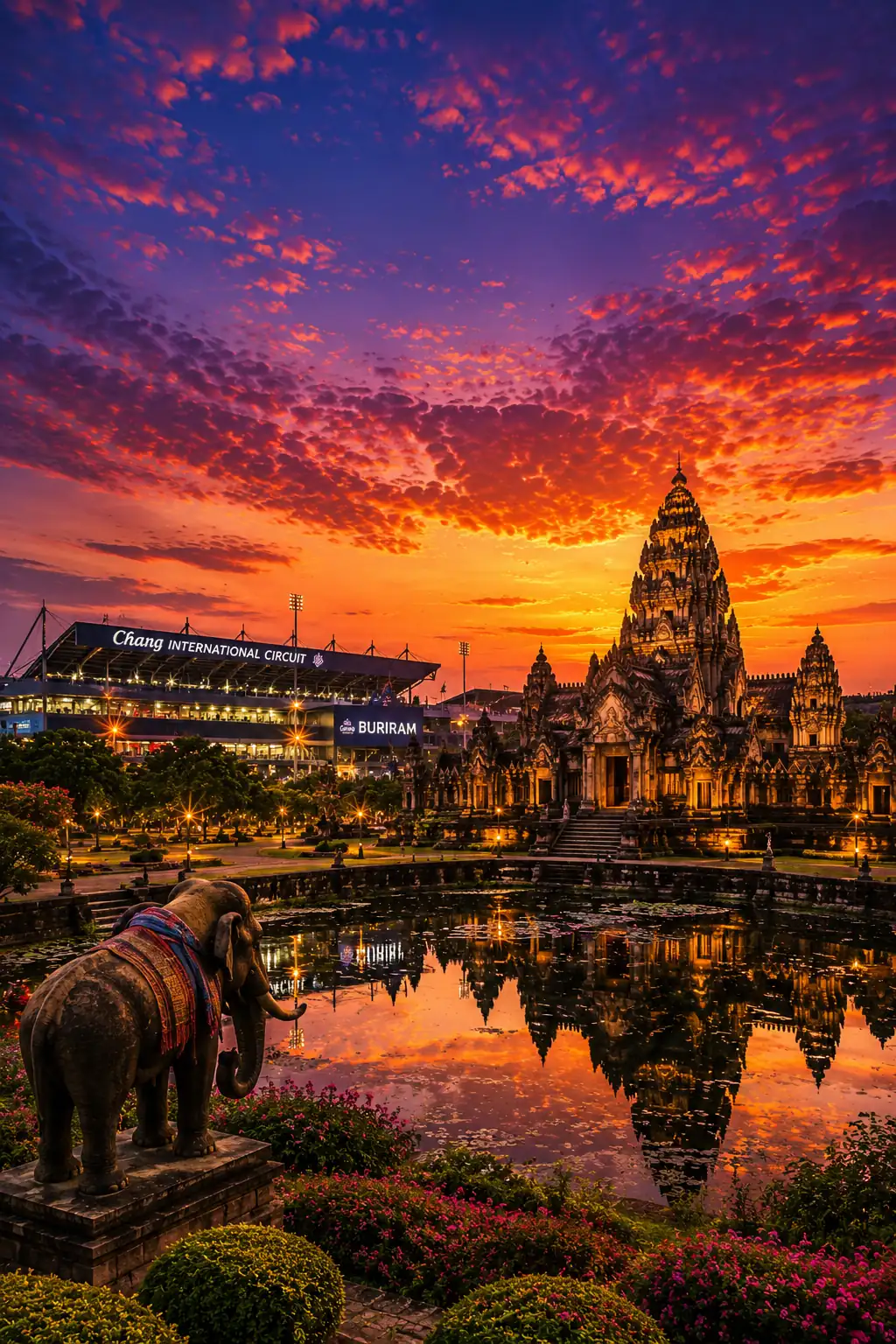
There is a particular kind of surprise that visitors feel when they first look closely at Buriram. On one side of the map sits Phanom Rung, a Khmer-era sandstone sanctuary so finely aligned with the rising sun that it draws pilgrims and photographers alike. On the other sits a gleaming, football-only stadium that roars to capacity on match nights, and not far beyond it, a Formula-grade race circuit that has hosted MotoGP in front of a global television audience. Both belong to the same province. Neither cancels the other out.
That coexistence is the real story of Buriram. This is not a tale of a sleepy town that had nothing until football arrived. Buriram had history, identity and meaning long before a ball was kicked in anger on its modern turf. What changed, and changed remarkably quickly, was visibility — the sense that this inland Isaan province, once known mainly to those with an interest in Khmer heritage or rural Thai life, could also become a fixture on Thailand's sporting map, and eventually on the world's.
A Province With Its Own Identity
Buriram's name is usually translated as something like "city of happiness" or "peaceful city," a fitting label for a place whose deeper identity has always rested on more than passing trade. The Tourism Authority of Thailand describes the province as rich in prehistoric and Khmer-period archaeological remains, home to more than sixty sandstone sanctuaries scattered across the landscape. Chief among them is Phanom Rung, widely regarded as one of the most important Khmer monuments in the country and the clearest expression of Buriram's deep historical roots.
Beyond the ancient stone, Buriram's character has long been shaped by the rhythms of rural Isaan life: silk weaving, agriculture, and a regional culture distinct from the tourist-facing provinces of the south or the commercial energy of Bangkok. Generations of families here built their livelihoods around rice fields, orchards and cottage industries rather than around any expectation that outsiders would one day come looking for them. This is a province that measured its importance in centuries, not headlines, and its sense of self was never dependent on being noticed by the rest of the country, let alone the rest of the world.
It is worth being clear about this from the outset, because it is easy for a story about sport to accidentally suggest that a place had no meaningful identity before the stadium lights switched on. That is emphatically not the case in Buriram. Sport did not replace an existing identity. It added a new and unexpected layer on top of one that had already stood for a very long time.
An Unlikely Candidate for Sporting Fame
Understanding why Buriram's sporting transformation feels so striking requires understanding what Buriram is not. It is not Bangkok, with its scale and infrastructure. It is not Chiang Mai, with its established tourist trail. It is not Phuket or Pattaya, built from the outset around international visitors. Buriram is an inland provincial city in lower Isaan, roughly 410 kilometres from the capital — geographically and culturally a world away from Thailand's classic holiday circuit.
And yet today, the Tourism Authority of Thailand lists Chang Arena alongside Buriram's cultural treasures, explicitly noting that the province now has both a football stadium and a motorsport circuit capable of drawing visitors in their own right. For a province whose fame had rested for centuries on ancient stone and rural life, this represented a genuinely new kind of pull — one built not on preservation, but on construction; not on the past, but on the present.
Few provinces anywhere in Thailand have managed quite this combination: a place that outsiders once associated almost exclusively with archaeological heritage now sits comfortably alongside destinations known for stadiums and racetracks. That shift did not happen by accident, and it did not happen quickly. It took more than a decade of sustained investment in sporting infrastructure, and a football club willing to plant its identity firmly in provincial rather than metropolitan soil.
Buriram United Becomes the Catalyst
The modern story begins with football, and specifically with Buriram United. The club's rise as a defining force in Thai football dates from around 2009 to 2010, when it became closely connected to Buriram under new ownership and organisation. There is no need to trace every detail of that reorganisation; what matters for the city's story is what came next. According to the club's own history, Buriram United went on to claim a long run of Thai League titles beginning in 2011 and continuing through multiple later seasons, establishing itself by the mid-2010s as one of the dominant forces in Thai football.
The significance here is not really about trophies. It is about what a provincial club achieved in terms of identity. Buriram United became a genuine national football brand while remaining unusually rooted in its home city — a rare thing in a footballing landscape where big clubs so often gravitate toward the capital, drawing talent, sponsorship and attention away from the provinces. Buriram United went in the opposite direction, choosing to build its power base in a province that had never previously produced a football team of national standing. The club carried Buriram's name into the national conversation, week after week, season after season, in a way that no single heritage site, however important, could realistically achieve on its own.
Football as Civic Branding
Buriram United did not merely play in the city; it became tied to it. Home matches brought travelling supporters, media coverage and commercial activity that a province of this size and profile had not previously experienced with such regularity. The club cultivated a strong visual and cultural identity — known as the "Thunder Castle" — that became closely associated with Buriram itself.
It would be easy to overstate the economic detail here, and the story deliberately avoids doing so: there are no precise figures for matchday spending or exact visitor totals to lean on. What can be said with confidence is the broader point — football gave Buriram a regular national media presence in a way that heritage tourism alone, however significant, had never quite managed to provide. Suddenly, the province's name was appearing in sports pages and broadcast highlights on a weekly basis.
Chang Arena Becomes a Landmark
The physical embodiment of this new identity is Chang Arena, formerly known as the I-Mobile Stadium. According to Buriram United, the stadium entered official use in 2012, and it currently holds a listed capacity of 32,600 seats. The club describes it as Thailand's first international-standard football stadium built without a running track separating spectators from the pitch — a detail that matters more than it might first appear.
Purpose-built, football-specific stadiums of this kind were still unusual in Thailand when Chang Arena opened. Removing the athletics track that typically distances fans from the action allowed for a steep, close, intensely atmospheric bowl — the kind of ground that produces genuine noise and proximity on matchdays. Buriram United states that the stadium meets FIFA and AFC standards and has hosted AFC-level competition, and the most accurate way to describe its international standing is as an international-standard football stadium used in AFC competition, built to meet FIFA's world-class benchmark and the AFC's top stadium classification.
What matters just as much as the technical specification is what the stadium became symbolically. It emerged quickly as a genuine Buriram landmark rather than simply a sports venue, and the Tourism Authority of Thailand now includes Chang Arena among the province's highlighted attractions — a striking image in itself: a modern football stadium sitting in the same tourism conversation as a thousand-year-old Khmer sanctuary.
The steep, close-to-pitch design that removed the running track also did something less tangible but equally important: it produced a distinctive matchday atmosphere, with supporters positioned close enough to the pitch to feel part of the action rather than watching from a distance across an athletics track. That kind of atmosphere does not show up in official capacity figures, but it is part of why the stadium became known well beyond footballing circles, and part of why it now sits comfortably alongside Buriram's older landmarks in the province's own tourism materials.
From Football to Motorsport
Football alone could have been the whole story. Instead, Buriram pushed further, into an entirely different sporting world. Chang International Circuit opened in 2014, designed by the renowned track architect Hermann Tilke, according to MotoGP's official circuit information. The circuit measures 4.554 kilometres with twelve turns, and it opened holding both FIM Grade A and FIA Grade 1 classifications — the highest circuit licence grades issued by motorcycling's and motor racing's respective governing bodies.
It is worth being precise about what these classifications mean and do not mean. FIM Grade A supports the top level of motorcycle competition, and FIA Grade 1 is the highest grade a circuit can hold under FIA rules. This does not mean Buriram has hosted Formula 1; rather, it means the circuit was built to standards capable of hosting the highest levels of international motorcycle and car racing. This was the moment Buriram's sporting ambitions stopped being a purely national story and became something with genuine international scale. A province that had, until recently, been known internationally to relatively few people outside specialist circles interested in Khmer archaeology now possessed a piece of sporting infrastructure built to the same classification standards used at some of the world's most demanding circuits.
World Superbike Arrives First
Before the biggest prize arrived, Buriram built a track record with a slightly smaller international audience. According to MotoGP's official circuit history, the Superbike World Championship began racing at Chang International Circuit in 2015, a year after the venue opened. This mattered as more than a warm-up act. It gave Buriram genuine experience hosting a major international motorcycle racing series, and it served as the bridge between "newly built circuit" and "credible global motorsport destination" — the proof of concept that made a still bigger step possible.
2018: MotoGP Changes the Scale Again
That bigger step came in 2018, when MotoGP made its debut at Chang International Circuit — confirmed by MotoGP's own official sources as Thailand's first Grand Prix at the venue. The effect was immediate and different in kind from anything that had come before. MotoGP is followed by television audiences in the millions across dozens of countries, and its arrival placed Buriram's name in front of viewers who might never otherwise have heard of the province at all. A city once known chiefly for Khmer ruins and rural Isaan life suddenly appeared on the world championship calendar, broadcast into homes on several continents.
A Sports-Tourism Destination
The significance of this moment goes beyond spectacle. MotoGP and Thailand's Sports Authority have explicitly described the Thai Grand Prix as a tool for sport tourism, with MotoGP noting economic effects that ripple across hotels, transport and wider supply chains around race weekends. This is not simply local entertainment; it is destination infrastructure, deliberately built and used to draw visitors from beyond the province and beyond Thailand itself.
The Tourism Authority of Thailand's own framing reinforces this. By presenting both the football stadium and the race circuit as attractions in their own right, TAT signals that sport in Buriram has moved well past the level of local pastime. It is genuinely part of how the province markets itself to the wider world, alongside its temples and its silk.
Precision About What the Circuit Represents
It is worth pausing here to be exact about what these classifications mean in practice, since motorsport terminology is easily misunderstood or overstated. FIM Grade A is the top licence grade issued for motorcycle racing venues, meaning the circuit is certified suitable for the highest level of competition that governing body sanctions. FIA Grade 1, similarly, is the highest circuit grade the FIA issues under its own separate system, generally associated with Formula 1-capable venues. Holding both grades from the outset placed Chang International Circuit in a genuinely elite category of motorsport facilities worldwide, even though the story of Buriram's circuit to date has been written almost entirely in motorcycle racing rather than in Formula 1. The honest and precise formulation is that Buriram built a circuit capable of hosting the highest levels of international motorcycle and car racing — not that it has already hosted every category that classification would technically permit.
A Long-Term Fixture, Not an Experiment
What has followed since 2018 shows that Buriram's motorsport role was never intended as a one-off spectacle. Thailand's presence on the MotoGP calendar, which began that year, has since been extended: MotoGP has confirmed the Thai Grand Prix at Buriram through 2031 inclusive under its latest agreement. For the 2025 and 2026 seasons, Buriram hosted the season opener — the first race of the entire world championship year — and MotoGP has announced that 2027 will again open the season there, making it three consecutive years in that prestigious slot.
None of this is meant to overshadow the province's older story; rather, it demonstrates that what began as a bold gamble on stadium and circuit infrastructure has matured into something durable. Buriram is not hosting international motorsport as an experiment. It has become one of the fixed points on the sport's global calendar, and the decision to open three consecutive seasons there speaks to a level of confidence, both organisational and commercial, that a newly built circuit could not have earned in a single event.
What Race Weekends and Matchdays Do to a City
There is an obvious rhythm to life in a province whose calendar now includes both league football and a world championship motorcycle race. Ordinary weeks pass much as they always have, built around agriculture, local commerce and the everyday business of a mid-sized provincial capital. Then, on a matchday or a race weekend, the character of the place shifts noticeably: hotels fill, restaurants see a surge in custom, and roads leading toward Chang Arena or the circuit carry far more traffic than usual. Major football fixtures and Grand Prix weekends bring visible, if not precisely quantified, changes to daily life in Buriram. MotoGP and Thailand's Sports Authority have acknowledged the broader effects across tourism, hotels and transport that these events generate. It is reasonable to describe this in structural terms rather than with invented statistics: Buriram's traditional visitor rhythm, oriented around heritage sites and their steady, unhurried pace, now coexists with large, recurring event weekends that bring an entirely different kind of energy — crowds, noise, hotel bookings stretched to capacity, and a temporary but intense surge of national and international attention.
Old Buriram and New Buriram, Side by Side
Perhaps the most telling detail of all is how effortlessly Buriram's own tourism authority now tells both stories at once. The current TAT provincial page presents Phanom Rung and Khmer heritage alongside Chang Arena and the province's motorsport credentials, as though these were simply two facets of the same place — because they are. The province did not have to become less Isaan, or less historically rooted, in order to become a sports city. Ancient stone and modern concrete have become two parallel symbols of the same province, each telling a different part of Buriram's story to a different kind of visitor.
A Different Kind of Isaan Story
Within the wider context of Isaan's provincial development, Buriram's path stands apart. Nakhon Ratchasima, often known as Korat, built its modern identity as a transport gateway into the region. Khon Kaen grew around universities, medicine and knowledge-driven regional growth. Udon Thani's development was accelerated by its history as a Cold War-era air base. Buriram's route has been sports-led place branding and tourism — a fourth, distinct model of modern development inside the same broad region. None of these stories ranks above the others; they simply show that provincial transformation in Isaan has taken several very different shapes.
What a Visitor Sees Today
A visitor moving through modern Buriram encounters a genuinely layered place. There is Phanom Rung at sunrise, its sandstone silhouette catching the early light much as it has for centuries. There is the ordinary rhythm of the city centre, unhurried and distinctly regional. Then, closer to matchday or race weekend, there is Chang Arena filling with supporters in Buriram United colours, the club's branding visible across the city, and — a little further out — the grandstands and paddock of Chang International Circuit, alive with the noise and colour of a MotoGP crowd. Beyond the sports zone, the rural Isaan landscape continues much as it always has. This is not a city that has been converted into a theme park for football or racing fans; it is a province where sport has taken its place alongside everything else that was already there.
A New Identity, Not a Replacement
Buriram did not become important because of sport. Its importance, in the form of Khmer heritage, agriculture and a distinct Isaan identity, predates any stadium or circuit by many centuries. What sport changed was visibility. A provincial football club grew into a genuine national force. A purpose-built stadium became a landmark recognised well beyond the world of football. A race circuit, built to some of the highest classifications in world motorsport, brought first World Superbike and then MotoGP to a province that had never previously featured on a global sporting calendar.
Visitors today arrive in Buriram for both reasons at once — to see what the province has preserved from its past, and to watch what it continues to build in the present. That, in the end, is the clearest evidence of what Buriram's transformation actually shows: that a provincial Thai city can construct an entirely new international identity for itself without discarding the one it already had.