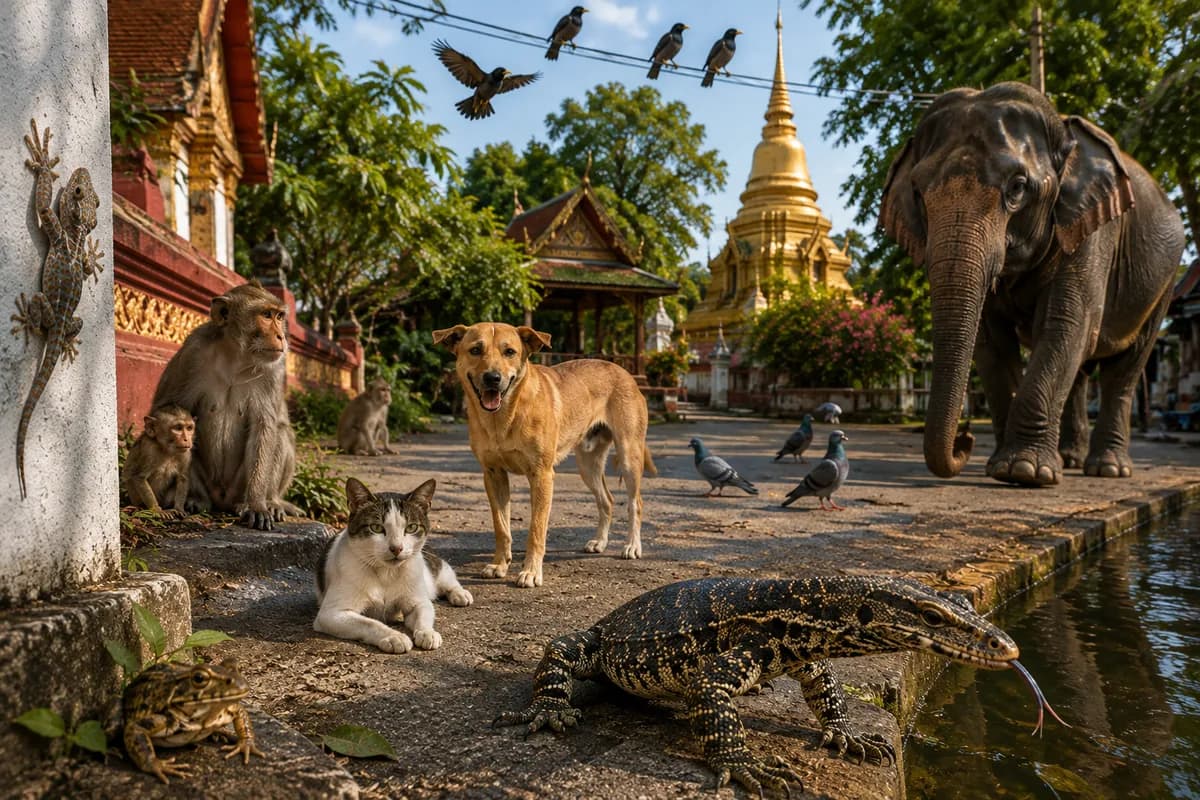
You do not need to book a jungle trek or wait until you reach a national park to have a genuine wildlife encounter in Thailand. Sometimes it happens before you have even unpacked: a small gecko clinging motionless to the wall above your hotel room door, catching insects drawn in by the porch light. Sometimes it happens on the way to breakfast, when a myna calls out from a power line, or a soi dog stretches out in a patch of morning shade outside a 7-Eleven. Walk beside a canal in Bangkok and you might spot something considerably larger and stranger: the unmistakable, prehistoric silhouette of a water monitor lizard, moving with unhurried confidence along the water's edge.
This is really the heart of what makes Thai wildlife so memorable for so many visitors. It is not only about rare species glimpsed on a carefully planned expedition into deep forest, though those experiences have their own considerable rewards. It is also, and perhaps just as much, about how close ordinary nature sits to everyday life here — on hotel walls, beside canals, around temples, along beach roads and scattered through city parks. Likelihood of any particular sighting depends heavily on where you are and how you behave, and no one should expect to tick off every animal on a single trip. But taken together, these everyday encounters give Thailand a sense of wildlife-richness that has very little to do with how deep into the jungle you venture.
There is something worth savouring in the way these encounters arrive largely unplanned. A traveller setting off deliberately in search of a rare bird or a particular mammal often has to work hard, wait patiently, and sometimes leave disappointed. The gecko on the wall, the myna on the wire, the monitor lizard beside the canal — these arrive on their own schedule, entirely indifferent to anyone's itinerary, which is precisely what makes them feel so genuinely part of the place rather than staged for visitors' benefit.
House Geckos
Few animals are more thoroughly woven into daily life in Thailand than the house gecko. Common house geckos are strongly adapted to human settlement, and Thai field research confirms their presence, alongside that of the larger tokay gecko, around buildings and human settlement generally. The smaller house geckos are the ones most visitors notice first: modest in size, quick-moving, drawn to lights and walls where insects gather in the evening. They are, in the most literal sense, insect-eaters doing useful work around your accommodation, rather than pests to be worried about.
Tokay geckos are a different matter in scale, if not in temperament. Considerably larger and more distinctive than their smaller relatives, tokays are also remarkably vocal, producing a loud, repeated call that gives the species its name and that often surprises first-time visitors who assume, understandably, that the sound must belong to something much bigger. They should never be handled. Left alone, they are a fascinating, slightly startling piece of everyday Thai wildlife; picked up or cornered, they are capable of delivering a firm bite.
Thai National Science Museum research into tokay ecology in residential settings underlines just how well established this relationship between tokays and human buildings has become over time. Rather than treating these lizards as unwelcome intruders, it is worth appreciating them for what they are: long-term residents of the built environment, going about a role in local insect control that most visitors never think to thank them for.
Soi Dogs and Cats
Free-roaming, community dogs are a familiar presence across much of Thailand, found on streets, around temples and throughout many neighbourhoods. For the most part, these dogs simply coexist alongside people, going about their own routines without much interest in visitors at all. Many travellers find them one of the more endearing everyday sights of a Thai trip — dozing in the shade, trotting purposefully along a soi, or gathering loosely near a food stall.
It is worth approaching unfamiliar dogs, however affectionate they may seem, with a degree of sensible caution. Avoid petting animals you do not know, and treat any bite or scratch as something that deserves proper medical assessment, since Thailand is rabies-endemic. This is not a reason to view soi dogs with suspicion or fear; it is simply a practical habit worth carrying with you, in much the same spirit as any other sensible precaution taken while travelling. Cats are just as common a sight around hotels, restaurants, temples and residential streets, generally going about their own business with considerably less interest in passers-by than dogs tend to show.
Both dogs and cats of this kind tend to occupy a particular, gently territorial relationship with the streets, sois and temple grounds where they are found, often recognised and cared for informally by nearby residents and shopkeepers even without any single owner in the conventional sense. Visitors who take the time to notice this dynamic often come away with real affection for these animals, alongside the simple, sensible habits that keep any encounter a positive one for everyone involved.
Everyday Birds
Birdlife forms a constant, if often unremarked, backdrop to daily life in Thailand. Mynas are a particularly familiar presence, vocal and confident, often seen strutting along pavements or perched on wires. Pigeons and doves are common in towns and cities, much as they are almost everywhere else in the world, while sparrows continue their long-standing association with human settlements. Around wetlands and fields, egrets are a striking and frequent sight, their white forms standing out clearly against green rice paddies or muddy waterways. Swifts and swiftlets, meanwhile, are often visible wheeling above towns at dusk, taking advantage of the insects that become active as the light fades.
None of these species should be assumed to appear with equal frequency in every part of the country; Thailand's geography is varied enough that birdlife shifts noticeably between coastal areas, cities, agricultural land and forest edges. But taken as a general picture, birds represent one of the most reliably present forms of everyday wildlife a visitor is likely to notice, often without any particular effort to look for them.
Monitor Lizards
Few sights surprise first-time visitors to Bangkok quite as much as a water monitor. These large lizards occur around canals, parks, wetlands and other natural habitats throughout much of the country, and their sheer size can make for a genuinely startling encounter, particularly for anyone who assumed such creatures belonged strictly to nature documentaries rather than city parks. It is not the case that every park in Bangkok hosts water monitors, and no visitor should expect a guaranteed sighting; but in the right setting, they are a memorable and not especially rare encounter.
Despite their imposing appearance, the correct response to a water monitor is simple: do not touch, feed or corner it. Left to their own business, they are a striking example of how much wildlife can persist within an intensely urban environment, moving along waterways that most residents and visitors barely think twice about.
It is worth adding, too, that water monitors are not dangerous urban predators in any meaningful sense, whatever their size might suggest to an anxious first-time observer. Their preference, given the choice, is almost always to continue about their own business undisturbed rather than to engage with a passing human at all, and the vast majority of sightings amount to nothing more than a memorable, slightly startling glimpse of a genuinely large lizard going quietly about its day.
Macaques
Long-tailed macaques rank among the primates most frequently encountered by travellers in Thailand, turning up around temples, parks, tourist sites and communities across a considerable stretch of the country. For many visitors, a macaque sighting becomes one of the more memorable moments of an entire trip — watching a group move confidently through a temple courtyard, or spotting mothers with young clinging close beside them.
The scale of this presence is worth understanding properly. A 2023 survey by the Department of National Parks, cited in peer-reviewed research, recorded 64,055 monkeys across 306 identified human–monkey conflict zones located outside protected conservation areas. This is a location-specific reality rather than a universal one: many travellers encounter macaques at particular temples, islands and viewpoints known for their monkey populations, rather than everywhere they go. Feeding tends to intensify conflict between macaques and people, so the most considerate approach, both for your own safety and for the animals' welfare, is simply to observe without feeding, and to keep a respectful distance.
It is also worth remembering that not every macaque a traveller sees across different parts of Thailand necessarily belongs to the same troop, or behaves in quite the same way as a group encountered elsewhere. A well-known population at a famous tourist site, long accustomed to visitors, is a genuinely different experience from a more incidental sighting elsewhere in the country, even though both fall under the same general heading of "seeing macaques in Thailand."
Mosquitoes
It would be an incomplete picture of Thailand's everyday wildlife to leave out the animal most visitors will, in practice, have the most physical contact with. Aedes mosquitoes, responsible for transmitting dengue, bite mainly during daylight hours, a detail that surprises many travellers who associate mosquito activity primarily with evening and night. Other mosquito species are active at different times of day. This subject deserves rather less detailed treatment here than in a dedicated discussion of traveller health risks; the essential everyday reality is simply that mosquitoes are a common background presence in many parts of Thailand, and sensible prevention, such as repellent and appropriate clothing, is worth building into ordinary daily habits rather than treating as an afterthought.
Butterflies, Dragonflies and Tropical Insects
On a considerably gentler note, Thailand's insect life offers some of its most quietly beautiful everyday wildlife encounters. Butterflies and dragonflies are especially noticeable around gardens, wetlands, forest edges and national parks, where warm, humid conditions support a striking variety of colour and movement. There is no need to chase down rare or specific species to appreciate this aspect of Thai wildlife; simply spending time in a garden, beside a pond, or along the edge of forested land is often enough to notice butterflies and dragonflies going about their business in numbers and varieties that would be considerably less common in cooler, drier climates.
Frogs and Toads
Frogs and toads become considerably more noticeable during wet weather, when gardens and other damp areas come alive with their calls, particularly in the evening. For visitors staying anywhere near greenery after rainfall, the resulting chorus can be one of the more distinctive sounds of a Thai evening, sometimes surprisingly loud for creatures rarely seen in the daylight hours that follow. As with birds, it is best to avoid making specific species-level claims about which frogs or toads are present in any given location without proper local knowledge; the more reliable general point is simply that wet weather and evening hours bring this particular form of wildlife more prominently into awareness than dry daytime conditions do.
Snakes
Thailand is home to a considerable number of snake species, including some that are venomous, though it is worth being clear from the outset that most tourists will not encounter snakes with any real frequency during an ordinary trip. Sightings become more plausible in certain settings: around gardens, in rural areas, along trails, and particularly during wet weather, when snakes may be more active or more likely to be encountered crossing paths or roads. As with any wild snake encountered anywhere, the correct response is simple and non-negotiable: never approach or attempt to handle it. Admiring a snake from a sensible distance, and then continuing on your way, is by far the safest and most sensible approach for any traveller who happens to spot one.
Elephants
Elephants occupy a genuinely distinct category within this discussion, and it is worth drawing a clear line between two very different kinds of encounter. Captive elephants involved in tourism activities are highly visible across many parts of Thailand, and a great many visitors will have some form of contact with elephants in this context during their trip. Genuinely wild elephant encounters are an entirely different matter: considerably less common, and concentrated specifically around particular protected areas and the roads that pass near them.
It would be a mistake to treat seeing a captive elephant as equivalent to a wildlife sighting in any meaningful sense; these are simply different experiences, arising from different circumstances. Where questions of welfare arise around captive elephant tourism, they are worth approaching with nuance and an evidence-led perspective rather than a fixed position in either direction — a subject considerably larger than can be fully addressed within an overview of everyday wildlife encounters, but worth acknowledging honestly rather than glossing over.
Marine Life
Along Thailand's coasts and islands, the range of everyday marine life a visitor might notice varies considerably depending on destination. Reef fish are a common and colourful sight for anyone snorkelling or diving in suitable areas, alongside crabs working their way across sand and rock, and sea urchins tucked into shallow reef crevices. Jellyfish appear from time to time as well, their presence and abundance varying by location and season. Turtles are an occasional sighting for some visitors, rather than a guaranteed one.
Whale sharks and dugongs occupy a different category entirely: genuinely special sightings for the fortunate few, rather than anything approaching an ordinary or guaranteed encounter. As with reef creatures more generally, the sensible approach to any marine life encountered is to observe rather than touch, both for the animals' welfare and, in many cases, for your own safety and comfort.
The variability of marine life by destination is worth keeping firmly in mind. A short snorkelling trip from one island might yield colourful reef fish and little else, while conditions and locations elsewhere might occasionally offer up something considerably more memorable. No single itinerary can guarantee any particular marine encounter, and it is worth setting expectations accordingly rather than treating any one sighting, however commonly advertised, as a certainty.
Animals You May Hear Before You See
Some of Thailand's most distinctive wildlife makes itself known through sound well before, or sometimes entirely instead of, any visual sighting. The loud, repeated call of a tokay gecko after dark is one of the more memorable examples, often puzzling visitors unfamiliar with its source. Frogs calling after rain create their own distinctive evening chorus in gardens and damp areas. Cicadas and other insects contribute a near-constant background hum across much of the country, rising and falling through the day. And at dawn, birdsong often provides one of the most reliable everyday reminders that, wherever you happen to be staying in Thailand, you are rarely as far from active wildlife as city surroundings might suggest.
A National-Park Bonus
For travellers who do make it into one of Thailand's national parks, the range of possible sightings expands considerably beyond what is typical elsewhere. Gibbons, hornbills, deer and, in selected areas, wild elephants all become genuine possibilities within these more protected, less developed environments. It is worth being clear, however, that none of these sightings are guaranteed on any given visit; national parks are not zoos, and their wildlife moves according to its own patterns rather than any visitor's itinerary. Patience, quiet observation and appropriately managed expectations remain the most reliable companions for anyone hoping for a memorable national-park wildlife encounter.
The Everyday Charm of Thai Wildlife
The real charm of wildlife in Thailand does not rest solely on rare species glimpsed after considerable effort, however rewarding those moments can be. It rests just as much on the closeness of everyday nature to ordinary daily life: geckos going about their business inside buildings, birds gathering around car parks and open spaces, monitor lizards moving unhurriedly beside urban canals, macaques encountered at particular temples and tourist sites, and frogs calling loudly after rain has passed. None of this requires a carefully planned expedition or specialist equipment. It simply requires paying attention to what is already there, in the ordinary spaces between one destination and the next — proof that in Thailand, genuine wildlife encounters are often considerably closer than most visitors expect.
Wherever your own trip takes you, whether that means a trek deep into a national park or nothing more adventurous than a walk from your hotel to a nearby restaurant, it is worth keeping half an eye open along the way. The wildlife is very often already there, quietly going about its business, waiting for nothing more than a moment's attention.