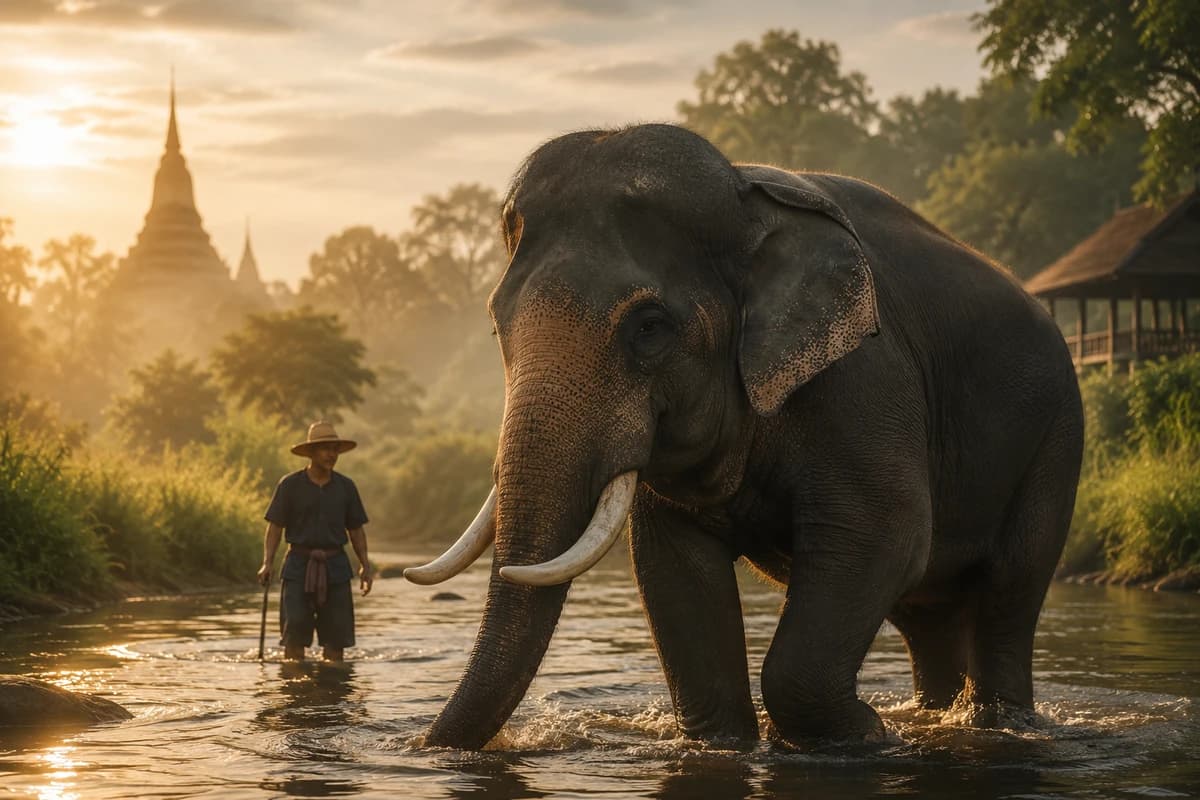
1. The Animal That Became Thailand
There are animals that live in a country, and then there are animals that become part of how a country imagines itself.
In Thailand, the elephant belongs firmly in the second category.
It appears in temple art, old royal traditions, military history, national symbolism, tourism campaigns, football nicknames, conservation programmes and the memories of families whose work has been tied to elephants for generations. A white elephant once stood at the centre of Siam’s national flag. Today the elephant remains one of Thailand’s most recognisable national symbols, associated in official Thai descriptions with strength, wisdom, longevity, auspiciousness and prestige.
Thailand even has a day dedicated to it. Thai Elephant Day is observed on 13 March. The date was formally approved by the Cabinet in 1998 after conservation and national-identity bodies argued that an annual day would help strengthen public awareness of the elephant’s importance and the need to care for it.
That continuity can make the relationship look timeless. It is not.
The elephant’s place in Thai society has changed again and again because Thailand itself has changed. Kingdoms became a modern nation-state. Warfare changed. Roads and machines replaced many forms of animal transport. The teak economy rose and declined. Natural-forest logging was brought to an end. International tourism expanded. Veterinary science and animal-welfare research developed. Protected areas grew in importance. Wild elephant populations in several Thai landscapes began to recover and expand.
At each stage, people had to answer the same basic question in a new way: what place does the elephant have in Thailand now?
That question is why the modern story cannot be reduced to a postcard image of an elephant beside a temple, nor to an argument about whether one tourist activity is good or bad. Thailand’s relationship with elephants is a historical relationship between animals, people, work, landscape, culture and changing ideas of care.
The elephant has not remained important because Thailand refused to change. It has remained important because Thailand kept finding a new role for it.
2. Kings, White Elephants and the Old Flag
To understand why the elephant carries such weight in Thailand, it helps to begin with the animal that was never simply another elephant: the white elephant.
The English phrase can be misleading. A Thai white elephant is not simply an albino animal with snow-white skin. Traditional classification considers a range of physical characteristics, and the animal’s colour may be much subtler than the name suggests. What mattered historically was not whiteness alone but auspicious status.
White elephants were closely connected with kingship across the region. Thai historical and Fine Arts Department material places them within an older political and cosmological world in which possession of auspicious elephants could enhance royal prestige. Searching for such elephants, presenting them to the monarch and formally recognising them became part of royal tradition.
That association was strong enough to become international symbolism.
Siam did not originally possess a modern national flag in the European sense. Red banners were used on trading ships, and royal flags later incorporated Chakri and elephant imagery. During the reign of King Mongkut, as Siam’s diplomatic and commercial relations with Western powers expanded, the white elephant on a red field became the national flag used to represent the kingdom. In 1891, regulations formally codified the design. The elephant remained on the national flag until the flag was redesigned during the reign of King Vajiravudh; the present red-white-blue tricolour was established in 1917.
For decades, therefore, foreigners approaching a Siamese diplomatic mission or ship could quite literally encounter the country through the image of an elephant.
The symbolism was never only decorative. In older Southeast Asian kingship, elephants represented power because they were difficult to obtain, difficult to manage and extraordinarily valuable. A ruler associated with auspicious elephants displayed more than wealth. The animals spoke to ideas of authority, merit and the proper order of the kingdom.
They were also living beings at the centre of elaborate systems of knowledge. Capturing, identifying, training, caring for and presenting important elephants required specialists, and court traditions developed terminology, ceremonies and bodies of expertise around them.
This is one reason Thailand’s elephant history cannot be understood by looking only at tourism camps today. Long before the first international holidaymaker arrived, elephants already occupied political, ceremonial and symbolic spaces that most working animals never entered.
Even after the white elephant disappeared from the national flag, the association survived. In modern Thailand, official institutions still describe the elephant as a revered national symbol. The image remains useful because it connects several versions of Thailand at once: royal Siam, rural life, forests, strength, memory and modern conservation.
The flag changed. The elephant did not leave the national imagination with it.
3. Elephants in War, Ceremony and Everyday Work
The most dramatic elephant stories from old Siam usually involve war.
Across South and Southeast Asia, rulers and armies used elephants as military animals. Their height gave commanders a platform above the battlefield, their strength made them formidable, and their presence carried enormous symbolic value. Thai chronicles and later historical traditions preserve several accounts of warfare involving elephants, including the celebrated yutthahatthi, or elephant combat, associated with King Naresuan.
That episode remains an important part of Thai historical memory. At the same time, surviving Thai, Burmese and later accounts do not always agree on every detail. The respectful way to approach it is therefore to recognise both parts of the story: elephant warfare was a genuine feature of regional military history, and particular famous episodes also accumulated layers of commemoration and national memory over time.
But focusing only on battles gives a distorted picture.
Most elephants did not spend their lives carrying kings into combat. Elephants were valuable precisely because their strength could be used in many settings. They carried people and goods, moved through terrain where wheeled transport was difficult, took part in ceremonies and became working partners for people who developed specialised knowledge of how to manage them.
This relationship did not resemble modern livestock farming in a simple sense. Elephants reproduce slowly, mature slowly and require long-term individual handling. The person caring for an elephant needed to understand its temperament, routines, health and responses. Over generations, that work developed into the mahout tradition.
The word mahout is widely understood internationally today, but in Thailand the role has never been just a tourist-job title. A mahout can be handler, carer, trainer, work partner and daily companion. Different communities developed their own traditions, and the social history of elephant handling is not identical across the country. In parts of the North, Karen elephant knowledge became particularly important to the forest economy. In Surin and the Northeast, Kui communities are famously associated with long-standing elephant traditions of their own.
This matters because it changes the way the story is framed. Thailand did not simply “use elephants” as interchangeable tools. It also developed human communities whose knowledge, livelihoods and identities became tied to individual animals. The elephant’s working history is therefore inseparable from the people who learned to live and work beside it.
As modern transport expanded, many older jobs naturally became less necessary. Trucks could carry more freight. Roads reached places that had once been difficult to access. Military technology had moved beyond the age of war elephants centuries earlier.
One industry, however, continued to make exceptional use of the elephant’s abilities well into the twentieth century.
That industry was forestry.
4. The Forest Economy and the Mahout
Northern Thailand’s teak forests created one of the most important modern working roles for elephants.
Commercial teak extraction expanded in the nineteenth century and eventually became a major organised industry. Long before heavy machinery could operate efficiently in every forest environment, elephants had an obvious advantage: they could move large logs through difficult terrain without requiring a road to be built to every tree.
The work was skilled rather than simply muscular.
A logging elephant had to respond to its mahout around heavy timber, steep slopes, rivers and other elephants. The mahout in turn had to judge what an individual animal could safely do. Contractors sometimes owned elephants themselves and sometimes hired elephant owners. Historical forestry material shows that Karen contractors and mahouts played an especially prominent role in parts of northern Thailand’s logging economy well into the late twentieth century.
Teak itself was becoming more tightly regulated at the same time. The Royal Forest Department was established in 1896, and over the following decades the state developed systems intended to control extraction and manage natural forests. By the twentieth century, selective felling cycles, concessions and forestry institutions had replaced the much looser arrangements of the earlier teak trade.
It is tempting to imagine this as a stable world that continued unchanged until one sudden government decision in 1989. The real timeline is more complicated.
Natural teak had already been under severe pressure. FAO forestry histories record that natural teak logging operations and concessions were terminated in 1983, with only limited residual or improvement activity continuing. The broader forestry sector, however, still supported extensive logging operations involving other natural forests and remained an important employer of elephants and mahouts.
Then came the disasters of 1988.
Severe floods and landslides in southern Thailand caused major loss of life and intensified public concern about deforestation. In January 1989, the government cancelled natural-forest logging concessions nationwide. The decision transformed Thailand’s forest sector almost overnight.
For conservation policy, it was a landmark. For many people and elephants whose working lives were tied to logging, it was also the end of an economic system they had known for years.
That is where the modern elephant story turns.
The challenge was not simply that an old occupation had become unpopular. A large captive elephant cannot be parked in a shed until a new industry appears. It needs food every day, space, veterinary attention, exercise, human care and an experienced person able to manage it safely.
The logging ban therefore created a question that Thailand had to solve in practical terms, not just ethical ones.
What work, and what life, came next?
5. 1989: When an Old Job Disappeared
The national logging ban is often presented as a clean dividing line in elephant history: logging stopped, so elephants moved into tourism.
That is broadly true, but the human reality was more gradual and more complicated.
The Forest Industry Organization, one of the country’s major forestry actors, later described the effect of the ban on its own operations as drastic. Logging licences were cancelled, earnings fell, and the number of working elephants and mahouts in its system was reduced sharply. Some residual work continued for a period as already felled timber was removed, but the direction was clear. The old forest labour market was disappearing.
For mahouts and elephant-owning families, the problem was immediate. An elephant remained expensive to maintain whether it was earning income or not, and traditional skills that had been economically valuable in the forest suddenly had fewer places to be used.
Thailand responded through more than one route.
The state forestry system retained elephant institutions, and what became the Thai Elephant Conservation Center in Lampang developed an increasingly important role in care, training, veterinary work and public education. Private owners and camps found other forms of employment. Some elephants returned to home communities. Others entered entertainment and tourism. As Thailand’s international visitor economy grew during the late twentieth century, elephant experiences became one of the country’s most recognisable tourism products.
It is easy, with hindsight, to treat this transition as though somebody designed it from the beginning. Nobody did.
Tourism expanded because it could solve several problems at once. Visitors wanted to see elephants. Owners needed income. Mahouts needed work. Elephants required daily support. Thailand already possessed deep cultural familiarity with elephant handling, and northern Thailand was becoming a major international tourism region.
The result was a new economic role built on an old human-animal relationship. That role was never static either.
Early camps often emphasised performance, demonstrations, riding and the remarkable abilities of trained elephants. Later visitor expectations began to shift. Feeding, bathing, walking beside elephants and observation became increasingly prominent. The word sanctuary entered the tourism vocabulary. International tour operators developed their own welfare policies. Thai universities, veterinarians, government agencies and camp operators began paying more attention to measurable welfare standards.
Then the COVID-19 pandemic exposed something important about the entire system.
When international tourism collapsed in 2020, many camps lost most of their income almost immediately. Research in northern Thailand found reductions in staff and mahout numbers, changes in exercise and feeding, and increased management pressures. The lesson was uncomfortable but valuable: tourism was not only something elephants were participating in. In many places it had become part of the financial system paying for their food, carers and veterinary support.
That does not mean every tourism model is equally good. It means the question has to be more thoughtful than simply asking whether tourism exists.
6. Tourism Gave the Elephant a New Role
Thailand is now one of the world’s most important centres of captive-elephant tourism.
That status brings enormous visibility. It also brings scrutiny.
A visitor can encounter very different elephant experiences under very similar language. One venue may offer distant observation. Another may allow feeding. Another may organise forest walks. Others may include bathing, riding or performances. Some operate with large numbers of animals and tourists; others are smaller. Some have extensive veterinary and natural-space resources; others work under tighter financial and land constraints.
The differences matter more than the label outside the gate.
A 2020 review led by researchers associated with Chiang Mai University and the Smithsonian Conservation Biology Institute made an unusually important point: public debate about elephant tourism often mixes emotion, opinion and evidence. The researchers did not conclude that all tourist interaction is harmless, nor that one activity automatically determines the welfare of an elephant.
Instead, they argued for looking at the animal’s actual life.
Does it receive suitable food and enough roughage? Does it maintain a healthy body condition? Can it exercise? Does it have appropriate opportunities for social contact? How much time is it restrained? What condition are its feet and skin in? Does it receive veterinary care? Is its daily workload appropriate? How is it handled? Does it have periods of rest and opportunities to express normal behaviour?
Those questions are less dramatic than a social-media slogan, but they are much more useful.
Research has even found examples where assumptions can be misleading. Some tourism elephants that walked more had healthier metabolic profiles than animals receiving large quantities of high-energy treats with less exercise. At the same time, long hours on hard surfaces, inappropriate restraint, wounds, insufficient movement or stressful interaction can create genuine welfare concerns.
The implication is not that visitors should stop caring about what they see. It is that caring should become more informed.
The word “sanctuary”, for example, is not by itself a scientific welfare measurement. Nor is the absence of riding proof that every other part of management is ideal. Conversely, the existence of a traditional management tool or a structured activity does not tell the whole story without understanding how, why and how often it is used.
For Thailand, this creates an opportunity rather than simply a criticism. The country has elephant veterinarians, long-established institutions, university research programmes and generations of mahout knowledge. Those different forms of expertise can be brought together to improve standards in ways that are practical for elephants and for the people responsible for them.
Tourism gave the captive elephant a new role after forestry changed. The next stage is making that role increasingly sustainable.
7. What Does Good Elephant Care Actually Mean?
Good elephant care starts with recognising the scale of the animal.
An Asian elephant is not a horse made larger. It has its own social behaviour, feeding needs, movement patterns, physical risks and long lifespan. A captive elephant may need decades of human care, which means management decisions made today can shape an individual animal’s life for many years.
That is also why the mahout remains central.
Research interviewing Thai elephant caregivers found that most mahouts described the elephants they cared for in family-like terms. Other studies have shown that longer, more stable handler-elephant relationships can influence cooperation and behaviour. A skilled mahout notices changes that a short-term visitor will never see: appetite, gait, mood, dung, sleep, social responses, skin condition and countless small signs that something is different.
This is not an argument that tradition should be beyond examination. Good traditions can be strengthened by new knowledge, and harmful practices can be changed. It is an argument that welfare reform works better when the people providing daily care are treated as part of the solution.
The COVID years illustrated this vividly. When camp income disappeared, mahout salaries fell, staffing ratios worsened and some elephants had less movement and altered diets. Elephant welfare and mahout welfare were not separate problems. They were connected.
Modern Thai elephant care therefore sits at an interesting meeting point. There is traditional handling knowledge. There is veterinary medicine. There is behavioural science. There are government regulations. There are tourism-market expectations. There are owners who must make facilities economically viable. And there are individual elephants whose needs vary with age, health, temperament and history.
The legal system reflects some of this complexity.
Thailand distinguishes between wild and captive elephants. Wild Asian elephants are protected under the Wild Animal Reservation and Protection Act 2019. Captive elephants fall under a different legal framework and must be registered; recent Thai reporting to CITES describes registration requirements that record information such as birth, parentage and identifying characteristics. Other animal-welfare and agricultural-standard rules can also apply to elephants under human care.
This distinction is important because “release them all” is not a workable policy for thousands of captive animals.
Many have lived under human management for generations. Suitable habitat is limited. Wild elephant populations already create management challenges in some landscapes. Moving captive elephants into protected forests would not remove responsibility; it would create new ecological, legal and welfare questions.
The more realistic goal is better lifetime care. That means improving management where improvement is needed, supporting mahout skills, strengthening veterinary access, ensuring suitable environments and allowing evidence to matter more than branding.
The future of Thailand’s captive elephants will probably not be one single model. But it can be a better-managed collection of models.
8. Thailand’s Wild Elephants Are Writing a Different Story
While captive elephants were adapting to a changing economy, Thailand’s wild elephants were following a very different path.
The Department of National Parks, Wildlife and Plant Conservation has recently estimated the country’s wild elephant population at roughly 4,013 to 4,422 animals, distributed across 16 forest complexes and 91 protected areas. Important populations survive in landscapes including the Western Forest Complex, the Eastern Forest Complex, Dong Phayayen-Khao Yai, Phu Khieo-Nam Nao and Kaeng Krachan.
The most encouraging part of the story is that several monitored populations are increasing.
That deserves to be recognised as a conservation achievement. Thailand has protected large forest landscapes, maintained national parks and wildlife sanctuaries, invested in monitoring and kept Asian elephants present in places where they could easily have disappeared.
Elephants also matter to the forest itself. Studies in Thailand have documented Asian elephants eating fruit and dispersing intact seeds, sometimes over considerable distances. They are enormous moving components of an ecosystem: browsing vegetation, opening paths, moving nutrients and carrying seeds through landscapes. Protecting an elephant population therefore protects more than a national symbol.
But successful conservation changes the problem rather than ending it.
Elephants need space. They can travel long distances. A forest boundary on a government map means nothing to an animal following food, water, seasonal movement or familiar routes. Outside protected areas, those routes may now pass through farms, roads, villages and rapidly developing landscapes.
The Eastern Forest Complex demonstrates the challenge particularly clearly.
DNP figures show its wild elephant population rising from about 334 in 2015 to 799 in 2025. That is an extraordinary increase over a decade. It is also a management challenge when habitat and surrounding land cannot expand at the same rate.
Elephants have been recorded travelling far beyond forest edges. Crops can offer concentrated, attractive food. Roads create collision risks. Farmers may lose a season’s work in a single night. Rangers and local response teams may face dangerous encounters while trying to move elephants away from communities.
This is sometimes described simply as “human-elephant conflict”. The phrase is useful, but it can sound as though either humans or elephants are the problem.
Neither is.
The problem is two successful ways of using the same landscape meeting at its edges.
9. Learning to Share the Landscape
The scale of human-elephant encounters in Thailand is now large enough to be a national policy issue.
A peer-reviewed study examining reported incidents from 2014 to 2023 identified human-elephant conflict across 34 of Thailand’s 77 provinces. Its dataset recorded serious consequences for both people and elephants, with agricultural areas appearing repeatedly because crops can attract elephants beyond forest boundaries. The authors also cautioned that media-based historical data can be biased toward more dramatic incidents, which means precise totals should be read carefully rather than treated as a complete census of every encounter.
The important point is not a single number. It is that coexistence has become one of the central conservation challenges of modern Thailand.
Thai agencies are responding with a mixture of approaches because no single barrier can solve every landscape.
Some areas use physical elephant barriers and repair older ones. Communities and officials operate surveillance and rapid-response networks. Habitat work aims to improve food and water inside protected areas. Monitoring helps identify movement routes and high-risk periods. Compensation and assistance programmes recognise that communities living beside protected forests should not be expected to absorb every cost of conservation alone.
Thailand has also begun exploring tools that would have sounded futuristic a generation ago.
In January 2026, DNP reported the country’s first field trial of contraceptive vaccination in wild female elephants. The programme followed earlier testing in captive females and was directed at the rapidly growing eastern population. Three wild elephants received the vaccine in the first field phase and were reported healthy during initial follow-up.
The point is not to stop elephants from existing or to replace habitat conservation with population control. It is to give managers another possible tool in landscapes where numbers are rising faster than available space can accommodate safely.
That careful distinction matters.
Conservation used to be described mainly as preventing wildlife from disappearing. Thailand’s elephant experience shows the next stage: what happens when protection works well enough that large animals begin reclaiming landscapes also used intensively by people?
The answer requires science, but it also requires trust. A farmer whose crops are repeatedly damaged needs to believe that conservation policy includes their livelihood. A ranger needs safe procedures and equipment. Communities need warnings and practical support. Conservationists need connected habitat. Elephants need room to move without every movement becoming an emergency.
There is no perfectly clean boundary between those needs.
That is what makes coexistence difficult — and why it is such an important part of Thailand’s modern elephant story.
10. The Elephant’s Place in Thailand Today
For centuries, the elephant’s role in Thailand was easier to name.
Royal elephant. War elephant. Transport animal. Forest worker. Tourism elephant.
Today, none of those labels is enough on its own.
The elephant is still a national symbol, but it is also a conservation responsibility. Captive elephants still support livelihoods, but expectations about how they should be cared for are becoming more sophisticated. Mahout knowledge remains valuable, while veterinary science and welfare research are adding new ways to understand individual animals. Wild elephant populations are being protected successfully in several landscapes, while that very success creates new pressure to improve coexistence with surrounding communities.
Thailand is therefore not moving from a bad elephant past toward one perfect modern answer. It is doing something more difficult: adapting a very old relationship to a country that no longer looks like the one in which that relationship began.
The forests are different. The economy is different. The roads are different. Tourism is different. Public expectations are different. Conservation science is different.
The elephant remains.
That is perhaps the most important point of the story.
When warfare changed, the elephant found other work. When machines and roads changed transport, the relationship continued. When natural-forest logging ended, tourism and conservation institutions became more important. When tourism itself was challenged — by changing welfare expectations and then by a global pandemic — Thailand’s elephant community adapted again. And as wild populations grow in some parts of the country, the next task is learning how elephants and people can share landscapes that both need.
There will be debates about how that should happen. There should be. A living relationship is not preserved by pretending every old practice is perfect or every new idea is automatically better.
It is preserved by paying attention.
To the elephant’s health. To the mahout’s knowledge and livelihood. To the farmer living beside the forest. To the ranger protecting it. To the science showing what works. And to the cultural history that explains why Thailand cares so deeply about the animal in the first place.
The white elephant may no longer stand at the centre of the Thai flag.
But more than a century after it disappeared from that design, the elephant still occupies a place at the centre of Thailand’s story.