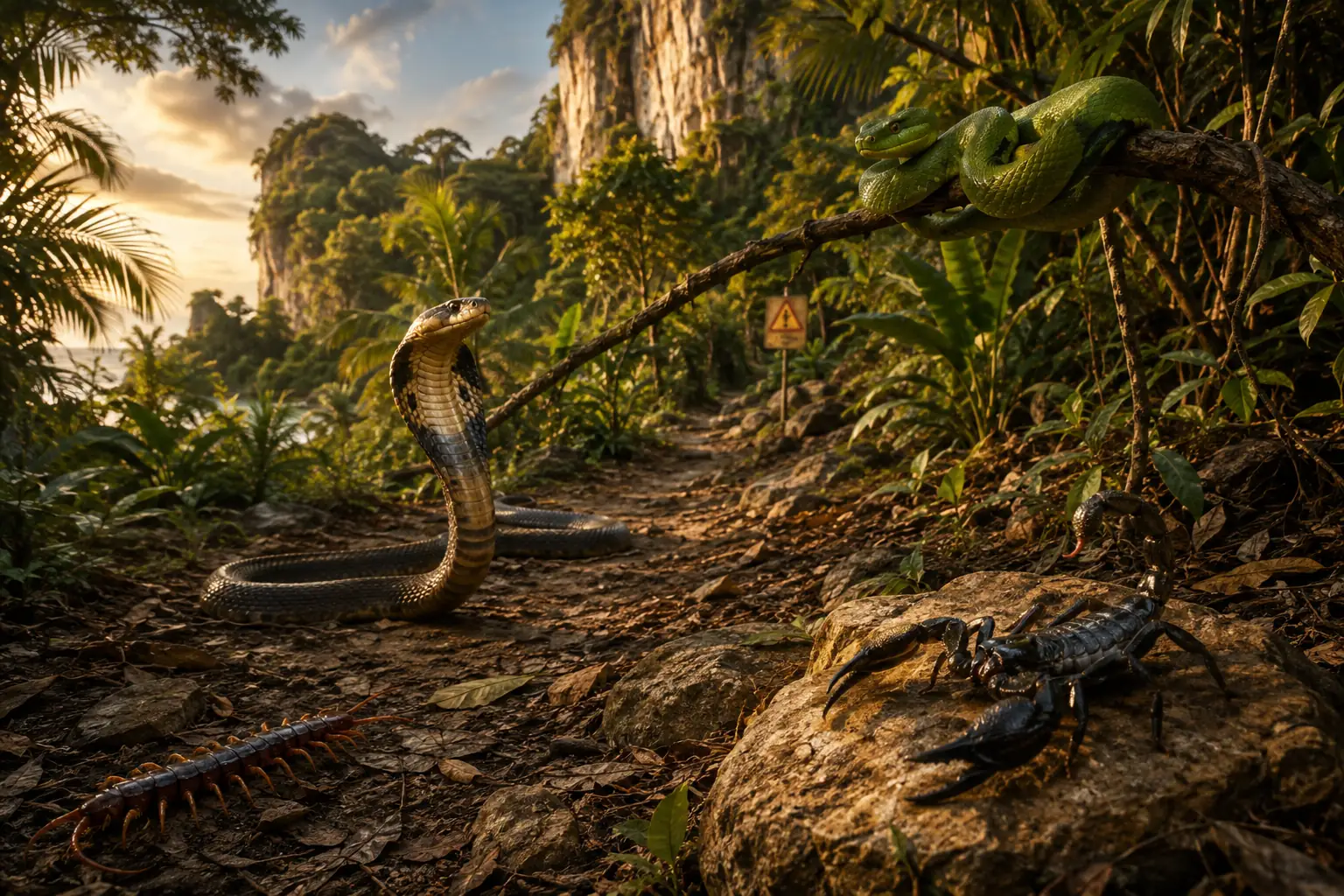
Ask most people to picture a dangerous animal in Thailand, and the images that come to mind are usually the cinematic ones: a cobra rearing up from tall grass, a crocodile gliding through a swamp, perhaps a tiger somewhere deep in the forest. These animals do exist in Thailand, and they are worth respecting. But for the ordinary traveller moving between hotels, temples, beaches and cities, they are almost never the thing that actually matters. The risks worth genuinely thinking about are considerably less cinematic, and considerably more useful to understand.
This is really a question of realistic traveller risk rather than dramatic possibility. Four things determine whether an animal deserves a place on that list: how likely you are to come into contact with it, how serious the consequences of that contact could be, how preventable those consequences are, and what you should actually do if contact happens. Judged by those measures, the animals that matter most to an ordinary visitor to Thailand are not the ones that make for dramatic headlines. They are mosquitoes, dogs, macaques, snakes in certain settings, and a small number of marine creatures found along the coast.
None of this is about diminishing Thailand's wildlife or pretending its more dramatic animals do not exist. It is simply about applying a more useful lens than the one most "deadliest animals" lists tend to use. A list built purely around which animal looks most frightening, or which has the most fearsome reputation, tells a traveller almost nothing about what they should actually plan for. A list built around genuine likelihood of contact and genuine seriousness of consequence tells them a great deal.
The Wrong Animals Get All the Attention
Thailand is home to cobras, wild elephants and plenty of other genuinely dramatic wildlife, and none of that should be dismissed. But the creatures that ordinary travellers should actually think about first are, for the most part, far less cinematic than the ones that dominate internet listicles. Understanding why requires setting aside the instinct to rank animals by how frightening they look, and instead asking a simpler, more practical question: what is actually likely to happen to you, and what should you do about it if it does?
Mosquitoes: Probably the Most Relevant Animal-Related Health Risk
If there is one creature that deserves more attention from visitors than it typically receives, it is the mosquito. Thailand's Department of Disease Control identifies Aedes aegypti as the principal vector for dengue in the country, with Aedes albopictus acting as a secondary vector. These particular mosquitoes bite mainly during the day, a detail that surprises many travellers who associate mosquito risk primarily with dusk and evening hours. Beyond dengue, Aedes mosquitoes can also transmit chikungunya and Zika.
None of this is meant to suggest that mosquitoes are Thailand's single greatest threat to visiting tourists in some dramatic, headline sense; there is no reliable basis for a claim of that kind, and it would be irresponsible to make one. What can be said with confidence is that mosquito-borne illness represents a genuinely relevant, everyday health consideration for anyone spending time in Thailand, considerably more relevant in practical terms than most of the animals that tend to dominate popular imagination.
Part of what makes mosquitoes easy to underestimate is precisely how unremarkable they seem. A cobra or a crocodile announces itself as something to be wary of; a mosquito landing on your ankle during a daytime temple visit does not carry the same instinctive sense of danger, even though, statistically and practically, it is the more relevant creature to be thinking about. The sensible response is straightforward: use insect repellent, wear clothing that offers some protection during the day, make use of screens or air conditioning where available, and if you are staying somewhere for an extended period, avoid leaving standing water around your accommodation, since it provides breeding sites for these mosquitoes.
Dogs: Common Contact, Serious Potential Consequence
Free-roaming dogs are a familiar sight across much of Thailand, found on streets, around temples and throughout many neighbourhoods. The overwhelming majority simply go about their business alongside people, and most encounters between visitors and these dogs pass without any incident at all. It would be entirely wrong to suggest that every dog you see represents some kind of looming danger.
What makes this worth taking seriously, however, is the combination of how common these encounters are with how serious the potential consequence can be. According to the World Health Organization, Thailand remains rabies-endemic, and dog bites and scratches account for the overwhelming majority of human rabies transmission worldwide. Rabies is virtually always fatal once symptoms appear, but it is preventable with prompt post-exposure treatment. This combination of common contact and potentially severe consequence, rather than any inherent viciousness in Thai street dogs, is exactly why this deserves a traveller's attention.
The practical guidance here is clear and worth remembering. The World Health Organization advises washing any bite or scratch wound thoroughly with soap and running water for at least fifteen minutes, and seeking prompt medical care afterwards. This applies regardless of how healthy or friendly the animal appeared at the time; there is no reliable way to judge rabies risk simply by looking at a dog, and reassurance based purely on appearance is not a safe substitute for proper wound care and medical assessment.
Macaques: More Relevant Than Many Tourists Expect
Long-tailed macaques rank among the primates most frequently encountered by visitors to Thailand, turning up at tourist sites, temples, parks and residential communities across the country. For many travellers, a macaque sighting is one of the more memorable wildlife moments of their trip — and for the most part, that is exactly what it should remain: a memorable, harmless encounter, provided a few sensible boundaries are respected.
The scale of macaque presence outside protected conservation areas is worth noting. Peer-reviewed research citing a 2023 Department of National Parks survey reports 64,055 monkeys across 306 identified human–monkey conflict zones located outside conservation areas. This figure reflects the reality that macaques and people share space across a considerable portion of the country, not merely in a handful of isolated wildlife hotspots. It is worth adding, too, that macaques encountered at different locations are not necessarily behaving identically or representing identical risk levels; a group accustomed to years of visitor feeding at a well-known tourist site is a genuinely different proposition from macaques encountered more incidentally elsewhere, even though both fall under the same general description.
Feeding and close interaction are the factors that most reliably increase the risk of conflict between macaques and people. Macaques that have become accustomed to being fed by visitors can become considerably more assertive around food, bags and belongings than macaques living without that conditioning. The practical response follows naturally: do not feed macaques, avoid teasing or provoking them, never attempt to touch their young, and do not challenge or corner them if they approach. It is also sensible to keep food and bags secured around areas where macaques are present. As with dog bites, any scratch or bite from a macaque deserves prompt medical assessment; this is not a case where reassurance based on the animal's apparent friendliness is a safe substitute for proper care.
Snakes: Real and Medically Important, Not a Constant Threat
Thailand is home to a number of medically significant venomous snakes, including green pit vipers, Malayan pit vipers, cobras, kraits and Siamese Russell's vipers. Thai hospital and toxicology literature confirms that these species represent a genuine treatment burden within the country's healthcare system. Thailand's Ministry of Public Health material reported roughly 12,000 patients treated in 2023 for bites from venomous snakes and other venomous animals combined — an important figure to understand correctly, since it reflects a combined category rather than snakebites alone, and should never be converted into a snakebite-specific statistic.
Snakebite in Thailand is, in practice, especially associated with rural and occupational settings, rather than representing a constant background risk for ordinary tourists moving between typical visitor destinations. This does not mean the risk can be dismissed entirely, particularly for travellers spending time on rural trails, in gardens, or in similar settings, but it does mean the risk should be kept in proportion rather than treated as a defining feature of every visit to Thailand. A short beach holiday spent largely on paved streets and resort grounds carries a very different level of snake-related risk than an extended stay in a rural farmhouse or a multi-day trek through forested terrain, and it is worth calibrating your own precautions to the kind of trip you are actually taking rather than to a generic worst-case scenario.
Sensible precautions include carrying a torch when walking at night in rural or garden areas, wearing appropriate footwear on trails, and never attempting to handle a snake under any circumstances. If a bite does occur, the correct response is to seek emergency medical care as quickly as possible. It is worth being equally clear about what not to do: never cut the wound, never attempt to suck out venom, never apply ice, never use electrical shock, and never apply an improvised tight tourniquet. None of these old folk remedies improve outcomes, and several can make things considerably worse. There is also no need, and no benefit, in trying to catch or kill the snake responsible; medical treatment for venomous snakebite in Thailand does not depend on bringing the snake itself to hospital.
Venomous Marine Stingers: Rare but Potentially Severe
Along Thailand's coastline, a small number of marine creatures deserve genuine respect, even though serious incidents remain uncommon. Thailand's Department of Marine and Coastal Resources documents the presence of box jellyfish in Thai waters. Historical surveillance covering the period from 1999 to 2021 recorded ten deaths and thirty-six severe injuries across eight provinces — figures that make clear this is a real, if statistically rare, risk rather than either a routine hazard or a purely theoretical one. This risk exists on both the Gulf and Andaman coasts, though encounters of this severity are not common.
More recently, 2026 alerts from the Department of National Parks also documented Portuguese man-of-war sightings around Koh Lanta and Phi Phi. It is worth being precise here: the Portuguese man-of-war is not taxonomically a true jellyfish, even though it is often popularly described as one. The safer and more accurate way to discuss both creatures together, without overstating or understating either one, is as venomous marine stingers.
The most important practical advice is straightforward. Follow local flags, warnings and lifeguard guidance wherever they are posted, since these are typically the most current and location-specific source of information about conditions on any given day. Never touch a stranded jellyfish on the beach with bare hands, even if it appears lifeless; stings can still occur from creatures that are no longer in the water. If a box-jellyfish sting does occur, guidance from Thailand's Department of Marine and Coastal Resources recommends applying vinegar continuously for at least thirty seconds, followed by urgent transfer for medical care.
It is worth keeping this risk in its proper context alongside everything else discussed here. A serious box-jellyfish sting is rare, and the great majority of beach and swimming holidays in Thailand pass without any encounter of this kind whatsoever. The value of understanding the guidance above lies not in expecting it to be needed, but in knowing exactly what to do in the unlikely event that it is.
Wild Elephants: Low Probability, High Consequence
Wild elephants occur in and around certain protected areas in Thailand, and they occasionally enter roads within or near those areas. For the great majority of visitors, whose time in Thailand is spent in cities, beach resorts and conventional tourist destinations, this is simply not an everyday risk of any kind. It becomes relevant only in specific locations associated with protected natural areas.
Guidance from the Tourism Authority of Thailand and the Department of National Parks is consistent and worth taking seriously in the places where it applies: keep your distance, never feed a wild elephant, remain calm if one is encountered, and respect marked routes and any barriers or guidance provided by park authorities. Wild elephants should never be approached for the sake of a photograph, regardless of how calm or docile an individual animal might appear to be at any given moment.
Centipedes, Scorpions and Similar Creatures
Thailand is also home to centipedes, scorpions and various similar creatures capable of delivering a painful bite or sting. For the ordinary traveller, these generally carry a lower public-health significance than mosquitoes, rabies exposure, or serious snakebite, though they are certainly capable of causing real discomfort and, in some cases, more serious symptoms.
Simple precautions reduce whatever risk exists. In more rustic accommodation, particularly anywhere close to nature, it is worth shaking out footwear before putting it on, since these creatures sometimes find their way into shoes left out overnight. Avoid handling any of these creatures directly, and seek medical care if symptoms are severe or if any sign of an allergic reaction develops following a bite or sting.
Monitor Lizards: Frightening to Look At, Not a Realistic Danger
Water monitors and other large monitor lizards are a striking sight for many first-time visitors, sometimes reaching a genuinely imposing size. Despite their prehistoric appearance, they do not represent a realistic predatory threat to ordinary tourists. They are, in many respects, the clearest illustration of a broader point running through this whole subject: an animal looking frightening is simply not the same thing as an animal representing a meaningful traveller danger. As with any wild animal, the sensible approach is not to corner, touch or feed monitor lizards, but there is no need to treat a sighting of one as cause for alarm.
Crocodiles, Tigers and Sharks: The Internet-List Problem
No honest account of dangerous animals in Thailand would deny that potentially dangerous wildlife, including crocodiles and tigers, exists somewhere within the country's borders. But routine tourist exposure to wild tigers or wild crocodiles is extremely low, and it makes little sense to devote much attention to a theoretical headline danger that has essentially no bearing on how an ordinary trip to Thailand actually unfolds. These are the animals that populate sensational online lists precisely because they sound dramatic, not because they reflect genuine traveller risk.
What to Do After a Mammal Bite or Scratch
Because bites and scratches from dogs and macaques represent two of the more genuinely relevant risks discussed here, it is worth setting out the appropriate response clearly and in one place. Wash the wound thoroughly with soap and running water for at least fifteen minutes. Seek medical care as promptly as you reasonably can. Depending on the nature of the exposure, post-exposure treatment for rabies may be required, and tetanus status and general wound management may also need to be assessed by a medical professional. None of this should be skipped or delayed on the basis that the animal in question looked healthy at the time; there is no reliable way to judge these risks by appearance alone, and prompt, proper care remains the only genuinely safe response.
Keeping It All in Proportion
None of this is meant to suggest that Thailand is some kind of wildlife gauntlet that visitors must navigate with constant vigilance. It is not. The sensible traveller simply uses mosquito protection as a matter of course, leaves dogs and monkeys alone rather than approaching or feeding them, respects beach warnings and flags where they are posted, applies basic awareness on rural trails, and gives wild animals like elephants the distance and respect they are due. None of these habits are difficult, and none of them require living in a state of anxiety throughout a trip.
Thailand's genuine animal risks are real, evidence-based, and, in nearly every case, straightforwardly manageable through simple, well-understood precautions. Knowledge of this kind should reduce fear rather than create it — replacing vague, cinematic worry about cobras and crocodiles with a clearer, calmer, more useful understanding of what actually deserves a traveller's attention, and what does not.
That, in the end, is the real value of thinking about this subject properly. The animals worth remembering as you plan a trip to Thailand are not the ones that would make the most dramatic photograph or the most gripping documentary footage. They are the quiet, unglamorous, entirely manageable realities of mosquito bites, dog and macaque encounters, sensible trail awareness, and respect for whatever the flags on any given beach happen to be telling you that day. Understood this way, wildlife in Thailand becomes something to enjoy and appreciate, rather than something to fear.