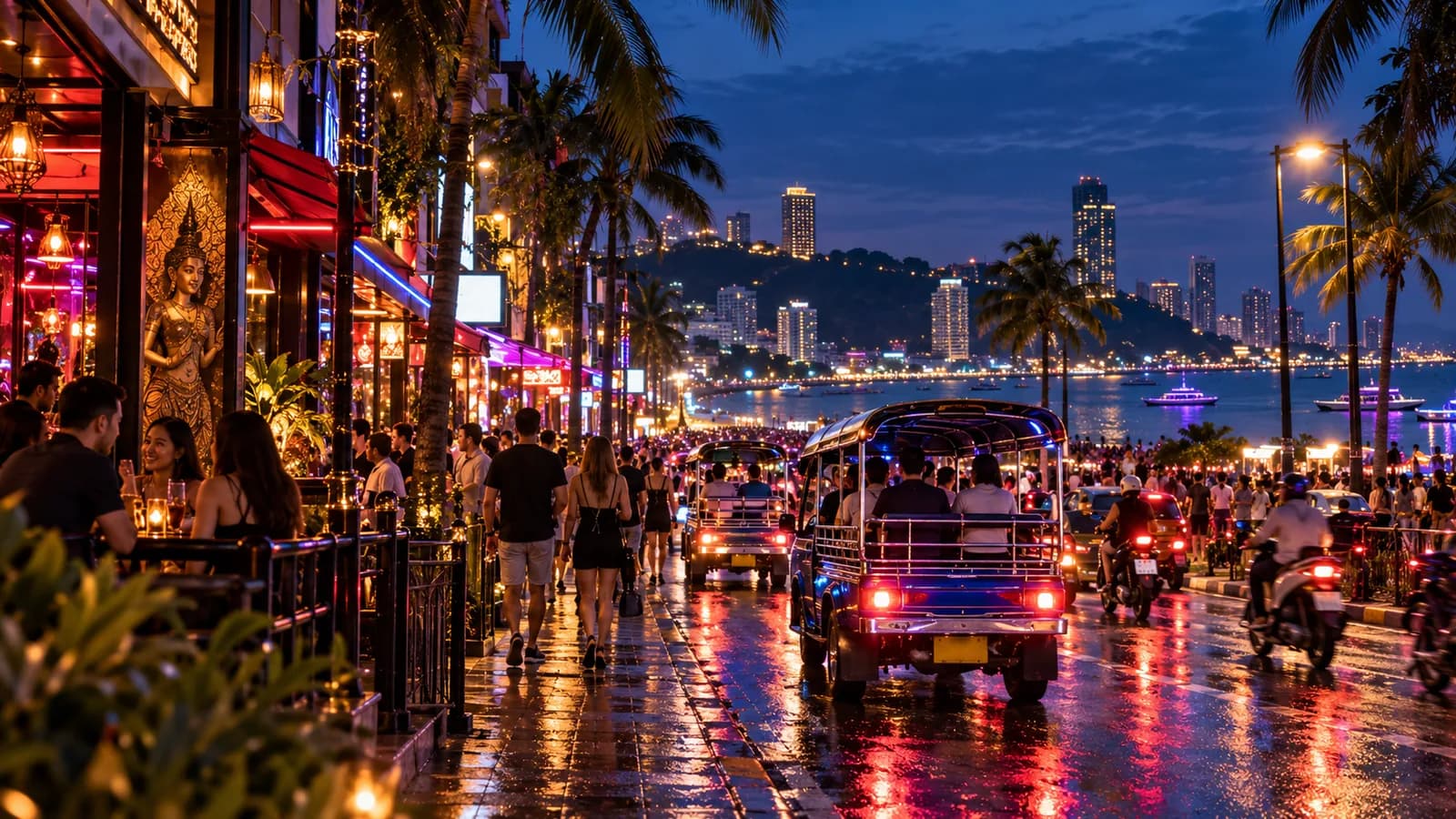
1. The Street That Became a Symbol
Walking Street is so strongly associated with Pattaya that it can appear to have been there from the beginning.
It was not.
The road at the southern end of Pattaya Bay existed before the neon signs, before the pedestrian barriers and before “Walking Street” became an international name. Its modern identity emerged from a sequence of changes in the city around it: the growth of coastal tourism, the presence of American military personnel during the Vietnam War era, the expansion of civilian tourism after the American withdrawal, the concentration of restaurants and entertainment businesses, and finally a late-twentieth-century decision to turn the road itself into a managed visitor attraction.
That sequence is important because Walking Street is often used as shorthand for Pattaya’s entire history.
Pattaya’s transformation was much broader than one road. The city had already attracted domestic visitors before mass foreign tourism, and nightlife developed in several different clusters over time. Even some of Pattaya’s earliest famous nightlife establishments were located elsewhere.
Walking Street became dominant later.
Its history is therefore not simply “how Pattaya nightlife started”. It is the narrower and more interesting story of how one waterfront road gradually became the city’s most recognisable after-dark public space.
2. Before Mass Tourism: A Working Waterfront
Before Pattaya became an international resort, the bay supported fishing and a small coastal community. Roads along the shore served practical local purposes long before they became tourist scenery.
Popular histories of Walking Street describe the southern waterfront road as part of this older fishing economy, linking the settlement and the pier area. That broad picture fits Pattaya’s pre-tourism geography, although precise claims about when each section of the road was built are difficult to document from surviving sources.
The key point is simpler: the road was infrastructure before it was entertainment.
Pattaya itself was also beginning to change before the Vietnam War reached its height. Academic research on the city’s entertainment geography notes that Pattaya attracted Bangkok elites and marine-sports visitors during the 1950s, so development did not begin from absolute isolation when American servicemen arrived.
What the American presence did was accelerate the scale and direction of change.
Hotels, restaurants, transport and leisure businesses now had a much larger foreign customer base. A small coastal resort was being connected to international flows of people and money at extraordinary speed.
The future Walking Street lay inside that larger transformation, but it had not yet become the concentrated nightlife corridor later generations would recognise.
3. R&R Changes Pattaya — But Not All at Once
The Vietnam War era is essential to Pattaya’s history, but it needs to be described precisely.
American military personnel began visiting Pattaya around the turn of the 1960s, while large U.S.-linked military operations in Thailand expanded during the following decade. Pattaya was within reach of Sattahip and U-Tapao, and rest-and-recreation travel brought a steady stream of visitors to the coast.
Accommodation, restaurants and nightlife grew in response.
Yet academic research also complicates the popular idea of an instant transformation. Shinsuke Hinata’s historical study of Pattaya’s entertainment district argues that, despite the importance of the U.S. military presence, Pattaya retained much of its quieter beach-resort atmosphere until the early 1970s.
That is a useful correction.
The military years created demand and infrastructure, but the entertainment city developed over time. The road that later became Walking Street was part of that process rather than a finished nightlife strip created at the beginning of the R&R era.
The American withdrawal in the mid-1970s might therefore have been expected to weaken Pattaya permanently.
Instead, it forced the resort to broaden.
Civilian tourists from Europe and elsewhere increasingly replaced military customers. Businesses adapted to a more diverse market, and Pattaya began moving from a resort heavily influenced by military-linked travel toward a mass international tourism economy.
4. The 1970s: The Strip Takes Shape
The mid-1970s are where the history of the future Walking Street becomes much easier to see.
One particularly useful piece of local history concerns B.J. Bar. Pattaya Mail’s 2004 profile of its American co-founder records that he and his Thai wife opened B.J.’s on what later became Walking Street and that it became one of the early expatriate-style bars on the road then remembered as “the strip”. The business dated its establishment to 1974.
This does not mean B.J.’s was the first bar in all of Pattaya.
Indeed, Hinata’s academic study places it within a wider entertainment economy developing across the resort. Other historically important venues appeared elsewhere: the Tahitian Queen, for example, opened on Beach Road in 1978 and is widely associated with the early development of Pattaya’s go-go format.
That geographical distinction matters.
Pattaya nightlife was not born on a single street. What happened on the southern waterfront was concentration: bars, restaurants, guest accommodation and other visitor businesses increasingly clustered along a route that already connected important parts of South Pattaya.
By the end of the 1970s, the American military presence had receded, but the commercial pattern remained.
The customers changed.
The strip survived.
5. The 1980s and 1990s: From Local Strip to Tourist Corridor
During the 1980s, Pattaya became a far larger civilian resort.
International visitor numbers to Thailand grew, package tourism expanded, and Pattaya’s accommodation and entertainment economy diversified. Popular local histories remember the southern strip adding more restaurants, music venues, discotheques and shows during this period.
The important structural change was that nightlife no longer depended on one customer group.
Western holidaymakers, expatriates, repeat visitors and travellers from an increasing number of countries moved through Pattaya, and the city’s tourism economy became more resilient because it could adapt to different markets.
The future Walking Street benefited from this density.
A visitor no longer needed to know one particular venue. The road itself was becoming the destination. Businesses gained from being beside one another: restaurants captured customers arriving for nightlife, nightlife venues benefited from diners and hotel guests, and the concentration created an atmosphere that no single establishment could reproduce on its own.
But the street also inherited the problems of rapid coastal development. Traffic, pedestrian safety, waste, wastewater, building control and access for public services all became harder to manage as the road grew busier.
By the 1990s, the question was no longer whether the strip had become important. The question was what Pattaya was going to do with it.
6. The Street That Nearly Faced Demolition
One of the most surprising parts of Walking Street’s history is that its modern identity emerged from a period of serious planning and environmental conflict.
Chootima Longjit and Douglas Pearce’s academic study of Pattaya destination management reports that buildings in the Walking Street area faced demolition in the late 1990s because of environmental problems associated with wastewater being discharged into the sea.
The outcome was not straightforward enforcement.
Local businesses opposed demolition, some government personnel were reluctant to carry it through, and Thailand was dealing with the severe economic disruption of the 1997 Asian financial crisis.
According to Longjit and Pearce, these pressures helped produce a different solution: businesses and public authorities redeveloped the street into a major tourist attraction organised around a pedestrian nightlife district.
This is crucial to understanding Walking Street.
The pedestrian zone was not merely a traffic convenience added to an already complete attraction. It was part of the process through which the street was redefined and managed as a destination.
Popular retellings often say a series of traffic accidents prompted the closure of the road to vehicles at night. That explanation may be part of the local memory, but the stronger academic record emphasises a broader combination of environmental pressure, planning conflict, economic conditions and redevelopment.
Walking Street was, in a very real sense, reinvented rather than simply renamed.
7. 1996: When the Road Became a Walking Street
The exact early stages of pedestrianisation are not documented equally well in every source, but one contemporary local record gives us a useful anchor.
In August 2006, Pattaya Mail reported celebrations for the tenth anniversary of the pedestrianisation of Walking Street. That places the beginning of the nightly pedestrian concept around 1996. The 2006 celebration also opened new entrance archways and extended the period during which vehicles were prohibited.
This helps explain how the name became permanent.
Before pedestrianisation, the southern strip was a road containing nightlife businesses. Once vehicles were removed each evening, the relationship reversed: the road itself became part of the entertainment experience.
People could move slowly through the centre rather than being pushed to narrow edges by traffic. Businesses could face a continuous stream of pedestrians. Signs, lighting, music and crowds interacted across the width of the street.
The public space became a stage shared by dozens of private businesses.
That is the central design idea behind Walking Street, even though it evolved rather than being designed in a single master plan.
The street’s new name was therefore descriptive before it became a brand.
People walked it.
Then they began travelling to Pattaya specifically because they had heard of the place called Walking Street.
8. From Informal Strip to Managed Attraction
Pedestrianisation also created a new management problem: who was responsible for a tourist attraction made up of a public street and many private businesses?
Pattaya’s answer was the Walking Street Committee.
Longjit and Pearce report that the committee was formally established in 2002. At the time of their field research it typically included roughly two dozen or more participants drawn from Pattaya City, the Tourism Authority of Thailand, tourist and traffic police, and business representatives from the street.
Its work covered practical issues such as safety, cleanliness, organisation, events and the area’s appearance.
This was significantly more coordinated than the management of Pattaya nightlife elsewhere in the city, where businesses were spread across many streets and agencies often had overlapping responsibilities.
Walking Street’s compact geography made collective action easier. The street could be cleaned as one zone; police and security resources could be concentrated; entrance arches and lighting could be treated as shared infrastructure; events could use the road itself as a venue.
A 2003 Pattaya Mail report captures this shift particularly well. The committee was discussing a “Fancy Lighting” competition involving more than one hundred businesses, while also setting rules intended to keep signs and decorations clear of fire and waste-collection vehicles.
The old strip had become something much more deliberate.
Pattaya was not merely allowing a nightlife street to exist. It was actively managing Walking Street as a tourism product.
9. Neon, Infrastructure and the Cost of Becoming an Icon
Walking Street’s visual identity became more elaborate as its fame grew.
Large signs, illuminated facades and competing displays turned the street into one of Thailand’s most photographed nighttime urban scenes. But the same visual density created practical problems.
Emergency access and sign placement became recurring concerns. Electricity demand was enormous, and overhead cables accumulated along a road where businesses depended heavily on lighting, sound and cooling systems.
By the 2020s, infrastructure that had grown incrementally over decades was being rebuilt on a much larger scale.
In February 2021, work began on a 103-million-baht project to place Walking Street’s electrical and communications infrastructure underground. Pattaya Mail reported plans for new manholes and around one hundred electrical cabinets, with the aim of improving reliability, reducing visual clutter and supporting the power requirements of the district.
The timing was striking.
The construction started while international tourism was largely absent because of COVID-19. One of Pattaya’s busiest streets had become quiet enough for major engineering work, even as many businesses were struggling to survive.
The project symbolised another stage in Walking Street’s evolution. A road that had once grown through piecemeal adaptation was now being treated as permanent urban tourism infrastructure.
10. COVID-19 and the Moment Walking Street Stopped Walking
The pandemic produced an experiment nobody had planned.
With international visitors largely gone and many nightlife businesses closed, Pattaya temporarily reopened Walking Street to vehicles in July 2020. Businesses hoping to attract domestic Thai customers argued that car access was more useful than maintaining a pedestrian zone with almost no pedestrians.
For twenty-one months, the street did not operate in the normal way implied by its name.
Then the logic reversed again.
As tourism returned and more businesses reopened, mixing cars, motorcycles and increasing numbers of pedestrians became impractical. Pattaya restored the nighttime vehicle closure on 28 April 2022.
The episode revealed how important pedestrianisation had become to the street’s identity.
Without crowds, Walking Street could function as an ordinary road.
With crowds, it worked best as a public space.
That difference helps explain why the pedestrian model has lasted for decades. It is not merely tradition; it solves a physical problem created by concentrating large numbers of visitors and businesses along a narrow corridor.
COVID also changed the people using the street. Pattaya’s visitor mix continued to diversify after reopening, as it had repeatedly since the 1970s.
Walking Street survived by doing what it had always done.
It adapted to whoever came next.
11. What Walking Street’s History Actually Tells Us
Walking Street is sometimes presented as proof that Pattaya’s modern tourism economy sprang directly from the Vietnam War.
That is only part of the story.
American military R&R was a major accelerator. It brought customers, investment and international visibility to a coastal resort that was already beginning to attract visitors. But the peak military period ended before Walking Street acquired the form and name known today.
The strip grew through the 1970s as civilian tourism expanded. It diversified during the 1980s and 1990s. Environmental and planning conflict in the late 1990s pushed businesses and authorities toward redevelopment. Pedestrianisation around 1996 turned a road with nightlife into a nightlife attraction built around the road itself. The Walking Street Committee formalised cooperation from 2002. Later projects rebuilt signage, electrical infrastructure and public space. COVID temporarily reversed the pedestrian model, only to demonstrate why it existed.
Seen this way, Walking Street is not a frozen relic of one era.
It is a product of repeated reinvention.
That is also why its story deserves to stand separately from the broader history of Pattaya. The city became a global resort through many forces and many neighbourhoods. Walking Street became famous because those forces were compressed into one unusually visible piece of urban space.
The old waterfront road did not disappear.
It changed function, changed audience, changed management and eventually changed name.
And once people started calling it Walking Street, the name proved strong enough to outlive almost every individual business that had helped create it.