1. A Famous Street With a Surprisingly Uncertain Beginning
Soi Cowboy is one of Bangkok’s most recognisable pieces of urban nightlife geography. The lane is short enough to walk in a few minutes, but its name has travelled much farther than its physical size suggests.
That fame has produced a simple origin story: a retired American serviceman named “Cowboy” Edwards opened a bar in 1977, wore a cowboy hat, and the street was named after him.
The broad outline is credible. The details are less tidy.
Academic work confirms that the lane developed into a foreign-oriented nightlife area during the 1970s and that an American known as Edwards became central to its identity. Later popular histories repeat the 1977 date, but a detailed specialist chronology based on old nightlife columns and surviving memories places an earlier establishment — the Gold Label — on the lane in 1975, before Edwards’ Cowboy Bar became the name people remembered.
That does not make the familiar story false. It makes it incomplete.
The real history is more interesting because Soi Cowboy was not created in a single moment. It emerged gradually from a quiet Sukhumvit lane, several small businesses, Bangkok’s expanding expatriate and tourist economy, and a nickname that eventually became more permanent than most of the venues that inspired it.
2. The Lane Before the Name
Soi Cowboy runs between Asok Montri Road, traditionally associated with Sukhumvit Soi 21, and Sukhumvit Soi 23. Today that location feels inevitable: Asok is one of central Bangkok’s busiest transport and commercial intersections.
In the 1970s, it was a very different urban environment.
Lower and mid-Sukhumvit were developing quickly, but the district had not yet acquired the density of offices, condominiums, hotels, shopping centres and mass transit that define it today. The nightlife landscape for foreign visitors was also centred elsewhere: Patpong was already the best-known international entertainment district, while the Nana area was still evolving toward the identity it would acquire in the 1980s.
Specialist historical accounts make an important point: the lane that became Soi Cowboy was not a major R&R entertainment street during the peak U.S. military years of roughly 1965–73. That matters, because Bangkok nightlife history is often compressed into a single Vietnam War explanation.
The war and the foreign-oriented hotel economy undeniably reshaped Bangkok, but Soi Cowboy’s growth came largely after the peak R&R era. Its history therefore belongs more to the transition from military-linked travel toward the broader expatriate and international tourism economy of the late 1970s and 1980s.
Before there was “Soi Cowboy”, there was simply a conveniently located lane waiting for the surrounding city to catch up with it.
3. Gold Label: The Bar That Complicates the Legend
The strongest reason to treat Soi Cowboy’s origin story carefully is the Gold Label.
Thomas Steinfatt’s academic study of Bangkok bar districts states that bar operations on the lane began in the early 1970s and that it had only one bar until 1977. A much more detailed specialist history from Bangkok Eyes places that first significant expatriate-oriented bar in early 1975 and identifies it as the Gold Label, operated by an American military retiree named Jim George.
According to that reconstruction, the Gold Label was more than a drinking place: it demonstrated that this otherwise quiet lane could support foreign-oriented nightlife. For a time, the soi was reportedly referred to informally as “Soi Gold Label”.
This is precisely the kind of detail that disappears when a place becomes famous.
The Gold Label did not leave the enduring name. It did not become the figure at the centre of the legend. But if the surviving chronology is correct, it was the business that first proved the location — which makes it historically important even if it has been largely forgotten.
The safest conclusion is therefore not that one source is completely right and another completely wrong. The evidence supports a gradual beginning: one early bar, followed by additional venues later in the decade, with Edwards’ Cowboy Bar becoming the establishment that gave the emerging nightlife strip its lasting identity.
4. The Cowboy Who Gave the Street Its Name
The figure who dominates the story is the retired U.S. Air Force serviceman generally identified as T. G. “Cowboy” Edwards.
Accounts consistently describe Edwards as known for wearing a cowboy hat, and that visual trademark made the nickname memorable long before the lane itself became internationally famous.
The exact chronology around his first bar is where sources diverge. Popular summaries often say he opened a bar on the street in 1977. The detailed Bangkok Eyes chronology places the Cowboy Bar slightly later, during the period when several venues were appearing and the lane was reaching what it calls a “critical mass” around 1978–79.
Even the initials are not perfectly consistent across historical accounts, which is another reason not to pretend the surviving record is more precise than it is.
What is much better supported is Edwards’ role in the name.
Bernard Trink, Bangkok’s influential English-language nightlife columnist, is widely credited with popularising “Soi Cowboy” as a label for the street. Trink wrote about Bangkok after dark for decades, first in the Bangkok World and later the Bangkok Post, and his language often became part of the city’s expatriate vocabulary.
The nickname was simple, visual and easy to remember.
Gold Label may have arrived first. Other bars came and went. But the Cowboy Bar gave Trink a name that stuck.
Eventually, “Soi Cowboy” became not just an expatriate nickname but the ordinary identity of the lane itself.
5. From One or Two Bars to a Recognisable District
Once multiple venues appeared, the character of the street changed quickly.
A single bar on a quiet lane is a destination only for people who already know it exists. A cluster creates something different: foot traffic, competition, visibility and the sense that the street itself is the attraction.
By the end of the 1970s, specialist histories describe that clustering process as firmly underway. Through the 1980s and 1990s, Soi Cowboy became established as one of Bangkok’s principal foreign-oriented nightlife areas.
Steinfatt’s research, published in 2002, recorded 31 bars in the district around the turn of the century. That figure is useful not because it represents a permanent total — businesses constantly changed names, owners and formats — but because it shows how far the lane had travelled from its one-bar beginning.
Soi Cowboy also developed differently from its two famous competitors. Patpong was an existing commercial street district that became an international nightlife centre. Nana Plaza was a commercial courtyard that gradually turned into an entertainment complex. Soi Cowboy remained, fundamentally, a lane lined by individual shophouse-scale businesses.
That physical form shaped its identity. There was no large central building and no long parallel market street; the entire district was compressed into a narrow passage connecting two larger roads. Its small scale made it easy to understand visually: enter at one end, walk to the other, and the whole district reveals itself.
The geography became part of the brand.
6. A Working Street, Not Just a Tourist Image
Nightlife districts are often described only through the eyes of visitors. That approach misses much of what makes them function.
Thai academic research on Soi Cowboy has treated the area as an urban social space: a place formed by the interaction of workers, businesses, residents, visitors and the built environment. That is a more useful way to understand its longevity than reducing the street to neon signs or international stereotypes.
For many years, specialist observers also described a stronger residential and community element than a casual visitor would have noticed. Some employees lived in rooms above or near the businesses. Food vendors and other small-scale services operated around nightlife hours, and people working on the soi knew one another across venue boundaries, even while the businesses themselves competed.
Those arrangements changed as Bangkok property values rose, the Asok district became denser and businesses became more formalised. But the underlying point remains: Soi Cowboy has always been a workplace as well as a destination.
That distinction matters in any responsible history. The people who made the street function were not scenery in somebody else’s Bangkok story. They were workers, managers, owners, vendors and residents participating in an urban economy that evolved over decades.
The history becomes more accurate — and less sensational — when the street is understood as a real piece of the city rather than an exotic exception to it.
7. The 2001 Social-Order Era
Soi Cowboy’s growth did not mean that its operating environment remained stable.
After the election of Thaksin Shinawatra’s government in 2001, Interior Minister Purachai Piumsombun became closely associated with a “social order” campaign that tightened enforcement around nightlife, drugs, closing hours and entertainment businesses.
Contemporary Associated Press reporting from 2002 described Soi Cowboy under noticeably stricter enforcement, with venues shutting earlier than in the previous era and police inspections becoming more visible.
For nightlife businesses across Bangkok, this period mattered because regulation changed not only what happened inside venues but also the rhythm of entire districts.
Soi Cowboy was particularly interesting because it did not have the same formal entertainment-zone status as Patpong. Over the years, enforcement and closing practices changed again, but the early-2000s campaign was a reminder that nightlife districts are shaped as much by law and policy as by tourism demand.
The long-term result was not the disappearance of Soi Cowboy. Instead, the street adapted.
That ability to survive different regulatory periods is one of the themes running through its history. Individual venues could disappear, rules could tighten or loosen, and visitor patterns could change, while the identity of the lane itself remained surprisingly resilient.
8. Asok Becomes One of Bangkok’s Great Intersections
The most important physical change around Soi Cowboy happened outside the soi.
Bangkok’s BTS Skytrain opened on 5 December 1999, with Asok station on the original Sukhumvit Line. The MRT’s first Blue Line service followed on 3 July 2004, including Sukhumvit station at the same major intersection.
Together, the two systems transformed Asok into one of Bangkok’s most useful interchange points.
Soi Cowboy had already been established for decades, so mass transit did not create it. What transit changed was accessibility.
A nightlife street that had once depended heavily on nearby hotels, taxis and people who already knew the district could now be reached directly from large parts of central Bangkok by rail. At the same time, the surrounding neighbourhood filled with offices, hotels, condominiums, retail development and international businesses.
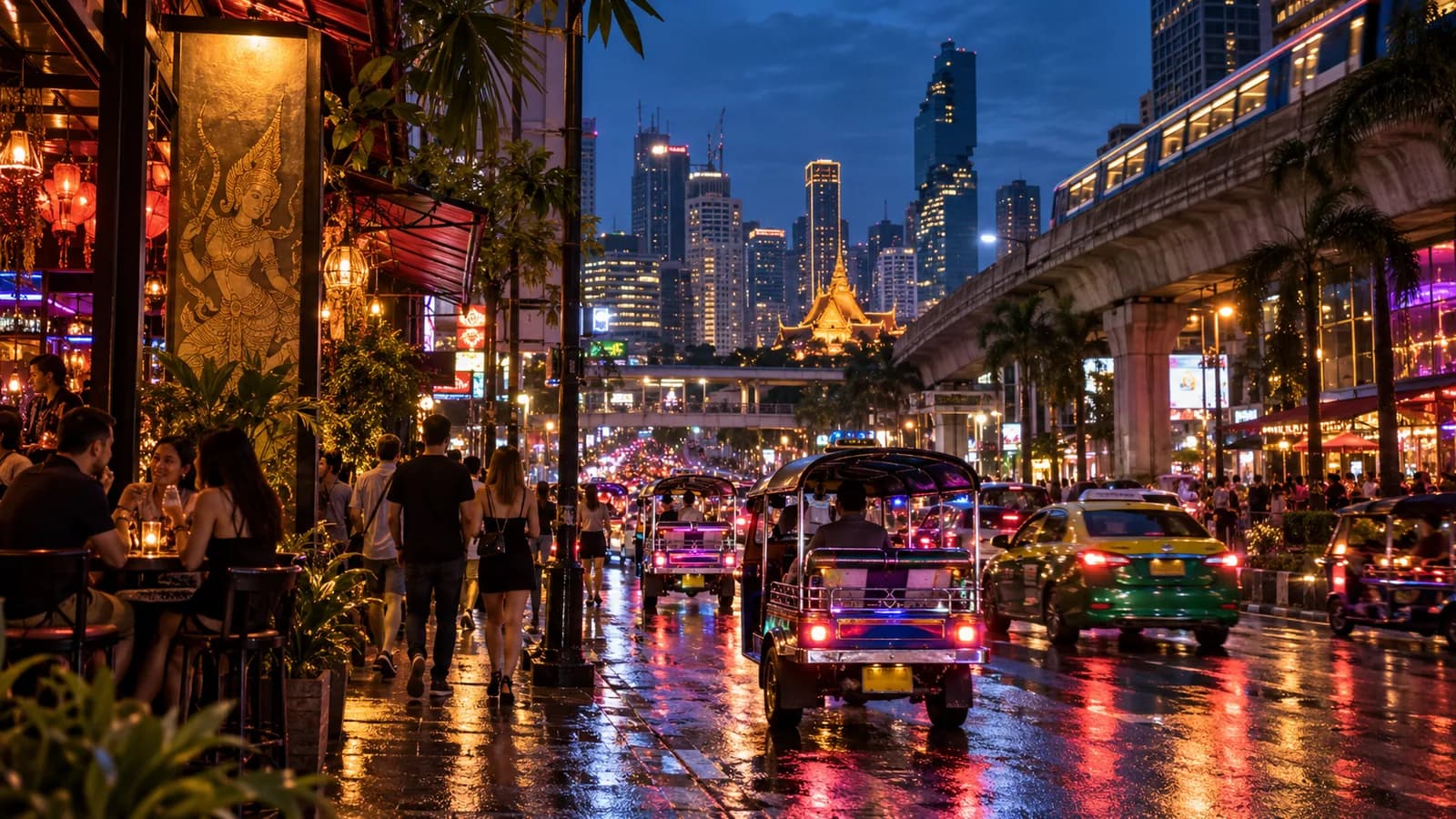
This produced an unusual contrast. The lane itself remained small and low-rise while the district around it became increasingly vertical, polished and connected, and the more Asok modernised, the more visually distinct Soi Cowboy appeared.
That contrast helped preserve its identity rather than erase it. A visitor could emerge from modern mass transit, pass major commercial developments and enter a narrow lane whose basic urban scale still reflected an earlier Sukhumvit.
9. How Neon and Film Turned a Local Name Into a Global Image
Soi Cowboy’s international image also changed during the 2000s.
Older photographic records show a street that was much less visually coordinated than the neon canyon familiar today. Specialist photo comparisons place a noticeable shift toward brighter, more elaborate frontages in the early 2000s, as venues renovated and competed more aggressively for attention.
The street became increasingly photogenic.
Cinema amplified that transformation. Soi Cowboy appeared in the Thailand sequence of Bridget Jones: The Edge of Reason and was later used as a location for Bangkok Dangerous. It also became associated with The Hangover Part II, which used the street during its Bangkok production.
Film did not make Soi Cowboy famous inside Thailand; it had been known for decades. What cinema did was export a particular visual shorthand: Bangkok at night represented through a compressed corridor of coloured signs, crowds and competing facades.
That shorthand has consequences. It can flatten a complex city into a stereotype, just as old R&R narratives can flatten decades of nightlife history into one explanation.
But it also demonstrates how completely the lane’s identity had changed. A place that needed word-of-mouth among expatriates in the 1970s had become recognisable enough to function as an instant international symbol of Bangkok.
10. What the Cowboy Story Gets Right — and What It Misses
The familiar version of Soi Cowboy’s history is appealing because it has everything a good origin story needs: one man, one hat, one bar and one memorable name.
Most of it is rooted in real history.
There was an American serviceman known as Cowboy Edwards. He was associated with a bar on the lane. His cowboy hat made him memorable. Bernard Trink helped popularise the name, and by the 1990s Soi Cowboy was firmly established alongside Patpong and Nana as one of Bangkok’s best-known nightlife districts.
What the simplified story misses is everything around those facts.
The Gold Label appears to have preceded Cowboy’s bar. The lane was not a major nightlife district during the peak R&R years. Its expansion belonged to the broader post-war growth of Sukhumvit, expatriate Bangkok and international tourism. Later, regulation changed its operating environment; BTS and MRT changed its accessibility; the redevelopment of Asok changed its surroundings; cinema changed the audience that recognised its image.
In other words, Soi Cowboy was not created by a cowboy hat.
The hat gave the street a name.
Bangkok did the rest.
That is why this tiny lane is historically useful. It shows how places become landmarks: through memory, business, migration, tourism, policy, transport, media and repetition. Individual bars disappear. Buildings are renovated. Generations of visitors and workers change.
Yet the name survives.
And in Soi Cowboy’s case, the accidental nickname became more durable than almost everything that originally surrounded it.