Chiang Rai feels noticeably different from Thailand’s larger tourist cities.
The centre is compact, the pace is slower and the surrounding mountains are never far away. Yet the province has an unusually rich mix of Lanna heritage, contemporary art, border history, hill landscapes and some of northern Thailand’s most distinctive temples.
For many travellers, the city works best as both a destination and a base.
A SMALL NORTHERN CITY WITH A STRONG IDENTITY
Chiang Rai is the capital of Thailand’s northernmost province.
It is much smaller than Chiang Mai and generally easier to understand quickly.
The city centre revolves around local streets, temples, markets, the Clock Tower, small hotels, cafés and restaurants.
There is enough nightlife and evening activity for a relaxed stay, but Chiang Rai is not built around party tourism.
Its appeal comes more from atmosphere than scale.
THE CLOCK TOWER AND CITY CENTRE
The golden Clock Tower is one of Chiang Rai’s best-known city landmarks.
Designed by artist Chalermchai Kositpipat, who also created Wat Rong Khun, it sits in the centre of town and becomes a focal point in the evening.
Nearby streets contain restaurants, cafés, guesthouses and local businesses.
The Night Bazaar area and Saturday walking street add more activity after dark.
WAT PHRA KAEW AND OLD CHIANG RAI
Chiang Rai’s religious history goes far beyond its modern landmark temples.
Wat Phra Kaew is one of the city’s most historically important temples and is associated with the discovery of the Emerald Buddha in the fifteenth century.
Other old temples around the centre help show Chiang Rai’s deeper Lanna character.
This historical side is easy to miss if you focus only on the White and Blue Temples.
WAT RONG KHUN – THE WHITE TEMPLE
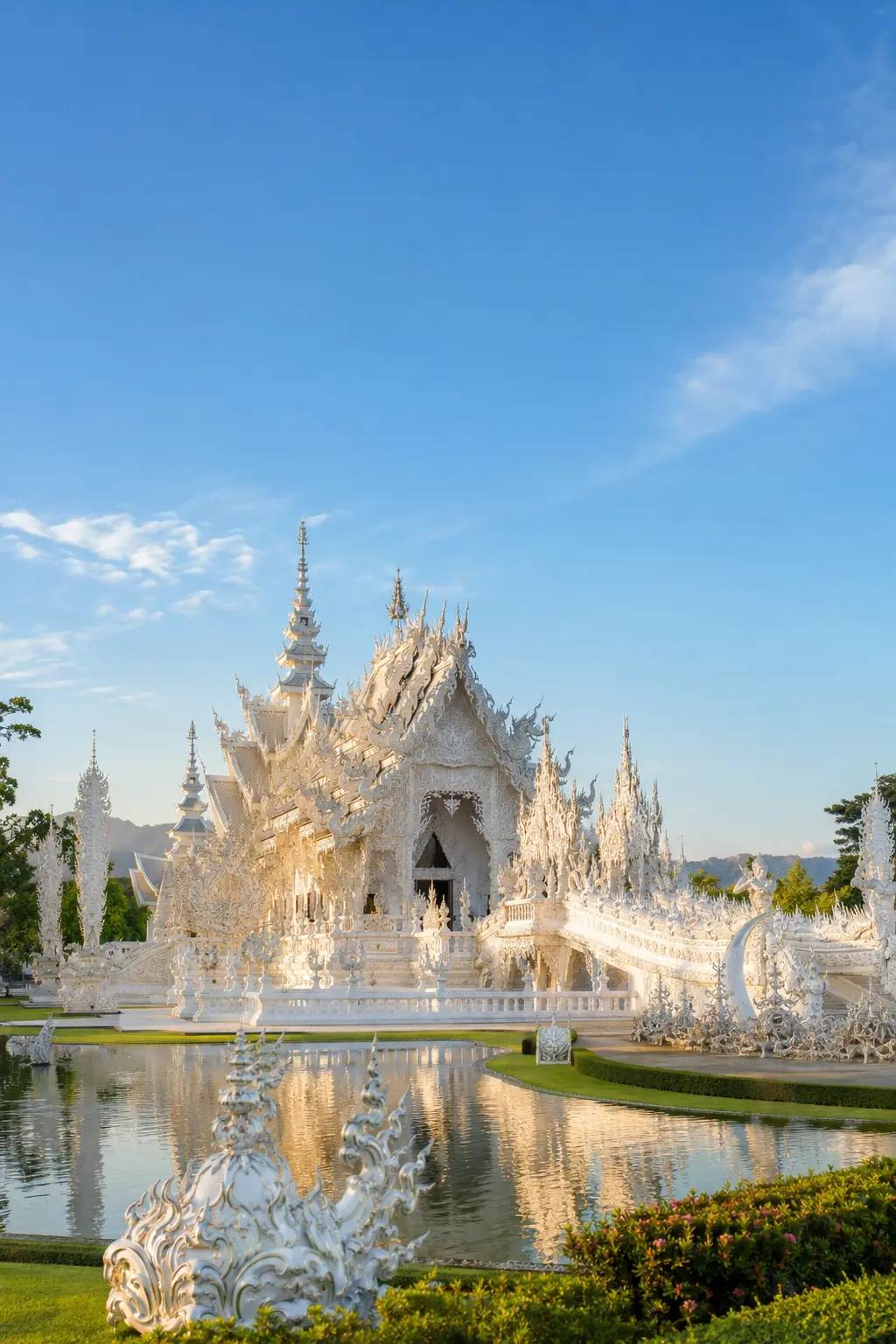
Wat Rong Khun is Chiang Rai’s most internationally recognisable attraction.
Created by contemporary Thai artist Chalermchai Kositpipat, the complex uses white architecture, mirrored details and symbolic artwork to reinterpret Buddhist themes in a highly personal modern style.
It lies south of the city centre and requires transport.
Wat Rong Khun is not an ancient temple.
That distinction matters because part of its significance comes from the way contemporary art and Buddhist symbolism are combined.
WAT RONG SUEA TEN – THE BLUE TEMPLE
Wat Rong Suea Ten is another major modern religious landmark.
Its intense blue colour, gold detailing, naga sculptures and large white Buddha create one of Chiang Rai’s most distinctive visual experiences.
The temple is much closer to the central city than Wat Rong Khun.
It is an active religious site as well as a popular visitor attraction, so normal temple etiquette still applies.
BAAN DAM MUSEUM
Baan Dam, often called the Black House, provides a striking counterpoint to Chiang Rai’s bright modern temples.
Created by national artist Thawan Duchanee, the site combines dark wooden structures, art, sculpture and collections arranged across a large compound.
It is north of the city and works well as part of a wider day of sightseeing.
Together, Wat Rong Khun, Wat Rong Suea Ten and Baan Dam show how strongly contemporary art has shaped modern Chiang Rai’s visitor identity.
THE KOK RIVER
The Kok River passes through Chiang Rai and adds another dimension to the city.
Riverside hotels, restaurants and quieter neighbourhoods sit away from the busiest central streets.
The river also connects Chiang Rai with rural landscapes and communities beyond the urban centre.
For travellers who prefer calm evenings, the riverside can be one of the most pleasant parts of the city.
FOOD AND MARKETS
Northern Thai food should be part of the trip.
Khao soi, sai ua, nam ngiao and other northern dishes are widely available.
Markets are useful for trying local snacks and everyday food.
The Night Bazaar is convenient for visitors, while local markets and walking streets provide a broader mix of food, shopping and evening atmosphere.
Chiang Rai’s café scene is also strong, helped by the surrounding province’s coffee and tea-growing regions.
DOI TUNG AND THE MOUNTAIN NORTH
Much of Chiang Rai Province’s appeal lies outside the city.
Doi Tung is one of the best-known mountain areas, with Mae Fah Luang Garden, royal-project history, temples and cooler upland scenery.
Road journeys north also lead towards Mae Sai, tea plantations, mountain villages and viewpoints.
Distances are significant, so these are proper excursions rather than city attractions.
THE GOLDEN TRIANGLE
The Golden Triangle is where the borders of Thailand, Laos and Myanmar meet around the Mekong region.
The area is historically associated with cross-border trade and the opium economy, but today it is mainly a scenic and historical visitor destination.
Chiang Saen and the Hall of Opium provide more historical context than the famous viewpoint alone.
The Golden Triangle is well outside Chiang Rai city.
Treat it as a substantial excursion rather than a quick city stop.
THAM LUANG
Tham Luang–Khun Nam Nang Non became internationally known after the 2018 rescue of the Wild Boars football team.
The forest park and cave area are in the far north of Chiang Rai Province near Mae Sai.
The site is now part of the province’s visitor landscape, but access conditions can vary with weather and season.
Access can vary with weather, season and site management, so check current conditions before travelling.
MOUNTAINS, TEA AND VIEWPOINTS
Chiang Rai Province contains some of Thailand’s most rewarding mountain scenery.
Doi Pha Tang, Phu Chi Dao and other highland viewpoints offer cool-season landscapes and sea-of-mist views.
Tea plantations such as Choui Fong add another distinctive northern experience.
These places are spread across a large province.
A private car, driver or carefully planned tour is often the easiest way to explore them.
NIGHTLIFE
Chiang Rai has enough nightlife for a relaxed evening.
Bars, live music, casual pubs, restaurants and the Night Bazaar area provide variety.
The scene is smaller and quieter than Chiang Mai.
For most visitors, Chiang Rai evenings are more about food, markets and a few drinks than late-night clubbing.
GETTING AROUND
The central city is compact enough for walking in individual areas.
Ride-hailing, taxis and local transport are useful for city trips.
For Wat Rong Khun, Baan Dam and most major provincial excursions, private transport becomes much more important.
If you plan to explore Doi Tung, the Golden Triangle, tea plantations or mountain viewpoints, a rental car, private driver or organised excursion can save a lot of time.
HOW LONG SHOULD YOU STAY?
Two nights gives you a quick introduction to the city and one major excursion.
Three to five nights is much better if you want to combine the city with Wat Rong Khun, Baan Dam, Doi Tung, the Golden Triangle or mountain scenery.
Longer stays suit slow travellers and anyone exploring the wider province.
Chiang Rai’s strength lies in contrast.
A compact northern city sits beside some of Thailand’s boldest contemporary temple art, while mountains, tea plantations and border landscapes spread far beyond it.
That range is what gives Chiang Rai a character of its own.