Chiang Rai is easy to visit, but the wider province is far larger than the compact city centre suggests.
A first trip works best when you separate the city from the mountain, border and temple excursions around it.
Do not try to fit the entire province into one rushed day.
START IN CENTRAL CHIANG RAI
The centre is small enough to understand quickly.
Begin around the Clock Tower, local temples, markets and central streets.
The Night Bazaar is useful in the evening for food, shopping and atmosphere.
This gives you a feel for the city before you start making longer trips into the province.
HOW LONG SHOULD YOU STAY?
Two nights is enough for a quick introduction and one major excursion.
Three to five nights is much better.
That gives you time for the city, Wat Rong Khun, Wat Rong Suea Ten, Baan Dam and one or two larger trips such as Doi Tung or the Golden Triangle.
If mountain scenery is a major reason for visiting, stay longer.
DO NOT TREAT EVERY TEMPLE THE SAME
Chiang Rai’s temples come from very different periods and traditions.
Wat Phra Kaew represents the city’s older religious history.
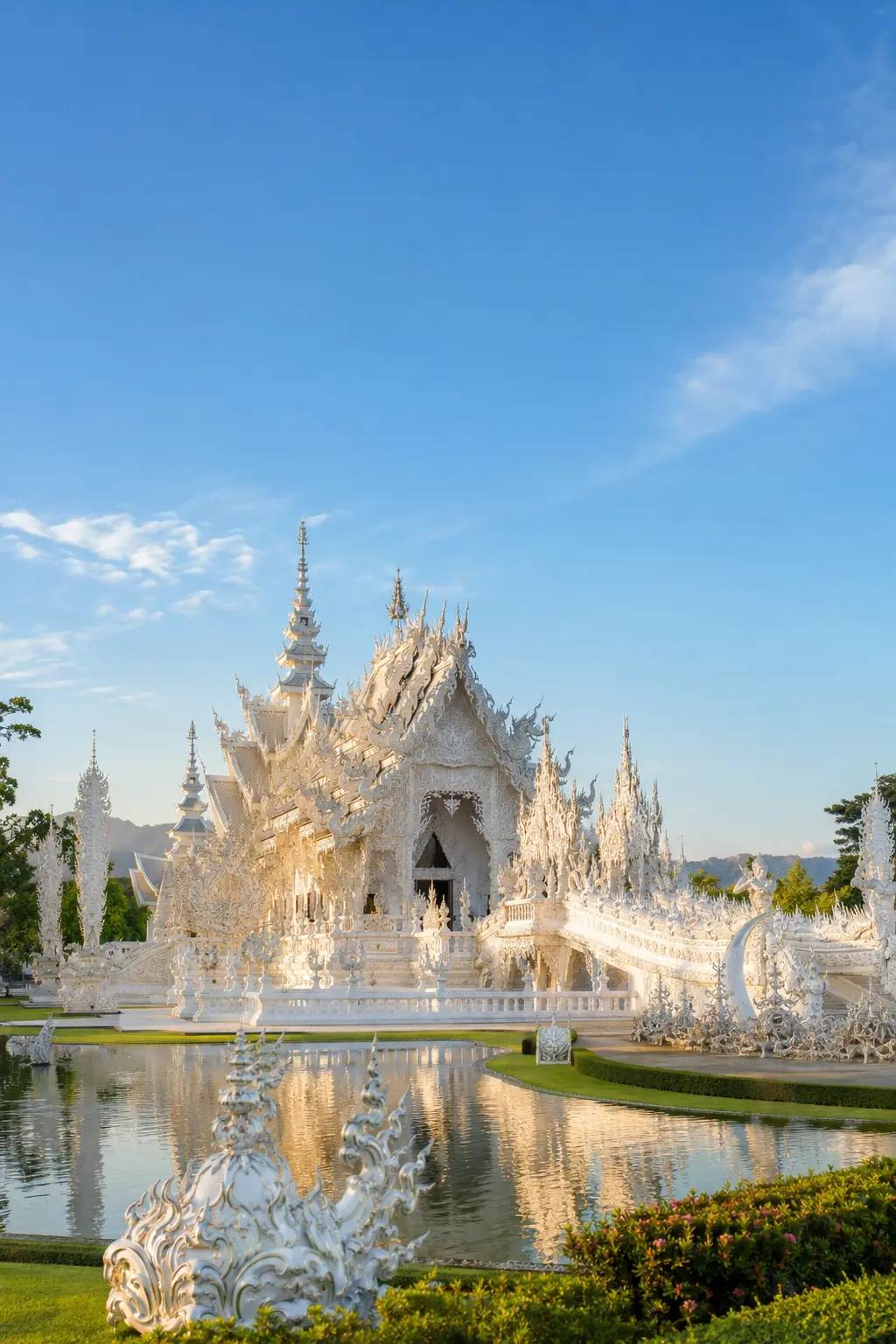
Wat Rong Khun is a contemporary artistic project.
Wat Rong Suea Ten is a modern active temple with a strong visual identity.
Understanding those differences makes the visits much more interesting.
WAT RONG KHUN
The White Temple is outside the city centre.
Allow transport time and avoid trying to squeeze it between unrelated city stops.
It can become very busy.
An earlier visit often makes the experience more comfortable.
Remember that it is not an ancient monument.
Its importance comes from contemporary Thai art, religious symbolism and the vision of Chalermchai Kositpipat.
WAT RONG SUEA TEN
The Blue Temple is much easier to combine with central Chiang Rai.
It is an active temple, so dress and behave respectfully.
The architecture and colour make it visually dramatic, but it should still be treated as a religious site rather than a photo set.
BAAN DAM
Baan Dam provides a useful counterpoint to the temples.
The dark architecture and art collections of Thawan Duchanee create a completely different atmosphere.
Because it is north of the city, it combines naturally with excursions towards Doi Tung, Mae Sai or other northern attractions.
FOOD
Northern food belongs in the itinerary.
Try khao soi, sai ua, nam ngiao and local market food.
Chiang Rai also has a strong café culture.
Coffee and tea grown in the surrounding highlands appear throughout the province.
The Night Bazaar is convenient, but do not rely on it for every meal.
Local restaurants and daytime markets give you a broader picture.
THE GOLDEN TRIANGLE
Do not reduce the Golden Triangle to the border viewpoint alone.
The wider area is more interesting when you include Chiang Saen or the Hall of Opium.
That gives context to the region’s trade routes, borders and opium history.
The journey is long enough that it should be planned as a proper excursion.
DOI TUNG
Doi Tung is another major northern excursion.
The area combines mountain scenery, gardens, royal-project history and cultural attractions.
It works well for travellers who want a greener, cooler side of Chiang Rai Province.
Road travel is required.
THAM LUANG
The Tham Luang cave area is best known internationally for the 2018 rescue.
If you visit, remember that access can change with weather, season and site management.
Check current conditions before travelling.
The surrounding forest and mountain landscape are part of the experience even when deep cave access is restricted.
MOUNTAIN VIEWPOINTS
Highland areas such as Doi Pha Tang and Phu Chi Dao are among the province’s most scenic destinations.
Cool season is especially popular for sunrise and sea-of-mist views.
These places are far from Chiang Rai city.
Early starts, private transport and careful planning are often necessary.
GETTING AROUND
Walking works well within central Chiang Rai.
Ride-hailing and taxis are useful for city trips.
Local transport can cover some routes.
For the White Temple, Baan Dam, Doi Tung, the Golden Triangle and mountain viewpoints, a private car, driver or organised tour is often much more efficient.
Do not underestimate the distances.
ARRIVING AND LEAVING
Chiang Rai has an international airport north of the city.
Bus services connect Chiang Rai with Chiang Mai and other northern destinations.
There is no railway station in Chiang Rai city.
If you are travelling overland, buses and private road transport are the main options.
NIGHTLIFE
Chiang Rai evenings are relaxed.
The Night Bazaar, central bars, restaurants and live music provide enough variety for a night out.
Do not expect Chiang Mai-scale nightlife.
For many visitors, food, markets and a quiet drink fit the city better than late-night clubbing.
WEATHER AND SEASON
Cool season is one of the most popular times to visit Chiang Rai, especially for mountain trips.
Mountain mornings can be much colder than the city.
Late dry season can bring haze and poor air quality across northern Thailand.
If mountain views are important to your trip, check current weather and air-quality conditions before long excursions.
FIRST-TIME MISTAKES TO AVOID
Do not assume the White Temple is in the city centre.
Do not treat every temple as an ancient historical site.
Do not underestimate distances across Chiang Rai Province.
Do not try to combine too many northern excursions in one day.
Do not visit mountain viewpoints without checking weather conditions.
Do not rely on walking for provincial attractions.
And do not spend the entire trip moving between famous photo stops.
A GOOD FIRST CHIANG RAI TRIP
A balanced first visit could include:
- the Clock Tower and central temples;
- the Night Bazaar or a walking street;
- Wat Rong Khun;
- Wat Rong Suea Ten;
- Baan Dam;
- northern Thai food;
- one major mountain or border excursion;
- and enough free time to enjoy Chiang Rai’s slower pace.
Chiang Rai is most rewarding when you leave space between the landmarks.
The city itself is calm and compact.
The province around it is broad, mountainous and culturally varied.
Together, they make Chiang Rai a destination with a far stronger identity than a simple alternative to Chiang Mai.