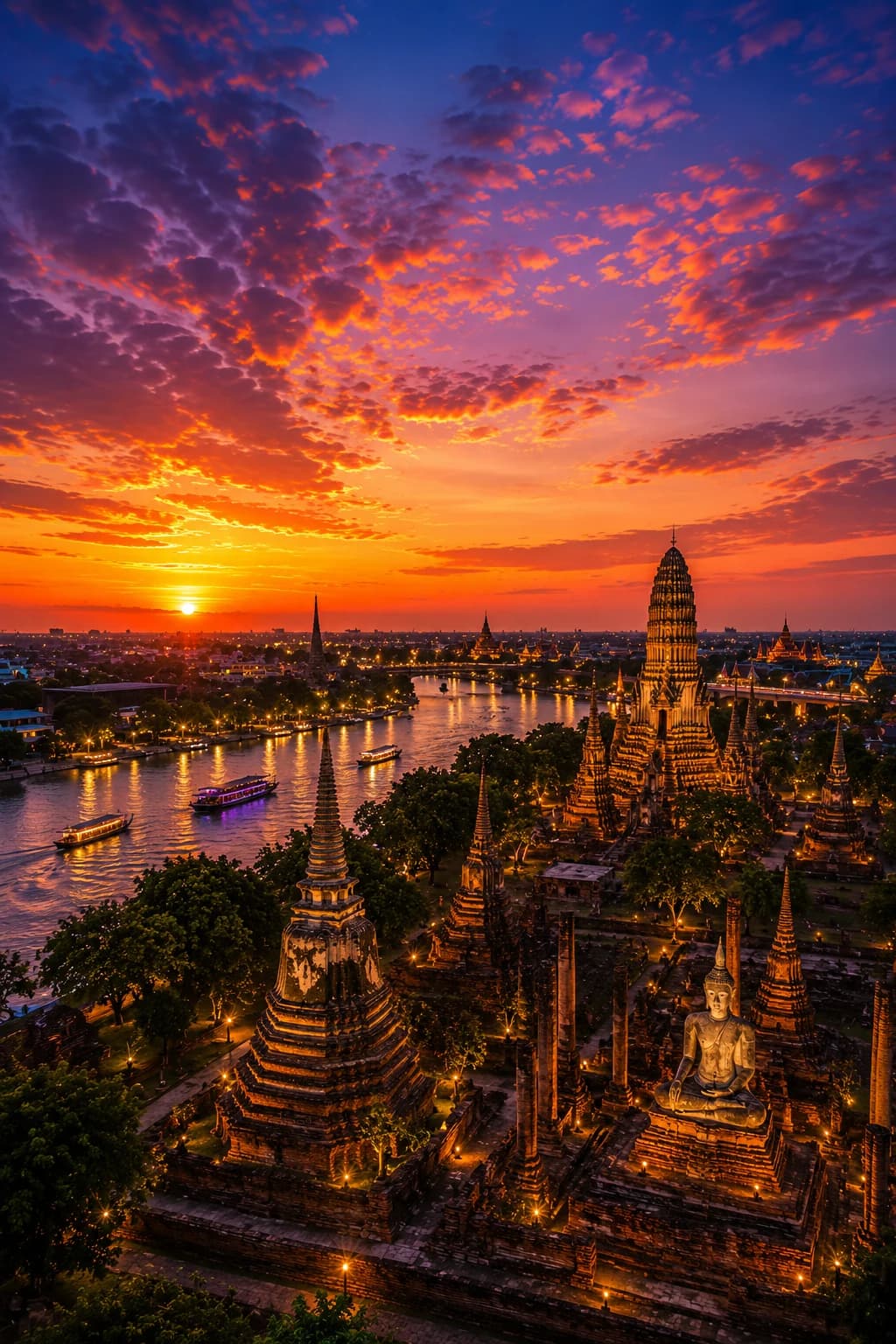
Ayutthaya is one of Thailand’s clearest places to grasp the scale of the country’s past.
Today it is a modern provincial city, but the old capital still shapes everything around it. Temple ruins rise beside roads and neighbourhoods, rivers define the historic island, and active temples continue to sit alongside archaeological remains.
That mix is what makes Ayutthaya much more than a simple day trip.
THE OLD CAPITAL
Ayutthaya was founded in 1350 and became the capital of the Siamese kingdom that carried its name.
For more than four centuries, it grew into a major political, commercial and cultural centre of Siam.
Its position on an island formed by the Chao Phraya, Lopburi and Pa Sak rivers helped connect the city with trade routes reaching far beyond Siam.
By the seventeenth century, Ayutthaya was known internationally as a wealthy and cosmopolitan city, with foreign merchant communities and diplomatic connections to Europe, Persia, China, Japan and other parts of Asia.
The city was attacked and destroyed by Burmese forces in 1767.
The capital later moved south, but the ruins of Ayutthaya remained.
AYUTTHAYA HISTORICAL PARK
The historical park contains the best-known remains of the old capital.
Wat Mahathat, Wat Ratchaburana, Wat Phra Si Sanphet and the former royal palace area are among the most important sites.
The famous Buddha head entwined in tree roots at Wat Mahathat is one of the most recognisable images of Ayutthaya, but it is only a small part of the historical landscape.
Ruined monasteries, chedis, prangs, walls and foundations are spread across a large area rather than concentrated inside one enclosed attraction.
That makes the old capital far more rewarding when explored slowly.
THE HISTORIC ISLAND
Ayutthaya’s old centre sits on a river island.
This geography matters because it explains both the historic city’s development and how modern visitors move around it.
Many of the major ruins are on or close to the island, while other important temples and attractions sit across the rivers.
Bridges connect the modern road network, but boats remain part of the city’s identity.
A map is useful here because places that appear close in a straight line may require a bridge, ferry or longer route around the water.
ACTIVE TEMPLES AND LIVING RELIGION
Not everything in Ayutthaya is a ruin.
Active temples remain important parts of local religious life.
Wat Phanan Choeng, Wat Yai Chai Mongkhon and several other major sites continue to attract worshippers as well as visitors.
This gives Ayutthaya a different atmosphere from an archaeological park where the historical remains are completely separated from modern life.
Buddhist practice, local belief and historical tourism overlap throughout the city.
THE RIVERS STILL MATTER
Ayutthaya grew because of its waterways, and the rivers remain one of the best ways to understand the city.
Boat trips around the island pass temples, houses, local communities and waterside restaurants.
They also reveal how closely the old capital was tied to water.
Even if you explore most ruins by road or bicycle, seeing part of Ayutthaya from the river adds useful context.
FOOD IS PART OF THE VISIT
Ayutthaya has several local foods that are strongly associated with the city.
Grilled giant river prawns are one of the best known.
Roti sai mai — thin strands of colourful sugar wrapped in soft roti — is another Ayutthaya classic and appears at stalls across the city.
Boat noodles and local Thai dishes are also easy to find.
Riverside restaurants, markets and simple local shops can make food one of the highlights of the trip rather than something fitted between temple visits.
MUSEUMS ADD CONTEXT
The ruins make much more sense when you understand what the city once was.
Museums such as the Chao Sam Phraya National Museum contain important objects recovered from Ayutthaya-era sites.
Gold artefacts, religious objects and archaeological material help explain the wealth and sophistication of the former capital.
For visitors with a serious interest in history, museum time is worth including rather than visiting temples alone.
A MODERN CITY AROUND THE RUINS
Modern Ayutthaya continues well beyond the historical park.
Local neighbourhoods, hotels, restaurants, markets, schools and businesses surround the old city.
This is not a preserved historic district sealed away from daily life.
Traffic passes ruined temples, residents live beside archaeological zones and modern shops sit only a short distance from monuments hundreds of years old.
That contrast is central to Ayutthaya’s character.
NIGHTLIFE IS LOW-KEY
Ayutthaya has bars, restaurants, live music and evening venues, but nightlife is not a major reason to visit.
Evenings are generally quieter than in Bangkok or Thailand’s resort destinations.
Markets, riverside restaurants and casual bars provide enough options for a relaxed night.
For most visitors, an early start the next morning is more rewarding than a very late night.
GETTING AROUND
Ayutthaya can be explored in several ways.
Bicycles are popular for the historical park and work best when the weather is manageable.
Tuk-tuks are useful for longer temple circuits and for visitors who want to cover several sites efficiently.
Ride-hailing and taxis can help with direct journeys.
Boats add another perspective and are particularly useful for riverside temples or island circuits.
Walking works inside individual parts of the historic zone, but the overall city is too spread out to rely on walking alone.
HOW LONG SHOULD YOU STAY?
Ayutthaya is often visited as a day trip from Bangkok, and that works if time is limited.
But staying overnight changes the experience.
Two nights gives you enough time to explore the major ruins without racing between them, visit a museum, enjoy the river and experience the city after the day-trip crowds begin to leave.
Three nights works well for travellers with a deeper interest in history, photography or slower travel.
Ayutthaya is close enough to Bangkok to be easy.
It is also historically important enough to deserve more than a few hurried hours.
Ayutthaya makes the strongest impression when you stop treating the ruins as separate attractions and start seeing them as the remains of a capital that still shapes the landscape around them.