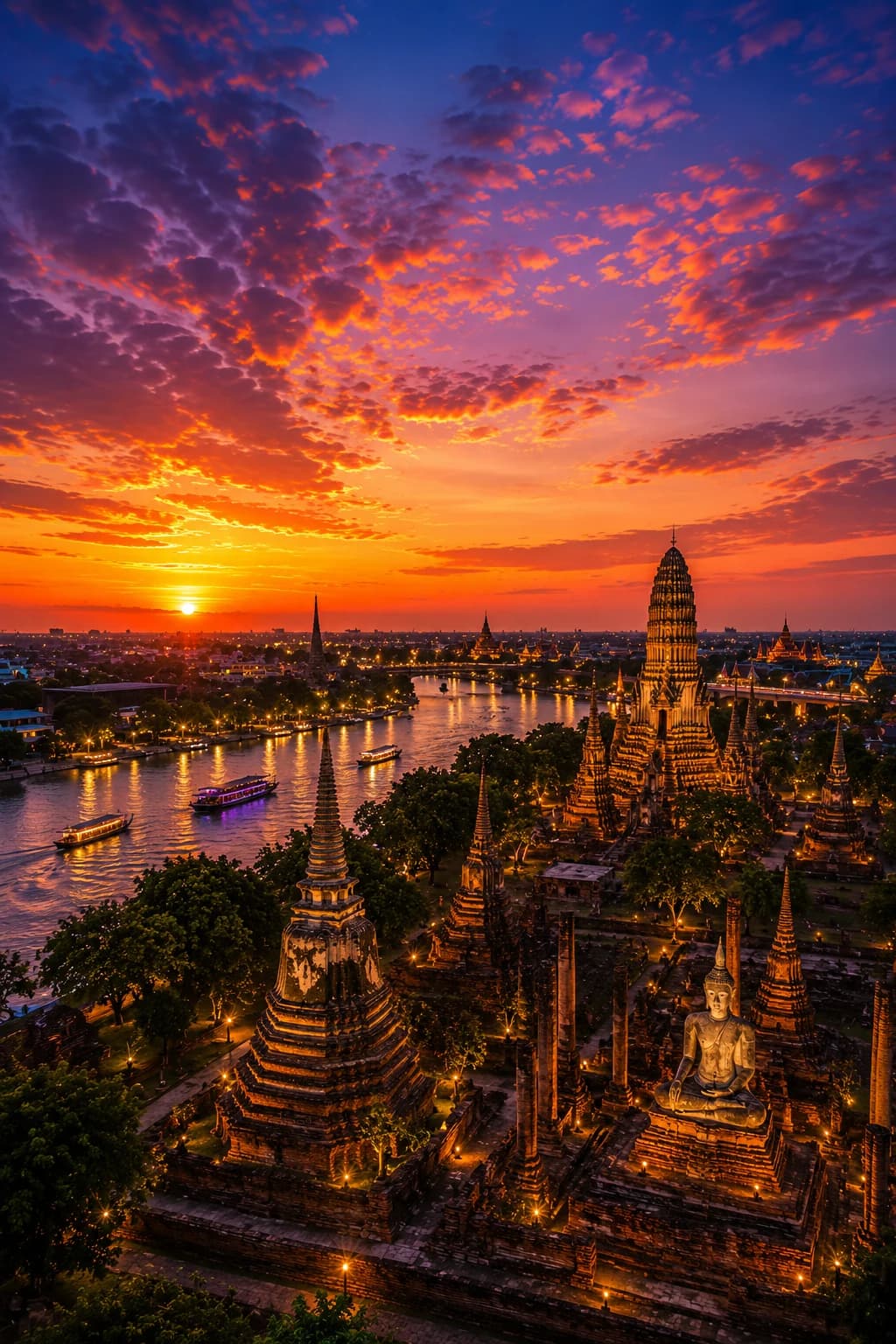
Ayutthaya is one of Thailand’s easiest historical cities to reach — and one of the easiest to rush.
Many visitors come from Bangkok for a few hours, see a handful of temples and leave. That works if time is tight, but Ayutthaya becomes much more rewarding when you stay long enough to understand the rivers, the old capital and the modern city around it.
For a first visit, the main goal is balance: see the major ruins, but leave real time for museums, food and the river.
START WITH THE HISTORIC ISLAND
The historic island is the easiest place to begin.
Major sites such as Wat Mahathat, Wat Ratchaburana and the former royal palace area are concentrated in and around the historical park.
This makes the island the best place to understand the scale of the former capital before heading to temples across the rivers.
Start early if you can.
The light is softer, the temperature is more manageable and the main sites are usually calmer before day-trip crowds arrive from Bangkok.
HOW LONG SHOULD YOU STAY?
A day trip is possible.
Two nights is a much better introduction.
That gives you time to explore the central ruins without rushing, visit at least one museum, take a river trip and enjoy Ayutthaya after the busiest daytime hours.
Three nights is ideal if you are especially interested in history, photography or slower travel.
Ayutthaya is close to Bangkok, but proximity should not be confused with simplicity.
There is enough here to reward a proper stay.
UNDERSTAND THE TEMPLE TYPES
Not every temple in Ayutthaya offers the same experience.
Some are archaeological ruins.
Others remain active places of worship.
Wat Mahathat and Wat Ratchaburana are important for understanding the ruined capital.
Wat Phra Si Sanphet and the former royal palace area show the political and ceremonial centre of Ayutthaya.
Wat Phanan Choeng and Wat Yai Chai Mongkhon remain active religious sites and give the city a living spiritual dimension.
That difference matters.
Ayutthaya is not just a collection of ruins.
It is a place where archaeology and modern Buddhist life still exist side by side.
DO NOT TRY TO SEE EVERY TEMPLE
One of the easiest first-time mistakes is trying to visit too many sites in one day.
Temple fatigue is very easy to underestimate.
After several chedis, prangs and ruined foundations, important differences become harder to notice.
Choose a smaller number of major sites and spend more time at each.
Then add a museum or river trip to change the pace.
A slower itinerary usually produces a much stronger impression of the city.
VISIT A MUSEUM
Museums make the old capital much easier to understand.
The Chao Sam Phraya National Museum is particularly useful because it contains important artefacts recovered from major Ayutthaya sites.
Gold objects, religious material and archaeological finds show how wealthy and sophisticated the old capital once was.
If you are interested in history, visiting a museum before or between temple days can completely change how you read the ruins.
USE THE RIVER
Ayutthaya was built around water.
The old city sits on an island formed by three rivers, and many important temples lie along the surrounding waterways.
A boat trip around the island gives you a different view of the city and helps explain why Ayutthaya became such an important trading centre.
It also provides a welcome break from walking or cycling between ruins.
Even a short river trip can add useful context to the visit.
GETTING AROUND
There is no single best way to explore Ayutthaya.
Bicycles are popular and work well for visitors who enjoy cycling and can handle the heat.
Tuk-tuks are one of the easiest ways to cover several temples efficiently.
Ride-hailing and taxis are useful for direct journeys.
Boats work especially well for riverside temples and island circuits.
Walking is practical inside smaller parts of the historic zone, but the city is too spread out to rely on walking alone.
If you rent a bicycle or scooter, be cautious around traffic and large roads.
FOOD SHOULD NOT BE AN AFTERTHOUGHT
Ayutthaya has several foods worth planning around.
Giant river prawns are one of the city’s best-known specialties and are especially associated with riverside restaurants.
Roti sai mai is the classic sweet snack: thin sugar threads wrapped in soft roti.
Boat noodles and local Thai food are also easy to find.
Markets and simple local restaurants are often more memorable than eating only near major tourist sites.
Try to leave at least one meal without a sightseeing schedule attached to it.
NIGHT MARKETS AND EVENINGS
Ayutthaya becomes quieter when many day visitors return to Bangkok.
That is one of the advantages of staying overnight.
Evening markets, riverside restaurants and casual local bars give the city a more relaxed atmosphere after dark.
Nightlife exists, but it is low-key.
Ayutthaya is better suited to dinner by the river, a market walk or a quiet drink than a major night out.
That makes early starts much easier the next morning.
ARRIVING FROM BANGKOK
Ayutthaya is close enough to Bangkok to reach by train, road transport or organised day trip.
Train travel is especially popular because the railway station is close to the historic city.
If you arrive by train, you will still need to cross towards the historical island and arrange local transport.
Road journeys are straightforward, but travel time depends heavily on Bangkok traffic.
For an overnight stay, arriving independently gives you far more flexibility than following a fixed day-tour schedule.
DRESS AND TEMPLE ETIQUETTE
Ayutthaya’s ruins are historical sites, but many temples remain sacred places.
Dress respectfully when visiting active temples.
Shoulders and knees should be covered where required, and shoes may need to be removed before entering certain religious buildings.
Do not climb on ruins unless a route is clearly intended for visitors.
At Wat Mahathat, the Buddha head in the tree roots should be approached respectfully, and visitors should avoid standing over it for photographs.
A little awareness goes a long way.
HEAT AND TIMING
Ayutthaya can be extremely hot.
Temple sites often have limited shade, and cycling during the middle of the day can become exhausting.
Start early, carry water and use sun protection.
Late afternoon is another good period for outdoor ruins and river areas.
Using the hottest part of the day for lunch, a museum or a break can make the whole visit more enjoyable.
FIRST-TIME MISTAKES TO AVOID
Do not try to visit every famous temple in a single day.
Do not treat every temple as an archaeological ruin — some are active religious sites.
Do not underestimate the heat.
Do not assume the entire historical park is comfortably walkable.
Do not leave without trying local food.
Do not ignore the museums.
Do not spend the whole visit looking through a camera.
And do not assume Ayutthaya must be a day trip just because it is close to Bangkok.
A GOOD FIRST AYUTTHAYA TRIP
A balanced first visit could include:
- Wat Mahathat and Wat Ratchaburana;
- Wat Phra Si Sanphet and the former royal palace area;
- one or two active temples such as Wat Phanan Choeng or Wat Yai Chai Mongkhon;
- the Chao Sam Phraya National Museum;
- a river or sunset boat trip;
- giant river prawns or another local meal;
- roti sai mai;
- an evening market;
- and enough unscheduled time to explore the old city slowly.
Ayutthaya rewards context more than speed.
The ruins become more impressive when you understand the city that once surrounded them.
The rivers make more sense when you understand the trade routes.
The active temples matter more when you see that the old capital is still part of everyday Thai life.
That is what turns Ayutthaya from a collection of beautiful ruins into one of Thailand’s essential historic destinations.