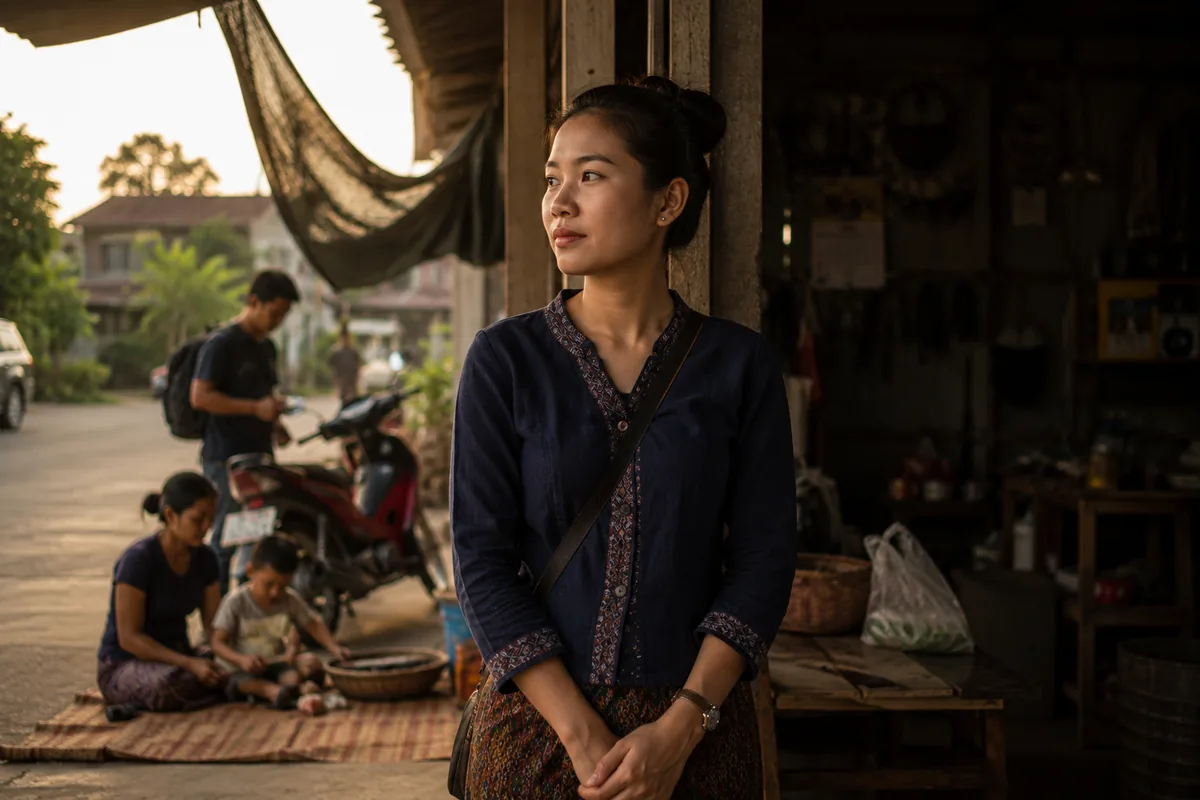
A woman from Isaan works in a tourist city. She has a Western partner. Money may move between households. Her family may still live in the Northeast. From the outside, the pieces can look as if they form one obvious story. After four parts of migration, work, family and relationships, the final chapter asks a different question: what happens when a real social pattern becomes a stereotype?
By now, the Isaan connection should feel both clearer and less simple than it did at the beginning. That is exactly where this series was trying to arrive.
Part 1 began with migration. People from parts of Northeast Thailand have moved through Bangkok, industrial provinces, regional cities and other centres of work and study for generations. The movement was never one-directional. Some stayed. Some returned. Some moved again. Networks between relatives, friends and previous migrants made later journeys easier.
Part 2 looked at women inside that history. Historical census research showed that women became especially visible in some migration streams to Bangkok as Thailand's manufacturing and service economy expanded. That told us something important about labour markets and economic change. It did not tell us what an individual Isaan woman wanted.
Part 3 followed the family after somebody moved. Money, goods, practical help, care and information could continue across distance. A household might no longer fit beneath one roof, yet still function as a network. That told us something about migration and kinship. It did not tell us that every daughter sends money home, that every family expects it, or that every migrant still regards the province she left as her only "real" home.
Part 4 finally reached Thai–Western relationships. Research from Northeast Thailand made one point especially difficult to avoid: love and money are not opposite boxes. Attraction, security, family, aspiration, companionship, mobility and practical life can overlap. Women have agency. Men have histories and expectations of their own. Some foreign husbands become part of Isaan families and communities rather than simply removing women from them. That told us something about transnational relationships. It still did not tell us why a particular couple is together.
And that brings us to the final problem. Once a pattern becomes visible, people start telling stories about it.
The stories may begin with real observations. An Isaan woman works in Bangkok or Pattaya. A foreign man marries a woman from the Northeast. A house in a village has been improved with money connected to a transnational marriage. Parents receive support. A farang son-in-law becomes part of the family. None of those things needs to be imaginary.
The mistake comes later, when observation turns into explanation. She is from Isaan, therefore she must have moved for a particular reason. She works in a tourist city, therefore her background must be obvious. She has a foreign husband, therefore money must explain the marriage. Her family receives support, therefore the relationship must be organised around obligation. He is Western, therefore his motives must be obvious too.
A collection of visible facts becomes a personality profile for people we have never met. That is how a social pattern becomes a stereotype.
Isaan is a region, not a character description
The first defence against stereotype is scale. Isaan is Thailand's twenty-province Northeastern Region. More than twenty million people live there. It contains major cities, universities, hospitals, factories, logistics networks, government centres, farms, small towns and villages. Nakhon Ratchasima is not Udon Thani. Khon Kaen is not Buriram. Ubon Ratchathani is not Roi Et. A university lecturer, factory manager, farmer, nurse, shop owner, civil servant, student and hotel worker can all be "from Isaan" without sharing much beyond regional geography and parts of a cultural landscape.
That sounds obvious. Yet the word often does far more work in outside discussions of Thailand than a regional label should be expected to do. Once a visitor learns that a woman is from Isaan, the information can begin acting like a shortcut. Her job is explained by it. Her family is explained by it. Her relationship is explained by it. Her attitude toward money is explained by it. Even her personality may be explained by it.
But regional origin is not a psychological test. At most, it can give us context. It may help us understand why particular migration routes developed, why family members live in different places, why certain regional identities matter, or why a person grew up speaking a particular dialect alongside standard Thai. It cannot tell us whether she is generous, ambitious, conservative, independent, romantic, materialistic, shy, outgoing, family-centred or interested in foreign men. Those are individual questions.
The whole series has really been an argument for keeping that boundary intact.
The stereotype often begins with something real
There is a temptation when correcting stereotypes to deny the underlying pattern entirely. That would be just as misleading.
Thai–Western marriages involving women from Isaan have been studied for years precisely because they became visible in particular Northeast communities. Researchers have examined migration, transnational marriage, remittances, family change, class, gender roles and foreign husbands living in Isaan. So the answer is not: "There is no Isaan connection." There is. The answer is that the connection is a pathway, not a diagnosis.
Migration research shows routes between parts of the Northeast and Thailand's growth centres. Gender research shows women became prominent in some of those migration streams. Family research shows relationships can remain active across distance. Transnational-marriage research shows some women from Isaan formed relationships with Western men and that those relationships became socially visible in particular communities.
Each layer adds context. None grants permission to skip the individual.
This is where prevalence, visibility and explanation must be kept separate. Something can be visible without being numerically dominant. Something can be common enough to study without describing a majority. And even a statistically common pattern would not tell us why one specific person followed it. That last step is where stereotype usually enters.
The "mia farang" label carries more than a description
One of the most important pieces of research for this final chapter comes from Sirijit Sunanta's work on perceptions of mia farang — Thai wives of foreign men — in wider Thai society.
The phrase itself can be descriptive. The social meaning attached to it has sometimes been much heavier. Sunanta's research examines how women from rural Isaan in transnational marriages have been discussed through classed, gendered and urban-centred ideas about morality, consumption, modernity and what rural Thai women are supposed to represent.
That does not mean Thai society holds one opinion of mia farang. It does not. Nor should we take the harsh labels analysed in academic work and repeat them as if they describe the women. The useful point is almost the opposite: a stereotype can tell us as much about the society producing the stereotype as it tells us about the people being described.
When women improve houses, travel, consume differently, support relatives or acquire property through lives that cross national borders, observers may interpret those changes through their own ideas about gender, class and what counts as respectable success. The woman becomes symbolic. Her choices are no longer only her choices. They become evidence in somebody else's argument about modern Thailand.
That is an extraordinary amount of meaning to place on one marriage. And it is precisely why Thailand4U should resist both negative and flattering versions of the same simplification. Calling the woman materialistic is a stereotype. Calling her naturally more loyal, traditional, feminine or family-oriented is also a stereotype. The second may sound kinder. It still predicts an individual from a category.
Money attracts attention because money is easy to see
Money has followed this series from beginning to end because it is one of the most visible parts of migration and transnational life. A bank transfer can be counted. A house can be photographed. Land can be purchased. A car can appear in a driveway. Parents can receive support. Travel can become possible. A couple can live at a standard that would have been difficult on one partner's previous income.
These changes are visible in a way that affection is not. No visitor can see companionship from the road. You cannot photograph whether two people trust one another. You cannot identify humour, tenderness, irritation, compromise or emotional dependence by looking at a house. But you can see the house. That creates an imbalance in what outsiders notice.
Research by Patcharin Lapanun is valuable because it refuses to solve that imbalance by pretending material life does not matter. Her work on transnational marriage in a Northeast village examines love, money and obligation together. Later research in two villages also describes changes in consumption, lifestyle and land ownership among some women with Western partners.
Those are real social effects in the communities studied. But effects are not motives. If a marriage later improves material security, that does not prove material security was the only reason the marriage began. If a woman values stability, that does not prove affection is false. If family members benefit, that does not prove they designed the relationship. If a man contributes financially, that does not prove he was deceived.
Money tells us something important about how a relationship operates. It does not automatically tell us what the relationship means. That principle would be unremarkable in most other marriages. It should remain unremarkable here.
Family responsibility can become a stereotype too
Part 3 made a similar correction around family. Research from Northeast Thailand has documented family exchanges across distance. Money, goods and help can move between migrants and relatives. The pattern can depend on parents, children, siblings, marriage and household circumstances.
That is much more flexible than the popular sentence: "Thai daughters have to support the family." The sentence sounds culturally informed. It is still too broad. Some people support parents substantially. Some contribute occasionally. Some live near family and provide care rather than money. Some have difficult family relationships. Some receive support themselves. Some households share resources extensively. Others do not.
The danger is especially clear when a foreign partner enters the picture. If money moves from a Thai–Western couple toward relatives, the transfer can become proof in two opposite stereotypes. One says the woman is exploiting the man. The other says the man should simply accept unlimited responsibility because "that is Thai culture". Neither respects the actual couple.
Family responsibility does not eliminate boundaries. Culture does not write household budgets. Adults negotiate what they can give, what they want to give and what other relatives may reasonably expect. The research helps us understand why family networks can matter. It cannot negotiate the relationship for them.
The foreign man can disappear inside a stereotype as well
Fairness has to work in both directions. The Western man in an Isaan relationship is often simplified almost as quickly as the woman. He may be imagined as rich. He may be assumed to be much older. He may be treated as somebody who came to Thailand for sex. He may be seen as lonely, naive, controlling, generous, foolish or privileged before anyone knows very much about him.
The research by Eric Thompson, Pattana Kitiarsa and Suriya Smutkupt is especially useful here because it examines the gap between public categories and individual lives. Their Current Anthropology paper uses the deliberately provocative contrast "From Sex Tourist to Son-in-Law". The title is not a statement that every foreign husband was once a sex tourist. The researchers explicitly distinguish the social categories surrounding farang men from the actual histories of particular men, and note that many couples in their research did not intersect with sex tourism at all.
That distinction is essential. A stereotype does not become accurate simply because the stereotype itself is socially real. Some farang husbands in the researchers' Isaan fieldwork settled in their wives' communities and became sons-in-law inside existing family networks. That creates a very different image from the tourist caricature.
The foreign man is not necessarily standing outside the family with a wallet. He may be living inside a social world he is still learning to understand. He may depend on his wife for language, family interpretation and local knowledge. She may depend on him in other areas. Both can be powerful in one part of the relationship and vulnerable in another.
Real couples are inconvenient like that. They refuse to remain symbols.
Isaan men are not the missing villain in the story
Another shortcut needs to be closed carefully. If some Isaan women form relationships with Western men, the story does not require a negative explanation of Thai men. There is no need to say Western men are better husbands. There is no need to say Thai men failed. There is no need to turn different relationship pathways into a competition between nationalities.
Research by Lapanun and Thompson has examined how visible transnational marriages can affect ideas of masculinity among local men in an Isaan village. Their work looks at changing breadwinner expectations, matrilineal family structures and the ways men negotiate social changes around them.
The value of that research is not that it gives us a verdict on Isaan men. It shows that transnational marriage can affect people who are not themselves part of a transnational couple. When money, land ownership, consumption patterns and ideas about marriage change visibly in a community, everyone has to interpret those changes. Women do. Foreign husbands do. Parents do. Neighbours do. Local men do.
That is social change. It should not be rewritten as personal failure. One village study is also one village study. Its purpose is to help us see a process, not classify the men of a twenty-province region.
Visibility can create its own statistics in our heads
Foreign visitors have another disadvantage when trying to understand the Isaan connection. We do not encounter a random sample of Thailand. We move through airports, hotels, bars, restaurants, shopping centres, tourist districts, transport systems and attractions. We meet people whose jobs put them in front of visitors. We notice mixed-nationality couples because they are visually distinctive to us. We remember stories that connect Thailand to our own countries.
And then human pattern-recognition does what it always does. Three examples begin to feel like a trend. Ten examples begin to feel like a rule. A familiar story begins to feel like a statistic.
This is not stupidity. It is how human beings make sense of limited information. But it creates a particular risk in travel. The more selective our field of vision, the more careful we need to be about generalising from it.
A visitor who spends two weeks in Pattaya may genuinely meet several women from Isaan. That tells him something about whom he met in Pattaya. It does not provide a demographic survey of Isaan. A man with several friends married to women from Udon Thani may genuinely feel he sees the same pattern repeatedly. That pattern may be real inside his social network. It still does not tell him what women in Udon Thani generally want.
Personal experience is evidence that something can happen. It is weak evidence of how often it happens across an entire population. And it is even weaker evidence of why.
Five shortcuts we can leave behind
After five parts, there are several conclusions we should now be able to resist without denying any of the real social patterns behind them.
Being from Isaan is not a personality. Working away from home is not evidence that somebody rejected home. Sending money is not proof of coercion, exploitation or motive. Having a Western partner is not proof that economics caused the relationship. And being a foreign husband does not make somebody automatically rich, naive, predatory or heroic.
None of those corrections requires pretending that migration, money, family responsibility, inequality, age, gender or citizenship never matter. They can matter enormously. The point is different. Context should make us more accurate, not more confident about strangers.
That may be the most important lesson from the research behind this series. Academic work can show us recurring structures. It can show that migration networks exist. It can show that labour markets have been gendered. It can show that family support crosses distance. It can show that transnational marriage has changed social life in particular Northeast communities. It can show that stereotypes around mia farang and farang husbands have histories.
But the closer we move from the pattern toward the person, the less permission we have to assume.
What Isaan can actually explain
So what does the Isaan connection explain? Quite a lot, if we keep the question at the right level.
It can help explain why people from parts of the Northeast became highly visible in Bangkok and other centres of employment. It can help explain how migration networks link particular families and communities to destinations elsewhere in Thailand. It can help explain why somebody working in one province may remain closely connected to relatives in another. It can help explain why women became especially visible in some historical migration streams and labour sectors. It can help explain why Thai–Western relationships became established and socially noticeable in some Northeast communities. It can help explain how a foreign husband may enter not only a relationship with one woman but also a wider family and local social world. It can help explain why money, remittances, property and mobility become unusually visible in cross-border relationships. And it can help explain where some of the stereotypes came from.
That is a substantial amount of explanatory power. But there is a line.
Isaan cannot explain why a particular woman moved. It cannot explain why she chose a particular job. It cannot explain how she feels about her parents. It cannot tell us whether she wants to support relatives financially. It cannot tell us why she fell in love with a Western man, or whether she ever wanted a Western partner in the first place. It cannot tell us whether a marriage is happy. It cannot tell us what the man wants. It cannot tell us whether either partner is generous, controlling, romantic, practical, independent or dependent. It cannot tell us whether their relationship is "genuine", because that is not something a regional label can diagnose.
The research can bring us to the door. It cannot walk into the relationship for us.
The point was never to find the correct stereotype
There is a final trap here. Once an old stereotype is shown to be unfair, there is a temptation to replace it with a nicer one. Perhaps the Isaan woman is not materialistic after all. Perhaps she is especially loyal. Especially family-oriented. Especially hardworking. Especially traditional. Perhaps the farang husband is not a sex tourist. Perhaps he is a generous provider who rescues a family.
Those stories may feel more respectful. They still turn people into characters. Thailand does not need flattering stereotypes any more than it needs insulting ones.
Respect is less dramatic. It allows uncertainty. It accepts that an Isaan woman can love her family deeply or have a difficult relationship with them. She can love a Western husband, leave one, never want one, or barely think about the category at all. She can move to Bangkok because of work, study, curiosity, a relationship, family, opportunity or several things at once. She can send money home or not. She can return to Isaan or build a permanent life somewhere else. A foreign man can become a deeply integrated son-in-law or remain socially distant. A Thai–Western marriage can work brilliantly, struggle, change shape or end.
None of those outcomes needs Isaan to supply the moral of the story.
That is perhaps why the series had to begin so far away from the relationship itself. If we had started with the couple, everything before them would have looked like an explanation for the couple. Instead we started with movement. Then work. Then family. Then relationships. And only at the end did we return to the image that outsiders often see first.
An Isaan woman. A Western man. Two people standing inside a much larger geography.
The geography matters. The history matters. The economics can matter. Family can matter. Culture can matter. But none of them replaces the people.
Isaan does not explain the woman. It helps explain the pathway around her.