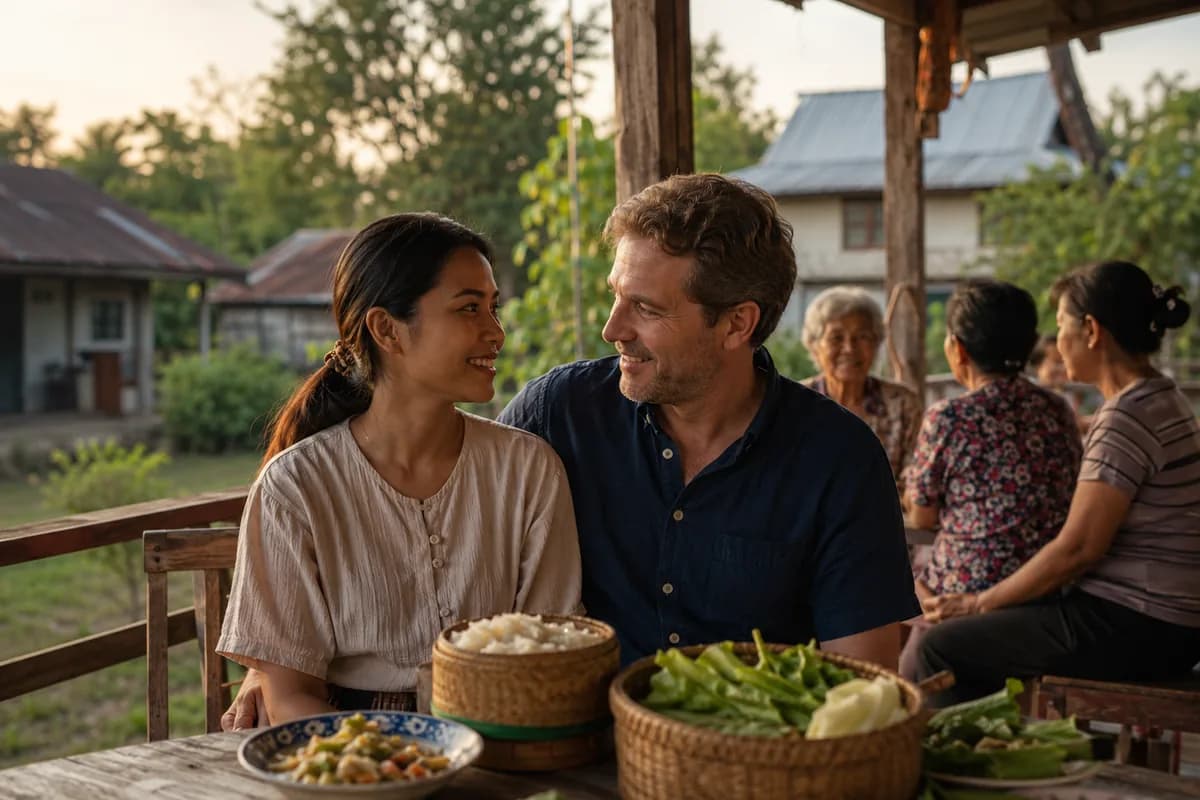
By the time a Thai woman from Isaan meets a Western partner, a much older story may already sit behind the relationship: migration, work, family networks and lives stretched across distance. Research on Thai–Western couples shows why the relationship itself cannot be reduced to either romance or economics — and why Isaan became one of the places where these connections became especially visible.
For three parts, we have deliberately avoided beginning with the foreign man. That may seem strange in a series called The Isaan Connection, because Thai women from the Northeast and Western men are one of the most visible combinations associated with the subject. But beginning with the couple would have made the story too easy to misunderstand.
Part 1 showed that migration from parts of Northeast Thailand has connected Isaan to Bangkok, the Eastern Seaboard and other centres of work for decades. Part 2 showed why women became especially visible in some of those migration streams and urban labour markets. Part 3 followed what happens after somebody moves: family relationships can continue across distance, money and practical help can travel in more than one direction, and a workplace address does not necessarily tell you where the rest of a person's life is located.
Only now do we reach the relationship. That order matters. If we had started with a Western man and an Isaan woman, it would have been tempting to treat everything around them as an explanation for why they are together. She is from Isaan. He is foreign. There is an economic difference. Her family may live elsewhere. Perhaps money moves between households. The conclusion can begin writing itself before either person has been allowed to become an individual.
The research gives us a better place to start. The relationship is not the explanation for the Isaan connection. It is one of the things that grew inside a much larger system of movement, opportunity, family, imagination and contact between different parts of Thailand and the wider world.
The simplest explanation is usually the weakest one
There are two easy stories about Thai–Western relationships. The first says it is about money. The second says it is about love. Both sound very different. They share the same weakness: they assume a relationship must have one true motive.
Patcharin Lapanun of Khon Kaen University addressed this directly in research with women and men involved in transnational marriages in an Isaan village. Her title is almost the conclusion: "It's Not Just About Money." Lapanun argues that the familiar opposition between romantic love and material incentives is too simple. Her fieldwork found what she called diverse and complex "logics of desire": motives and expectations shaped not only by economics or intimacy, but by ideas about marriage, gender, family, modernity and possible futures.
That does not mean money is irrelevant. It means money does not automatically cancel everything else. A person can love someone and value greater financial security. A person can be attracted to someone and also think about the future. A person can want companionship, stability, travel, marriage, family life or a different set of opportunities. Those motives can coexist because adults rarely make major life decisions for only one reason.
The same is true outside Thailand. People everywhere consider personality, attraction, income, children, housing, location, family, work and the kind of life a relationship may make possible. Cross-border relationships simply make some of those practical differences easier to see. Different passports may create different mobility. Different incomes may create different choices. Different languages may create different dependencies. Different family systems may create different expectations. The relationship can therefore look unusually "economic" from the outside because the material consequences are unusually visible.
But visibility is not proof of motive. Part 3 made the same point about remittances. A bank transfer proves that money moved. It does not tell us what somebody felt. The same principle applies here.
The woman is not a passenger in her own relationship
One of the most important changes in research on Thai–Western relationships has been the attention given to women's agency. That word can sound more complicated than the idea behind it. Agency simply means that women are participants in decisions about their own lives.
That should be obvious. Yet many popular versions of the Thailand story struggle to allow it. In one version, the Thai woman is passive and financially dependent. In another, she is a calculating strategist who has somehow designed the entire relationship around material gain. Those images appear opposite. In reality, both deny her ordinary human complexity. The first says she has too little control. The second says every choice is calculated.
Research from Lapanun and others offers a much more useful picture. Women make decisions inside circumstances. They respond to opportunities. They have preferences. They imagine futures. They negotiate family responsibilities. They evaluate partners. They may change their minds. They may make choices that work well, choices that become difficult, or choices whose consequences only become clear years later.
Agency does not mean that every choice is free from constraint. Nobody's is. Income matters. Citizenship matters. Age matters. Family matters. Previous relationships matter. Where someone lives matters. What jobs are available matters. But acknowledging those structures should not turn a woman into the passive product of them. She still chooses inside them.
This is also why the phrase "Isaan woman" becomes dangerous when it starts doing too much explanatory work. Regional origin can help us understand a migration pathway. It cannot tell us why a particular woman chose a particular man.
A relationship can be personal and structural at the same time
Sirijit Sunanta and Leonora Angeles use an especially useful idea in their research on transnational marriage in Northeast Thailand: intimate globalisation. Their point is that globalisation is not only something that happens through factories, finance, trade agreements or technology. It also enters private life. A relationship can connect two people while also connecting different economies, migration systems, passports, ideas about marriage and imagined futures.
Their research on the phua farang — literally "foreign husband" — phenomenon in Isaan places these marriages inside broader differences in economic and spatial opportunity while also emphasising individual desires, aspirations and imagination. That balance is important. If we talk only about structure, the couple disappears. The woman becomes an economic actor. The man becomes a source of foreign income. The relationship becomes a pipeline between rich and less-rich places. That is too mechanical. But if we talk only about romance, we lose the context that makes some relationships more likely to become imaginable in the first place.
The Isaan Connection series has been building exactly that context. Migration creates movement. Movement creates contact. Networks make later movement easier. Family links remain active across distance. People learn from relatives, friends and previous migrants. New possibilities become visible. A relationship with someone from another country can become part of that landscape of possibility without becoming inevitable.
This is the distinction worth protecting. Structure can help explain why a pathway exists. It cannot tell us who will walk down it.
Why Isaan became associated with the farang husband
The association between Isaan women and Western men did not appear from nowhere. Academic researchers have documented transnational marriages in Northeast villages for years, including work in Khon Kaen, Udon Thani and other settings. But the existence of a visible pattern should not tempt us into inventing a single origin story.
There is no one route by which an Isaan woman meets a Western man. Some lives involve internal migration before the relationship. Some involve tourism environments. Some involve international movement. Some relationships develop through social or personal networks. Technology has expanded the ways people can meet across distance. The research base does not give us one dominant pathway that can safely be applied to every couple.
What it does show is that by the time researchers began examining these marriages closely, the phenomenon was established enough to be changing social life in some Northeast communities. Lapanun's ethnographic work in two villages found that women with Western partners could become visible as a new social group through changes in consumption, lifestyle and land ownership. Sunanta and Angeles examined how transnational marriage connected women, households and villages to wider economic and social worlds. Other research looked at what happened when foreign husbands moved in the opposite direction and became part of Isaan family and village life.
That last point is especially important. The story is not only about Thai women leaving Thailand. Foreign men move too.
From foreigner to son-in-law
The phrase "farang son-in-law" changes the picture immediately. A foreign man may arrive in Thailand as a visitor. Later he may become somebody's husband. Then somebody's son-in-law. He may live in a Northeast village, build routines there, become known by relatives and neighbours, participate in family life and spend years negotiating what it means to belong in a place where he began as an outsider.
Research by Eric Thompson, Pattana Kitiarsa and Suriya Smutkupt deliberately examined this transition. Their work was based on fieldwork in Bangkok and Isaan and asked what happens when the public image of the Western male visitor collides with the much more ordinary reality of men building long-term lives in Thailand. The title of their paper makes the contrast deliberately sharp: From Sex Tourist to Son-in-Law.
That title should not be misunderstood as a claim that every farang husband began as a sex tourist. It did not. The researchers were examining social categories and stereotypes surrounding foreign men as well as the men's own experiences.
That distinction matters for the same reason it matters when we discuss Thai women. A stereotype can exist in society without accurately describing an individual. The foreign man can be simplified too. He may be imagined as rich because his income is foreign. He may be assumed to have chosen Thailand for one reason. He may be treated as somebody who understands the financial expectations around him better than he actually does. He may arrive with his own expectations about marriage, gender and family, some accurate and some shaped by fantasy.
Then, just like the woman, he meets an actual person rather than a social category. The relationship has to work from there.
The foreign husband enters a family, not an empty space
Part 3 showed why this matters. A Thai woman who has moved away from Isaan may still be connected to parents, children, siblings and a wider household network. When a foreign partner enters her life, he may eventually encounter that network too.
This does not mean that "marrying a Thai means marrying the whole family." That popular phrase is far too absolute. Families differ. Couples set different boundaries. Some relatives are close. Others are not. Some households share resources extensively. Others organise money much more separately.
But the relationship rarely begins on an empty social map. Research on farang–Isaan couples and rural transformation shows that foreign men can become incorporated into existing kinship structures rather than simply replacing them. In some Isaan communities studied by researchers, matrilineal and matrifocal family patterns created a familiar social place for an in-marrying man: the son-in-law.
The interesting part is not that the foreign husband somehow becomes Thai. He does not need to. It is that a family system can make room for somebody who arrived from very far outside it. That is a much richer way to understand the "farang connection" than the image of a foreign man simply extracting a woman from her family. Sometimes the direction of movement is the opposite. He joins her world.
Money is part of the relationship because money is part of life
At this point, money returns. It has to. Avoiding the subject would be just as misleading as making it the whole story.
The economic difference between partners can be substantial in some Thai–Western relationships. Research on transnational marriage has repeatedly examined material exchange, household support, property, mobility and social class. But the lesson from that research is not that economics reveal the "real" relationship beneath the romance. The lesson is that economics and intimacy can coexist.
Lapanun's work is particularly useful because it refuses the idea that love becomes less real the moment money matters. A couple may discuss housing. A partner may contribute to family expenses. A woman may gain greater security. A man may take on provider expectations. Property decisions may alter the couple's long-term position. None of those facts answers the question: do they love one another?
The question itself may be badly framed. Love is not an accounting category that becomes invalid when practical considerations enter. Long-term relationships everywhere are full of negotiated exchanges. People give time. People give care. People give money. People compromise over where to live. They support children. They care for ageing partners. They change careers. They absorb one another's risks. Cross-cultural relationships do not stop being relationships because the exchanges are easier for outsiders to notice.
Social mobility needs equally careful language
Researchers also discuss social mobility. Again, the phrase is easy to misuse. A relationship with a Western partner can change material possibilities. That is unsurprising when partners come from different economic environments or when the relationship creates access to international movement. In the villages studied by Lapanun, some women with Western partners became differentiated from other villagers through consumption, lifestyle and increased ownership of farm or residential land.
That is evidence of social change. It is not a moral judgement. Wanting greater security or more options is not uniquely Thai. Nor does increased material wellbeing prove why a relationship began. The sequence matters. A relationship can have material consequences without being caused only by material desire.
It can also create forms of mobility that are not simple improvements. Moving to another country may create opportunities while removing familiar networks. A person can gain income and lose professional status. She can gain mobility and become dependent on a partner for language or bureaucracy. She can improve her financial position while feeling socially isolated. The word "upward" can therefore hide as much as it reveals. A life can improve in one dimension and become more complicated in another.
Long relationships are especially good at destroying simple theories
Paul Statham's research is useful here because it deliberately looks beyond the beginning. His work drew on twenty in-depth biographical interviews with Thai women who had been with Western partners for between seven and thirty years. The average relationship in the sample had lasted roughly fourteen years. Most of the women were living primarily in Thailand when interviewed, with eleven in Udon Thani, five in Phetchabun, two in Pattaya and two in Bangkok.
This is a small qualitative sample. It cannot tell us what all Thai–Western relationships are like. But that is not what makes it valuable. Its strength is time.
When a relationship lasts for a decade or two, the original question — why did she choose him? — stops being enough. The couple has had to decide where to live. They may have dealt with immigration systems. They may have cared for children or parents. Age differences can change meaning as partners grow older. Financial dependence can shift. Health can change. A woman who once depended on a husband may later become the person providing care. A couple may move between countries. The meaning of "home" can change repeatedly.
Statham's studies show how material gains can coexist with cultural negotiation, dependency, questions of belonging and, in some cases, isolation. Again, the point is not that Thai–Western marriage is unusually difficult. It is that long relationships become real. The fantasy on either side eventually has to coexist with laundry, health, paperwork, relatives, money, ageing and ordinary Tuesday afternoons.
That may be the most effective antidote to stereotype available.
Both sides can arrive with expectations
The Thai woman is not the only person imagining a future. The Western man has ideas too. Lapanun's work points to cultural expectations on both sides of transnational relationships. A Western man may arrive with assumptions about Thai women, family life or gender roles. A Thai woman may have assumptions about Western husbands, stability, communication, family responsibilities or life abroad.
Neither set of expectations has to be malicious. People use the information available to them. Stories travel. Friends talk. Relatives describe what happened to them. Media creates images. Previous couples become examples. Success stories are remembered. Difficult stories travel too.
This is another way networks matter. Part 1 showed that migrants can make destinations imaginable for later migrants. Something similar can happen socially. Once cross-cultural marriages exist visibly in a community, the idea itself becomes less abstract. People know someone who has done it. They may see how that life developed. They may form expectations from what they observe. That does not mean they copy it. It means the possibility has entered the social landscape.
An established phenomenon is not a universal aspiration
Research in Udon Thani gives us another useful boundary. A 2021 study by researchers from Khon Kaen University specifically examined marriages between Thai women and foreign men in Udon Thani Province using questionnaires and semi-structured interviews.
The study is useful because it confirms that these marriages were an established enough local phenomenon in Udon Thani to be examined systematically. This was not an imagined association invented by foreign tourists.
But the study does not give us permission to turn the phenomenon into the aspiration of "Isaan women". That leap is enormous. Udon Thani is one province. The research sampled women who were already in the relevant relationships. It did not ask a representative sample of every woman in Isaan what kind of partner she preferred. That distinction should remain permanent. Studying a pattern is not the same as defining a population.
Why the pattern can look bigger from the outside
There is another reason the farang connection can feel overwhelming to a foreign observer. It is memorable. A Thai–Thai couple in Udon Thani may not register as a special social phenomenon to a Western visitor. A Thai–Western couple does. A large house in a village connected to a foreign husband may attract notice. A Western man sitting with an extended Thai family is visually obvious.
Cross-border relationships are therefore not only socially visible. They are cognitively visible. We notice difference. That can make an established minority pattern feel like the defining story of a place.
The same happened in Part 2 with service work. The visitor sees a selected slice of Thailand and begins treating repeated personal encounters as a census. The answer is not to deny the pattern. The answer is to keep its scale honest.
Thai–Western relationships are real. They have been studied extensively in parts of Isaan. They have changed some households and communities. They have become culturally recognisable. But they remain one form of relationship inside a region of more than twenty million people.
What the research allows us to say
By this point, we can make several claims with confidence. Transnational marriages between Isaan women and Western men are a documented social phenomenon. Researchers have studied them in Northeast villages and cities including Udon Thani. The phenomenon sits inside a wider history of migration, changing labour markets, family networks and global connections. Material differences can matter. So can love, attraction, aspiration, family ideas, gender expectations and imagined futures. Women have agency inside these relationships. Foreign men also have their own motives, histories and vulnerabilities. Some foreign husbands become embedded in Isaan family and village life as sons-in-law. Long-term relationships can create both opportunities and difficulties that are invisible at the beginning.
And no single one of those statements tells us why a particular couple is together. That final limit is essential. We cannot say Isaan women prefer Western men. We cannot say Western men prefer Isaan women because they are more "traditional". We cannot say money explains the relationship. We cannot say love explains away money. We cannot infer a woman's motive from her family's economic circumstances. We cannot infer a man's motive from his nationality or age. We cannot treat relationships that began in tourism settings as representative of every Thai–Western couple. And we cannot turn a real regional pattern into a personality profile for millions of women.
The farang connection is a pathway, not an answer
There is a reason Isaan appears so often in conversations about Thai–Western relationships. The pattern is real enough to have generated decades of research. But the series has now given us a better way to understand what "real" means.
It does not mean there is something about Isaan women that makes them naturally seek foreign partners. It does not mean Western men discovered a particular kind of woman in the Northeast. It means several pathways became connected. People from Isaan moved through Thailand. Women participated strongly in some migration streams. Families remained connected across distance. Thailand's tourist and urban economies created contact with people from abroad. International mobility expanded. Communication became easier. Transnational relationships became visible in some Northeast communities. Some foreign men then moved into those communities themselves.
What began as movement between places became movement between social worlds. And inside all of that, two people still have to like one another enough to build a relationship.
That may sound almost disappointingly ordinary after so much sociology. It should. The research is most useful when it returns us to the individual. Isaan can help explain how two lives might have entered the same field of possibility. Economics can help explain some of the choices available. Migration can help explain where people met. Family can help explain some of the responsibilities surrounding the couple. Culture can help explain some expectations they bring with them.
None of those things can tell us what the relationship means to the people inside it. That is where explanation has to stop.
And where the next part begins. Because once a visible pattern exists, stories gather around it. Some are sympathetic. Some are suspicious. Some are flattering. Some are insulting. Over time, they become stereotypes about Isaan women, farang men, money, family and relationships.
Part 5 will look at those stories directly. Not to decide which stereotype is the "correct" one. To show why the need for one simple explanation was the problem from the beginning.