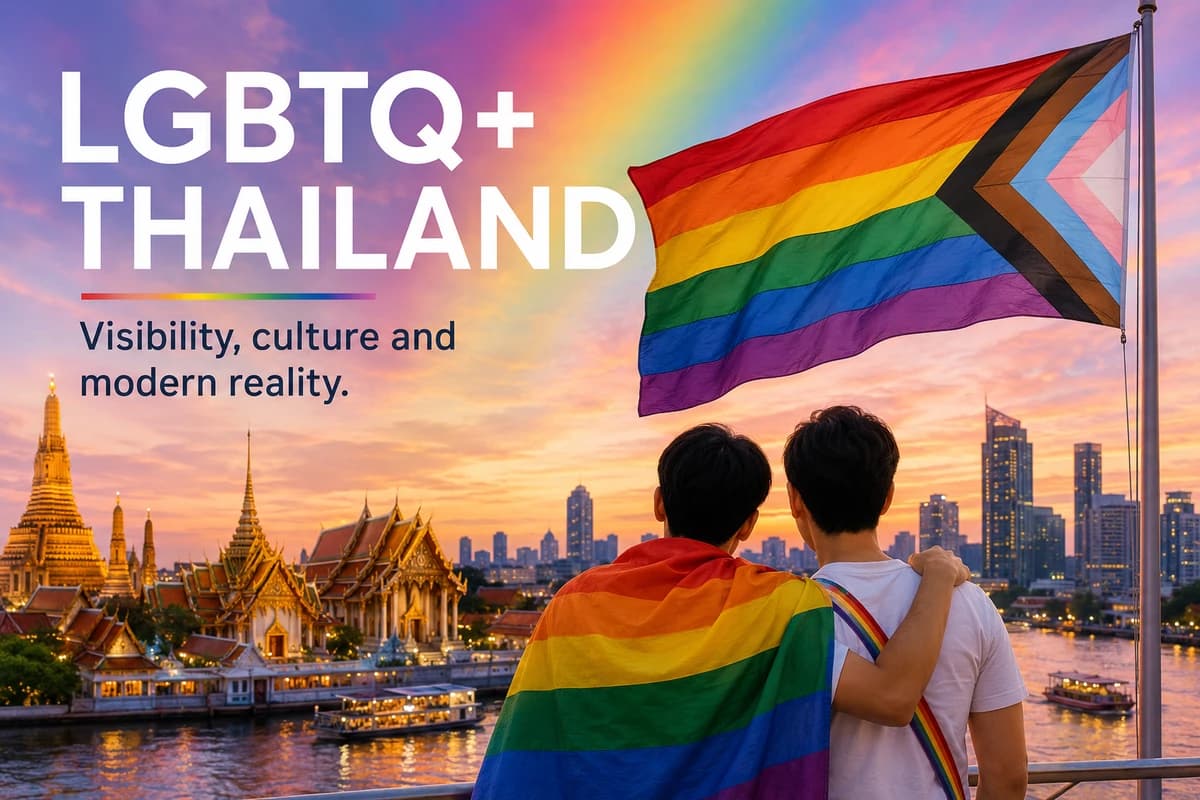
1. A Country Known for Visibility
Thailand is one of the countries international visitors most readily associate with visible gender and sexual diversity.
Same-sex couples walk through shopping centres and night markets. Pride flags appear in Bangkok each June. LGBTQ+ performers, presenters, actors, business owners, creators and public figures are part of everyday media and cultural life. Transgender women are highly visible in popular culture, while gay communities have long had their own social spaces, publications and networks. In January 2025, Thailand went further still: marriage equality entered into force, making it the first country in Southeast Asia where same-sex couples could marry with the same legal recognition as other couples.
All of that is real. But visibility is only the beginning of the story.
A country can be socially familiar with gender diversity without every family responding in the same way. A person can be visible in entertainment while still encountering an identity document that does not match how they live. A same-sex couple can be legally married while older social expectations around family, children and gender roles continue to change more gradually. A city can stage one of Asia’s largest Pride celebrations while individual experiences still vary by age, profession, community and household.
None of those things cancels out the others.
Thailand’s LGBTQ+ history makes more sense when it is understood as a long process of adaptation rather than a test of whether the country is either perfectly accepting or secretly intolerant. Thai society had its own categories and ways of talking about gender and sexuality before today’s international LGBTQ+ vocabulary became common. Those older terms have changed over time. New identities have emerged. Laws have changed. Public discussion has expanded. People have found new language for experiences that were already part of Thai life.
That is why the familiar tourist shorthand can be misleading. Thailand is not interesting because it is an exotic exception where ordinary social rules somehow do not apply. It is interesting because gender and sexual diversity have become unusually visible while Thai law, institutions, family expectations and individual identities have continued to evolve around that visibility.
The result is neither a contradiction nor a finished story. It is modern Thailand.
2. Thailand Had Its Own Language for Diversity
One of the easiest mistakes an outsider can make is to assume that English-language LGBTQ+ categories map neatly onto Thai life. They do not always.
Modern terms such as gay, lesbian, bisexual, transgender, queer and non-binary are now familiar in Thailand, particularly among younger people, activists, professionals and urban communities. The English word gay itself became part of Thai identity language during the twentieth century. But these terms arrived into a society that already had its own vocabulary for gender expression, relationships and social roles.
That vocabulary has never been static.
Thai discussions of phet — a word that can relate to sex, gender and sexuality depending on context — have not always separated biological sex, gender identity and sexual orientation into the same conceptual boxes used in contemporary English. Over time, local categories and international identities have overlapped, competed, narrowed, widened and changed meaning.
Kathoey is the best-known example, but it is not the only one.
Within female same-sex cultures, the terms tom and dee have long been used by some people. Tom, derived historically from “tomboy”, is generally associated with masculine gender expression, while dee developed from “lady” and is generally associated with a more feminine presentation. Research in Thailand has repeatedly shown that these are not simply Thai translations of “butch lesbian” and “femme lesbian”. Some people use tom or dee as their primary identity and may not describe themselves as lesbian at all. Others use lesbian, bisexual, queer, transgender or another term. Individual usage matters more than an outsider’s desire to make the categories line up perfectly.
The same caution applies to transgender men. International discussion of Thailand has historically focused far more heavily on transgender women, which can create the false impression that transmasculine people are absent. They are not. Their public visibility and the vocabulary used around them have simply developed differently.
Gay male identity has its own Thai history as well. Scholars studying Bangkok’s gay magazines and social spaces in the 1980s and 1990s have shown that modern Thai gay culture was not merely imported from Europe or the United States. International ideas mattered, but they interacted with Thai-language media, local class structures, Bangkok’s changing urban life and specifically Thai ways of understanding masculinity and relationships.
That is the broader pattern. Thailand did not wait for an international acronym before gender and sexual diversity existed. Nor did global LGBTQ+ language simply replace everything that came before it.
The two developed together.
For a visitor, the practical lesson is simple: a familiar English label may be useful, but it should never be treated as a complete translation of another person’s identity.
3. Kathoey and the Limits of Translation
No Thai gender term is more internationally recognised — or more frequently mistranslated — than kathoey.
The word has a long history in Thailand and has been used in different ways at different times. In modern usage it is often associated with people assigned male at birth who have a feminine gender identity or expression. Some may identify strongly as women. Some use hormones or have gender-affirming medical treatment; others do not. Some use kathoey proudly as a self-description. Others prefer transgender woman, phu ying kham phet, sao praphet song or simply woman. Some people who might once have been placed under the broad social category kathoey would now use a different identity altogether.
That variation is exactly why the word cannot be translated with a single English equivalent.
Academic research on Thailand repeatedly cautions that kathoey does not map directly onto the Western category transgender. Historically it could cover a broader range of feminine identities and expressions among people assigned male at birth. Its meaning has also changed as medical possibilities, media, global LGBTQ+ language and Thai self-identification have changed.
It is equally unhelpful to declare kathoey “Thailand’s third gender” as though every Thai person agrees on a fixed three-part system. The idea has appeared in scholarship and popular explanation, and it can illuminate some historical ways of organising gender. But modern Thailand contains far more varied identities than three boxes can hold.
Then there is the English word “ladyboy”. International visitors will encounter it, particularly in tourism and entertainment contexts. Some individuals use it for themselves, including in English-language marketing or conversation. That does not make it a precise synonym for kathoey, and it is not a neutral term for every transgender woman. For some people it can feel dated, reductive or overly tied to entertainment and sexualised tourist imagery.
Thailand4U therefore does not use “ladyboy” as a general label for people. The respectful approach is the same one that works elsewhere: use the identity a person uses for themselves. When no individual preference is known, transgender woman or trans woman is normally clearer in English when that is what is meant.
That distinction matters because international representations have too often reduced Thai transgender women to one narrow image — cabaret stages, beauty pageants, nightlife or medical tourism. Those are real parts of Thailand’s public landscape, but they are not a biography for an entire population.
Transgender women in Thailand are teachers, doctors, students, office workers, designers, shop owners, civil-society organisers, parents, creators and people living ordinary lives that rarely become part of tourist storytelling.
Understanding kathoey properly therefore requires something surprisingly simple.
Stop treating the word as an attraction. It is a piece of Thai social language used by real people, and like most identity language, its meaning depends on who is using it and why.
4. From Private Lives to Public Voices
Thailand’s modern LGBTQ+ public culture did not appear overnight with Pride parades or social media.
During the later twentieth century, new spaces slowly allowed people to talk about same-sex relationships and gender diversity in public rather than only through family, friendship or private social networks.
One particularly revealing example came from the magazine Plaek in the 1970s. Advice columns written under the name Uncle Go became a place where gay men, lesbians and kathoey readers could write about relationships, identity, family concerns and everyday life. Historian Peter Jackson has preserved and analysed these letters because they capture something that official histories often miss: people describing themselves in their own words at a moment when modern Thai identity categories were still developing.
The letters did not create LGBTQ+ life in Thailand. They made some of it visible in print. That distinction matters.
During the 1980s and 1990s, Thai-language gay magazines, bars and social networks became increasingly important in Bangkok. Research published by the Journal of the Siam Society argues that these spaces helped shape a distinctly local modern gay culture. Thailand’s rapid economic growth, the expansion of Bangkok, a growing middle class and the development of Thai-language commercial media all influenced the way gay men met, socialised and understood themselves.
Female same-sex communities and transgender communities followed their own pathways rather than simply sharing one unified history. That is another reason not to tell the story as if one single “LGBTQ+ community” has always existed in exactly its present form.
Public celebration also developed gradually.
In 1999, Bangkok staged the Bangkok Gay Festival on and around Silom Road, widely described at the time as Thailand’s first major event of its kind. It was celebratory more than overtly political, reflecting the particular social environment of that period. Modern Bangkok Pride would later become much larger, more explicitly rights-focused and more broadly representative of LGBTQ+ identities.
The contrast between those moments shows how quickly the public conversation has changed. In one generation, Thailand moved from magazine advice columns and relatively small community spaces to nationally visible Pride events, corporate participation, public policy debate and marriage equality.
The change was not simply a Western template being copied. Thai activists, writers, artists, organisations, academics, families, businesses and LGBTQ+ people themselves shaped the language and priorities of the movement. International ideas became part of the conversation, but the conversation remained Thai.
That is why Thailand’s LGBTQ+ history is better understood as an exchange: local identities responding to a changing country while global ideas about rights and identity became more available.
The result is a public culture that looks familiar in some ways and distinctly Thai in others.
5. From Visibility to Legal Protection
For much of modern Thai history, public familiarity with LGBTQ+ people developed faster than specific legal protections. That began to change more clearly in the twenty-first century.
A major step came with the Gender Equality Act B.E. 2558, adopted in 2015. The law created national mechanisms to address unfair gender discrimination and uses a definition broad enough to include people whose appearance differs from the sex assigned at birth. For transgender people in particular, this was an important legal recognition that discrimination based on gender expression could be challenged rather than treated merely as a social problem.
The Act also established committees and procedures through which complaints could be considered and remedies provided.
It should not be described as a complete LGBTQ+ civil-rights code. Reviews of its implementation have identified both achievements and limitations, and the law contains exemptions in particular circumstances. But it changed the legal landscape by placing gender equality and unfair discrimination inside a formal national framework.
That matters in a country where social visibility had sometimes been mistaken for legal equality.
The difference can be easy for visitors to miss. Seeing openly LGBTQ+ people in public can create the impression that the law must already have resolved every related question. In reality, different legal areas developed separately. Employment, family law, official documents, healthcare, education and marriage did not all change at the same time.
This gradual process is not unique to Thailand. What is notable is how rapidly several major changes have occurred once reform gathered momentum.
Marriage equality is the clearest example.
But the path to it was long. Thai civil-society groups and LGBTQ+ advocates spent years debating different models, including civil partnerships and full marriage equality. Parliamentary processes moved forward, stalled and returned. By the early 2020s, the question was no longer whether same-sex couples should receive some form of recognition, but increasingly whether anything short of the same marriage law was sufficient.
The final answer was unusually clear. Thailand did not create a parallel institution. It changed marriage itself.
6. Marriage Equality Changed the Legal Landscape
On 23 January 2025, Thailand’s Marriage Equality Act entered into force.
The date marked one of the most significant legal changes in the country’s modern social history. Thailand became the first country in Southeast Asia to recognise marriage regardless of the sex or gender of the two spouses.
The reform amended more than sixty provisions of the Civil and Commercial Code. Gender-specific terms such as husband and wife were replaced in key sections by gender-neutral language such as spouse. The minimum marriage age was raised to eighteen. Most importantly for same-sex couples, marriage now carried the same core legal framework around property, inheritance, divorce, medical decision-making and family recognition.
Adoption rights were included as well.
That last point is worth stating clearly because international reporting sometimes continued to repeat older information after the law changed. Under the amended Civil and Commercial Code, same-sex married couples can adopt under the same legal framework as other married couples.
The law did more than create practical rights. It changed the meaning of official recognition.
Before 2025, a same-sex couple might have lived together for decades, shared finances, cared for relatives and built a family while remaining legal strangers in situations where marriage mattered. After the reform, the relationship could be registered under the same institution used by other couples.
For Thailand’s LGBTQ+ movement, the change followed more than a decade of sustained advocacy by civil-society organisations, activists, lawyers and supporters. It also reflected a wider political and social shift. Marriage equality moved from a community demand to legislation supported across a broad part of Thai public life.
The first day of registrations therefore carried unusual symbolic weight. Couples who had waited years could finally complete an ordinary administrative act that had previously been unavailable to them.
Yet marriage equality did not automatically settle every question connected to gender and family law.
Some legal language and administrative systems remain built around older male/female classifications. Surrogacy, parenthood terminology and legal gender recognition are separate legal questions. A transgender person’s ability to marry does not automatically mean every identity document can be changed to reflect that person’s gender.
This is not a reason to diminish the marriage law. It is precisely why the law is so important. It demonstrates that one major part of the system can change decisively even while work continues elsewhere.
Thailand’s LGBTQ+ legal landscape after January 2025 is therefore fundamentally different from the one that existed before it.
Marriage equality is no longer an aspiration. It is Thai law.
7. Transgender Thailand Beyond the Image
Thailand’s international reputation for transgender visibility can make one legal fact particularly surprising.
As of 2026, Thailand still does not have a general legal procedure allowing transgender people to change the sex marker recorded in core civil-registration documents to match their gender identity.
The issue remains under active debate. Draft legislation has proposed systems for legal gender recognition, including changes to registered sex and personal titles, but those proposals have not yet produced a general national recognition procedure. Thai Senate material discussing a citizen-proposed bill in 2025 explicitly described the existing legal system as one in which official status and identity documents continued to operate primarily through male and female classifications that did not fully recognise gender-diverse identities.
The practical consequences are more important than the abstract legal terminology. An identity document may reveal information a person would not otherwise choose to explain. Administrative systems can require extra clarification. Travel, banking, education, employment or other formal situations can become more complicated when appearance, title and official sex marker do not align.
At the same time, another part of transgender policy has moved forward quickly: healthcare.
Thailand has long been internationally known for gender-affirming medical expertise, including specialist clinical and surgical care. But high-profile medical tourism should not be confused with universal access for Thai transgender people themselves.
A major domestic change began through the Universal Coverage, or Gold Card, system.
In 2025, the Thai government announced a budget of approximately 145.63 million baht for new health benefits that included gender-affirming hormone services. In June 2026, the government reported that the service was being rolled out through around fifty healthcare facilities, combining hormone treatment with laboratory monitoring and broader medical assessment. The current protocol described by the government includes self-consenting access for eligible people aged eighteen and over following medical assessment, with referral available where specialist care is required.
That is a significant development. It shifts part of gender-affirming healthcare from something many people had to finance privately into the public-health system, where treatment can be monitored more safely and consistently.
Again, the pattern is not one of a country moving in a single straight line.
Legal gender recognition remains unresolved while public healthcare has expanded. Marriage law has changed while identity-document law has not yet caught up. Social visibility is longstanding while administrative reform is comparatively recent.
That unevenness is easy to call contradictory. It is more useful to call it a society changing through several systems at once.
8. Family, School, Work and Everyday Acceptance
Law is important, but most people do not experience acceptance first in a parliament or courtroom. They experience it at home.
That is one reason family occupies such a large place in research on LGBTQ+ life in Thailand. Thai society places strong value on family relationships, responsibility and harmony. For many LGBTQ+ people, family acceptance can therefore matter at least as much emotionally as formal public recognition.
Experiences vary enormously.
Some families are supportive from the beginning. Others understand gradually. Some may accept a relationship in private while remaining uncomfortable discussing it publicly. Others may worry less about sexual orientation itself than about marriage, grandchildren, social expectations or whether a child will face difficulty at work.
The most comprehensive national survey remains UNDP’s 2019 study, which included 2,210 participants across Thailand: 1,349 LGBT respondents and 861 non-LGBT respondents, alongside focus groups in several regions. Among the non-LGBT respondents surveyed, 69 percent reported generally positive attitudes towards LGBT people.
That finding is important, but so is its context.
The same research documented experiences of stigma, exclusion and discrimination in family life, education, employment and other settings. Acceptance was not identical across every relationship or region, and some respondents said they had concealed their identity in particular environments.
Those findings should not be treated as a fixed description of Thailand in 2026. The survey was conducted before marriage equality and before several years of rapid public change. It is better understood as a valuable baseline showing something more subtle: broadly favourable attitudes could exist at the same time as practical barriers.
Workplaces illustrate the same point.
Thailand has many companies that openly support Pride, LGBTQ+ employee networks and inclusive workplace policies. UNDP, universities and business partners have also developed inclusion tools and training for Thai employers. At the same time, earlier studies documented particular employment difficulties for some LGBTQ+ people, especially transgender applicants whose identity documents or gender expression could become part of the hiring process.
The direction of change is therefore visible, but individual experience cannot be predicted from a national reputation.
The same is true of schools and universities. Younger generations often use a wider vocabulary for identity and may encounter LGBTQ+ topics much more openly than previous generations did. Yet the experience of one Bangkok university student cannot automatically describe a teenager in another province, just as one supportive family cannot stand for every family.
Respectful writing about LGBTQ+ Thailand needs to leave room for that diversity.
There is no single Thai LGBTQ+ experience. There are millions of individual relationships with family, school, work, faith, community and self — and those relationships do not all move at the same speed.
9. Pride, Media and a Welcoming Destination
If the legal story shows how quickly Thailand has changed, Pride shows how visible that change has become.
Bangkok’s early Gay Festival in 1999 was significant, but the scale of modern Pride is different. Large public parades returned in the early 2020s and rapidly became major city events involving community organisations, businesses, public agencies, performers, campaigners and international visitors.
By 2026, Pride was not simply tolerated on the margins of Bangkok. It had become part of the city’s public calendar.
The Tourism Authority of Thailand participated in Bangkok Pride 2026 and has explicitly promoted Thailand as an LGBTQIA+ friendly destination. TAT campaigns such as Go Thai Be Free and Amazing Thailand Out There have treated LGBTQ+ travellers as a recognised tourism market rather than an afterthought. Bangkok has also promoted a “Road to WorldPride 2030” ambition.
That final wording matters: it is an ambition and readiness campaign, not confirmation that Bangkok has already been selected to host WorldPride 2030.
Tourism promotion works because it connects with something visitors can genuinely observe. Many LGBTQ+ travellers experience Thailand as relaxed and welcoming. Same-sex couples are common in tourist areas. Hotels and hospitality businesses routinely serve diverse guests. Bangkok has longstanding LGBTQ+ social scenes, while Chiang Mai, Pattaya, Phuket and other destinations have their own communities and venues.
But tourism should remain only one chapter of the national story.
Thailand’s transgender population is not an entertainment product. Gay life is not defined by bars. Lesbian, bisexual and transmasculine lives do not become less important because they are less visible to tourists. Pride is not evidence that every person experiences complete inclusion.
Media has similar power and similar limitations.
Transgender performers and beauty pageants have helped make gender diversity highly visible for decades. Television, film and online culture have expanded the range of LGBTQ+ public figures even further. Greater visibility can open doors, normalise difference and give younger people examples of lives they recognise.
It can also create a narrow template if the same kinds of personalities and occupations are shown repeatedly.
The most useful measure of progress is therefore not simply how many LGBTQ+ people appear on a screen. It is whether a wider range of people can live ordinary lives without their identity becoming the most remarkable thing about them.
In that sense, Thailand’s tourism image and Pride culture are meaningful precisely because they are no longer the whole story. Marriage registration offices, universities, hospitals, workplaces and families are now part of the same conversation.
10. A Society Still Writing Its Story
Thailand’s LGBTQ+ story is often presented from outside as a puzzle.
How can a country have such visible transgender culture yet still be debating legal gender recognition? How can same-sex couples be commonplace in public while some families need time to adjust? How can Pride become a major tourism event while workplace inclusion remains an active policy topic?
The answer is that societies do not change all at once. Different institutions move at different speeds.
Thailand’s gender and sexual diversity did not begin with modern LGBTQ+ activism, but activism gave people new legal language and political tools. Local identities such as kathoey, tom and dee did not disappear when words such as gay, lesbian, bisexual and transgender became widespread. Marriage equality did not erase every administrative problem, but it transformed the legal standing of same-sex couples. Public transgender visibility did not automatically produce legal gender recognition, but public healthcare is now beginning to include gender-affirming hormone services.
Each development belongs to the same larger story. So does the changing meaning of acceptance.
For one generation, being left alone may have felt like progress. For another, equal access to marriage, work, healthcare and documents is the more relevant measure. Younger Thais are growing up with vocabulary, public figures and legal possibilities that did not exist in the same way for their parents. Older generations have also changed, often through something much more personal than politics: discovering that the person asking for understanding is their child, sibling, colleague, neighbour or friend.
That is why it is unhelpful to reduce Thailand to either of two clichés.
It is not an effortless “LGBTQ+ paradise” where social difference has never mattered. Nor is its reputation for openness merely a tourist illusion.
Thailand has genuine traditions of gender diversity, real public visibility, an increasingly developed rights framework and a remarkable recent milestone in marriage equality. It also has unfinished legal and social questions, particularly around gender recognition and the unevenness of everyday experience.
Both can be true without cancelling each other out.
The most respectful way to understand LGBTQ+ Thailand is therefore not to search for one verdict on the country. It is to pay attention to the people and institutions shaping the next stage: couples using a marriage law that did not exist before 2025; transgender patients entering a public healthcare pathway expanded in 2026; families finding their own language of acceptance; businesses revising workplace policies; activists drafting the next reform; and people choosing the words that fit their own lives.
Thailand’s LGBTQ+ story is not finished.
That is not a weakness in the story. It is what makes it alive.