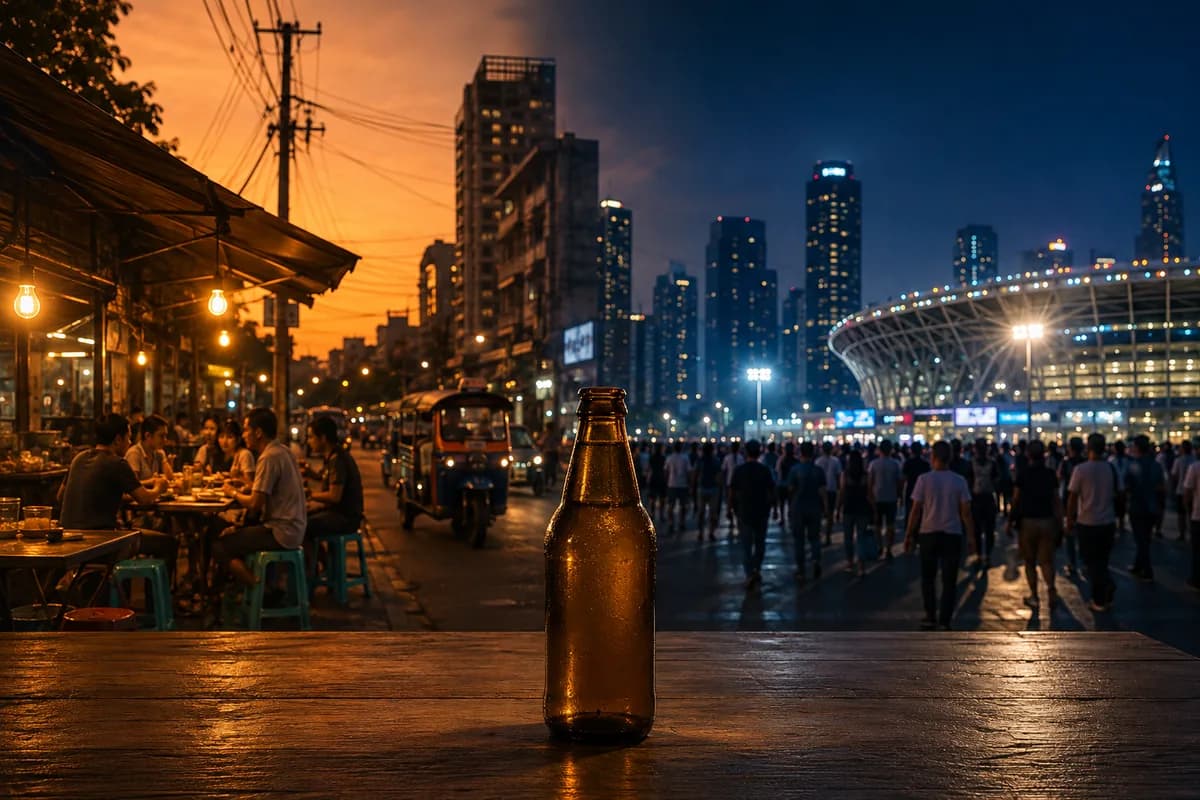
A silver-and-blue can of Red Bull looks about as international as a product can get. It sits on Formula 1 cars, sponsors football clubs, and has been strapped to the chest of a skydiver falling from the edge of space. But trace the drink back far enough and the trail does not lead to Austria. It leads to Thailand, and to a small, sweet, non-carbonated bottle called Krating Daeng.
Before Red Bull, There Was Krating Daeng
Krating Daeng — written กระทิงแดง in Thai — is usually translated for foreigners as “Red Bull.” It is a convenient shorthand, but not quite accurate. A krathing is a gaur, a massive wild bovine native to the forests of South and Southeast Asia, and considerably wilder and rarer than the domestic cattle the English name suggests. “Red Gaur” would be the more faithful translation, and it matters, because the animal on the label is not some generic bull — it is a specific, powerful creature drawn from the Thai countryside.
The drink itself was developed by the Thai entrepreneur Chaleo Yoovidhya and introduced commercially in Thailand in 1976. Unlike the fizzy, chilled can familiar to Europeans and Americans today, the original Krating Daeng was sold in a small brown glass bottle, was not carbonated, and tasted noticeably sweeter and more syrupy — closer to a medicinal tonic than a soft drink. Its basic building blocks — caffeine, taurine, sugar and B vitamins — will be familiar to anyone who has opened a modern energy drink, but the format and the audience it was built for were entirely different.
Chaleo Yoovidhya and Thailand's Working-Man Energy Drink
Chaleo Yoovidhya built his business through T.C. Pharmaceutical Industries, and Krating Daeng grew out of that pharmaceutical background rather than out of any ambition to create a fashionable lifestyle product. From the start, it was aimed squarely at Thailand's working population: long-haul truck and bus drivers, taxi and tuk-tuk drivers, construction crews and farmers putting in punishing hours in the heat. Historical accounts of the brand describe Chaleo deliberately building his early market upcountry, among provincial working people, rather than chasing the fashionable consumers of Bangkok.
This is worth pausing on, because it is easy to look at Red Bull's later glossy, extreme-sports image and assume the brand was always built around glamour. It was not. Its DNA is blue-collar: a bottle of concentrated energy handed to someone about to start a night shift behind the wheel.
Why Two Red Animals Still Appear on Every Can
Krating Daeng's branding featured two red gaur charging toward each other in front of a golden sun disc — an image meant to evoke raw physical power. Anyone who has ever picked up an international can of Red Bull will recognise that same composition immediately: two animals, head to head, in front of a sun. The Western product changed almost everything about the drink — its taste, its packaging, its price point, its audience — but it kept this one piece of Thai visual identity almost untouched. It is, in a sense, the closest thing the global brand has to a signature carried over intact from its Thai origins.
The Austrian Who Discovered It in Thailand
Krating Daeng might well have remained a strictly Thai product were it not for Dietrich Mateschitz, an Austrian marketing executive working for the consumer goods company Blendax. His job took him travelling extensively across Asia, and it was on one of these trips through Thailand that he came across the local tradition of small, potent tonic drinks — accounts of the story describe him finding these drinks useful against jet lag. Krating Daeng, in particular, caught his attention, and he eventually sought out its creator, Chaleo Yoovidhya.
What Mateschitz recognised was not just a good drink, but an entire product category that had no real Western equivalent. Asia already had a tradition of functional tonic drinks by this point — Japan's Lipovitan, for instance, had been on shelves since 1962 — but nothing like it existed in the supermarkets of Europe or North America. That gap was the opportunity.
A Thai-Austrian Partnership
In 1984, Chaleo Yoovidhya and Dietrich Mateschitz formalised their collaboration by founding the company that would become Red Bull GmbH. According to the commonly cited ownership split at the time, Mateschitz and Chaleo each held 49 percent of the new company, with the remaining 2 percent going to Chaleo's son, Chalerm Yoovidhya. Reporting on the deal has put each founder's initial investment at roughly $500,000. Mateschitz took on the role of running the international business.
This detail matters for how the story should be told. Red Bull was not simply an Austrian idea that happened to borrow a Thai drink, nor was it a Thai product quietly appropriated by a foreign businessman. It was a genuine 49/49/2 partnership between a Thai entrepreneur and an Austrian marketer, each bringing something the other did not have: Chaleo, the product and the manufacturing know-how; Mateschitz, an understanding of how to sell it to an entirely new market.
Turning Krating Daeng Into Red Bull
Getting from a Thai bottle to a global can was not a matter of relabelling. Red Bull's own corporate history describes a development process lasting almost three years, between 1984 and 1987, during which the formulation, taste, packaging and positioning were all reworked for Western tastes.
The single biggest change was carbonation. The original Krating Daeng was still and syrupy; the Western product was carbonated to match what European consumers expected from a chilled drink. The packaging shifted from a small brown glass bottle to the now-famous slim silver-and-blue aluminium can. And the positioning flipped entirely: a hard-working tonic for drivers and labourers became a premium, faintly rebellious lifestyle product aimed at students and young professionals. Even the name was translated and simplified, from Krating Daeng to the more universally pronounceable Red Bull.
Red Bull Energy Drink officially launched in Austria on 1 April 1987, three years after the company's founding — a gap that reflects just how much reworking the original Thai product went through before it was considered ready for a Western shelf.
How Marketing Changed Everything
If Chaleo supplied the product, Mateschitz's real contribution was arguably a new way of selling it. Rather than simply buying advertising space, Red Bull built its identity through sampling campaigns, student promotions, nightlife culture and, above all, sport — not as a sponsor standing on the sidelines, but as an owner and organiser of the events themselves. Over the following decades this grew to include Formula 1 teams, football clubs, cliff-diving championships, air racing and stunts such as Felix Baumgartner's stratospheric skydive under the Red Bull Stratos programme.
None of this was really new in spirit, though. Krating Daeng had already built its Thai reputation partly through associations with Muay Thai — a sport built on endurance, power and working-class grit. What changed under Mateschitz was the scale and the audience, not the underlying idea that the drink belonged in the world of physical performance.
From Muay Thai to Formula 1
Seen side by side, the two eras of the brand look almost unrelated: a Thai worker's tonic sponsoring boxing rings on one hand, a global energy-drink empire bankrolling Formula 1 constructors on the other. But the throughline is consistent — strength, stamina and physical risk have been part of the brand's identity since its earliest days in Thailand, long before anyone in Europe had heard of it. The audience changed from truck drivers to extreme-sports athletes and students; the underlying story of energy and endurance did not.
Krating Daeng in Thailand Today
The original product never disappeared. Travellers to Thailand can still find Krating Daeng on the shelves of almost any convenience store, sitting alongside a crowded field of local competitors such as M-150, Carabao Daeng and Sponsor. Compared to the can most visitors already know, it
can come as a small surprise: a compact glass bottle, no fizz, a sweetness closer to cough syrup than soft drink, and a price aimed squarely at everyday Thai consumers rather than tourists. Trying one is, in effect, tasting the product Red Bull was built from before three years of reformulation turned it into something else.
The Thai DNA Inside a Global Brand
It would be wrong to describe Red Bull as simply an Austrian success story with a curious Thai footnote. The entire product depends on a Thai formula, a Thai brand concept and a Thai entrepreneur that existed years before Mateschitz ever encountered them. It would be equally wrong, though, to say Red Bull is just Krating Daeng with better marketing — the reformulation, the packaging, and above all the radical approach to selling the drink were genuine Austrian contributions that took the product somewhere it would likely never have gone on its own.
What makes the story worth telling is the honesty of that split. Today, Red Bull reports sales of close to 14 billion cans a year across more than 170 countries, run by a company with tens of thousands of employees and billions of euros in annual turnover. None of it changes the fact that, on the front of every single can, two red gaur are still charging toward each other in front of a rising sun — a piece of branding designed decades ago for a small bottle sold to tired drivers on Thai highways. Anyone cracking open a Red Bull in Stockholm, London or New York is, without necessarily realising it, holding a small and very literal piece of Thailand.