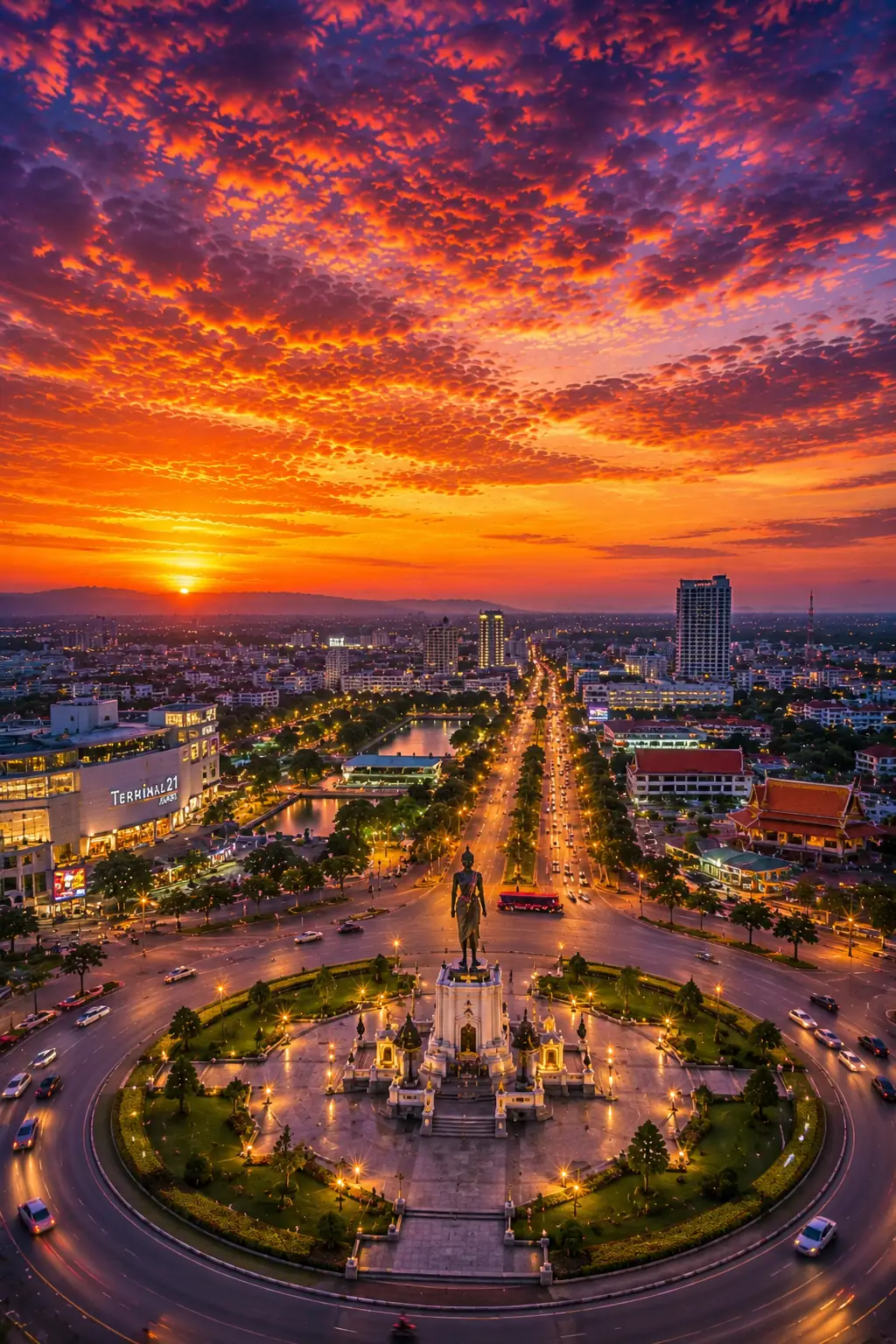
Korat feels very different from Thailand’s major tourist cities.
There is no beach, no resort strip and no single neighbourhood built around international visitors. Instead, Korat is a large working Thai city shaped by local life, food, markets, universities, shopping, transport and its role as the main gateway into lower Isan.
That difference is exactly what makes Korat interesting.
For travellers who want to see a more everyday side of Thailand, Korat combines city life, regional culture and access to some of the northeast’s most important historical sites.
KORAT OR NAKHON RATCHASIMA?
Both names refer to the same city and province.
Nakhon Ratchasima is the official name, while Korat — or Khorat — is the name you will hear constantly in everyday conversation.
The province is enormous, but the city itself is the transport, commercial and administrative centre of the region. It sits on the main routes between Bangkok and northeastern Thailand and has long functioned as a gateway between the central plains and Isan.
THE HISTORIC CENTRE
The heart of old Korat is centred around the historic city area and Thao Suranari Monument, usually called Ya Mo.
The monument is one of the city’s defining landmarks and a major local symbol. It commemorates Thao Suranari, whose story is deeply connected to Korat’s identity.
Nearby Chumphon Gate and the old-town street plan hint at Korat’s history as a fortified frontier city.
Temples, markets, old shops and local restaurants are scattered through the surrounding streets, making the centre one of the easiest places to start exploring on foot.
Unlike a preserved tourist old town, this is still a working part of the modern city.
FOOD IS ONE OF THE BEST REASONS TO COME
Food is one of Korat’s strongest reasons to stop.
The city sits at the gateway to Isan but has its own local food traditions as well as the broader northeastern favourites found throughout the region.
Som tam, grilled chicken, sticky rice, grilled meats, spicy salads and Isan-style dishes are everywhere, but Korat also has local specialties that are worth seeking out.
One of the best-known is pad mee Korat, a local stir-fried noodle dish with a sweet, salty and slightly spicy flavour.
Another strong local tradition is khanom jeen Pradok, rice noodles associated with Ban Pradok and commonly served with several different curries and sauces.
Markets, simple restaurants and roadside food spots are often as important to the Korat experience as formal sightseeing.
MARKETS AND SHOPPING
Korat mixes traditional markets with very modern shopping.
SaveOne is one of the city’s best-known evening markets and a major destination for food, clothes, everyday goods and casual shopping.
Closer to the centre, local markets give you a more everyday look at how the city eats and shops.
At the other end of the scale, Terminal 21 and other large malls show how modern and commercially important Korat has become.
This combination is typical of the city: an old market, a major shopping centre and a local food stall can all be part of the same day without feeling unusual.
A CITY THAT RUNS ON LOCAL RHYTHMS
Korat is not built around tourism.
Most of the people around you are going to work, studying, shopping, eating with friends or taking care of everyday life.
That changes the atmosphere significantly compared with Bangkok, Chiang Mai or Thailand’s beach resorts.
English is less universally used, international tourism infrastructure is thinner and some parts of the city quiet down earlier.
At the same time, Korat is a major regional city, with large hotels, malls, hospitals, transport hubs, restaurants and most of the conveniences a visitor needs.
NIGHTLIFE EXISTS – BUT IT IS NOT THE POINT
Korat has nightlife, just not on the scale or in the style of Thailand’s major party destinations.
Bars, live music, beer gardens, night markets and local evening venues provide plenty of places to go out.
The atmosphere tends to be more local, with Thai customers, students, workers and residents making up much of the crowd.
If you want a night out, Korat can provide one.
If nightlife is the main reason for your trip, other Thai destinations make more sense.
That distinction is important because Korat is at its best when you enjoy it as a working Isan city rather than expecting it to imitate Bangkok or Pattaya.
PHIMAI AND THE KHMER CONNECTION
One of the strongest reasons to use Korat as a base is Phimai Historical Park.
Phimai lies outside the city but is one of Thailand’s most important Khmer temple complexes and one of the major historical attractions of northeastern Thailand.
The sanctuary reflects the period when the region was strongly connected with the Khmer Empire and gives the wider Korat area a historical depth that is easy to miss if you only stay in the modern city centre.
Phimai can be visited as a day trip, and the town itself is small enough to explore at a relaxed pace.
Korat Province also contains other traces of Khmer, Dvaravati and prehistoric settlement, so history here goes far beyond the modern city.
BEYOND THE CITY
Korat is the kind of destination where the province matters almost as much as the city.
Depending on how much time you have, day trips and onward travel can take you towards pottery villages, silk-producing communities, temples, countryside and major historical sites.
The province also stretches towards Pak Chong and Khao Yai, although these areas are far enough from central Korat that they are better thought of as separate trips rather than quick city-centre excursions.
That huge provincial scale is worth remembering whenever you see an attraction described simply as being “in Nakhon Ratchasima”.
It may be much further away than expected.
GETTING AROUND
The centre is manageable in sections, but Korat as a whole is spread out.
Songthaews operate around the city and remain part of the local transport system.
Ride-hailing and taxis are useful for direct trips, especially when you are travelling between the centre, malls, hotels, markets and transport hubs.
Motorcycle taxis can also be useful for shorter journeys.
Korat is an important rail and road hub, with trains and buses connecting it to Bangkok and destinations deeper into Isan.
If you plan to explore the wider province extensively, having your own transport can make a major difference.
HOW LONG SHOULD YOU STAY?
Two nights is enough for a first look at the city.
Three or four nights gives you time to enjoy Korat at a slower pace and include a day trip such as Phimai without turning the visit into a rush.
Longer stays make sense if you are using Korat as a regional base or want to explore more of Nakhon Ratchasima Province.
The city is not packed with headline tourist attractions, and that is part of the point.
Korat rewards curiosity more than checklist tourism.
Come for the food, walk through the old centre, spend an evening at a market, see how a major Thai provincial city actually works and use it as a doorway into Isan.
For the right traveller, that can be more memorable than another polished resort destination.