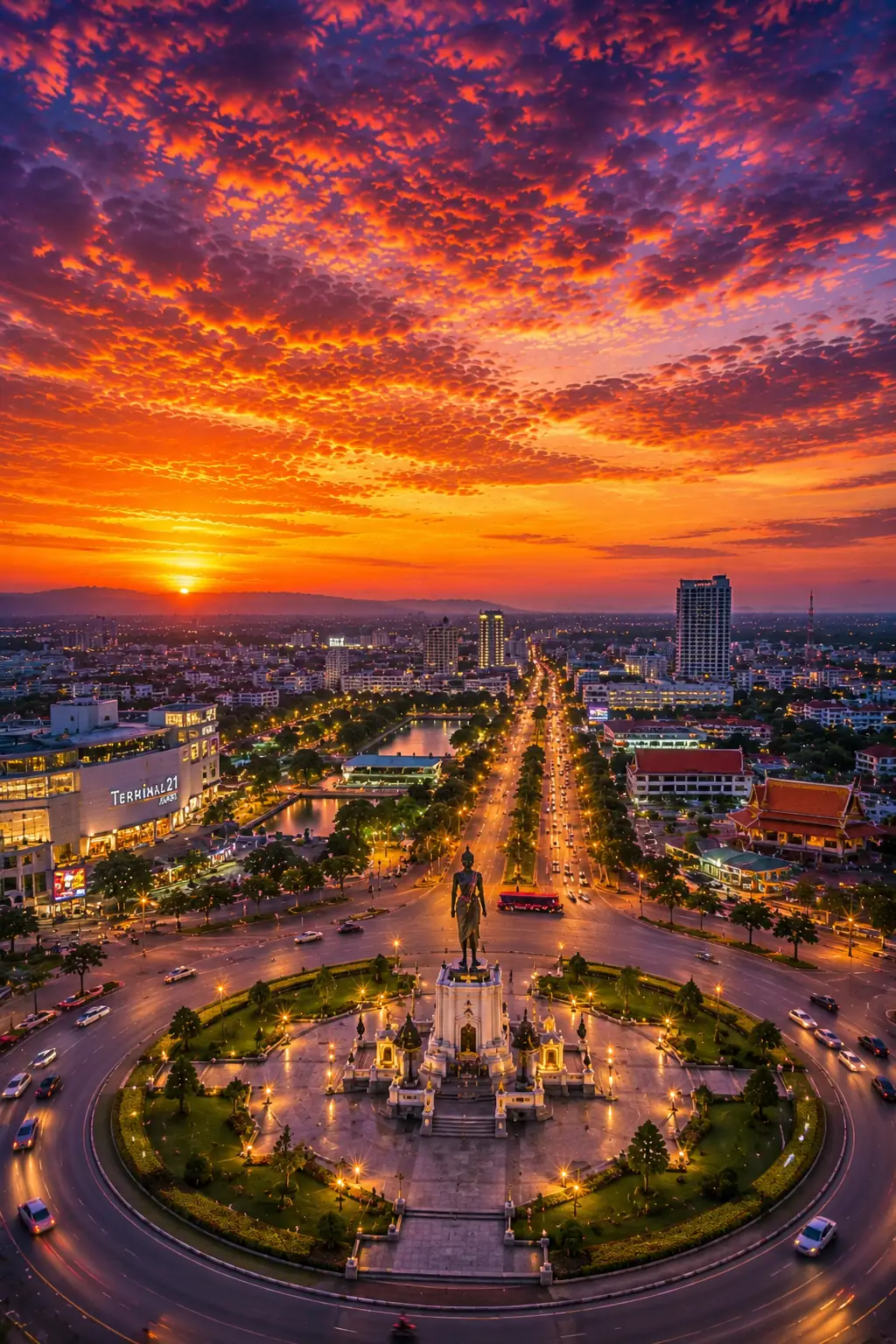
Korat makes more sense once you stop expecting it to behave like a conventional tourist destination.
It is large, busy and deeply local, with markets, malls, temples, restaurants, universities and transport hubs spread across a wide urban area. There is plenty to see, but much of the appeal comes from being in a major Thai provincial city rather than inside a resort bubble.
For a first visit, a little planning helps.
START IN THE CENTRE
The easiest introduction to Korat is around Thao Suranari Monument, usually called Ya Mo.
This is the symbolic heart of the city and a useful starting point for walking through the historic centre.
Nearby you will find temples, local restaurants, markets, old city streets and Chumphon Gate.
Do not expect a preserved old town like Chiang Mai or Phuket Town.
Korat’s centre is still part of the working city, which is exactly why it feels different.
HOW LONG SHOULD YOU STAY?
Two nights is enough for a quick introduction.
Three or four nights is better if you want time to explore the city, eat properly and include a day trip such as Phimai.
If Korat is part of a wider Isan journey, it also works well as a transport base before continuing to places such as Khon Kaen, Buriram, Udon Thani or other northeastern destinations.
FOOD SHOULD BE PART OF THE PLAN
Do not treat food as something to squeeze between attractions.
In Korat, food is part of the attraction.
Pad mee Korat is the local noodle dish most closely associated with the city and is worth trying at least once.
Khanom jeen Pradok is another important local tradition, with rice noodles served alongside different curries and accompaniments.
Beyond those specialties, Korat is full of Isan favourites such as som tam, grilled chicken, sticky rice, spicy salads and grilled meats.
Some of the most memorable meals may come from simple local restaurants and food stalls rather than polished dining rooms.
Markets and busy food stalls are a major part of the experience.
VISIT A MARKET IN THE EVENING
Korat comes alive in a different way after the daytime heat begins to drop.
Evening markets are among the easiest places to experience local food, shopping and casual city life.
SaveOne is one of the best-known options and is large enough to spend a substantial part of an evening exploring.
Other smaller markets around the city can be equally rewarding if you prefer something less sprawling.
Markets are also useful for first-time visitors because they bring together food, shopping and atmosphere without requiring much planning.
MODERN KORAT MATTERS TOO
Do not spend the whole trip looking only for old Korat.
The city is an important commercial centre, and modern shopping complexes are a major part of daily life.
Terminal 21 and other large malls provide restaurants, cafés, supermarkets, cinemas and air-conditioned space when the weather becomes exhausting.
They also show a completely different side of Korat from the temples and markets.
That contrast between old and new is central to the city’s identity.
PHIMAI IS WORTH THE TRIP
If you have enough time, Phimai Historical Park is one of the strongest day trips from Korat.
The Khmer sanctuary is one of northeastern Thailand’s most important historical sites and gives much more context to the region’s past.
Phimai is outside Korat city, so allow proper travel time rather than treating it as a quick stop.
If history interests you, it can easily become one of the highlights of the trip.
GETTING AROUND
Korat is too spread out to rely on walking alone.
Walking works well around the historic centre and within individual districts, but moving between major parts of the city usually requires transport.
Songthaews remain part of the local system and are useful if you understand the routes.
Ride-hailing and taxis are easier for many first-time visitors, especially for direct trips between hotels, markets, malls, restaurants and transport hubs.
Motorcycle taxis can be practical for shorter distances.
If you intend to explore the wider province extensively, renting a car or having access to private transport can make the trip much easier.
ARRIVING BY TRAIN OR BUS
Korat is one of northeastern Thailand’s major transport hubs.
Trains connect the city with Bangkok and continue deeper into Isan.
Long-distance buses and vans also connect Korat with Bangkok and many regional destinations.
The city has more than one transport terminal, so always check exactly where your service arrives or departs.
Do not assume every “Korat bus station” is the same place.
NIGHTLIFE
Korat has nightlife, but it is not built around international tourism.
Expect local bars, live music, beer gardens, restaurants, night markets and venues aimed primarily at Thai customers.
The scene can be lively, especially on weekends and around areas popular with younger locals and students, but it is much smaller and more dispersed than in Bangkok or Pattaya.
For most visitors, nightlife works best as one part of Korat rather than the main reason for coming.
ENGLISH AND COMMUNICATION
English is used in hotels, malls and some visitor-facing businesses, but it is less universal than in Thailand’s major tourist centres.
A few Thai phrases can be genuinely useful.
Translation apps can also help with menus, transport and small local businesses.
This should not put you off visiting.
Korat is a large city and perfectly manageable, but a little patience and flexibility go a long way.
CITY DISTANCES CAN BE DECEPTIVE
One of the easiest mistakes to make is assuming that everything labelled “Nakhon Ratchasima” is close to the city centre.
The province is enormous.
Attractions, resorts and restaurants can be tens of kilometres away while still carrying the same provincial name.
Always check the exact location before planning a route or booking accommodation.
This matters especially for places around Pak Chong, Khao Yai and rural parts of the province.
FIRST-TIME MISTAKES TO AVOID
Do not expect Korat to feel like a resort destination.
Do not plan the entire visit around headline attractions.
Do not ignore the local food.
Do not assume the whole city is walkable.
Do not confuse Korat city with the entire Nakhon Ratchasima Province.
Do not underestimate travel time for Phimai or other provincial attractions.
And do not dismiss the malls as irrelevant to the experience — they are part of modern Korat life.
A GOOD FIRST KORAT TRIP
A balanced first visit could include:
- the Ya Mo monument and historic centre;
- Chumphon Gate and nearby temples;
- pad mee Korat or khanom jeen Pradok;
- an evening at a local market;
- time in one of the city’s major shopping centres;
- a relaxed local night out;
- and a day trip to Phimai if your schedule allows.
There is no need to rush between attractions.
Korat is more rewarding when you allow time to eat, wander, watch everyday life and understand its role as a doorway into Isan.
It may not give you the instant postcard image of a Thai island or temple town.
What it gives you instead is something harder to fake: a large Thai city living primarily for itself.