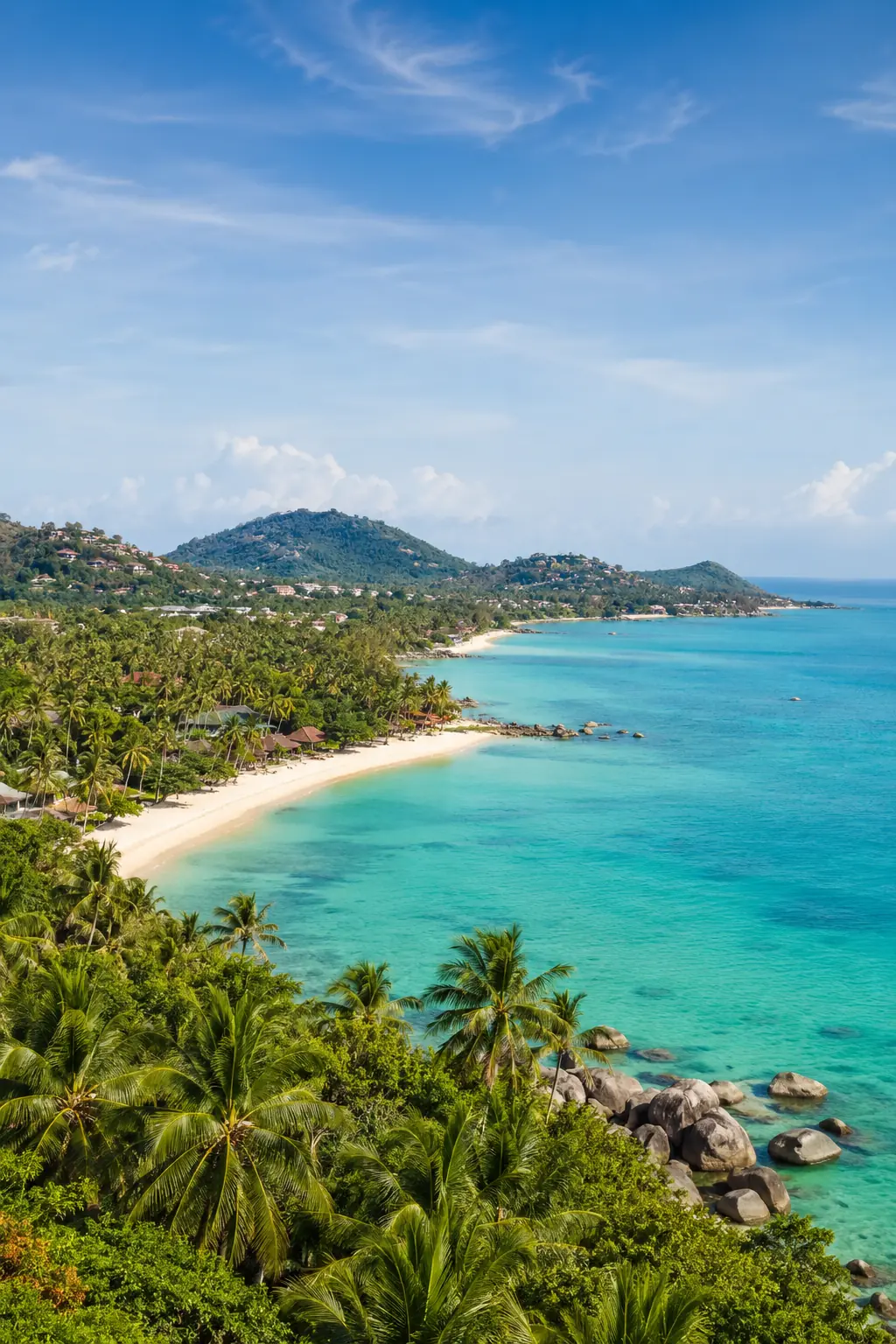
Koh Samui is large enough that where you stay changes the trip.
The island has developed into several distinct resort centres rather than one dominant town, which is why Thailand4U uses five public traveller areas.
CHAWENG
Chaweng is the island’s busiest visitor zone.
Its long beach, dense hotel strip, restaurants, shopping and nightlife create the strongest concentration of tourism infrastructure on Samui.
It is the obvious choice for travellers who want action close by.
It is also the least suitable choice if quiet evenings are important.
LAMAI
Lamai is the major alternative to Chaweng.
It remains a full resort town with restaurants, bars and a long beach, but the atmosphere is generally slower.
Hin Ta and Hin Yai lie nearby and add one of Samui’s best-known sightseeing stops to the area.
For many couples and repeat visitors, Lamai provides the best balance between convenience and calm.
BOPHUT & FISHERMAN'S VILLAGE
Bophut’s strongest identity is Fisherman’s Village.
TAT describes it as an old fishing community that has evolved into a waterfront area of restaurants, shops and walking-street activity.
The result is one of Samui’s most atmospheric evening areas.
Bophut Beach adds a real resort base behind the village.
MAENAM
Maenam is quieter and more spread out.
The beach is long, the village retains a more local feel and resorts tend to suit families and longer stays.
Evenings are calmer than in Bophut or Chaweng.
This is a good choice for travellers who want a north-coast base without being inside the island’s busiest visitor centres.
CHOENG MON
Choeng Mon is compact and upscale.
The beach and resort village create a quieter alternative in the north-east.
Its strengths are comfort, family-friendly resort stays and easy access to the airport side of the island.
It is not a major nightlife or shopping district.
BEACHES
Samui has beaches around much of the island, but the five Thailand4U areas represent the strongest public visitor bases.
Chaweng is the busiest.
Lamai is broad and balanced.
Bophut and Maenam offer calmer north-coast experiences.
Choeng Mon is smaller and more sheltered-feeling.
Sea conditions vary with wind and season, so beach quality should not be described as identical year-round.
FISHERMAN'S VILLAGE
Fisherman’s Village is one of Samui’s strongest evening experiences.
The historic waterfront settlement now combines restaurants, boutiques and market activity.
It remains more dining-and-strolling oriented than nightlife-heavy.
Walking-street operating schedules are time-sensitive and should be verified before a visit is planned around a specific evening.
TEMPLES
Big Buddha and Wat Plai Laem are among the island’s most important visitor sights.
They sit outside Thailand4U’s five accommodation-area structure and should remain island-wide sightseeing stops.
Dress respectfully and behave as you would in any active religious site.
WATERFALLS
Na Muang waterfalls are among Samui’s best-known inland attractions.
Water flow and access vary with weather.
After heavy rain, trails can be slippery.
Do not treat waterfall photos from one season as a guarantee of current conditions.
ANG THONG MARINE PARK
Mu Ko Ang Thong National Marine Park is one of Samui’s classic offshore excursions.
Boat trips can include limestone islands, viewpoints, kayaking and snorkelling depending on current routes and conditions.
It is not a Samui neighbourhood.
Weather and marine conditions can affect departures.
FOOD
Samui’s food scene is broad.
Chaweng has the greatest variety.
Bophut is especially strong for waterfront and destination dining.
Lamai is a good all-round restaurant base.
Maenam and Choeng Mon are quieter but still support long stays.
Local southern Thai food and seafood deserve space alongside resort restaurants.
NIGHTLIFE
Nightlife is concentrated.
Chaweng is the clear late-night centre.
Lamai has bars and social evenings.
Bophut is stronger for dining and cocktails.
Maenam and Choeng Mon are much quieter.
Area choice therefore matters significantly if nightlife is a priority.
SHOPPING
Chaweng has the island’s strongest mainstream shopping.
Fisherman’s Village offers boutiques and market-style retail.
Lamai and Maenam have smaller local shopping scenes.
Choeng Mon is limited.
Do not present every area as if it has a mall.
GETTING AROUND
Samui is too large to explore entirely on foot.
Taxis, songthaews, ride-hailing and private transfers are useful.
Walking works inside individual resort centres.
Scooters are common, but they are not necessary and should not be treated as a default for inexperienced riders.
AIRPORT
Samui Airport sits in the north-east, outside the five public Thailand4U areas.
Choeng Mon and Chaweng are relatively close.
Lamai and the farther north-west side require longer transfers.
Allow for traffic and airline check-in time rather than relying on a simple distance estimate.
FERRIES
Samui has multiple ferry and passenger-boat connections.
Nathon is the main west-coast ferry town, while other services use north-coast piers depending on route and operator.
Nathon is not a sixth Thailand4U public area.
Schedules and pier assignments should be verified close to travel.
HOW LONG SHOULD YOU STAY?
Three nights gives a quick beach break.
Five to eight nights is better for a first visit because it leaves room for a beach base, temples, a waterfall or island drive and one marine excursion.
A week or more works especially well for split stays between two different areas.
Samui is at its best when visitors use one or two resort bases and explore the rest of the island selectively.