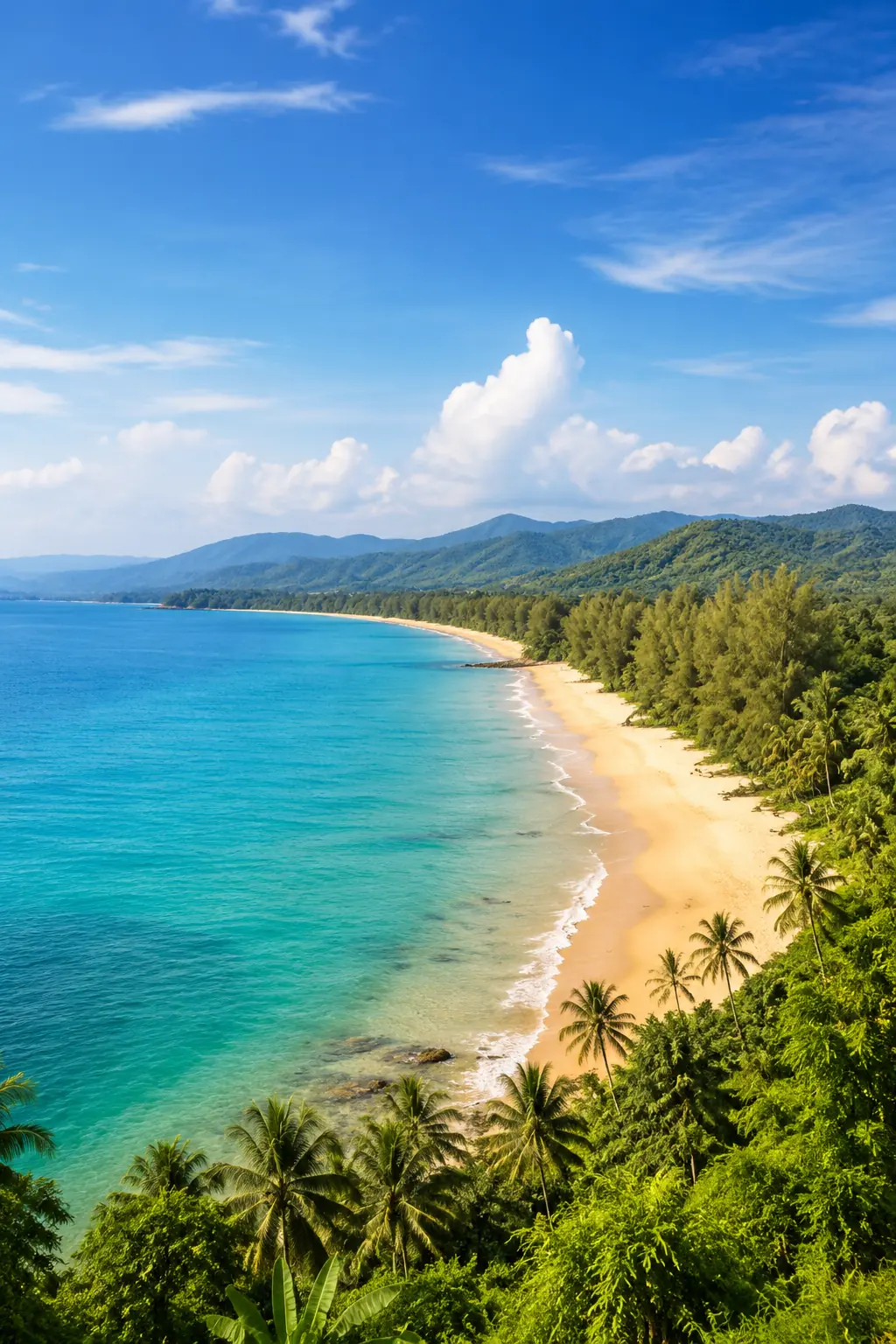
Khao Lak is easier to understand once you stop thinking of it as one town.
The name describes a long mainland resort region in Phang Nga Province, north of Phuket, with a sequence of beaches, villages and hotel clusters along the Andaman coast.
That geography is why Thailand4U uses four public traveller areas.
NANG THONG
Nang Thong is the most practical central base.
The beach sits close to Bang La On, the commercial heart that many visitors informally think of as central Khao Lak.
Restaurants, cafés, dive shops, convenience stores and visitor services are concentrated here.
For a short first trip, this is the easiest place to understand the destination.
BANG NIANG
Bang Niang sits just north of Nang Thong and combines beach resorts with one of Khao Lak’s strongest market and evening scenes.
Bang Niang Market is a major draw for food and casual shopping.
The area is also closely linked with the 2004 Indian Ocean tsunami story through the Police Boat 813 memorial site.
The combination of beach, market and memorial gives Bang Niang more off-beach identity than many resort zones.
KHUK KHAK
Khuk Khak is quieter.
The beach is long, resort development is more spread out and the area feels less like a compact visitor centre.
It suits travellers who want a resort base with more space and less evening activity.
Some practical services sit closer to the main road than the beach.
PAK WEEP & BANG SAK
The northern resort coast becomes progressively quieter.
Pak Weep, White Sand/Ao Thong and Bang Sak are associated with long beaches, larger resorts and a slower pace.
Independent restaurants and shops are less concentrated than farther south.
This is the right part of Khao Lak for travellers who want the hotel and beach to be central to the holiday.
BEACHES
Khao Lak’s beaches face the open Andaman Sea.
They can look calm in one season and rough in another.
During the southwest monsoon, red flags and dangerous currents can occur.
Never ignore local beach warnings simply because the water looks manageable.
Nang Thong and Bang Niang are the easiest beaches to combine with restaurants and services.
Khuk Khak and the northern beaches are stronger for space and quiet.
DIVING AND SNORKELLING
Khao Lak is one of Thailand’s major bases for trips to the Similan Islands.
The Surin Islands and other marine sites are also connected with the wider Khao Lak diving scene.
These are offshore excursions, not Khao Lak neighbourhoods.
Boat schedules, national-park access and sea conditions are seasonal and can change.
SIMILAN SEASONAL CLOSURE
The Similan Islands operate under national-park rules and normally close for part of the southwest-monsoon season to allow ecological recovery and for safety.
In 2026, Thailand’s Department of National Parks announced the seasonal tourism closure beginning on 16 May.
Do not hard-code that as a permanent annual date.
Travellers should verify the current reopening and closure schedule with official park information before booking a trip.
TSUNAMI HISTORY
Khao Lak was one of the Thai areas devastated by the 26 December 2004 Indian Ocean tsunami.
The Police Boat 813 memorial in Bang Niang is the most visible visitor memorial.
The boat was carried far inland by the wave and remains as part of the remembrance landscape.
Visit respectfully.
This is recent human history, not simply another photo stop.
WATERFALLS AND NATIONAL PARKS
Khao Lak’s appeal extends inland.
Khao Lak–Lam Ru National Park, waterfalls and forest areas add hiking and nature to the coastal experience.
Conditions vary with rain and season.
Waterfall flow, trail conditions and park access should be checked close to the visit.
TAKUA PA
Takua Pa lies north of the main Khao Lak resort strip.
Its old-town architecture, markets and local history make it a useful excursion for visitors who want more than beaches and resorts.
It is not a fifth Khao Lak public area.
Treat it as a separate nearby town and excursion.
PHANG NGA DAY TRIPS
Khao Lak also works as a base for wider Phang Nga travel.
Depending on the trip, visitors may combine it with national parks, temples, viewpoints, rafting, canoeing or Phang Nga Bay excursions.
Travel times matter.
Do not describe distant provincial attractions as if they sit inside the Khao Lak beach strip.
FOOD
Khao Lak has a broad food scene for a resort region.
Nang Thong and Bang Niang have the greatest concentration of restaurants and cafés.
Khuk Khak and the north rely more heavily on resort dining and scattered local restaurants.
Seafood and southern Thai food deserve space alongside international resort menus.
NIGHTLIFE
Khao Lak nightlife is deliberately low-key.
Bang Niang is the liveliest area for bars and evening markets.
Nang Thong has restaurants, casual bars and drinks.
The farther north you stay, the quieter evenings become.
Khao Lak is not a clubbing destination.
GETTING AROUND
The destination is spread along the main north-south road.
Walking is useful inside individual centres but not across Khao Lak as a whole.
Taxis, hotel shuttles, private transfers and excursion pickups are the most practical options.
Scooters are available, but they are not essential and should not be presented as the default for inexperienced riders.
ARRIVING
Phuket International Airport is the main air gateway for many Khao Lak visitors.
Khao Lak itself does not have a commercial airport.
Road transfers from Phuket vary with traffic and exact hotel location.
Northern Khao Lak hotels take longer to reach than Nang Thong.
HOW LONG SHOULD YOU STAY?
Three nights works for a short resort break.
Four to seven nights is better for a first visit if you want beach time plus at least one marine or nature excursion.
A week or more suits divers, families and travellers using Khao Lak as a slow coastal base.
Khao Lak’s strength is not urban intensity.
It is the combination of beach space, nature and enough infrastructure to make a longer stay easy.