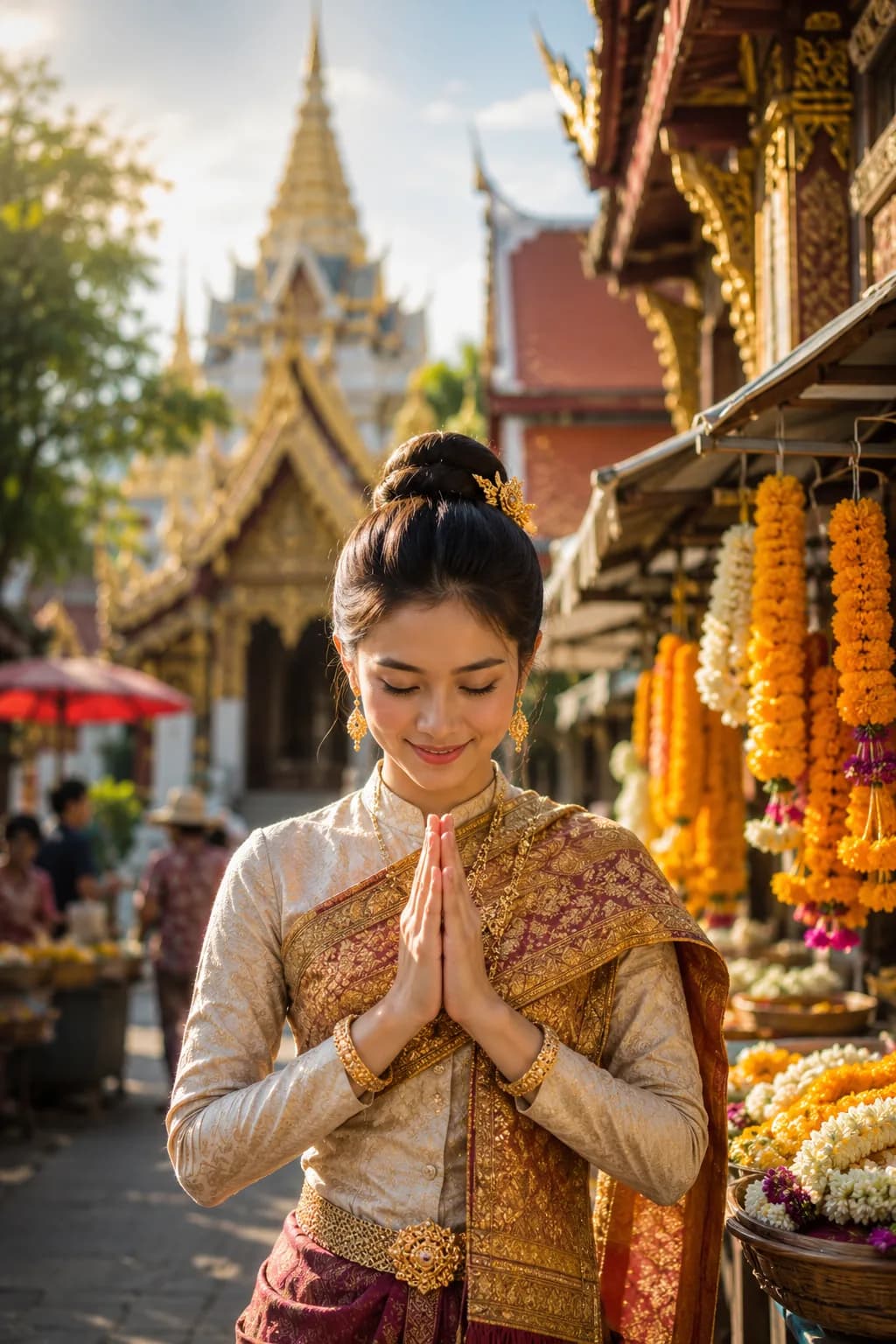
The easy mistake is to imagine Thailand as somewhere the old rules survived — a place where men are still men, women are still women, families stay close, nobody argues about gender roles, and modernity somehow stopped at passport control.
It didn't. Thailand is not a preserved version of the West before social change. It's a modern society that changed along a different path. That distinction matters.
Thai women study, work, manage businesses, move for jobs, delay marriage, support parents, raise children, use dating apps, live alone, travel abroad and make independent decisions about their lives. Bangkok is not waiting patiently for a visiting European man to explain feminism.
Thailand itself has transformed enormously. Urbanisation reshaped where people live and work. Education expanded. Family structures changed. Social media altered dating, status and communication. Women became increasingly visible across professions and public life. Rural communities became deeply connected to cities and overseas labour markets. Younger generations grew up with very different expectations from their grandparents. If you're looking for 1957, you've arrived several decades late.
But that doesn't mean every society modernises into the same thing. Modernity isn't a conveyor belt with Stockholm at one end and Bangkok slowly inching toward it. Societies can become wealthier, more educated and more individualised while still holding onto different ideas about family, duty, ageing, gender and what people owe one another.
That's where Thailand starts to feel genuinely different — not behind, just different.
In much of the contemporary West, adulthood is increasingly understood as an individual project: build your career, find your identity, create your own life, become financially independent, leave home, set boundaries, choose relationships that support your personal wellbeing. There's a powerful logic behind that. Independence protects people. It makes it easier to leave unhealthy families, abusive relationships, and social roles that no longer fit.
Thailand contains plenty of individual ambition too. But family often remains more visibly woven into adult life. Parents don't necessarily disappear from the picture when a child turns eighteen. Grandparents may help raise grandchildren. Adult children may contribute financially to ageing parents. Siblings may share responsibilities across households. A job in Bangkok may support a family hundreds of kilometres away. Someone's income can belong partly to the person who earned it, and partly, in practice, to a wider network of obligations.
That can surprise Westerners — sometimes pleasantly, sometimes very much not. A Western man may think he's entering a relationship with one woman and slowly discover that the relationship has acquired parents, siblings, children, cousins, school fees, medical bills, and a family LINE group he can't read. To him, this may initially feel like other people intruding on the couple. To his Thai partner, those people may never have been outside the relationship in the first place. Neither interpretation is automatically unreasonable — they simply begin from different assumptions about where the individual ends and the family begins.
This is one reason a word like "traditional" can mislead. A Thai woman can work full-time, earn her own money, make her own decisions, and still feel a strong duty to support her parents. That's not a contradiction. Nor is a woman automatically dependent because she values a man who contributes financially to a family. Modernity didn't erase obligation — it changed the environment in which obligation operates.
The same is true of gender. Some visitors notice forms of femininity expressed openly in Thailand, while expectations around men may include reliability, contribution and visible responsibility. Those tendencies do not define individual couples. A woman can enjoy femininity without surrendering authority over her life, and a man can value a provider role without expecting ownership.
There is no single Thai model. A professional couple in central Bangkok may organise life very differently from a farming family in rural Isaan. Class, education, age, region, family history and personality all matter. Thailand contains dual-career couples, multigenerational homes, single-parent households and families with very different ideas about responsibility. The useful point is not that one arrangement is more authentic than another, but that interdependence can carry meanings that a strongly individualised framework may miss.
No arrangement becomes automatically fair simply because it is culturally familiar. Expectations around family, money or roles can create tension when they are unclear, unequal or not freely chosen. The important point is that the same behaviour can carry different meanings in different social settings. Sending money to a parent can look like dependence from one angle and responsibility from another. Living close to family can look like failure to separate, or like successful adulthood. A man paying more of the household expenses can read as generosity, duty, control or simply an agreed division of labour. Context matters. This is where some Western visitors get Thailand badly wrong: they see a society that feels different from home and conclude it must be more traditional across the board, right up until they meet an educated Thai woman with a career, her own money, strong opinions and no intention of being managed by anyone. The fantasy tends to have a short life expectancy.
Thailand is not a refuge from modern women. Thai women are modern women. They live inside a society where modernisation has developed alongside enduring patterns of family obligation, hierarchy, care and interdependence, and those patterns continue to change. Younger generations may negotiate family expectations differently from their parents. Migration can reshape obligations to relatives, social media exposes people to global ideas about relationships and identity, and the practical demands of urban life keep changing how households organise themselves. Thailand is moving. It always has been.
The interesting comparison, then, isn't between a modern West and a traditional Thailand. It's between two modern societies that have settled on different mixtures of individual freedom and social obligation. And those mixtures matter enormously when people try to build relationships across them. A Western man may arrive with assumptions built around independence. A Thai woman may arrive with assumptions built around responsibility to family. He may interpret love partly through emotional closeness and personal choice. She may interpret it through those things too — but also through reliability, action, and willingness to become part of a wider family structure. Or the roles may be reversed entirely. Humans remain annoyingly resistant to cultural diagrams.
Still, patterns matter — and one of the most important patterns in Thailand is that the relationship between the individual and the family often works differently from what many Westerners expect. That difference reaches directly into money, children, ageing parents, household roles, and ideas about what makes somebody a good partner.
The next step is to look more closely at the expectations carried inside the relationship itself: where the couple ends, where family begins, and what each person believes a partner is supposed to contribute.